
磷酸铁锂动力电池

Search documents
孚能科技获广汽集团定点
Xin Lang Cai Jing· 2026-03-17 04:14
Group 1 - The core point of the article is that Guangzhou Fueneng Technology Co., Ltd., a subsidiary of Fueneng Technology, has been selected by GAC Group to develop and supply power batteries, with supply expected to commence in the first half of 2027 [1] - The collaboration will utilize the Super Punch Solution (SPS) design for lithium iron phosphate power batteries [1]


孚能科技将为广汽集团开发供应动力电池
Zhi Tong Cai Jing· 2026-03-16 11:15
Core Viewpoint - The company has been selected by Guangzhou Automobile Group Co., Ltd. to develop and supply power batteries, marking a significant partnership in the electric vehicle sector [1] Group 1 - The company's wholly-owned subsidiary, Guangzhou Funeng Technology Co., Ltd., received a "Designation Development Notice" from Guangzhou Automobile Group [1] - The partnership will focus on the development and supply of lithium iron phosphate power batteries based on the Super Punch Solution design [1] - The company anticipates starting deliveries in the first half of 2027 according to the sales forecast and arrangements from Guangzhou Automobile Group [1]
孚能科技(688567.SH)将为广汽集团开发供应动力电池
智通财经网· 2026-03-16 11:11
Core Viewpoint - The company, Funeng Technology, has been selected by Guangzhou Automobile Group to develop and supply power batteries, marking a significant partnership in the electric vehicle sector [1] Group 1: Company Announcement - Funeng Technology's wholly-owned subsidiary, Guangzhou Funeng Technology Co., Ltd., has received a "Designation Development Notice" from Guangzhou Automobile Group [1] - The company is expected to start supplying batteries in the first half of 2027 based on the sales forecast and arrangements from Guangzhou Automobile Group [1] Group 2: Product Details - The project will utilize a lithium iron phosphate power battery designed based on the Super Punch Solution (SPS) [1]
孚能科技子公司获广汽集团定点开发通知书,预计明年起供货磷酸铁锂动力电池
Cai Jing Wang· 2026-03-16 10:51
Core Viewpoint - Company Fudi Technology (孚能科技) has received a development notification from GAC Group, marking a significant step in its partnership to supply power batteries, specifically lithium iron phosphate batteries, starting in the first half of 2027 [1] Group 1: Partnership and Product Development - Fudi Technology's wholly-owned subsidiary, Guangzhou Fudi Technology Co., Ltd., has been selected by GAC Group to develop and supply power batteries [1] - The project will utilize the Super Punch Solution (SPS) design for lithium iron phosphate batteries, indicating a further breakthrough in the new energy passenger vehicle sector [1] Group 2: Market Recognition and Financial Performance - The receipt of the development notification signifies an increase in market recognition for Fudi Technology's SPS battery products [1] - In the fiscal year 2025, Fudi Technology reported a revenue of 9.084 billion yuan, a year-on-year decrease of 22.23%, and a net loss attributable to shareholders of 767 million yuan, compared to a loss of 332 million yuan in the previous year [1]
1月动力电池装车量稳步增长
Zhong Guo Neng Yuan Wang· 2026-02-26 01:13
Core Insights - The report indicates a steady growth in China's power battery installation volume, with January figures showing a total of 42 GWh, representing an 8% year-on-year increase [1] - The sales of new energy vehicles in January reached 945,000 units, a slight increase of 0.1% year-on-year, with a penetration rate of 40.3% [1] - Leading companies in the power battery sector, such as CATL and BYD, have shown varying performance, with CATL's installation volume increasing by 15% to 20.9 GWh, while BYD's decreased by 18% to 7.3 GWh [1] Industry Performance - The power equipment industry experienced a weekly increase of 1.13%, ranking 13th among 31 primary industries in the Shenwan index [2] - The industry outperformed the CSI 300 index, with the Shanghai Composite Index and CSI 300 both showing a 0.4% increase [2] - Sub-sectors such as electric motors and other power equipment saw gains of 2.4% and 6.0%, respectively, while photovoltaic and wind power equipment experienced declines [2] Investment Strategy - The report suggests focusing on companies within the power battery supply chain that are technologically advanced and hold significant market influence, particularly CATL [3]


GGII:市场驱动下, 磷酸铁锂装机份额仍有上行空间
高工锂电· 2026-01-02 11:50
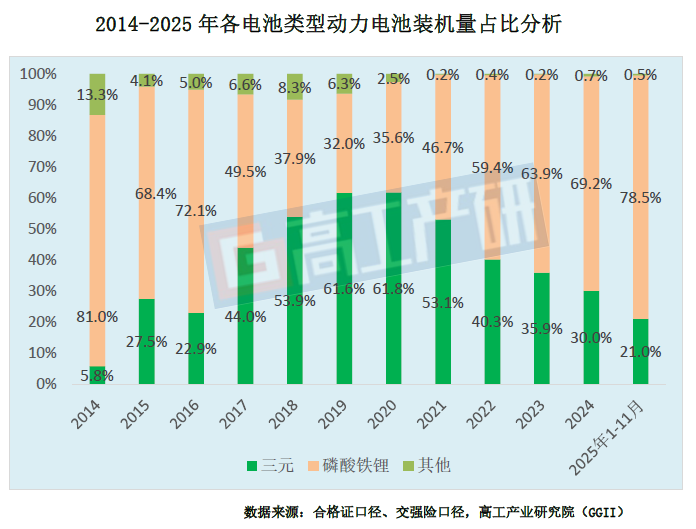
Core Viewpoint - The domestic lithium iron phosphate (LFP) battery installation volume is expected to reach a new high, driven by market demand and the increasing acceptance of LFP batteries due to their safety, cost-effectiveness, lifespan, and resource sustainability advantages [17]. Group 1: Market Performance - In the period from January to November 2025, the domestic installation volume of LFP batteries is approximately 490 GWh, representing a year-on-year growth of 55% and a market share of 78.5%, which is an increase of 10 percentage points compared to the same period last year [5][4]. - The market share of LFP batteries is close to the peak of 81% reached in 2014, with only a 2.5% difference, raising the question of whether it will surpass this peak again [5]. Group 2: Market Drivers - The significant increase in the share of LFP batteries is fundamentally different from 2014, as it is now primarily market-driven, particularly in the passenger vehicle sector, whereas in 2014, it was mainly policy-driven, focusing on the bus sector [8]. - The proportion of new vehicles equipped with LFP batteries has remained between 90% and 96% this year, indicating a growing preference among manufacturers for LFP technology [10]. Group 3: Vehicle Models and Growth - The number of passenger vehicle models equipped with LFP batteries has increased from 213 in the past three years to 536 by November this year, with popular models like Geely Xingyuan, Xiaomi SU7, and XPeng MONA M03 contributing to this growth [13]. - Specific vehicle installation numbers and year-on-year growth rates for LFP battery models include: - Geely Xingyuan: 417,935 units (1214%) - Hongguang MINI EV: 405,752 units (81%) - Xiaomi SU7: 161,753 units (277%) - XPeng MONA M03: 161,142 units (398%) [14]. Group 4: Competitive Landscape - The top 10 companies in the domestic LFP battery installation market accounted for 95.3% of the total volume from January to November 2025, with companies like CATL, EVE Energy, and others showing steady growth over the past three years [16].

GGII:2025年1-11月国内磷酸铁锂动力电池装机份额高达78.5% 后市有望突破历史峰值
智通财经网· 2025-12-25 08:52
Core Insights - The domestic lithium iron phosphate (LFP) battery installation volume is projected to reach approximately 490 GWh from January to November 2025, representing a year-on-year growth of 55% and a market share of 78.5%, an increase of 10 percentage points compared to the same period last year [1][5]. Group 1: Market Trends - The significant increase in the market share of LFP batteries is primarily driven by market demand rather than policy incentives, contrasting with 2014 when policy was the main driver [3]. - The proportion of new vehicles equipped with LFP batteries has remained between 90% and 96% this year, with a notable increase from 92% to 94.5% in the second half of the year, indicating a growing preference among manufacturers for LFP technology [5]. Group 2: Product Offerings - The number of new energy passenger car models equipped with LFP batteries has risen from 213 to 536 over the past three years, with popular models like Geely Xingyuan, Xiaomi SU7, and XPeng MONA M03 accelerating production and delivery, further boosting the market share of LFP batteries [8]. Group 3: Competitive Landscape - The top 10 companies in the domestic LFP battery installation market accounted for 95.3% of the total volume from January to November 2025, with companies like CATL, EVE Energy, and Xinwangda showing steady growth over the past three years [10]. - CATL's market share is projected to increase from 34.42% in 2023 to 36.79% in 2025, while BYD's share is expected to decline from 43.49% to 29.19% during the same period [11].


磷酸铁锂涨价潮背后,锂电产业的“反内卷”博弈
经济观察报· 2025-12-20 05:21
Core Viewpoint - The recent price surge of lithium iron phosphate (LFP) contrasts sharply with the three-year downward price trend in the lithium battery industry, raising questions about whether this increase is a temporary relief for companies or a sign of a fundamental shift in the industry [2][4]. Price Increase Drivers - The primary driver of the recent price increase in LFP is the rise in costs of upstream raw materials, including lithium salts and various auxiliary materials [3]. - Lithium carbonate, which constitutes over 40% of the cost of LFP, has seen its price rise significantly, with market prices reaching between 97,200 to 100,000 yuan per ton, marking an increase of over 50% from mid-year lows [4]. - Other chemical raw materials for LFP production have also experienced price increases, with phosphoric acid and other components rising by 6.9% to 8.5% in November [4]. Demand and Market Dynamics - The demand for LFP is primarily driven by the electric vehicle (EV) and energy storage markets, with the latter expected to see substantial growth [6][7]. - In 2025, China's energy storage lithium battery shipments are projected to reach 580 GWh, with a growth rate exceeding 75% [7]. - The Chinese automotive industry has reported significant growth in EV production and sales, with a year-on-year increase of 31.4% in production and 31.2% in sales from January to November 2025 [6]. Industry Challenges and Responses - Despite the price increases, many LFP manufacturers are still operating at a loss, with only 16.7% of companies in the sector reporting profitability [10]. - The recent price hikes provide a much-needed respite for struggling LFP manufacturers, with some companies reporting positive outcomes from negotiations with clients [10]. - The industry is also witnessing a shift towards higher-quality products, with companies focusing on high-pressure density LFP products that offer better profitability [10]. Future Outlook - Analysts predict that lithium prices may continue to rebound in 2026, driven by a tightening supply-demand balance in the lithium market [6]. - The market for LFP in the energy storage sector is expected to grow significantly, with policies supporting the expansion of new energy storage capacity [8]. - The competitive landscape is shifting, with companies needing to focus on technology, capital, and supply chain integration rather than just production capacity and pricing strategies [11].

11月动力电池装车量稳步增长 | 投研报告
Zhong Guo Neng Yuan Wang· 2025-12-19 02:05
Core Insights - The report indicates a stable growth in the sales of new energy vehicles (NEVs) in China, with November 2025 sales reaching 1.823 million units, a year-on-year increase of 20.6%, resulting in a penetration rate of 53.2% [1][2] - The cumulative sales of NEVs from January to November 2025 reached 14.78 million units, reflecting a year-on-year growth of 31.24% and a penetration rate of 47.5% [1][2] - The installed capacity of power batteries in November was 93.5 GWh, marking a year-on-year increase of 39%, with a cumulative installed capacity of 672 GWh from January to November, up 42% year-on-year [1][2] New Energy Vehicle Market - The growth in NEV sales is attributed to major manufacturers accelerating their transition to new energy, leading to an optimistic outlook for the market [2] - The penetration rate of NEVs is expected to continue increasing as the industry evolves [2] Power Battery Market - The installed capacity of lithium iron phosphate (LFP) batteries in November was 75.3 GWh, accounting for 81% of total installations, with a year-on-year growth of 40% [2] - The installed capacity of ternary batteries was 18.2 GWh, representing 19% of total installations, with a year-on-year increase of 33.8% [2] - Cumulatively, LFP battery installations from January to November reached 545.4 GWh, also 81% of total installations, with a year-on-year growth of 57% [2] - Ternary battery installations during the same period totaled 125.7 GWh, accounting for 19% of total installations, with a modest year-on-year growth of 1% [2] Leading Companies in Power Battery - CATL (Contemporary Amperex Technology Co., Limited) had an installed capacity of 40.9 GWh in November, representing 44% of total installations, with a year-on-year growth of 42% [3] - BYD (Build Your Dreams) had an installed capacity of 19 GWh in November, accounting for 20% of total installations, with a year-on-year increase of 13% [3] - From January to November 2025, CATL's cumulative installed capacity was 287.7 GWh, 43% of total installations, with a year-on-year growth of 36% [3] - BYD's cumulative installed capacity during the same period was 148.2 GWh, 22% of total installations, with a year-on-year increase of 26% [3] Industry Performance - The power equipment industry experienced a weekly change of 1.19%, ranking 5th among 31 primary industries, outperforming the CSI 300 index [4] - The Shanghai Composite Index, CSI 300, Shenzhen Component Index, and ChiNext Index had weekly changes of -0.3%, -0.1%, 0.8%, and 2.7% respectively [4] - In sub-sectors, the performance varied, with electric motors II, other power equipment II, photovoltaic equipment, wind power equipment, batteries, and grid equipment showing different weekly changes [4] Stock Performance - The top five stocks in the power equipment industry by weekly gains were Maiwei Co., Tongguang Cable, Feiwo Technology, Hongxiang Co., and Aikesai Bo [5] - The top five stocks by weekly losses included Huarui Co., Binhai Energy, Tianji Co., Haike Xinyuan, and Yihua Tong [6]
10月动力电池装车量稳步增长 | 投研报告
Zhong Guo Neng Yuan Wang· 2025-11-20 02:06
Core Insights - The report indicates a positive outlook for the electric vehicle (EV) market in China, with significant growth in sales and battery installation volumes expected through 2025 [1][2]. Electric Vehicle Market - In October 2025, China's EV sales reached 1.715 million units, marking a year-on-year increase of 19.9% and a penetration rate of 51.6% [1][2]. - From January to October 2025, total EV sales amounted to 12.943 million units, reflecting a year-on-year growth of 32.75% and a penetration rate of 46.7% [1][2]. - The acceleration of major manufacturers transitioning to new energy is contributing to the optimistic market outlook [1][2]. Battery Installation Volume - In October 2025, the installation volume of power batteries in China was 84 GWh, representing a year-on-year increase of 42% [2]. - Cumulatively, from January to October 2025, the total installation volume of power batteries reached 578 GWh, also showing a year-on-year growth of 42% [2]. Lithium Iron Phosphate Battery Performance - In October 2025, the installation volume of lithium iron phosphate batteries was 67.5 GWh, accounting for 80% of total installations, with a year-on-year growth of 44% [2]. - For the same period, ternary battery installations were 16.5 GWh, making up 20% of total installations, with a year-on-year increase of 35.2% [2]. - From January to October 2025, lithium iron phosphate battery installations totaled 470.1 GWh, representing 81% of total installations and a year-on-year growth of 60% [2]. - Ternary battery installations during this period were 107.5 GWh, accounting for 19% of total installations, with a year-on-year decrease of 3% [2]. Leading Companies in Battery Installation - In October 2025, CATL's battery installation volume was 36.1 GWh, representing 43% of total installations and a year-on-year growth of 43% [3]. - BYD's battery installation volume was 17.9 GWh, accounting for 21% of total installations, with a year-on-year increase of 13% [3]. - From January to October 2025, CATL's cumulative battery installation volume was 246.8 GWh, maintaining a 43% share and a year-on-year growth of 35% [3]. - BYD's cumulative battery installation volume was 129.1 GWh, representing 22% of total installations, with a year-on-year increase of 28% [3]. Industry Performance - The electric equipment industry experienced a weekly decline of 0.80%, ranking 23rd among 31 primary industries [4]. - The industry outperformed the CSI 300 index during the same period [4]. - The weekly performance of major indices was as follows: Shanghai Composite Index -0.18%, CSI 300 -1.08%, Shenzhen Component Index -1.40%, and ChiNext Index -3.01% [4]. Stock Performance - The top five stocks in the electric equipment industry by weekly gain were: Huasheng Lithium Battery, Haike New Source, ST Hezhong, Shida Shenghua, and Fangyuan Co [5]. - The top five stocks by weekly loss were: Liangxin Co., Jinpan Technology, Magmi Tech, Zhongheng Electric, and Oulu Tong [6]. Investment Strategy - The report suggests focusing on companies within the power battery supply chain that are technologically advanced and hold significant market influence, such as CATL [7].