
第二代 VLA

Search documents
大制造中观策略行业周报:周期反转,成长崛起,新全球化-20260318
ZHESHANG SECURITIES· 2026-03-18 03:53
Investment Highlights - The report aims to summarize important in-depth reports, significant commentary, and marginal changes in the macro strategy group of large manufacturing [1] - The core focus is on the recovery of cycles, the rise of growth, and the new globalization [1] Core Stocks - Key stocks include Yaxing Anchor Chain, Zoomlion, XCMG, Yokogawa Precision, Zhejiang Rongtai, Shanghai Yanpu, Jinwo Co., Huatest, Taotao Vehicle, Sany Heavy Industry, China Shipbuilding, Hangcha Group, Juxing Technology, Hongdu Aviation, Hengli Hydraulic, Zhongji United, BGI JiuTian, Robotech, and Jereh [2] Core Portfolio - The core portfolio consists of Zoomlion, Yokogawa Precision, Zhejiang Rongtai, Shanghai Yanpu, Fudan Microelectronics, Jinwo Co., New Times, Taotao Vehicle, Sany Heavy Industry, XCMG, Zhenlan Instrument, China Shipbuilding, Huatest, Hangcha Group, Yaxing Anchor Chain, Robotech, Juxing Technology, Yadi Holdings, Aima Technology, Hongdu Aviation, Zhongji United, BGI JiuTian, Huaxiang Co., Jack Technology, Wuzhou Xinchun, Anhui Heli, Zhongli Co., Shantui, LiuGong, Hengli Hydraulic, Jereh, Jinghua New Materials, China Marine Defense, China Ordnance, Inner Mongolia First Machinery, and Optoelectronics [3] Industry Insights - In the machinery sector, excavator exports exceeded expectations in January-February; in wind power equipment, the UK canceled import tariffs on wind power components [4] - The best-performing indices in the large manufacturing sector for the week ending March 13, 2026, were the wind power industry index (+6.88%), the Wind Lithium Battery Concept Index (+5.37%), and the Wind New Energy Concept Index (+5.19%) [5][21] Company Reports - The report highlights the domestic aerospace power leader, benefiting from the accelerated development of commercial aerospace [6] - The company has provided power systems for over 700 spacecraft since 1970, with a projected domestic market share of approximately 51% by 2024 [8] - Revenue CAGR from 2022 to 2024 is expected to be 11.4%, with net profit CAGR at 25.7% [8] Key Company Commentary - XPeng Motors officially released the second-generation VLA, achieving breakthroughs in intelligent driving [10] - The second-generation VLA is expected to enhance traffic efficiency by 30% compared to traditional L2 and Robotaxi systems, with significant improvements in perception and decision-making capabilities [10] - The company has received L3 testing licenses and has initiated regular L3 road testing [10] Profit Forecasts and Valuation - The report projects revenue for the company to be 33 billion, 42 billion, and 65 billion for 2025-2027, with year-on-year growth rates of 6%, 25%, and 56% respectively [12] - The expected net profit for the same period is 3.3 billion, 5.7 billion, and 9.6 billion, with corresponding growth rates of -3%, 74%, and 69% [12] - The projected PE ratios for 2025, 2026, and 2027 are 331X, 190X, and 113X respectively [12] Company Profitability Predictions - The report includes profitability predictions for key companies, with EPS and PE ratios provided for various firms, indicating expected growth and market performance [18]
国海证券晨会纪要-20260310
Guohai Securities· 2026-03-10 01:21
Group 1: Automotive Industry Insights - BYD held a press conference for its second-generation blade battery and megawatt flash charging technology, showcasing significant advancements in battery safety, energy density, and charging speed [3][4] - The second-generation blade battery achieves an energy density of 190-210 Wh/kg, a 35%-50% improvement over the first generation, and maintains over 85% capacity at -20°C [3] - The automotive sector underperformed compared to the Shanghai Composite Index, with the automotive index declining by 2.8% during the week of March 2-6, 2026 [3][6] - Analysts maintain a "recommended" rating for the automotive industry, highlighting opportunities in high-end domestic brands and the acceleration of smart technology integration [6] Group 2: Pharmaceutical Industry Developments - The pharmaceutical sector saw a decline of 2.78% during the week of March 2-6, 2026, with various sub-sectors such as chemical pharmaceuticals and medical services experiencing significant drops [8][9] - A total of 42 companies, including 13 in the biopharmaceutical and healthcare sectors, were added to the Hong Kong Stock Connect, which is expected to enhance trading liquidity [8][9] - The pharmaceutical sector's valuation stands at 33.3 times PE, representing a 26% premium over the overall A-share market, indicating a relatively strong market position despite recent declines [9] Group 3: ETF and Market Trends - ETF funds shifted from net outflows to net inflows, with a net inflow of 3.947 billion yuan during the week of March 2-6, 2026, indicating a positive sentiment in the market [12] - The macro funding environment showed signs of marginal contraction, with the central bank conducting reverse repos to manage liquidity [12] - Structural differentiation in equity fund issuance was noted, with sectors like oil and transportation seeing increased financing, while electronics and computing faced outflows [12] Group 4: Company-Specific Performance - Desay SV's 2025 revenue reached 32.557 billion yuan, a year-on-year increase of 17.88%, with net profit growing by 22.38% [14][15] - The company reported a gross margin of 19.07% for its automotive electronics business, with a slight decline compared to the previous year [15][16] - Desay SV is expanding its international market presence, with overseas revenue growing by 41% in 2025, contributing to a structural increase in its revenue mix [17][18]



小鹏汽车-W:2026年2月份销量点评:月销1.5万辆,第二代VLA即将发布-20260306
Changjiang Securities· 2026-03-05 02:50
Investment Rating - The investment rating for the company is "Buy" and is maintained [4]. Core Insights - In February 2026, the company delivered a total of 15,256 vehicles, representing a year-on-year decrease of 49.9% and a month-on-month decrease of 23.8%. The decline in sales is attributed to the impact of the Spring Festival holiday and seasonal factors. However, with the upcoming launch of the second-generation VLA and a recovery in the automotive market, sales are expected to rebound [2][6]. - The company is entering a new vehicle cycle with the launch of models such as MONA M03 and P7+. The combination of scale enhancement, cost reduction from platforms and technology, and the expansion of software profitability models, along with continued growth in overseas markets, suggests significant future earnings flexibility for the company [2][6]. Summary by Relevant Sections Sales Performance - February 2026 saw the delivery of 15,256 new vehicles, down 49.9% year-on-year and 23.8% month-on-month. Cumulatively, 35,000 vehicles were delivered in January and February 2026, reflecting a year-on-year decrease of 42.0% [2][6]. New Product Launches - The second-generation VLA is set to be launched in March 2026, which is expected to enhance sales as the market recovers. The new models, including the P7+ and the upcoming X9 electric version, are anticipated to drive sales growth [6]. Future Outlook - The company forecasts a delivery volume of 125,000 to 132,000 vehicles for 2025, representing a year-on-year growth of 36.6% to 44.3%. Expected revenue for the same period is projected to be between 21.5 billion to 23 billion yuan, indicating a year-on-year increase of 33.5% to 42.8% [6]. - The company is positioned for a significant year in 2026 with multiple new vehicle launches, which are expected to enhance the sales cycle. The advancements in AI technology and the introduction of new AI applications are likely to lead to a revaluation of the company's stock [6].
小鹏汽车-W(09868):港股研究|公司点评|小鹏汽车-W(09868.HK):小鹏汽车2026年2月销量点评:月销1.5万辆,第二代VLA即将发布
Changjiang Securities· 2026-03-04 23:30
Investment Rating - The investment rating for the company is "Buy" and is maintained [4]. Core Insights - In February 2026, the company delivered 15,256 new vehicles, representing a year-on-year decline of 49.9% and a month-on-month decline of 23.8%. The decline in sales is attributed to the impact of the Spring Festival holiday and seasonal factors. However, with the upcoming release of the second-generation VLA and a recovery in the automotive market, sales are expected to rebound [2][6]. - The company is entering a new vehicle cycle with the launch of models such as MONA M03 and P7+. The effects of scale enhancement, cost reduction from platforms and technologies, and the expansion of software profitability models, along with continued growth in international markets, suggest significant future earnings flexibility [2][6]. - The company anticipates delivering between 125,000 to 132,000 vehicles in Q4 2025, representing a year-on-year growth of 36.6% to 44.3%, with expected revenue between 21.5 billion to 23 billion CNY, a year-on-year increase of 33.5% to 42.8% [6]. Summary by Relevant Sections Sales Performance - February 2026 saw a total of 15,256 vehicles delivered, with a cumulative delivery of 35,000 vehicles in January and February, down 42.0% year-on-year. The sales performance is expected to improve in March as the market recovers from seasonal lows [4][6]. New Product Launches - The second-generation VLA is set to be released in March 2026, alongside the launch of the new X9 electric version. The company is also preparing for the mass production of the new generation IRON robot and the delivery of flying cars within the year [6]. Future Outlook - The company is positioned for a strong new vehicle year in 2026, with multiple new models expected to enhance sales cycles. The anticipated revenue for 2025-2026 is projected to be approximately 75.1 billion and 105 billion CNY, corresponding to price-to-sales ratios of 1.5 and 1.1 [6].
AI智能涌现新阶段-智驾VLA与世界模型之争
2026-03-04 14:17
Summary of Conference Call Records Industry Overview - The conference call discusses the evolution of intelligent driving paradigms, transitioning from "rules + maps" to "VLA (Vision-Language-Action) + world models" with significant advancements expected post-2025, particularly with the introduction of cost-effective reasoning models like Deepseek [1][3][4]. Key Points and Arguments Technological Advancements - The parameter scale of models is increasing, with vehicle-side models reaching tens of billions and cloud-side models approaching hundreds of billions. Xiaopeng's second-generation VLA has achieved a 33% reduction in prediction error through a 32-fold ultra-dense visual reasoning chain [1][12]. - The training paradigm is shifting from imitation learning to a combination of "pre-training + SFT (Supervised Fine-Tuning) + reinforcement learning," which enhances reasoning capabilities and addresses risk asymmetry in emergency scenarios [1][8]. Industry Dynamics - The competitive landscape is characterized by a divergence in technical paths: Huawei and NIO focus on "cloud-based world engines + vehicle-side action models," while Xiaopeng and Li Auto emphasize the VOA route, integrating LLMs (Large Language Models) into their algorithms to improve generalization in long-tail scenarios [1][2][12]. - The introduction of L2 strong standards is anticipated in Q2 2026, with external catalysts such as Tesla's Cybercab mass production and FSD (Full Self-Driving) entering China, indicating a nearing commercial breakthrough for L3/L4 [1][13]. Model Development and Training - The evolution of general AI models since 2017 has been marked by significant milestones, including the introduction of the Transformer architecture and the integration of multimodal capabilities, leading to enhanced reasoning abilities [4][5]. - The scaling law emphasizes the critical role of model size, data, and computational power in enhancing capabilities, which is also applicable to intelligent driving models [4][6]. Future Projections - By 2026, key players are expected to focus on VLA-type large models, with significant advancements in the integration of visual, language, and action components within a unified framework [9][10][12]. - The world model's role is to simulate and predict future states of the physical environment, enhancing the vehicle's ability to anticipate and respond to complex scenarios [11][12]. Additional Important Insights - The transition from traditional end-to-end systems to VLA and world models is driven by the need for better understanding of physical laws and improved decision-making capabilities in complex environments [7][10]. - The industry is witnessing a shift towards more integrated models that combine perception, reasoning, and action generation, with a focus on enhancing the interpretability and robustness of outputs [10][11]. - Key players are diversifying their strategies, with Xiaopeng focusing on enhancing driving experience through its second-generation VOA, while Huawei and NIO are leaning towards world model approaches [12][13]. Investment Focus - Investment opportunities are concentrated in areas such as LiDAR technology (e.g., Hesai), high-level autonomous driving chip localization (e.g., Horizon Robotics), and the commercialization of Robotaxi services (e.g., Pony.ai, WeRide) [2][13].
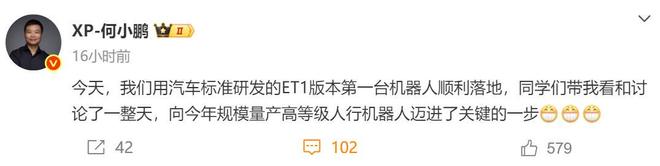
何小鹏:用汽车标准研发的 ET1 版本第一台机器人已落地
Huan Qiu Wang Zi Xun· 2026-01-20 06:01
Core Viewpoint - Xiaopeng Motors is making significant strides in the development of robotics, with the successful launch of the first ET1 version robot, marking a key step towards mass production of high-level humanoid robots by 2026 [1] Group 1: Robotics Development - The chairman of Xiaopeng Motors, He Xiaopeng, announced the successful development of the first ET1 version robot, which was created using automotive standards [1] - The company is planning to transition from technology exploration to practical application, with a focus on mass production of humanoid robots and flying cars by 2026 [1] Group 2: Future Plans - Xiaopeng Motors aims to launch the second-generation VLA in the first quarter, which will initiate the operation of Robotaxi services [1] - The company is set to achieve significant milestones in the fields of robotics and AI, indicating a shift towards more advanced technological applications in the automotive industry [1]


政策与技术双驱-智驾L3与L4的变局
2026-01-19 02:29
Summary of Conference Call Records Industry Overview - The conference call discusses the developments in the autonomous driving industry, particularly focusing on the advancements in L3 and L4 technologies, as well as the impact of NVIDIA's open-source Alpaca model on the Robotaxi market and L2+ technology adoption [1][2]. Key Points and Arguments NVIDIA's Open-Source Model - NVIDIA's Alpaca model, with approximately 10 billion parameters, has been released as an open-source project, which includes weights, inference scripts, simulation frameworks, and a physical AI open dataset. This initiative aims to lower the technical barriers for Robotaxi scalability and L2+ technology adoption [2]. - The open-source ecosystem provided by NVIDIA allows companies to operate and optimize their models without starting from scratch, thus reducing trial and error costs [2]. Regulatory Changes in North America - Recent regulatory changes in North America have simplified approval processes and relaxed safety requirements for autonomous vehicles, promoting innovation and commercialization. This creates a more efficient and flexible R&D environment for both domestic and global automakers [5][6]. - The new policies include exemptions for vehicles without steering wheels or pedals, allowing faster testing and deployment of non-compliant vehicles [6]. Technical Challenges and Solutions - Key challenges in autonomous driving technology include adaptation to extreme weather, construction zone recognition, and building user trust. Solutions involve enhancing modal strategies, combining visual and language understanding, and implementing redundant designs in control systems [7][8]. - The need for explainable decision-making and transparency is emphasized to build user trust, with companies encouraged to disclose decision-making processes [8]. Market Projections for 2026 - Significant advancements in China's smart driving sector are expected in 2026, including conditional commercialization of L3 technology, expansion of Robotaxi fleets, and iterative optimization of models and methodologies by autonomous driving companies [11]. - The penetration rate for L2 assisted driving is projected to reach 70%, with urban NOA penetration exceeding 15%. L3 technology is expected to account for 1%-2% of the market, primarily in mid-range vehicles [16]. Competitive Landscape - The competitive landscape is evolving, with major players like Huawei, Xiaopeng, and others continuously iterating their technology solutions. The performance of new models is under scrutiny, with some experiencing regressions in capabilities [12][14]. - The industry is anticipated to see significant changes in rankings and performance, with some manufacturers potentially being eliminated due to competitive pressures [15]. Additional Important Insights - The conference highlights the importance of simulation and physical AI applications in enhancing model performance, particularly in special scenarios that are not well-represented in real-world driving data [10]. - The establishment of a national-level autonomous driving technology assessment framework in China is suggested to facilitate the evaluation and regulation of L3 and L4 technologies [10]. This summary encapsulates the critical insights and projections regarding the autonomous driving industry, emphasizing the role of technology, regulatory changes, and competitive dynamics shaping the market landscape.
国信证券晨会纪要-20251127
Guoxin Securities· 2025-11-27 01:53
Industry and Company Overview - The mechanical industry report highlights Xiaopeng's plan to mass-produce humanoid robots, targeting one million units by 2030, marking a significant milestone for domestic manufacturers in this sector [7][8] - Google's release of the Gemini 3 AI model is noted, which is expected to enhance AI infrastructure and applications [9] Key Events and Developments - Xiaopeng announced plans for humanoid robot mass production by the end of 2026, with a goal of one million units by 2030 [7] - Google introduced the Gemini 3 AI model, which has shown exceptional performance in various benchmark tests [9] Investment Opportunities - The report suggests focusing on companies with strong positions in the humanoid robot supply chain, such as Feirongda, Longxi, and Weiman Sealing, for their potential growth and market positioning [8] - For AI infrastructure, companies like Yingli and Haomai Technology are recommended due to their strategic roles in energy supply for AI data centers [9] Market Dynamics - The humanoid robot sector is experiencing significant investment interest, with multiple companies securing funding for related technologies [10] - The AI infrastructure market is projected to grow, driven by increasing demand for AI computing power and related technologies [9] Company Performance - Zhou Da Fu reported stable overall performance in the first half of the fiscal year, with a slight revenue decline of 1.1% year-on-year, but a notable increase in same-store sales by 38.8% in October [18][19] - The company is focusing on high-margin products and optimizing store structures to enhance sales performance [20] Clinical Research Updates - Sanofi's 707 combination chemotherapy for NSCLC has shown promising results in Phase 2 trials, leading to plans for Phase 3 studies [21][22] - The company is expected to maintain steady growth due to rapid clinical advancements and successful licensing agreements [22] Financial Engineering Insights - The A-share market is experiencing a rebound, with significant activity in sectors like AI applications and CPO concepts [23] - Market sentiment is positive, with a notable number of stocks hitting the daily limit up [24]
小鹏拆掉过去的自己,再战 “物理 AI”
晚点LatePost· 2025-11-26 08:46
Core Insights - The article discusses how Xiaopeng Motors is shifting its focus towards advanced technologies, particularly in the realm of "physical AI," which encompasses autonomous driving, robotics, and flying cars [2][20]. Group 1: Technological Innovations - Xiaopeng Motors has introduced a new autonomous driving model called VLA (Vision-Language-Action), which aims to deploy AI reliably in real-world scenarios [3][20]. - The second generation of the VLA product has been designed to be more "human-like," capable of interpreting gestures and navigating complex traffic situations [3][4]. - The company is also focusing on humanoid robots, with the latest iteration showcasing advanced design features that enhance its mobility and human-like characteristics [4][7]. Group 2: Strategic Shifts - Xiaopeng's leadership emphasizes the need to dismantle past successful experiences to foster innovation and adaptability in a rapidly changing technological landscape [4][10]. - The company is moving away from traditional modular approaches to a more streamlined, end-to-end architecture for its autonomous driving technology [10][12]. - The strategy includes a dual approach where one team iterates on existing products while another focuses on new technologies, ensuring continuous improvement and innovation [13][20]. Group 3: Future Goals and Market Position - Xiaopeng aims to become a global leader in embodied intelligence, with plans to scale production of humanoid robots and advanced autonomous vehicles by 2026 [20][24]. - The company has set ambitious targets, including the production of 1 million robots by 2030, aligning its goals with industry leaders like Elon Musk [23][24]. - Recent financial performance indicates a positive trend, with a cumulative delivery of 350,000 vehicles and a gross margin exceeding 20% in Q3 [19][20].

平安证券(香港)港股晨报-20251107
Ping An Securities Hongkong· 2025-11-07 03:03
Market Overview - The Hong Kong stock market experienced fluctuations, with the Hang Seng Index closing at 23,831 points, down 145 points or 0.61% [1] - The market saw a significant increase on a previous day, with the Hang Seng Index rising 2.12% to 26,485.90 points, and the Hang Seng Technology Index soaring 2.74% [1] - Southbound funds recorded a net inflow of 31.2 billion HKD in the first four trading days of November, significantly surpassing last year's total of 80.79 billion HKD [3] Key Sectors - The semiconductor sector showed strong performance, with companies like Hua Hong Semiconductor and SMIC seeing stock increases of over 9% and 7% respectively [1] - The report emphasizes the importance of technology sectors such as artificial intelligence, semiconductors, and industrial software as core investment themes for the future [3] - The energy sector, particularly companies like China National Offshore Oil Corporation and China Petroleum, is highlighted for its low valuation and high dividend yield [9] Company Performance - Hua Hong Semiconductor reported a record high in sales for the third quarter, although its net profit decreased by 42.6% year-on-year [11] - China Petroleum signed contracts worth nearly 17.5 billion USD at the recent China International Import Expo [11] - BYD's sales figures for October showed a significant volume, with over 20,000 units sold for its new model [11] Investment Recommendations - The report suggests focusing on companies in the technology sector, particularly those involved in AI and semiconductor production, as they are expected to benefit from long-term growth opportunities [3] - It also recommends considering state-owned enterprises with lower valuations and higher dividends, as well as upstream non-ferrous metal companies benefiting from anticipated interest rate cuts [3]