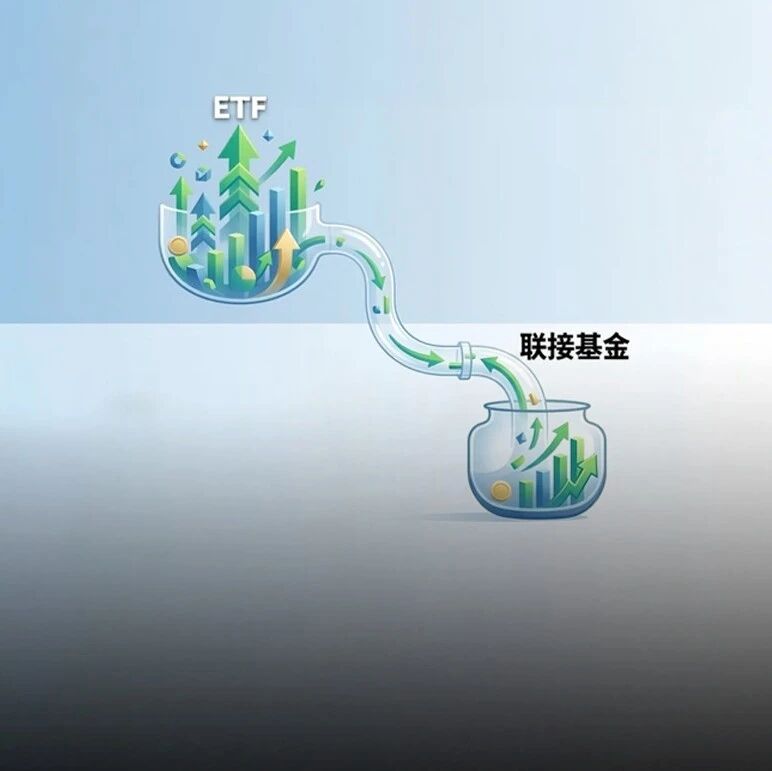
联接基金

Search documents
暴涨行情下,联接基金为什么总是“跟不上”ETF?
市值风云· 2026-03-10 10:10
Core Viewpoint - The article discusses the differences between on-market ETFs and off-market linked funds, emphasizing that there is no absolute superiority between the two, as their performance is influenced by their underlying operational mechanisms [1][4]. Group 1: Differences Between ETFs and Linked Funds - On-market ETFs are traded on stock exchanges, allowing real-time transactions and low costs, while off-market linked funds act as intermediaries, enabling investors without brokerage accounts to invest indirectly in ETFs [6][7]. - The operational differences lead to performance discrepancies, particularly in volatile markets, where linked funds may lag behind ETFs due to additional layers in their structure [8]. Group 2: Reasons for Underperformance of Linked Funds - The first reason for the underperformance of linked funds is the inherent cash reserve requirement, which limits their ability to operate close to full investment capacity, resulting in a drag on returns during market upswings [11][12]. - The second reason is the dilution effect caused by large inflows of new capital, which can increase the total number of shares and dilute existing shareholders' returns during rapid market movements [13][15]. - The third reason involves timing discrepancies in the trading mechanism, where funds submitted for linked funds do not immediately convert into ETF shares, potentially causing investors to miss out on gains during market surges [17][18]. Group 3: Performance Comparison - During a specific period in March 2026, the on-market oil ETF saw significant gains of 10.03% and 7.97%, while the corresponding linked fund only increased by 6.97% and 2.94%, highlighting the performance gap [15]. - Conversely, during market downturns, linked funds may exhibit better resilience due to their cash reserves and lower investment levels, as seen when the oil ETF dropped significantly while the linked fund experienced smaller declines [19][20]. Group 4: Investment Considerations - For investors seeking quick trading opportunities, on-market ETFs are recommended as the superior choice, while those focused on long-term value and convenience may find off-market linked funds to be a more suitable option [21].

一图看懂科创综指
Zhong Guo Ji Jin Bao· 2026-01-09 11:16
Core Viewpoint - The Shanghai Stock Exchange and China Securities Index Company have launched the "Comprehensive Index of the Sci-Tech Innovation Board" (科创综指) to provide a comprehensive view of the market, marking a new phase in the index system construction for the Sci-Tech Innovation Board [10][16]. Group 1: Index Overview - The Sci-Tech Innovation Comprehensive Index covers nearly all non-ST and *ST securities listed for over a year on the Sci-Tech Innovation Board, with a sample size of 576 stocks and a market capitalization coverage exceeding 90% [13][14]. - The average total market capitalization of the index components is 16.3 billion [14]. Group 2: Market Performance - Since its launch, the Sci-Tech Innovation Comprehensive Index has shown a steady upward trend, achieving a growth rate of approximately 48% by December 31, 2025, significantly outperforming major broad-based indices [26]. - The index has gained 115% since September 24, 2024, reflecting market recognition of the value of hard technology assets [26]. Group 3: Financial Performance of Components - In the first three quarters of 2025, the index components collectively achieved operating revenue of 1.1 trillion, a year-on-year increase of 7.7%, and a net profit attributable to shareholders of 48.3 billion, with a year-on-year growth of 7.1% [23]. - The revenue and net profit growth rates have shown a quarterly increase, indicating the operational resilience of the listed companies [23]. Group 4: Product Ecosystem - The index has gained widespread recognition among investors, leading to a complete product chain that includes ETFs, linked funds, and enhanced products, facilitating efficient access to the development dividends of new quality productivity [32]. - As of December 31, 2025, 46 fund managers have launched a total of 78 index funds tracking the Sci-Tech Innovation Comprehensive Index, with a combined scale of 27.4 billion, making it the second-largest broad-based index for the Sci-Tech Innovation Board [32].

一图看懂科创综指
中国基金报· 2026-01-09 11:08
Core Viewpoint - The article discusses the rapid development of the index system in China, highlighting the launch of the Shanghai Stock Exchange's Science and Technology Innovation Board Comprehensive Index (referred to as the "Kechuang Comprehensive Index") as a significant milestone for investors to observe and invest in the overall performance of the Science and Technology Innovation Board [8][9]. Group 1: Background and Launch - The Kechuang Comprehensive Index was launched on January 20, 2025, by the Shanghai Stock Exchange and China Securities Index Co., marking a new phase in the index system construction for the Science and Technology Innovation Board [9]. - This index aims to provide a comprehensive representation of the overall operation of the Science and Technology Innovation Board, addressing the urgent need for a balanced index as the market expands [9]. Group 2: Index Composition and Performance - The Kechuang Comprehensive Index includes all non-ST and *ST securities listed for over a year on the Science and Technology Innovation Board, covering nearly all listed companies [12]. - As of now, the index comprises 576 sample stocks, with a market capitalization coverage exceeding 90%, and an average total market capitalization of 16.3 billion yuan [12][14]. - Since its launch, the index has gained significant attention, becoming one of the four core broad-based indices in A-shares, alongside the Shanghai Composite Index, Shenzhen Component Index, and ChiNext Index [15]. Group 3: Fundamental Performance of Constituent Stocks - The constituent stocks of the Kechuang Comprehensive Index have shown overall positive fundamentals, with total operating revenue reaching 1.1 trillion yuan in the first three quarters of 2025, reflecting a year-on-year growth of 7.7% [22]. - The net profit attributable to shareholders reached 48.3 billion yuan, with a year-on-year growth of 7.1%, indicating a significant improvement compared to the previous year [22]. - The index's constituent stocks are primarily distributed across new-generation information technology (59.4%), biomedicine (13.6%), and high-end equipment (12.9%) [18]. Group 4: Market Recognition and Product Development - The Kechuang Comprehensive Index has been widely recognized by investors, leading to a rapid development of related products, including ETFs, linked funds, and enhanced products, creating a complete product chain [28]. - As of December 31, 2025, 46 fund managers have launched a total of 78 index funds tracking the Kechuang Comprehensive Index, with a combined scale of 27.4 billion yuan, establishing it as the second-largest broad-based index for the Science and Technology Innovation Board [28].
“A股四大指数”要来了?
Di Yi Cai Jing· 2026-01-05 02:24
Core Viewpoint - The launch of the Sci-Tech Innovation Board Composite Index (Sci-Tech Index) marks a significant development in the A-share market, with its performance and structure suggesting it should be recognized as one of the four core indices of A-shares alongside the Shanghai Composite Index, Shenzhen Component Index, and ChiNext Index [1][5]. Group 1: Importance of the Sci-Tech Index - The Sci-Tech Index has shown a growth of approximately 48% since its launch on January 20, 2025, and a cumulative increase of 115% since September 24, 2024 [1]. - The index has attracted significant interest, with 46 fund managers launching 78 index funds, accumulating a total scale of 27.4 billion yuan [1][8]. - Experts believe the Sci-Tech Index enhances the A-share index system by providing a comprehensive representation of the technology sector, filling a structural gap in the existing indices [2][5]. Group 2: Index Structure and Coverage - The Sci-Tech Index covers 576 stocks, achieving a coverage rate of 96% within the Sci-Tech Board, while other indices have different coverage and industry weight distributions [3][4]. - The industry weight of the Sci-Tech Index is heavily skewed towards information technology (54.63%), contrasting with the other indices that have a more diversified industry representation [3]. Group 3: Investment Implications - The Sci-Tech Index is expected to shift the investment logic from a profit-oriented approach to an innovation-driven one, reflecting the unique characteristics of hard technology assets [6][7]. - Investors are advised to focus on long-term growth potential and technological breakthroughs when investing in hard technology assets, while traditional assets should emphasize cash flow stability [7]. Group 4: Future Outlook - The Sci-Tech Index is anticipated to continue gaining attention and importance in the capital market, potentially becoming a global benchmark for Chinese technology stocks [12]. - There is a call for enhancing the index's representation of core technology and improving the quality of constituent disclosures to strengthen its global influence [12].
“A股四大指数”呼之欲出,科创综指成新质生产力定价新锚
Di Yi Cai Jing· 2026-01-04 11:48
Core Viewpoint - The Sci-Tech Innovation Index (科创综指) is proposed to be recognized as one of the four core indices of A-shares, alongside the Shanghai Composite Index, Shenzhen Component Index, and ChiNext Index, due to its significant role in the A-share market as the number of listed companies on the Sci-Tech Innovation Board reaches 600 [1][5]. Group 1: Importance and Functionality of the Sci-Tech Innovation Index - The Sci-Tech Innovation Index was officially launched on January 20, 2025, and has seen a growth of approximately 48% since its inception, with a cumulative increase of 115% since September 24, 2024 [1]. - The index has been recognized for enhancing the A-share market's index system, providing more representative indices across different market tiers and industries, which helps guide capital towards core technology and high-growth potential Sci-Tech enterprises [2]. - The inclusion of the Sci-Tech Innovation Index fills a critical gap in the existing index system, providing a comprehensive representation of the technology sector and addressing the structural void in systematic representation [5]. Group 2: Complementarity with Other Indices - The Sci-Tech Innovation Index complements the existing indices by covering a broader range of companies, specifically focusing on hard technology and small to mid-cap growth in the technology sector, which is underrepresented in other indices [5]. - The index's industry weightings show a significant focus on information technology (54.63%), contrasting with the other indices, which have a more diversified industry representation [3]. - The four indices together create a multi-layered, differentiated core index system for the A-share market, each fulfilling distinct roles from market representation to sector focus [4]. Group 3: Investment Dynamics and Trends - The valuation of the Sci-Tech Innovation Index is notably higher than that of other indices, reflecting a fundamental shift in pricing logic from profit-oriented to innovation-driven metrics, indicating a new investment paradigm [6][7]. - The index has attracted significant capital inflow, with a total of 78 index funds launched, accumulating a scale of 27.4 billion yuan, showcasing its appeal to institutional investors [8]. - The investment ecosystem surrounding the Sci-Tech Innovation Index is characterized by high concentration, volatility, and significant institutional participation, making it a core vehicle for allocating technology hard assets [8][9]. Group 4: Future Outlook - The future of the Sci-Tech Innovation Index is expected to be positive, with increasing attention from domestic and international long-term investors, enhancing its role as a benchmark for Chinese technology stocks [12]. - Continuous improvement in the quality of listed companies and the index's components is anticipated, which will further optimize its structure and increase its global influence [12]. - The index is seen as a potential "global business card" for China's technological innovation, with plans to enhance its representation and attract more international capital [10][12].
科创新能源ETF(588830)单日大涨9.24%,近期持续收到资金关注
Xin Lang Cai Jing· 2025-09-05 08:01
Group 1 - The core viewpoint of the news is that the Kexin New Energy ETF (588830.SH) has experienced significant growth, with a 9.24% increase as of September 5, 2023, and its associated index, Kexin New Energy (000692.SH), rising by 9.17% during the same period [1] - Major constituent stocks of the ETF have shown strong performance, with Xiamen Tungsten New Energy rising by 20.00%, Canadian Solar increasing by 13.45%, Trina Solar up by 9.50%, Daqo New Energy rising by 8.86%, and TianNai Technology increasing by 12.33% [1] - From September 1 to September 4, the Kexin New Energy ETF saw a continuous net inflow of funds for four consecutive days, with a single-day net inflow of 127 million yuan on September 4 [1] Group 2 - Related products include the Kexin New Energy ETF (588830) and its linked funds (Class A 023075, Class C 023076, Class I 024157) [2] - Related individual stocks include JinkoSolar (688223), Trina Solar (688599), Daqo New Energy (688303), Canadian Solar (688472), Funeng Technology (688567), TianNai Technology (688116), Rongbai Technology (688005), Xiamen Tungsten New Energy (688778), Electric Wind Power (688660), and Pylon Technologies (688063) [2]
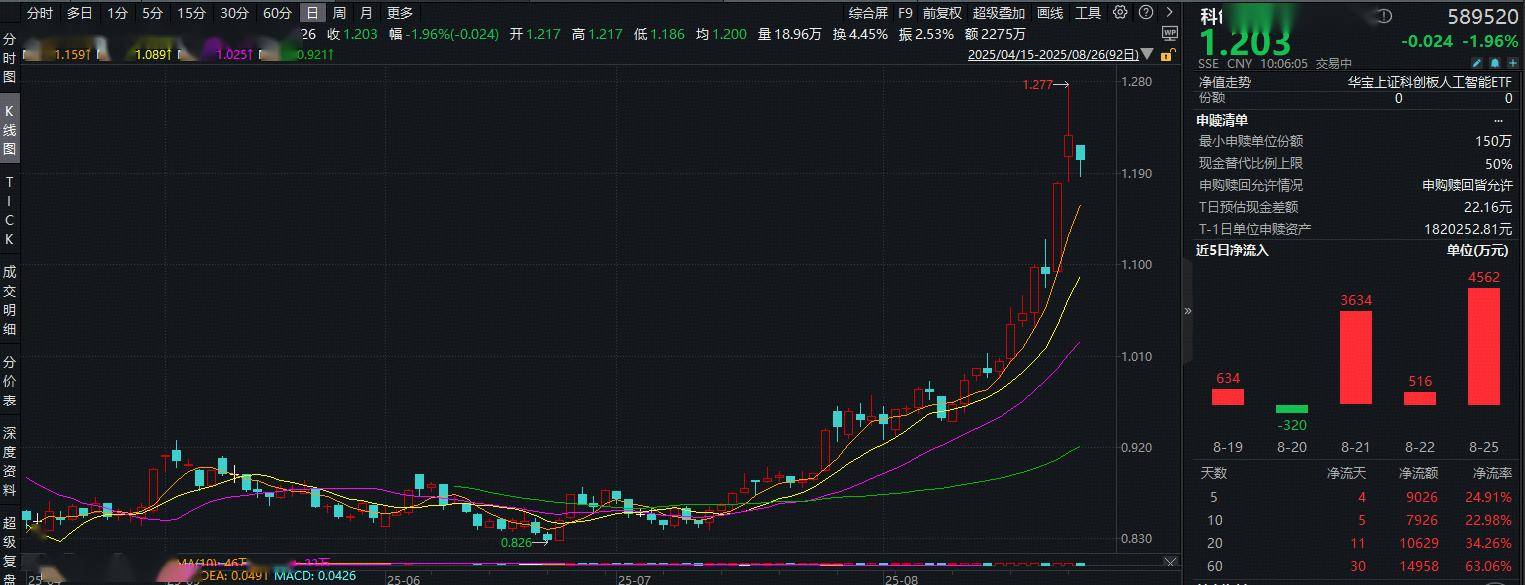
ETF盘中资讯|科创人工智能为何遭遇调整?589520盘中跌近2%?AI亟需自主可控!资金迎来逢跌布局机会?
Sou Hu Cai Jing· 2025-08-26 02:38
Core Viewpoint - The domestic AI industry chain, particularly the Sci-Tech Innovation Artificial Intelligence ETF (589520), is experiencing market adjustments, with significant fluctuations in key stocks, reflecting both market sentiment and individual stock performance [1][3]. Group 1: Market Performance - On August 26, the Sci-Tech Innovation Artificial Intelligence ETF (589520) saw a decline of 1.96%, with major components like Chipone Technology dropping over 8% and Cambricon Technologies falling more than 3% [1]. - The ETF attracted 45.62 million yuan in a single day on August 25, accumulating 150 million yuan over the past 60 days, indicating strong capital inflow into domestic AI alternatives [1]. Group 2: Stock Adjustments - The adjustment in the ETF is attributed to the decline of major weighted stocks, particularly Cambricon Technologies and Chipone Technology, which faced significant sell-offs [3]. - The decline in Chipone Technology is linked to a large discounted share sale by its shareholders, although this is not indicative of the company's business deterioration [3]. Group 3: Domestic Chip Development - The development of domestic computing chips is characterized by two main technical routes: one focusing on GPGPU compatibility with NVIDIA's CUDA, and the other aiming to establish an independent ecosystem outside of NVIDIA's influence [4][5]. - The domestic computing market share is expected to grow significantly, driven by product advancements and the increasing competitiveness of domestic manufacturers [5]. Group 4: Market Outlook - Analysts predict that the urgency for domestic computing chip replacement will continue to rise, with expectations of a doubling market capacity by 2025 due to rapid growth in domestic demand [5]. - The AI chip market is anticipated to expand significantly, with local brands like Cambricon expected to capture a 40% market share by 2025, driven by increased demand for inference and training computing power [5].