腾讯豆包

Search documents
商家骑手订单暴涨 千问AI大战稳赢了?
Bei Jing Shang Bao· 2026-02-08 14:00
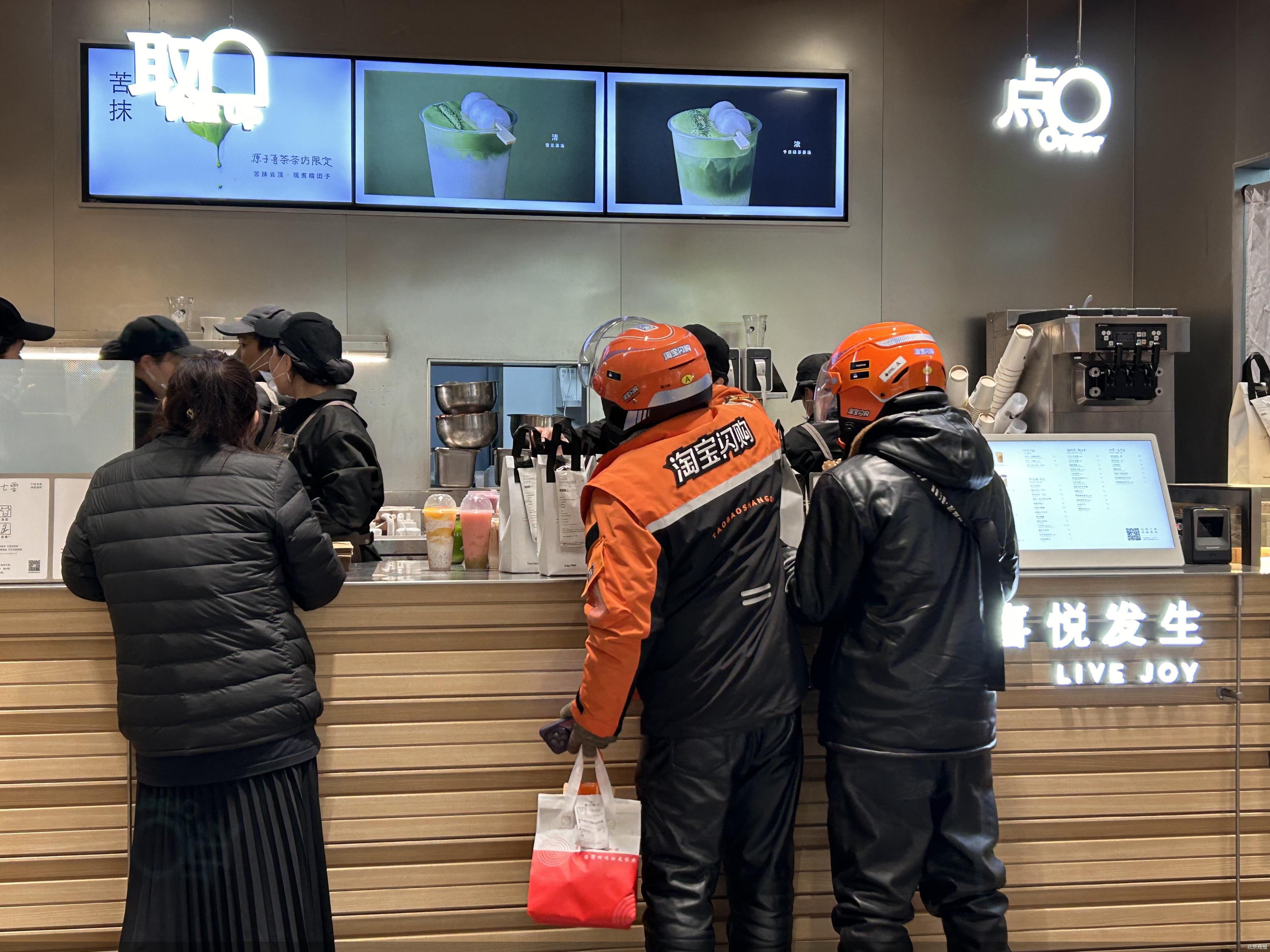
Core Insights - The article discusses the impact of the "30 Billion Free Order" campaign launched by Qianwen App, which significantly increased orders at local tea shops, leading to delivery delays and mixed consumer experiences [1][5][6] Group 1: Campaign Overview - Qianwen App's promotional event on February 6 allowed users to order tea for free using a 25 yuan voucher, resulting in over 10 million orders within 9 hours [6][8] - The campaign aimed to gather real-world data for AI consumption scenarios, marking a significant marketing effort with a budget of 30 billion yuan [1][8] Group 2: Consumer Experience - While many users enjoyed the excitement of free tea, others faced long delivery times and issues with order accuracy, leading to complaints about the service [5][9] - The app experienced technical difficulties, including crashes and delays, which affected user satisfaction and fulfillment [8][9] Group 3: Market Dynamics - The campaign's success drew attention from competitors like Meituan and JD, who are also exploring AI-driven local services [7][9] - The event highlighted the competitive landscape among major tech companies, with Qianwen's strategy reflecting traditional market capture tactics through incentives like free orders and cash rewards [9]


中国万亿市值公司之变:4家新贵晋级,工业富联狂飙近200%
21世纪经济报道· 2026-01-08 11:47
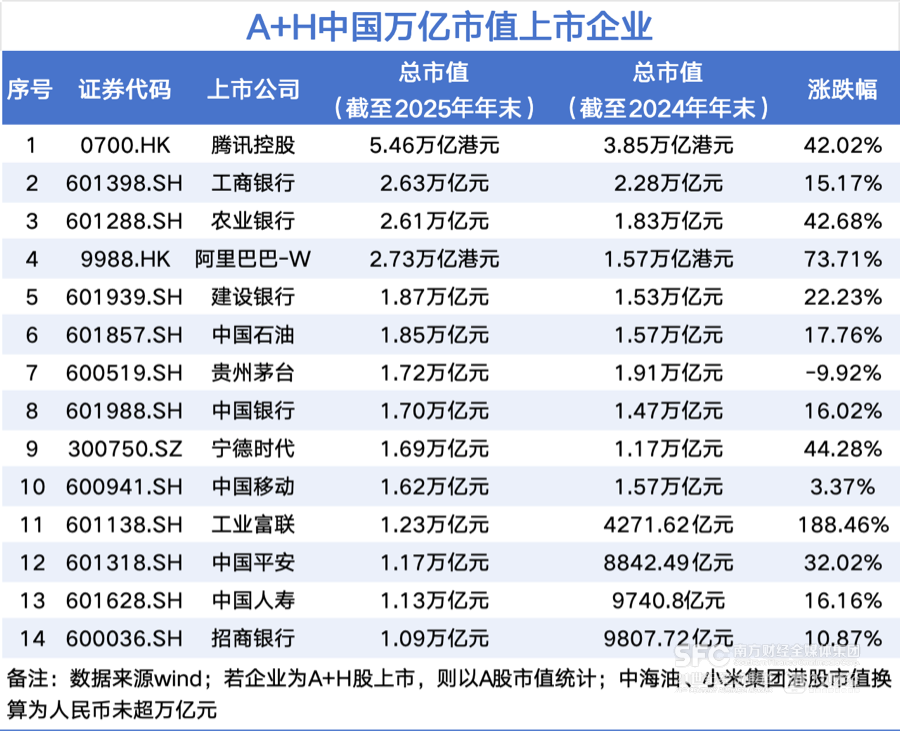
Core Viewpoint - The number of companies with a market capitalization exceeding 1 trillion yuan in China's A+H share market has increased to 14 by the end of 2025, with a total market value increase of approximately 9 trillion yuan, reflecting a growth rate of over 50% [1][2]. Group 1: New Trillion-Yuan Companies - Four new companies have joined the trillion-yuan market cap club: Industrial Fulian, China Ping An, China Life, and China Merchants Bank [1][4]. - Industrial Fulian has seen a remarkable market cap increase of approximately 188%, driven by its core business in AI and precision manufacturing [4][5]. - The financial sector's recovery is highlighted by China Ping An's 32.02% increase, China Life's 16.16% increase, and China Merchants Bank's 10.87% increase in market cap [4][5]. Group 2: Market Trends and Characteristics - The market capitalization growth is characterized by a leading trend in technology and new sectors, while financial and energy sectors show stable growth [1][7]. - Tencent and Alibaba have both seen significant market cap increases, exceeding 1 trillion Hong Kong dollars, driven by AI advancements and recovery in e-commerce [7][9]. - The banking sector, particularly Agricultural Bank of China, has shown strong performance with a market cap increase and a notable rise in stock price, breaking the long-standing "price-to-book" ratio below 1 [11][12]. Group 3: Company Performance Highlights - Tencent's market cap reached 5.46 trillion HKD, with a year-on-year increase of 42.02%, supported by its AI strategy and business integration [2][8]. - Alibaba's market cap rose to 2.73 trillion HKD, benefiting from AI integration and a recovery in its e-commerce business [9]. - Agricultural Bank of China reported a revenue of 550.88 billion yuan and a net profit of 220.86 billion yuan, reflecting a stable asset quality and strong market recognition [12].







中国万亿市值公司之变:四家新贵晋级 两大增长逻辑
2 1 Shi Ji Jing Ji Bao Dao· 2026-01-08 11:41
Core Insights - The number of companies with a market capitalization exceeding 1 trillion yuan in mainland China has increased to 14 by the end of 2025, with a total market value increase of over 9 trillion yuan, reflecting a growth rate of over 50% [1][2] Group 1: New Trillion-Yuan Companies - Four new companies have joined the trillion-yuan market cap club: Industrial Fulian, China Ping An, China Life, and China Merchants Bank, with four headquartered in Shenzhen [3][4] - Industrial Fulian has seen a remarkable market cap increase of approximately 188%, while the other three companies in the financial sector have experienced more modest growth rates: China Ping An at 32.02%, China Life at 16.16%, and China Merchants Bank at 10.87% [4][5] Group 2: Market Trends and Dynamics - The rise of these companies reflects two core market dynamics: explosive growth in the technology sector and valuation recovery in the financial sector [5] - Industrial Fulian's rapid growth is attributed to its comprehensive involvement in the AI industry chain, with a significant revenue increase of 38.4% year-on-year, reaching 603.93 billion yuan in the first three quarters of 2025 [6] - China Life has reported a total premium exceeding 700 billion yuan, with a 41% increase in total investment income, while China Ping An has established a strong competitive barrier through its extensive customer base and technology capabilities [7] Group 3: Performance of Major Players - Tencent and Alibaba have also seen significant market cap increases, with both companies adding over 1 trillion Hong Kong dollars to their valuations, driven by AI advancements and a recovery in their core businesses [8][10] - Tencent's market cap reached 5.46 trillion Hong Kong dollars by the end of 2025, with a stock price increase of over 40%, while Alibaba's market cap rose to 2.73 trillion Hong Kong dollars [10][11] Group 4: Banking Sector Insights - The banking sector has shown signs of valuation recovery, with Agricultural Bank of China achieving a notable stock price increase of over 50% and breaking the long-standing "price-to-book" ratio below 1 [12][13] - Agricultural Bank's revenue for the first three quarters of 2025 was 550.88 billion yuan, with a net profit of 220.86 billion yuan, reflecting a year-on-year increase of 3.03% [12][13]

不管是中国还是美国最终走向都是人工智能时代是这样吗?
Sou Hu Cai Jing· 2025-10-08 20:55
Core Insights - The development trajectories of China and the U.S. are clearly pointing towards the era of artificial intelligence, driven by technological iteration and industrial upgrading, but with significant differences in development paths and focus areas [1][3] Group 1: Technological Development - The U.S. maintains an advantage in foundational algorithms, large model architectures (e.g., original BERT framework), and core patent fields, focusing on fundamental breakthroughs in its research ecosystem [1] - China leverages its vast user base, mobile internet accumulation (e.g., mobile payments/e-commerce), and industrial chain collaboration to accelerate scenario-based applications, with some areas already surpassing the U.S. in user experience [1] Group 2: Policy and Strategic Approaches - The U.S. strategy aims to reinforce its technological hegemony through export controls, standard-setting, and collaboration with allies to curb competitors [3] - In contrast, China's approach focuses on leveraging its manufacturing foundation and data scale advantages, emphasizing the integration of AI with the real economy [3] Group 3: Competitive Landscape - Key differences in innovation focus: the U.S. prioritizes foundational theory and general large models, while China emphasizes scenario applications and engineering implementation [5] - Competitive advantages differ as well: the U.S. excels in academic originality and global standard leadership, whereas China leads in commercialization speed and market scale [5] Group 4: Future Competition Focus - The competition between the two nations will center around three main technological lines: the proliferation of agents, cost reduction and efficiency enhancement through mixed expert models (MoE), and the creation of incremental markets through multimodal integration [7] - China's 5-8 year lead gained during the mobile internet era may provide a crucial springboard for competition in AI applications [7]