英伟达H100/H200

Search documents
博通打算做空英伟达
3 6 Ke· 2026-01-22 02:42
Core Insights - Goldman Sachs report highlights a significant 70% reduction in inference costs with the new TPU v7 chips from Google and Broadcom, indicating a major shift in the AI computing landscape [1][2][10]. Group 1: Cost Reduction and Implications - The 70% cost reduction signifies a fundamental change in the industry, moving beyond traditional hardware upgrades [2][5]. - The report emphasizes the importance of inference costs over training speeds, as the industry transitions from model training to deployment [4][10]. - The cost savings are attributed to three main factors: improved data transmission efficiency, tighter chip packaging, and specialized architecture of ASICs [7][8]. Group 2: Competitive Landscape - The TPU v7's cost is now comparable to NVIDIA's offerings, altering the competitive dynamics as companies reconsider their chip choices [9][10]. - The report suggests that the rise of ASICs represents a challenge to NVIDIA's dominance in the GPU market, indicating a shift towards customized solutions [11]. Group 3: Major Contracts and Market Movements - Anthropic's $21 billion order for custom ASICs marks a significant investment in dedicated AI infrastructure, reflecting a strategic shift in the industry [12][13]. - The funding for this order is backed by major players like Google and Amazon, highlighting the financial support for custom chip development [14][15]. Group 4: Role of Broadcom - Broadcom has transitioned to a key player in the AI chip market, acting as a contractor for major tech firms and providing essential interconnect technology [22][25]. - The company's business model, which includes upfront R&D fees and revenue sharing from chip sales, offers a more stable income compared to NVIDIA's model [24][27]. Group 5: Implications for China - The rise of ASICs and the reduction in inference costs may accelerate the development of China's own custom chip solutions, as companies seek alternatives to NVIDIA's GPUs [28][29]. - Chinese firms are increasingly investing in self-developed chips, aiming to create tailored solutions for their AI models [29][30]. - The report suggests that the focus should be on companies with core competencies in chip design and packaging technologies, rather than merely competing in low-cost chip production [31][34].


马斯克最大算力中心建成了:全球首个GW级超算集群,再创世界纪录
量子位· 2026-01-18 05:29
Core Viewpoint - The launch of Colossus 2, the world's first 1GW supercomputing cluster, marks a significant advancement in AI infrastructure, with plans to upgrade to 1.5GW by April and potentially reach 2GW, which could match the power consumption of major U.S. cities [2][12]. Group 1: Colossus 2 Overview - Colossus 2 is equipped with approximately 200,000 NVIDIA H100/H200 GPUs and around 30,000 NVIDIA GB200 NVL72 GPUs, significantly enhancing its computational power compared to its predecessor, Colossus 1, which was built in just 122 days [9][10]. - The cluster's 1GW capacity can power about 750,000 households, equivalent to the peak power demand of San Francisco [11]. - Once fully operational, Colossus 2 will house 555,000 GPUs, surpassing the GPU counts of Meta, Microsoft, and Google [13][14]. Group 2: Implications for AI Development - The advancements in Colossus 2 are expected to facilitate the development of Grok 5, which is projected to have parameters around 6 trillion, more than double that of Grok 4 [15][18]. - With the recent $20 billion funding round for xAI, the scaling capabilities for Grok 5 are increasing, leading to larger model parameters and faster training and deployment speeds [18][19]. - The rapid development of AI models is seen as a competitive advantage in the industry, emphasizing that speed is a crucial factor in the AI era [20]. Group 3: Energy Supply Concerns - The construction of large data centers like Colossus 2 is contributing to a projected annual electricity demand growth of 4.8% over the next decade, which is unprecedented for the U.S. energy system [27]. - The imbalance between rapidly increasing demand and slow supply growth is causing concerns about the stability of the power grid, leading to potential rolling blackouts for 67 million residents in 13 states during extreme weather [5][22][23]. - PJM, the regional transmission organization, is struggling to maintain supply-demand balance and has proposed measures to reduce peak demand from data centers, which have faced opposition from major tech companies [32][34].


马斯克买了新厂房上GPU,2GW供电规模,“巨硬”更更硬了
Sou Hu Cai Jing· 2025-12-31 07:15
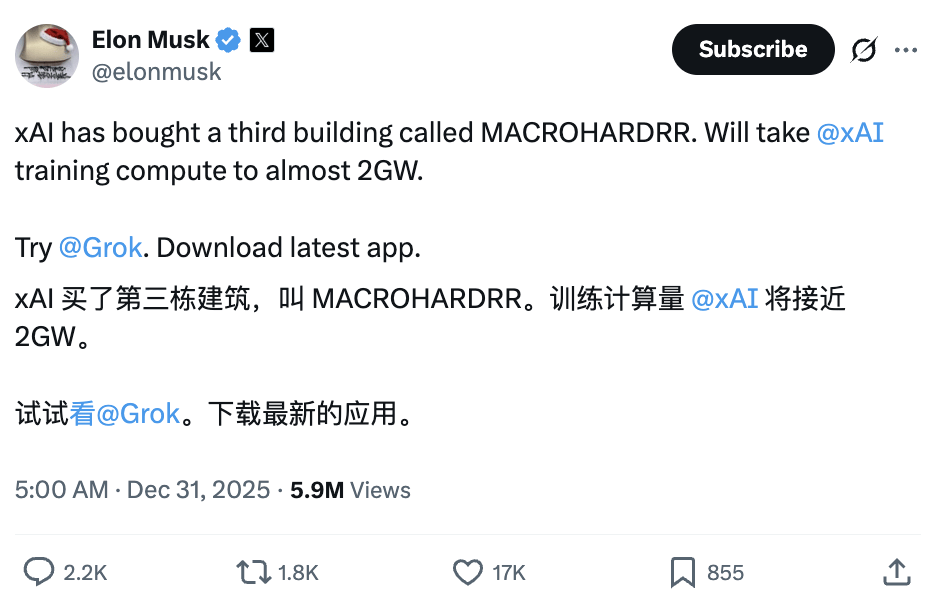
Core Insights - Elon Musk's "Macrohard" project has acquired a third dedicated facility named MACROHARDRR, which will have a power supply capacity of 2GW [1][9] Group 1: Project Overview - The 2GW power capacity is sufficient to meet the electricity needs of approximately 750,000 American households [2] - The facility is expected to support around 1.1 million NVIDIA GB200 NVL72 GPUs based on previous power density and efficiency metrics [2] - The first facility, Colossus I, was built in just 122 days and is currently the largest and most stable single computing cluster globally, equipped with around 200,000 NVIDIA H100/H200 and 30,000 NVIDIA GB200 NVL72 GPUs [2] Group 2: Expansion Plans - Colossus II, the second facility, began construction on March 7, 2025, and has a total area of 1 million square feet, with a cooling capacity of 200MW to support 110,000 GB200 NVL72 GPUs [4][5] - The ultimate goal for Colossus II is to deploy over 550,000 GPUs, with peak power demand expected to exceed 1.1GW [5] Group 3: Infrastructure and Community Impact - The MACROHARDRR facility is located near Colossus II, and construction has included a new road connecting the two sites [9] - The project has faced community complaints regarding air pollution from gas turbines and noise from construction, leading to the installation of a wall to mitigate noise [10] - To avoid impacting the local power grid, 168 Tesla Megapack battery storage systems have been deployed at Colossus II to provide power during peak demand [11] Group 4: Financial Aspects - xAI is reportedly planning to raise $15 billion at a valuation of $230 billion to support the extensive capital requirements for the construction and expansion of these computing facilities [11]
马斯克买了新厂房上GPU,2GW供电规模,“巨硬”更更硬了
量子位· 2025-12-31 05:28
Core Viewpoint - Elon Musk's xAI is expanding its computing power through the "Macrohard" project, with the acquisition of a third facility named MACROHARD RR, which will have a power supply capacity of 2GW [1][2]. Group 1: Facility Expansion - The new facility MACROHARD RR is located near the existing Colossus II site, which is part of the Macrohard project [15][16]. - Colossus I, the first facility, was built in just 122 days and is currently the largest and most stable computing cluster globally, equipped with approximately 200,000 NVIDIA H100/H200 and 30,000 NVIDIA GB200 NVL72 GPUs [6][7]. - Colossus II is set to deploy 110,000 NVIDIA GB200 GPUs in its first phase, with a final goal of over 550,000 GPUs and a peak power demand exceeding 1.1GW [11]. Group 2: Power Supply and Infrastructure - The 2GW power capacity of the new facility can support around 1.1 million NVIDIA GB200 NVL72 GPUs, based on previous power density and efficiency metrics [2][4]. - xAI has partnered with Solaris Energy Infrastructure to build a permanent gas turbine power plant in Mississippi, which is expected to provide over 1GW of power by early 2027 [18][20]. - To mitigate noise complaints from nearby residents, xAI has constructed a wall between the power plant site and residential areas and deployed 168 Tesla Megapack battery storage systems to support local power needs during peak usage [20]. Group 3: Financial Aspects - xAI is reportedly planning to raise $15 billion at a valuation of $230 billion to support its expansion efforts [22]. - Musk has denied reports regarding the fundraising but has not provided further clarification [23].

在AI泡沫刷屏时刻 托起“AI信仰”的竟是Arm(ARM.US)! “ARM架构浪潮”席卷数据中心 营业利润猛增155%
智通财经网· 2025-11-06 00:21
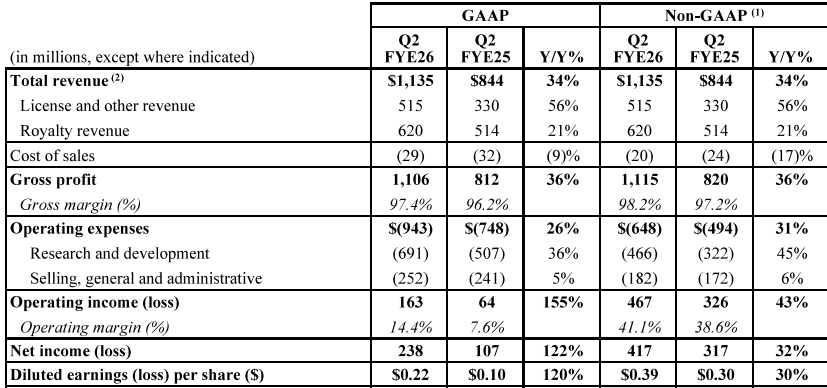
Core Viewpoint - Arm Holdings Plc has provided optimistic revenue forecasts that exceed Wall Street expectations, driven by the expansion of AI data centers globally, indicating a strong demand for AI computing infrastructure [1][2][3] Financial Performance - In the second fiscal quarter ending September, Arm's total revenue increased by 34% to approximately $1.14 billion, surpassing previous forecasts [5][6] - Non-GAAP earnings per share for the same quarter were $0.39, exceeding analyst expectations of $0.33 [5][6] - The company reported an operating profit of approximately $163 million, a 155% year-over-year increase, with an operating margin of 14.4% [5][6] Revenue Breakdown - Arm's revenue consists of two main components: licensing fees and royalties. Licensing revenue for the second quarter was approximately $515 million, a 56% increase year-over-year, while royalty revenue was about $620 million, reflecting a 21% increase [7][4] Market Position and Strategy - Arm is transitioning to a more complete chip design provider, enhancing its influence in the semiconductor market and capitalizing on the growing AI spending by enterprises [7][8] - The company is actively expanding into larger markets such as data centers and personal computer components, aiming to benefit from the robust demand for AI infrastructure [7][8] Industry Context - Arm's architecture is increasingly penetrating the data center server cluster market, traditionally dominated by x86 architecture, due to its energy efficiency and cost-effectiveness [8][10] - The company is a key player in the AI technology development landscape, participating in significant AI infrastructure projects alongside major tech firms [8][9] Investor Sentiment - Arm's strong performance and outlook have bolstered the narrative of a long-term AI bull market, countering recent pessimism regarding an "AI bubble" [2][12] - The overall sentiment in the market remains optimistic, with major players in the AI computing space continuing to invest heavily in infrastructure [12][14]

ChatGPT引发青少年安全风暴 美国参议院点名调查OpenAI
智通财经网· 2025-09-19 02:21
Group 1 - A key Republican senator in the U.S. has requested OpenAI CEO Sam Altman to submit core documents regarding the risks of ChatGPT to children and teenagers, significantly expanding the congressional investigation into AI applications [1] - Senator Josh Hawley expressed concerns about the potential harm AI chatbots pose to children, citing increasing evidence of serious damage caused by such technologies [1] - OpenAI is required to respond to a list of questions by October 17, which relate to the research and design of its products and significant incidents of harm to young users [1] Group 2 - OpenAI is undergoing a restructuring plan to transition from a non-profit organization to a Public Benefit Corporation (PBC), aiming to enhance fundraising capabilities while maintaining its mission [2][3] - The non-profit parent organization will retain control, with plans to secure over $100 billion in equity, and a non-binding memorandum of understanding with Microsoft to extend collaboration [2] Group 3 - OpenAI's ChatGPT has surpassed 700 million active users weekly as of early August, a significant increase from 500 million in March [4] - The company is expected to double its revenue this year to $13 billion, with projected revenue of approximately $3.7 billion in 2024 [4] - OpenAI plans to collaborate with Broadcom to launch its first customized AI chip, with expected orders exceeding $10 billion [4] Group 4 - OpenAI's valuation is projected to reach $500 billion, making it one of the most valuable unicorns globally, surpassing SpaceX's valuation [4][5] - The company has been investing heavily in NVIDIA GPUs and is now partnering with Broadcom to build an AI ASIC chip cluster, indicating a shift towards customized AI infrastructure [5] Group 5 - CEO Sam Altman stated that OpenAI plans to invest trillions of dollars in core AI infrastructure, including AI chips and high-performance data center equipment, emphasizing the long-term importance of AI [6]
博通(AVGO.US)带着OpenAI百亿美元大单重磅宣告:AI ASIC黄金时代到来
智通财经网· 2025-09-05 09:54
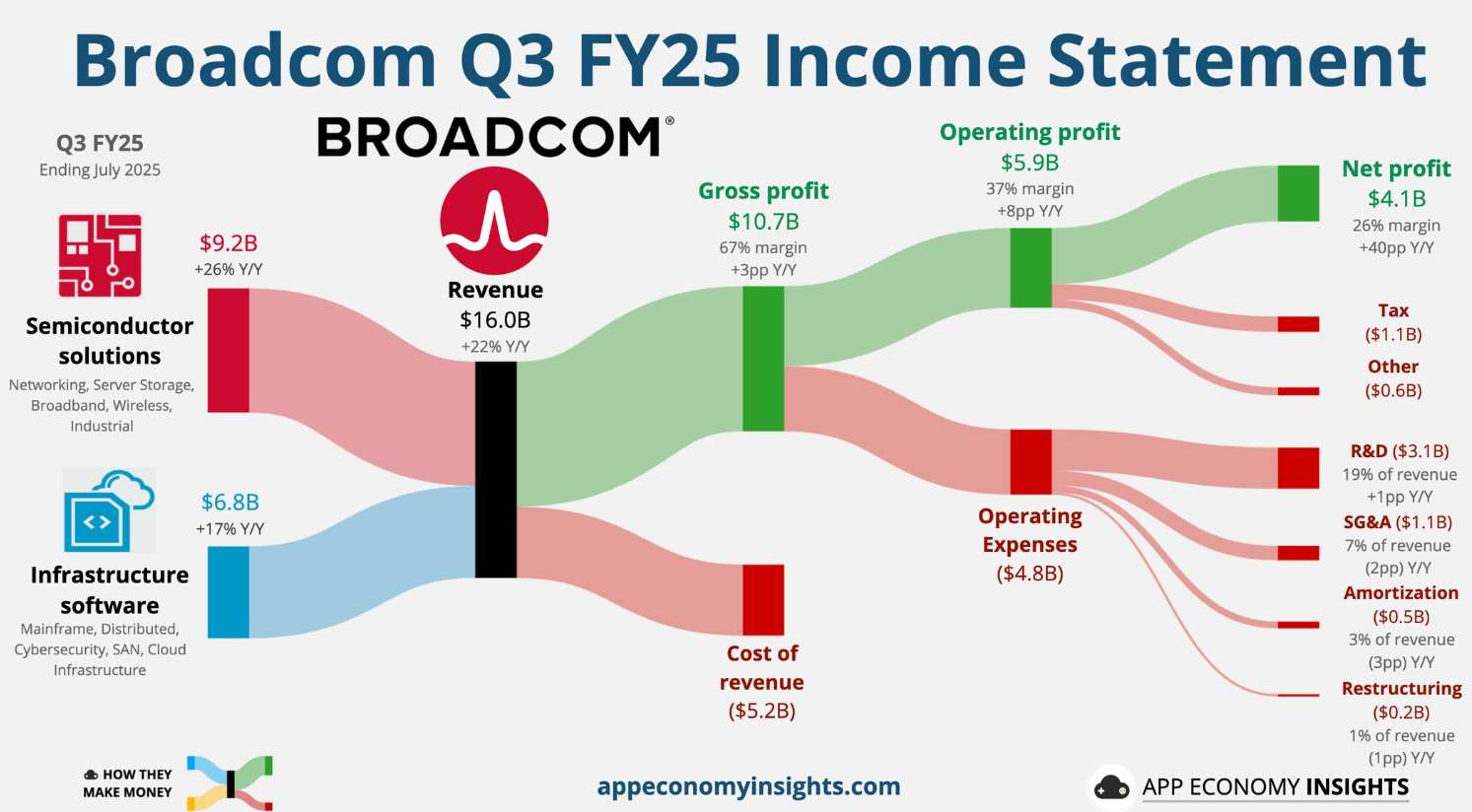
Core Insights - OpenAI is collaborating with Broadcom to develop its first custom AI ASIC chip, which will initially be used internally rather than sold to external clients [1][2][3] - OpenAI's CEO, Sam Altman, indicated plans to invest trillions of dollars in AI infrastructure, including chips and data centers, emphasizing the long-term importance of AI [2] - Broadcom's recent performance and future outlook highlight a surge in demand for AI ASICs, with a significant order from OpenAI exceeding $10 billion [4][7] Company Developments - OpenAI is finalizing the design architecture for its AI ASIC in collaboration with Broadcom, with plans to have it manufactured by TSMC [3] - Broadcom's CEO announced that AI-related revenue growth is expected to be stronger than previously anticipated, with a projected growth rate of 50% to 60% for fiscal year 2026 [4] - Broadcom's semiconductor revenue related to AI infrastructure reached approximately $5.2 billion, a year-over-year increase of 63% [5] Market Trends - The demand for AI ASICs is expected to continue growing, following the trend set by major tech companies like Google and Amazon [3][8] - Broadcom's strong earnings have revitalized investor confidence in the AI sector, leading to a significant increase in its stock price, which has more than doubled since April [5][7] - The AI ASIC market is anticipated to expand rapidly, potentially matching or exceeding the growth of AI GPU demand in the coming years [8][14] Analyst Sentiment - Analysts are optimistic about Broadcom's stock performance, with several firms raising their target prices significantly following the company's strong earnings report [15] - The overall sentiment in the market is bullish regarding AI infrastructure investments, driven by the increasing reliance on custom AI chips [14][15]

博通(AVGO.US) 带着OpenAI百亿美元大单重磅宣告:AI ASIC黄金时代到来
Zhi Tong Cai Jing· 2025-09-05 08:30
Core Insights - OpenAI is collaborating with Broadcom to develop its first custom AI ASIC chip, which will initially be used internally rather than offered to external clients [1][2][3] - OpenAI's CEO, Sam Altman, indicated plans to invest trillions of dollars in AI infrastructure, including chips and data centers, emphasizing the long-term importance of AI [2] - Broadcom's recent performance and outlook highlight a surge in demand for AI ASICs, with expectations of significant revenue growth from AI-related orders [4][5][7] Group 1: OpenAI and ASIC Development - OpenAI plans to finalize the design architecture for its AI ASIC in the coming months, with manufacturing to be handled by TSMC [3] - The move to develop custom AI chips aligns OpenAI with other tech giants like Google and Amazon, who have also created ASICs for handling large AI workloads [3][8] - OpenAI's strategy aims to diversify its AI computing resources and reduce reliance on NVIDIA GPUs [2][3] Group 2: Broadcom's Performance and Market Outlook - Broadcom's CEO announced over $10 billion in AI infrastructure orders from a new large-scale client, identified as OpenAI, leading to an upgraded revenue growth forecast for AI-related sales [4][5] - The company expects AI-related revenue growth to exceed previous estimates, with projections of a 50% to 60% increase for fiscal year 2026 [4][5] - Broadcom's stock has seen significant gains, outperforming NVIDIA, as investor sentiment towards AI infrastructure remains strong [5][7] Group 3: Industry Trends and Competitive Landscape - The demand for AI ASICs is expected to grow significantly, with Broadcom positioned as a leader in this space, benefiting from partnerships with major tech companies [3][8] - The performance of Google's latest TPU chip, developed with Broadcom's involvement, demonstrates the competitive advancements in AI ASIC technology [9] - Analysts predict that the market share for AI ASICs will expand, potentially balancing the dominance currently held by NVIDIA in the AI chip sector [8][14]
博通(AVGO.US)?带着OpenAI百亿美元大单重磅宣告:AI ASIC黄金时代到来
Zhi Tong Cai Jing· 2025-09-05 08:00
Core Viewpoint - OpenAI is collaborating with Broadcom to develop its first custom AI ASIC chip, indicating a significant shift towards tailored AI hardware solutions in the industry [1][2][3] Group 1: OpenAI and AI ASIC Development - OpenAI plans to utilize the custom AI ASIC chip internally before offering it to external clients, highlighting its focus on enhancing its AI infrastructure [1] - CEO Sam Altman stated that OpenAI will invest hundreds of billions into AI infrastructure, including chips and data centers, emphasizing the long-term importance of AI [2] - OpenAI's collaboration with Broadcom and TSMC for chip manufacturing reflects a strategic move to diversify its AI computing resources and reduce reliance on NVIDIA [2][3] Group 2: Broadcom's Performance and Market Outlook - Broadcom's CEO announced over $10 billion in AI infrastructure orders from a new large-scale client, expected to significantly boost AI-related revenue growth [4] - The company anticipates a revenue growth rate of 50% to 60% for AI-related segments, driven by strong demand from super-scale cloud service providers [4][5] - Broadcom's third-quarter revenue reached approximately $16 billion, with AI infrastructure-related semiconductor revenue growing 63% year-over-year [5][6] Group 3: Industry Trends and Competitive Landscape - The demand for AI ASICs is surging, with major tech companies like Google, Amazon, and Meta also developing custom AI chips to handle massive workloads [3][7] - Broadcom is positioned as a key player in the AI ASIC market, benefiting from the increasing investment in AI by major tech firms [7][8] - Analysts predict that the market share for AI ASICs will expand significantly, potentially equalizing with NVIDIA's dominance in AI GPUs, which currently holds a 90% market share [7][8] Group 4: Stock Market Reactions and Future Projections - Following strong earnings and optimistic forecasts, Broadcom's stock has surged, outperforming NVIDIA and boosting investor confidence in the AI sector [5][6][12] - Wall Street analysts have raised their target prices for Broadcom, reflecting a bullish outlook on the company's future performance driven by AI ASIC demand [12]
寒武纪凭什么?
虎嗅APP· 2025-09-01 00:07
Core Viewpoint - The article discusses the rapid rise of AI stocks in China, particularly focusing on the domestic AI chip leader, Cambricon, which has surpassed Kweichow Moutai in stock price, indicating a shift in market sentiment towards AI technology over traditional sectors like liquor [2][3]. Group 1: AI Industry Dynamics - The current A-share market is characterized as a structural bull market driven by asset revaluation, with a focus on the AI industry as the new frontier for investment opportunities [3][4]. - The article highlights the strategic competition between the U.S. and China in AI, emphasizing the U.S. "America First" policy aimed at maintaining its AI dominance through innovation, infrastructure, and geopolitical influence [6][9][10]. Group 2: Cambricon's Market Position - Cambricon's stock surge reflects the initial success of China's AI industry in breaking through U.S. technological barriers, particularly in chip performance and algorithm development [6][11]. - The company has faced challenges due to reduced orders and reliance on government projects, but recent developments suggest a potential turnaround as domestic demand for AI chips increases [20][24]. Group 3: Financial Performance and Valuation - Cambricon reported a remarkable revenue growth of 4347.82% year-on-year in the first half of 2025, achieving a net profit of 1.038 billion yuan, marking a significant recovery from previous losses [31][26]. - Despite impressive financial results, the company's dynamic price-to-earnings ratio stands at 276.48, indicating a potential valuation bubble as investors may need to wait 276 years to recoup their investment based on current earnings [34][36]. - The article suggests that while Cambricon's narrative of replacing NVIDIA is compelling, the high valuation may not be sustainable, and the market's enthusiasm could be overextended [37][36].