
英伟达Omniverse平台

Search documents
百事(PEP.US)打造行业首个智能生态系统,联手英伟达定义“未来工厂”
Zhi Tong Cai Jing· 2026-01-07 06:49
Core Viewpoint - PepsiCo has announced a groundbreaking multi-year partnership with Siemens and NVIDIA at CES, aimed at deploying advanced AI and digital twin technologies to transform its manufacturing and supply chain operations [1] Group 1: Partnership and Technology - The collaboration will start with a pilot factory in the U.S. and will gradually expand globally [1] - The partnership utilizes Siemens' new digital twin builder developed on NVIDIA's Omniverse platform to create high-fidelity 3D simulations for every machine, conveyor belt, pallet path, and operator path [1] - The platform is expected to help PepsiCo design, test, and optimize facility layouts virtually before making physical changes [1] Group 2: Benefits and Outcomes - The industrial metaverse environment combines 2D and 3D digital twin data with real-time operational information, allowing AI agents to identify up to 90% of potential issues in advance [1] - Early deployments have achieved a 20% increase in throughput, nearly 100% design validation, and reduced capital expenditures by 10% to 15% by validating investments in a virtual environment rather than through traditional physical expansion [1] Group 3: Strategic Vision - PepsiCo's CEO for Latin America and Global Strategy and Transformation Officer, Asina Kaniula, stated that the company is deploying its first digital blueprint to reimagine the design, construction, and expansion of its supply chain, marking an industry first [1] - Kaniula emphasized that with a unified, AI-driven digital foundation, PepsiCo is building a future where every factory and warehouse operates as part of a single intelligent ecosystem, capable of responding to and predicting demand [1]


英伟达(NVDA.US)深化韩国AI版图:协助三星、SK、现代建设AI工厂 三星或为其供应HBM4芯片
智通财经网· 2025-10-31 11:50
Core Insights - Nvidia has announced partnerships with Samsung Electronics, SK Group, and Hyundai Motor Group to advance AI factory construction in South Korea, supplying over 260,000 accelerated chips for AI projects [1][6] Group 1: Samsung Electronics - Nvidia will collaborate with Samsung to build a next-generation AI factory, integrating smart computing with chip manufacturing, featuring over 50,000 Nvidia GPUs [2] - Samsung is in close discussions with Nvidia regarding the supply of next-generation high-bandwidth memory chips (HBM4), with plans to launch the new chip next year [2] - The partnership has a 25-year history, with significant milestones including the first commercial HBM chip and the latest HBM3E and HBM4 supply collaboration [2] - Samsung is utilizing Nvidia's Omniverse platform to create digital twin systems for global wafer fabs, enhancing predictive maintenance and operational optimization [3] Group 2: SK Group - Nvidia is partnering with SK Group to establish an AI factory aimed at semiconductor R&D and cloud infrastructure development, with over 50,000 Nvidia GPUs planned for the facility [4] - The first phase of the AI factory is expected to be completed by the end of 2027, providing GPU-as-a-service to SK Hynix and other subsidiaries [4] - SK Telecom plans to deploy an industrial AI cloud platform in Asia, featuring over 2,000 Nvidia RTX PRO 6000 Blackwell GPUs to support semiconductor manufacturing and digital twin applications [4] Group 3: Hyundai Motor Group - Nvidia and Hyundai will collaborate on an AI factory based on the new Blackwell architecture, focusing on autonomous vehicles and smart factory innovations, deploying 50,000 Nvidia Blackwell GPUs [5] - The total investment for advancing physical AI development in South Korea is approximately $3 billion, in response to the government's initiative [5][6] - Hyundai is exploring the use of Nvidia's Omniverse and Cosmos platforms to develop digital twins for automotive factories and robotic systems [6]
兔子蹦迪疯传,5亿观看!全球恐慌:一段AI视频把全人类拉入虚拟现场
Sou Hu Cai Jing· 2025-08-04 04:24
Core Insights - A viral AI-generated video of rabbits "partying" at night has deceived over a billion people globally, raising concerns about the ability to distinguish between real and fake content in the future [2][12] - The video, which appeared on TikTok, was designed to mimic home security footage, making it difficult for viewers to identify its artificial nature [4][5] Group 1: AI Technology and Its Impact - The AI-generated video was convincing due to the inherent blurriness of surveillance footage, which obscured typical indicators of AI manipulation [4] - The static background of the video helped avoid the hyper-realistic effects often associated with AI-generated content, further enhancing its believability [4] - The video gained significant traction on TikTok, amassing 500 million views and sparking widespread panic about the inability to discern reality from AI-generated content [12] Group 2: Public Reaction and Implications - Many viewers, particularly younger generations, expressed shock at being deceived by AI, previously believing such occurrences would not happen to them [5][6] - The incident has led to a broader realization that AI-generated content can mislead anyone, not just the elderly, highlighting a shift in public perception regarding AI's capabilities [5][6] - The situation raises critical questions about the future of media consumption and the potential consequences of believing in fabricated videos [6][12]


兔子蹦迪疯传,5亿观看!全球恐慌:一段AI视频把全人类拉入虚拟现场
猿大侠· 2025-08-04 04:12
Core Viewpoint - The article discusses the increasing difficulty in distinguishing between real and AI-generated content, exemplified by a viral video of rabbits "partying" that fooled millions on TikTok, raising concerns about the future of media authenticity [1][12][23]. Group 1: AI-Generated Content - A viral video featuring rabbits was created using AI technology, deceiving a large audience who believed it to be real [4][12]. - The video's success in misleading viewers is attributed to the low-quality, blurry nature of surveillance footage, which obscures typical indicators of AI generation [8][12]. - The static background of the video helped it avoid common pitfalls of AI-generated content, making it appear more realistic [8]. Group 2: Public Reaction and Implications - The incident has led to a broader realization among viewers, including younger generations, that they too can be deceived by AI-generated media [12][15]. - The video garnered significant attention, with over 500 million views on TikTok, highlighting a global concern about the inability to differentiate between reality and AI fabrication [23]. - The article raises questions about the future of media consumption and the potential consequences of believing in fabricated content, suggesting a need for societal adaptation to a world where "seeing is not necessarily believing" [23][24].

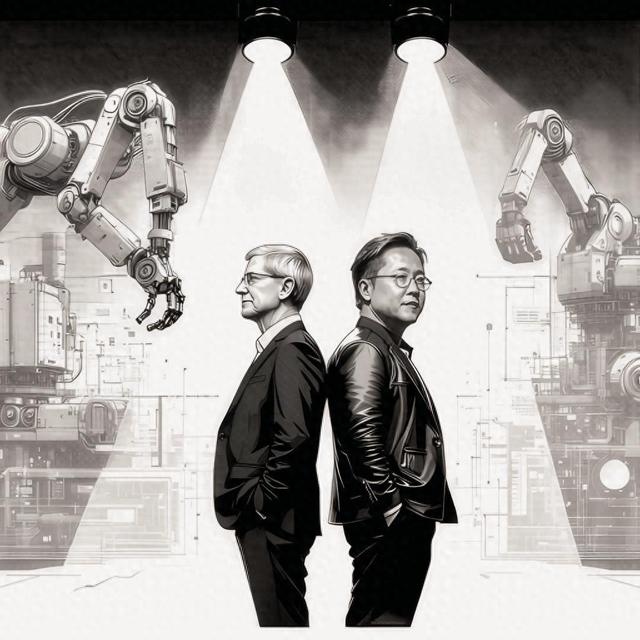
【环球热评局——链博系列之二】链博会聚光灯下,从库克到黄仁勋的接力
Huan Qiu Wang· 2025-07-16 00:38
Group 1 - Nvidia's market capitalization surpassed $4 trillion for the first time on July 9, 2023, highlighting its significant growth in the AI infrastructure sector [2] - CEO Jensen Huang's frequent appearances at major technology conferences indicate Nvidia's strategic positioning as a key player in the AI era, moving beyond its traditional chip manufacturing identity [2][3] - Huang emphasized the explosive growth potential of the AI industry, comparing it to the evolution of the chip industry from $300 million in 1993 to a trillion-dollar data center market [2] Group 2 - China is recognized as the second-largest data center market globally, contributing 75% of global consumer electronics manufacturing and 40% of AI paper production [3][4] - Huang stated that losing access to the Chinese market would be detrimental, as there is no alternative to China's unique position in the global tech landscape [4] - Nvidia's collaborations with leading Chinese companies in the automotive sector, such as BYD and Xpeng Motors, showcase its commitment to integrating Chinese innovation into global technology standards [4]
空间智能:AI从虚拟到现实
2025-03-23 15:02
Summary of Conference Call Records Industry Overview - The conference call discusses the **space intelligence** industry, focusing on advancements in AI technology and its applications in industrial design and home CAD software. [1][2][3] Key Points and Arguments 1. NVIDIA Omniverse Platform - The **NVIDIA Omniverse platform** utilizes ray tracing technology and physical simulation to enhance manufacturing efficiency for high-cost industrial products like airplanes, rockets, and cars. It provides real-time simulation and collaborative design capabilities. [1][4] 2. Domestic Simulation Companies - Companies like **Sotun Technology** are transitioning from graphics to simulation through large models and CAX integration, aiming to meet industrial process needs and improve production efficiency. The main development logic includes domestic substitution, mergers, and physical AI. [1][6][8] 3. Market Growth in Home CAD Software - **Qunke Technology's** CoolJiaLe leads the home CAD software market, with a market size of **3 billion yuan** in 2023 and a compound annual growth rate (CAGR) of **17%** from 2019 to 2023. AI technology is lowering design barriers and addressing non-standard design challenges. [1][9] 4. AI Empowerment in Home Design - AI technology is continuously iterating home CAD software, enhancing rendering capabilities and efficiency. Qunke Technology's MoniCore platform deploys key tasks on GPU clusters for realistic rendering. [10] 5. Robotics Training and AIGC - Qunke Technology's **spatialverse platform** provides a digital environment for robots, enabling complete closed-loop training from cognitive understanding to action interaction. This positions the company favorably in the robotics training and AIGC sectors. [11] 6. Industry Collaborations - **Juran Home** is integrating NVIDIA's AI Universe platform and Huawei's Harmony ecosystem to enhance 3D digital asset interoperability, benefiting from the AI-driven transformation in the home industry. [3][12] 7. Future of Industrial CAD - Industrial CAD is expected to experience rapid development by **2025**, becoming a crucial part of space intelligence through CAX integration, which will enhance design efficiency and reshape industrial processes. [3][14][21] 8. Challenges in 2D to 3D Conversion - Multi-modal large models face challenges in converting 2D images to 3D due to the lack of precise spatial attributes. Solutions involve using specialized tokens for coordinate conversion and generating numerous renderings for accurate outputs. [18] 9. International Progress in AI and CAD - Overseas companies like Autodesk and Dassault are making significant strides in integrating AI with CAD, enhancing model generation and real-time data processing capabilities. [19] 10. Domestic Software Companies' Potential - Domestic innovative software companies are expected to achieve substantial growth, with projected revenues reaching **1 billion yuan** by 2025 and a target market value between **15 billion to 20 billion yuan**. [20] Other Important Insights - The integration of space intelligence with CAD is anticipated to enhance design efficiency and profitability, potentially becoming a competitive advantage for industrial enterprises. [15][16] - The application of space intelligence in the construction industry is evolving, with significant improvements in design, construction, and operation management through AI and digital twin technologies. [23][24][26]