苹果智能(Apple Intelligence)

Search documents
外企头条丨谷歌推出“个人智能”功能
Xin Lang Cai Jing· 2026-01-17 14:38
Core Insights - Google has announced the user testing of its new AI tool "Personal Intelligence," which integrates personal information from various applications like Gmail and Google Photos to provide personalized responses through the Gemini chatbot [1] - The feature aims to enhance Gemini's reasoning capabilities, allowing it to autonomously understand context and provide valuable insights without explicit user instructions [1] - This move is seen as a strategy to compete with Apple's Apple Intelligence, as both companies are intensifying their efforts in the generative AI space [1] Company Developments - Josh Woodward, Vice President of Google Labs and head of the Gemini application, highlighted that the new feature emphasizes Gemini's ability to perform reasoning analysis based on user data [1] - The testing version of the feature is not yet fully free of vulnerabilities, particularly in handling time-sensitive information or details, and it avoids making subjective inferences on sensitive topics like health [1] - Apple has selected Google to provide technical support for some of its AI functionalities, indicating a collaborative aspect in the competitive landscape [1] Industry Trends - The AI industry is moving towards a tighter integration of user data with AI services, aiming to create deeply personalized intelligent assistants with contextual understanding capabilities [2] - This trend is recognized as a core evolution in the competitive landscape of the AI sector, highlighting the importance of user data in enhancing AI functionalities [2]

如果AI泡沫破灭,美股七巨头谁能幸存?
财联社· 2025-11-23 06:36
Core Viewpoint - The article discusses the ongoing AI arms race among major tech companies, particularly the "Big Seven" in the U.S. stock market, highlighting the significant capital expenditures being made to build AI infrastructure and the associated market concerns regarding the sustainability of these investments [1][2]. Group 1: Market Performance and Reactions - The recent sell-off in the tech sector has heavily impacted companies like Meta, while Alphabet and Apple have shown resilience, with their stock prices increasing by 6.6% and 0.4% respectively in the past month [5][4]. - The Nasdaq Composite Index has dropped by 6.1% since early November, reflecting growing investor concerns over excessive AI spending [5]. Group 2: Company Strategies and Market Sentiment - Alphabet's AI product Gemini has gained traction, particularly with the recent launches of Gemini 3 and Nano Banana Pro, contributing to positive market sentiment [5][7]. - Apple's conservative capital expenditure strategy has been validated as a means to mitigate concerns over excessive spending, allowing it to avoid the pitfalls faced by other companies [6][5]. Group 3: Competitive Landscape and Future Outlook - Google has successfully alleviated investor fears regarding AI's impact on its search business, positioning Gemini as a strong competitor to ChatGPT [7]. - Analysts suggest that if the AI bubble bursts, larger companies like Google and Apple may emerge stronger, benefiting from reduced competition and lower spending demands [8][9]. Group 4: Risks and Industry Dynamics - The article highlights the potential risks for smaller players in the AI space, as a downturn could lead to significant reductions in orders for hardware suppliers like Nvidia [11]. - The cyclical nature of investments in semiconductors and AI infrastructure is noted, indicating that these investments carry higher risks [12].


AI泡沫破灭谁能幸存?七巨头中Alphabet(GOOGL.US)和苹果(AAPL.US)或“笑到最后”
智通财经网· 2025-11-23 03:10
Core Insights - Major tech companies, led by the "Big Seven" in the US stock market, are engaged in an intense AI arms race, significantly increasing capital expenditures to build AI infrastructure and seize opportunities in the industrial revolution [1][2] - Despite concerns over an AI bubble, two companies, Alphabet and Apple, have shown resilience, with their stock prices increasing during a broader tech sell-off [1][2] Group 1: Company Performance - Alphabet and Apple are the only two companies among the "Big Seven" that have seen stock price increases of 6.6% and 0.4% respectively in the past month, indicating their potential to weather an AI bubble burst [2][3] - Google's AI product Gemini has gained traction, particularly with the recent launches of Gemini 3 and Nano Banana Pro, contributing to its stock performance [2][4] - Apple's conservative capital spending strategy has been validated as a means to mitigate concerns over excessive AI expenditures [2][3] Group 2: Market Dynamics - The Nasdaq Composite Index has dropped 6.1% since early November, reflecting widespread investor anxiety over excessive AI spending [2] - Concerns about AI-related capital expenditures have intensified following the third-quarter earnings season, despite Nvidia's strong financial results [2][4] - The market's reaction to Alphabet's increased AI spending forecast for 2025, raised from $85 billion to between $91 billion and $93 billion, suggests investor confidence in its AI performance [3][4] Group 3: Competitive Landscape - Google has successfully alleviated investor fears regarding AI's impact on its search business, positioning Gemini as a strong competitor to ChatGPT [4][5] - In contrast, Meta's stock has declined by 8.3% following its CEO's announcement to accelerate AI investments, raising concerns about the company's lack of a clear AI strategy [4][5] - Analysts suggest that large-scale cloud service providers like Google are better prepared to navigate potential downturns in the AI sector [4][5] Group 4: Future Outlook - If the AI bubble bursts, smaller players may be eliminated, while larger companies like Google and Apple could benefit from reduced competition and lower spending demands [5][6] - The influx of capital into AI infrastructure could dwindle if returns on investment do not materialize, leading to a significant drop in the value of data center assets [5][6] - The current sell-off hints at potential losers, particularly hardware suppliers like Nvidia, who may face reduced orders if AI demand declines [6]

股市面面观丨苹果市值一夜增万亿元 苹果概念股强势拉升
Xin Hua Cai Jing· 2025-10-21 06:33
Core Insights - Apple's stock price surged by 3.9% to $262.24, reaching a historical high since December 2024, with a market capitalization increase of $147.5 billion, totaling $3.89 trillion, making it the second-largest company in the U.S. by market cap, following Nvidia [1] - Strong sales of the iPhone 17 series in both China and the U.S. have led to increased optimism in the market, with a 14% year-over-year sales growth compared to the iPhone 16 series [1][4] - Analysts express confidence in Apple's performance in China, indicating that the iPhone 17 series could drive steady revenue growth for the company [4] Sales Performance - The iPhone 17 series has shown robust sales momentum, particularly the standard version, which is noted for its attractive price-to-performance ratio [4] - Apple's annual shipment forecast for the iPhone 17 series has been raised from 88 million to 94 million units since its launch on September 10 [5] - The iPhone 17 series dominated the top three spots in a recent sales ranking during the "Double 11" shopping festival in China [2] Market Sentiment - The positive market sentiment has led to a rebound in A-share Apple concept stocks, with several companies experiencing significant gains [1] - Loop Capital upgraded its rating on Apple from "hold" to "buy," raising the target price to $315, indicating a potential upside of about 20% from the current price [5] Valuation Concerns - Some analysts question whether the current enthusiasm for the iPhone 17 series can sustain Apple's high valuation, as the company's price-to-earnings ratio exceeds 32, significantly higher than the 10-year average of 22 [6] - Among 33 analysts tracking Apple, 20 recommend buying, while 11 suggest holding, indicating a mixed outlook on the stock [6] Challenges Ahead - Apple faces challenges in integrating artificial intelligence into its products, with delays in the AI version of Siri and departures of key AI executives raising concerns about its competitive position in the Chinese market [11] - The company aims to enhance its AI capabilities across applications, but significant technical breakthroughs are required to achieve this goal [11]

库克已在中国近一周!“正推动苹果智能进入中国”
Di Yi Cai Jing Zi Xun· 2025-10-18 08:39
Core Insights - Apple's CEO Tim Cook is actively promoting the integration of Apple Intelligence into the Chinese market, focusing on AI capabilities across all applications [2] - The visit to China includes discussions on health features of Apple Watch and the promotion of eSIM technology in iPhone Air [2] Group 1: Apple Intelligence in China - Apple is working to integrate AI functionalities into its operating system, aiming for a seamless user experience across applications [2] - The push for Apple Intelligence's launch in China is a primary objective of Cook's visit, alongside collaboration with local carriers on eSIM technology [2] Group 2: Challenges in AI Development - Apple faces significant challenges in achieving its AI goals, particularly with Siri needing access to personal user data for improved functionality [3] - Recent executive departures from Apple's AI division, including key personnel involved in AI search development, complicate Apple's efforts to compete with companies like OpenAI, Meta, and Google [4] Group 3: Competitive Landscape - The delay in launching Apple Intelligence in China may place Apple at a competitive disadvantage, as local smartphone manufacturers are rapidly integrating AI features [5]

苹果公司CEO库克:企业没有部署AI,就会丧失竞争力
Sou Hu Cai Jing· 2025-10-18 06:13
Core Insights - Apple's CEO Tim Cook emphasized that AI is not a distant concept but a foundational technology deeply integrated into the company's operations, enhancing human creativity through Apple Intelligence [2][4] - The company maintains a user-centric approach in its AI strategy, focusing on practical applications that improve user lives, such as health monitoring and emergency services [2][5] - Cook highlighted the rapid adoption and creativity of the Chinese developer community in integrating AI into workflows, showcasing successful local innovations [2][6] AI Integration in Apple - AI is utilized across all functional departments within Apple, from code assistance to optimizing manufacturing processes and large-scale sales training [2][5] - The company has developed tools that empower developers to leverage AI effectively, enhancing the capabilities of various applications [5][14] - Cook stated that without AI deployment, companies risk losing competitiveness and missing out on revenue growth opportunities [14] AI's Impact on Health and Safety - Cook shared a case where an Apple Watch detected abnormal health metrics, leading to timely medical intervention for a user, illustrating AI's potential to save lives [8][9] - The integration of AI in health technology can significantly improve life quality and longevity, enabling users to monitor their health without frequent hospital visits [9] AI in Education - Cook discussed the role of AI in education, emphasizing its ability to assist students in formulating constructive questions and solutions, which is crucial for critical thinking [10][12] - The educational approach at Tsinghua University focuses on developing students' abilities to ask meaningful questions and shape values, particularly in the context of AI usage [12][13] Developer Community in China - The speed at which Chinese developers adopt AI technologies is remarkable, with a significant percentage actively participating in the developer community [6][7] - Cook noted that the creativity and innovation of young Chinese developers are impressive, contributing to rapid advancements in AI applications [7][12]
科技巨擘财报连环炸场! 11万亿美元“四大超级巨头”能否续写标普创新高神话?
智通财经网· 2025-07-28 13:17
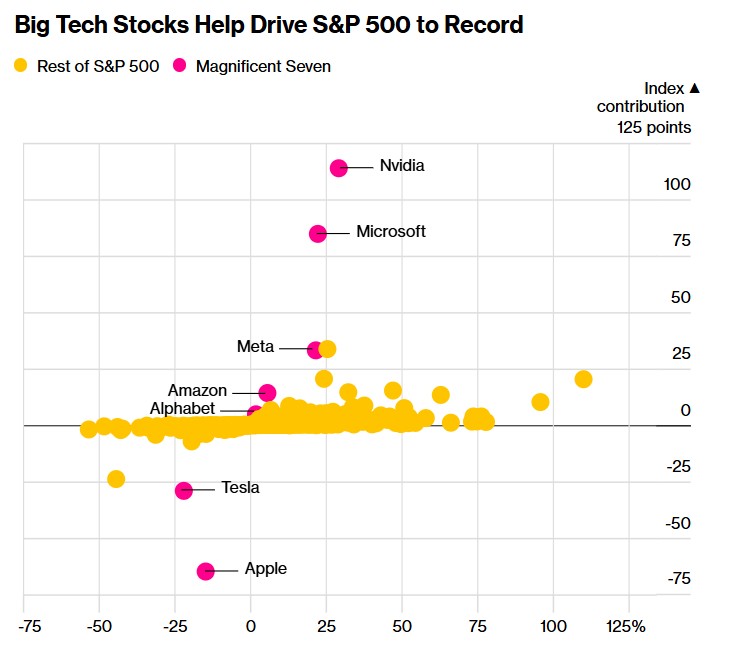
Core Viewpoint - The upcoming earnings reports from major tech giants Microsoft, Meta Platforms, Apple, and Amazon are crucial for maintaining the upward momentum of the S&P 500 and Nasdaq 100 indices, which have recently reached historical highs. These companies collectively represent nearly 20% of the indices' weight, and their performance will provide key insights into the health of core business areas such as consumer electronics, AI applications, cloud computing, and e-commerce [1][3][4]. Group 1: Performance of Major Tech Giants - The "Magnificent Seven" tech giants, including Apple, Microsoft, Google, Tesla, Nvidia, Amazon, and Meta Platforms, are the primary drivers behind the recent highs in the S&P 500 index, accounting for approximately 35% of its weight [2][3]. - Since the beginning of 2023, these tech giants have been the strongest engines driving the U.S. stock market, leveraging their market advantages in AI to generate robust revenues and maintain strong fundamentals [2][3]. - The earnings reports from these companies must significantly exceed expectations to sustain the market's upward trend, as merely meeting expectations has proven insufficient for driving stock prices higher [3][4]. Group 2: Market Expectations and Valuations - The earnings growth rate for the "Magnificent Seven" in Q2 was 16%, which is below the 19% expected prior to the announcement of tariffs by the Trump administration [9][13]. - The overall expected annual earnings growth for the S&P 500 is 4.5%, significantly lower than the 7.5% predicted earlier in the year, indicating a downward adjustment in earnings expectations [13]. - High valuations and optimistic earnings forecasts place significant pressure on these tech companies to deliver strong performance and positive outlooks for the upcoming quarters [13][18]. Group 3: AI Investment and Market Dynamics - The demand for AI computing power is surging, with major tech companies expected to invest a total of $317 billion in capital expenditures this fiscal year, a 35% increase from the already strong spending in 2024 [17]. - Companies like Nvidia, which dominate the AI computing power sector, are expected to continue benefiting from this trend, with their stock prices likely to reflect ongoing bullish market conditions [16][17]. - There is a notable divergence in stock performance among the "Magnificent Seven," with companies like Meta, Microsoft, and Nvidia benefiting significantly from AI, while others like Apple, Tesla, and Amazon struggle to keep pace with market expectations [14][15].



特朗普威胁三星:25%
Guan Cha Zhe Wang· 2025-05-24 03:14
Core Viewpoint - The U.S. President Trump has threatened to impose a 25% tariff on iPhones produced outside the U.S., specifically targeting Apple and similar companies like Samsung, urging Apple to manufacture iPhones domestically instead of in countries like India or China [1][4]. Group 1: Tariff Threat and Market Reaction - Trump stated that if Apple does not produce iPhones in the U.S., it must pay a minimum of 25% in tariffs [1]. - Following the announcement, European stock markets declined, and Apple's stock fell by 3.02% [1]. - Approximately 80% to 90% of the over 60 million iPhones sold annually in the U.S. are manufactured in China, with the remainder produced in India and Vietnam [1]. Group 2: Apple's Production Strategy - Apple plans to shift most of its iPhone production to India starting in the second quarter of this year as part of its strategy to navigate U.S.-China tensions [2]. - Trump expressed discontent with Apple's decision to expand production in India, emphasizing the need for Apple to focus on U.S. manufacturing instead [4]. - Despite Trump's pressure, Apple has only a minimal production presence in the U.S., primarily for the Mac Pro, and 90% of its flagship iPhone models are still assembled in China [5]. Group 3: Investment and Manufacturing Costs - Apple announced a $500 billion investment plan in the U.S., focusing on AI, advanced manufacturing, and domestic supply chain development [5]. - Experts warn that relocating iPhone assembly to the U.S. would be impractical and significantly increase costs, estimating that U.S.-made iPhones could cost at least three times more [5].

钛媒体科股早知道:AI需求为行业复苏提供新支撑,国际机构已连续第四年上调该领域全球增长预期
Tai Mei Ti A P P· 2025-05-22 00:34
Group 1 - Apple is preparing to allow third-party developers to use its AI models to stimulate new application development, with plans to announce this at the upcoming Worldwide Developers Conference on June 9 [2] - Tencent Cloud and WeRide have signed a strategic cooperation agreement to advance the commercial operation of L4-level autonomous Robotaxi services and explore integration with WeChat and Tencent Maps [3] - The demand for AI is providing new support for industry recovery, with international institutions raising global growth expectations for the AI sector for the fourth consecutive year [4][5] Group 2 - The construction of water infrastructure is accelerating, with significant progress reported in various major water conservancy projects across the country [6] - In 2024, China's investment in water conservancy construction is expected to reach a historical high, with 41 major national water network projects initiated and a total investment of 1.3529 trillion yuan, reflecting a year-on-year growth of 12.8% [6]
特朗普点名库克:忍了苹果在中国很多年,你居然又往印度跑?!
Guan Cha Zhe Wang· 2025-05-16 01:45
Group 1 - Apple is accelerating the transfer of its iPhone production for the U.S. market to India, aiming to reduce reliance on the Chinese supply chain, with plans to complete this by 2026 [5] - Trump publicly criticized Apple for its plans to expand production in India, urging the company to focus on manufacturing in the U.S. instead [1][3] - Currently, 90% of Apple's flagship iPhone models are still assembled in China, and the company has minimal production in the U.S. [3] Group 2 - Trump's administration has previously pressured Apple to move iPhone production back to the U.S., with industry experts warning that such a move would significantly increase costs [3][4] - Apple announced a $500 billion investment plan in the U.S., focusing on artificial intelligence and advanced manufacturing, but has not disclosed specific details regarding increased production in the U.S. [3] - The U.S. and India are engaged in complex trade negotiations, with India recently proposing retaliatory tariffs against U.S. goods, indicating a shift in its trade stance [8][9]