葵花

Search documents
蓝莓飘香日子甜
Xin Lang Cai Jing· 2026-02-24 20:22
Group 1 - The core idea of the article highlights the successful implementation of modern agricultural technology in the Monghai Town Natural Power Modern Agricultural Technology Demonstration Park, which utilizes patented technologies for nutrient conversion and precision irrigation [1] - The demonstration park covers an area of approximately 1,000 acres and has established 8 blueberry greenhouses with a total area of 36 acres, leading to a significant yield increase [1] - The expected yield per blueberry plant is between 3.5 to 4 kilograms, with each greenhouse projected to produce around 6,000 kilograms, resulting in an estimated annual output value of approximately 500 million yuan for the 8 greenhouses [1] Group 2 - The local farmers, like Li Wanyun, have adopted a "renting + planting + working" model to achieve diversified income, with thousands of farmers benefiting from this approach [2] - The region combines high-standard farmland construction with specialty planting, exploring a rural revitalization path that promotes employment and income growth [2]
新农人的年终盘点
Xin Lang Cai Jing· 2026-02-08 19:33
Group 1: Livestock Farming - The intelligent livestock farming base in Linhe District, Bayannur City, showcases healthy and well-fed sheep, benefiting from advanced feeding systems that reduce labor costs and ensure scientific feeding practices [1] - The price of meat sheep has risen to 29 yuan per kilogram, with an additional government subsidy of 60 yuan per sheep sold, highlighting the significant benefits of large-scale farming [1] - The farmer, with 23 years of experience, has established a complete industrial chain of breeding, raising, and selling sheep, with a stable annual production of 700 lambs from 500 breeding ewes [1] Group 2: Agricultural Policies and Practices - The government has increased support for agriculture, providing various subsidies that have encouraged new farmers to adopt innovative practices and expand their operations [2] - A local farmer has successfully cultivated a diverse range of crops on 5,000 acres, including glutinous corn, feed corn, and sunflowers, which enhances land utilization and mitigates market risks [2] - The focus is shifting towards high-quality and high-value crop production, with plans to expand the planting area of staple crops and develop vegetable production for Hong Kong [2]
多元特色产业鼓起孪井滩农民“钱袋子”
Xin Lang Cai Jing· 2026-02-01 19:21
Core Insights - The article highlights the successful agricultural practices in the Alxa League's Luanjing Tan Ecological Migration Demonstration Zone, focusing on food security, industrial efficiency, and rural revitalization [1][2][3] Group 1: Agricultural Production - The demonstration zone achieved a stable grain planting area of over 41,000 acres, with a total grain output surpassing 19 million kilograms and an average yield of 1,144.64 kilograms per acre, marking a new high in production [1] - Farmers are utilizing advanced agricultural techniques, including the promotion of salt-tolerant and lodging-resistant crop varieties, which has led to the establishment of a 10,000-acre high-yield grain demonstration area [2] Group 2: Technological Integration - The integration of technology in agriculture is emphasized, with the adoption of the BeiDou navigation automatic driving system allowing for centimeter-level precision in farming operations, contributing to a mechanization rate approaching 90% [2] - Soil testing and formula fertilization techniques have a coverage rate exceeding 90%, combined with biological pest control methods, effectively reducing pest damage and enhancing crop quality [2] Group 3: Diversification and Economic Growth - The demonstration zone is developing a "grain-economy-feed" triad planting system, guiding farmers to cultivate economic crops such as sunflowers and melons on 14,400 acres, achieving a dual win in food production and economic returns [2] - Livestock farming is also thriving, with farmers like Zhang Yinliang successfully integrating breeding and feeding practices, leading to a scale of 40 cattle and 120 sheep, thus enhancing income opportunities [3]
内蒙古巴彦淖尔:精准施策唤醒盐碱地
Zhong Guo Zi Ran Zi Yuan Bao· 2025-12-03 03:40
Core Viewpoint - The article highlights the successful transformation of saline-alkali land in the village of Shidaogou, Inner Mongolia, into productive sunflower fields, showcasing innovative agricultural practices and land management strategies [1] Group 1: Agricultural Transformation - Over 10,000 acres of sunflowers have been harvested in Shidaogou village, which previously struggled with saline-alkali soil conditions [1] - The village has a total of 12,200 acres of arable land, with 85% classified as moderately to severely saline-alkali [1] - Improved soil conditions have led to a more than 20% increase in sunflower yield per acre compared to previous outputs [1] Group 2: Land Management Strategies - The local natural resources bureau is promoting high-standard farmland construction to enhance land consolidation and infrastructure [1] - Techniques such as "covering with film and using straw" and subsurface drainage for salt removal are being implemented for saline-alkali land remediation [1] - A profit-sharing mechanism is being explored to incentivize investment in saline-alkali land rehabilitation by rural collectives, enterprises, and individuals [1]
甘肃民勤:科技赋能沙漠寒旱农业
Zhong Guo Xin Wen Wang· 2025-11-14 06:40
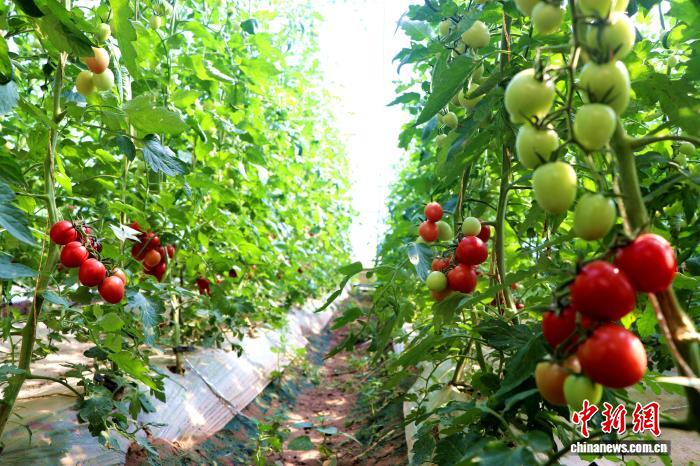
Core Viewpoint - Gansu's Minqin County is leveraging technology to transform its arid desert agriculture into a sustainable and productive industry, focusing on high-quality produce and innovative agricultural practices [1][4][7]. Group 1: Agricultural Innovation - Minqin County is utilizing organic fertilizers and soil improvement techniques to enhance the quality of its agricultural products, such as the "desert ruby" tomatoes, which are in high demand due to their superior quality [1][4]. - The county has developed a multifunctional protective system that integrates windbreaks, soil conservation, and ecological restoration, significantly improving agricultural production conditions [4][7]. Group 2: Technological Empowerment - The local industry is adopting advanced technologies like automated production lines and low-temperature purification processes to enhance the quality of products such as fennel, which is becoming a key driver of local income [2][6]. - A comprehensive technical system has been established, combining information, knowledge, and smart equipment, to support the modernization of agriculture and improve production efficiency [4][5]. Group 3: Sustainable Development - Minqin County is focusing on ecological governance and sustainable development, aiming to combat desertification and ensure long-term agricultural viability [4][5]. - The county's agricultural strategy includes the development of a complete industrial chain from production to processing, ensuring the sustainable growth of its cold-resistant vegetable industry [7]. Group 4: Brand Building and Market Strategy - The county is enhancing the reputation of its agricultural products through systematic brand development and diversified promotional strategies, aiming to boost the recognition and quality of "Minqin-produced" goods [5]. - A strategic approach is being implemented to optimize the agricultural layout based on regional advantages, focusing on high-value crops and ecological practices [5][7].

内蒙古:用好土地建好粮仓
Jing Ji Ri Bao· 2025-11-04 22:21
Core Insights - Inner Mongolia has focused on becoming a key national agricultural and livestock product production base, achieving a grain output of 82.01 billion jin in 2024, ranking sixth in the country, with expectations for another bumper harvest this year [1][2] Group 1: Agricultural Infrastructure and Technology - The region has implemented high-standard farmland construction as a foundational project for agricultural development, with Baotou City completing 1.6303 million acres of high-standard farmland, aiming for a total of 7.3939 million acres by 2027 [2][3] - The introduction of technologies such as Beidou navigation and integrated water and fertilizer systems has significantly improved agricultural production efficiency, with individual farmers managing up to 1,000 acres and achieving notable yield increases [2][3] Group 2: Saline-Alkali Land Management - Inner Mongolia is actively addressing the challenges of saline-alkali land through targeted improvement strategies, with 240 million acres of saline-alkali land upgraded during the 14th Five-Year Plan period [3][4] - The transformation of saline-alkali land has led to increased crop yields, with reports of sunflower yields rising from 200 jin to an expected 350 jin per acre after improvements [4][5] Group 3: Economic Impact and Community Benefits - The shift to high-standard farmland and the introduction of cooperative farming models have resulted in increased incomes for local farmers, with reports of collective incomes reaching 100,000 yuan in certain villages [2][3] - The comprehensive utilization of saline-alkali land has not only improved ecological conditions but also provided new income streams for local herders through the cultivation of specialized forage crops [3][4]
筑牢北疆万里绿色长城
Jing Ji Ri Bao· 2025-10-27 22:37
Group 1 - The core viewpoint emphasizes the importance of high-quality development in border ethnic areas for the overall strategy of Chinese modernization, highlighting ecological protection and sustainable development [1] - The Baotou region is focusing on integrated ecological protection and management, achieving a historical shift from desertification to greening, and utilizing water resources effectively [1][2] - The agricultural and livestock industry in Baotou has seen significant growth, with the total output value of the agricultural industry chain exceeding 90 billion yuan, and stable grain production at over 5.8 billion jin [2] Group 2 - Promoting national unity and progress is a key focus, with initiatives aimed at strengthening the sense of community among various ethnic groups and improving infrastructure and public services [3] - The region is leveraging its unique resource advantages to develop characteristic industries, aiming to stimulate economic vitality and improve living standards [2][3] - The future development prospects for border ethnic areas are promising, with strategies like the Western Development and East-West cooperation providing new momentum for growth [4]
内蒙古着力推动农牧业转型发展(奋勇争先,决战决胜“十四五”)
Ren Min Ri Bao· 2025-06-29 22:12
Core Insights - Inner Mongolia is actively promoting the transformation and development of agriculture and animal husbandry, focusing on ecological agriculture and deep processing of agricultural products to enhance the quality and efficiency of the industry [2][6]. Group 1: Agricultural Production Optimization - The introduction of intercropping, such as planting sunflowers between rows of wheat, has led to a 30% increase in net profit per mu [2]. - In 2024, grain production in Inner Mongolia is expected to reach 82.01 billion jin, with an average yield increase of 24.2 jin per mu [2]. Group 2: Structural Improvement - The region is optimizing its production structure by developing 18 advantageous industrial belts for crops and livestock, including corn, wheat, and beef [4]. - The focus is on selecting high-quality varieties and efficient planting models to ensure both yield and income for farmers [4]. Group 3: Technological Empowerment - The contribution rate of agricultural technology progress in Inner Mongolia has reached 62.4%, with over 90% mechanization in crop farming [5]. - Smart farming technologies are being adopted, allowing for automated feeding and management of livestock, significantly improving efficiency [5]. Group 4: Deep Processing and Value Chain Extension - The development of deep processing in agriculture aims to extend the industrial chain, with a target of achieving a processing conversion rate of over 78% for major agricultural products in 2023 [6]. - The agricultural industry in Inner Mongolia is projected to exceed 700 billion yuan in key industry chain output value by 2024 [6].
为中国饭碗装入更多“河套粮” ——内蒙古巴彦淖尔建设黄河流域现代高效农业集聚区
Jing Ji Ri Bao· 2025-06-05 22:08
Core Insights - The article highlights the agricultural advancements and modernization efforts in Bayannur City, Inner Mongolia, emphasizing its role as a significant grain and livestock production base in China [1][2][9]. Group 1: Agricultural Development - Bayannur City is recognized as a "granary" and "vegetable basket" due to its fertile land and favorable climate, with over 13 million acres of arable land [1][2]. - The city is implementing a high-standard farmland construction project, aiming to enhance agricultural efficiency and sustainability over the next 3 to 5 years [2]. - In 2024, the grain output in Bayannur is projected to reach 5.87 billion jin, with significant increases in wheat and sunflower production [4]. Group 2: Modern Agricultural Practices - The introduction of advanced irrigation systems, such as drip irrigation, has led to water savings of 30% to 50% compared to traditional methods [3]. - The use of digital technology in agriculture, including a fully automated irrigation system, allows farmers to manage resources efficiently through mobile applications [3]. - The establishment of agricultural cooperatives under a "company + village party branch + farmers" model is enhancing productivity and profitability for local farmers [3]. Group 3: Seed and Crop Innovation - Bayannur City is focusing on seed industry revitalization, emphasizing the breeding of local specialty varieties and collaboration with research institutions [5][8]. - The "Bamai 13" wheat variety has set new records for yield and quality, showcasing the success of local breeding programs [6][7]. - The city plans to cultivate over 10 new crop varieties annually, reinforcing its position as a key seed production base in western Inner Mongolia [8]. Group 4: Livestock Industry - The meat sheep industry is a leading sector in Bayannur, with over 23 million sheep and an annual meat production exceeding 300,000 tons [9][10]. - The city is recognized as a major hub for sheep production and processing, with initiatives to enhance the value of sheep by-products [9][10]. - In 2024, livestock inventory is expected to reach approximately 11.77 million heads, with a slight increase in meat and milk production [10]. Group 5: Future Prospects - Bayannur City aims to transform traditional agriculture into a modern, efficient system, focusing on deep processing of agricultural products and sustainable practices [11]. - The city is committed to developing 11 key industrial chains, including wheat, sheep, and sunflower, to contribute to national food security [11].
国网山西电力“链”动农业增效新希望
Xin Hua Cai Jing· 2025-05-23 09:12
Group 1 - The State Grid Shanxi Electric Power Company is actively supporting the agricultural industry in Shanxi Province by ensuring reliable electricity supply for cold chain storage, which helps farmers extend the shelf life of their products and improve their income by 30%-40% [1] - In Yuncheng, the establishment of cold storage facilities has become essential due to the competitive pricing of seasonal fruits, with over 600 cold chain fruit warehouses built in Linyi County alone [1] - The company has implemented initiatives such as the "Taihang Dawn Communist Party Service Team" and "Electricity Little Farmer" service team to ensure the safety and reliability of power supply for cold storage operations [1] Group 2 - In Dajiao Village, the construction of a strawberry seedling base has been facilitated by the State Grid Yuncheng Jiangxian Power Supply Company, which installed a 200 kVA transformer in just four days to meet the electricity needs of the new facility [2] - The seedling base is expected to produce over 300,000 seedlings annually, generating direct economic benefits of over 70,000 yuan, enhancing the village's price competitiveness and risk resilience [2] - The Dazhong Huatingcheng Agricultural Development Company in Datong has established a fully automated production line for processing daylilies, requiring significant electricity support from the local power supply company [2] Group 3 - The Dazhong Huatingcheng Agricultural Development Company has contributed to local employment and income generation, distributing 500,000 yuan in dividends to two villages and providing stable income for over 600 local farmers [3] - The Hongfengkang Agricultural Cooperative in Zuoyun County has also benefited from electricity support, enabling the establishment of an automated production line for sunflower processing, which enhances productivity and income for local farmers [3] - The ongoing efforts by the State Grid Shanxi Electric Power Company are pivotal in extending the agricultural industry chain and improving the quality of life for local communities [3]