黄花菜

Search documents
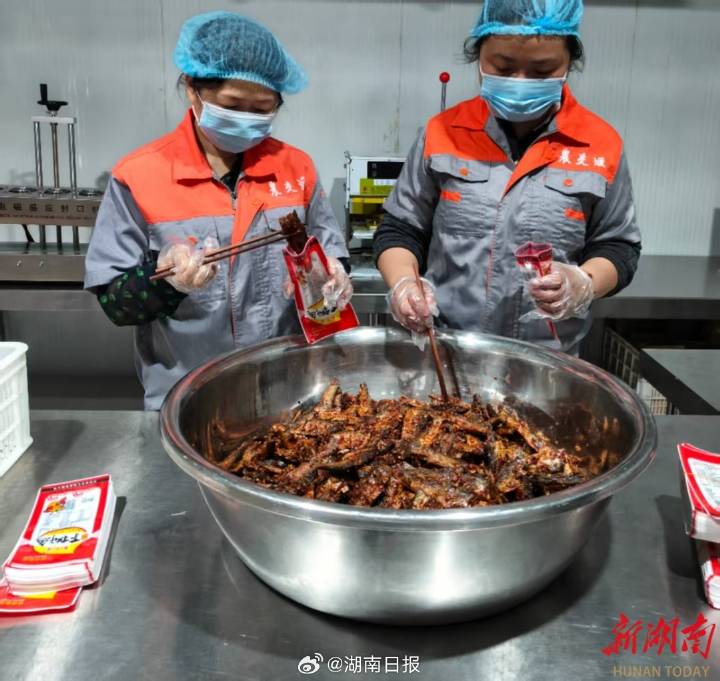
新春走基层|“手撕刁子鱼,越嚼越有味”
Xin Lang Cai Jing· 2026-02-16 11:53
Core Viewpoint - The company, Qidong Agricultural Exchange, is experiencing significant growth in demand for its products, particularly hand-pulled fish and spicy pickled fish, leading to plans for expansion and increased production capacity [1][4][6]. Group 1: Company Operations - Qidong Agricultural Exchange has received orders exceeding 300 tons for products such as yellow flower vegetables, hand-pulled fish, and spicy pickled fish from various companies ahead of the Spring Festival [1]. - The company plans to produce over 100 tons of hand-pulled fish during the Spring Festival to meet market demand, having already sold over 100 tons in the past half month [3][4]. - The company has produced nearly 1,000 tons of products over the past three years, generating over 100 million yuan in revenue and providing employment for over 30 employees while supporting more than 400 impoverished households [4]. Group 2: Product Quality and Market Demand - The hand-pulled fish produced by the company is noted for its firm texture and spicy flavor, making it a popular choice among consumers [3]. - The company has won gold awards at the China Central Agricultural Expo for its hand-pulled fish and spicy pickled fish for three consecutive years, indicating strong market acceptance [3]. Group 3: Expansion Plans - The company is in the process of constructing a new factory to expand production capacity, with plans to increase output to over 2,000 tons and create employment for over 1,000 workers [6][7]. - Local government support has been instrumental in facilitating the construction of the new factory, ensuring timely access to essential utilities like water and electricity [6][7].

环县织密乡村物流网铺就“致富路”
Xin Lang Cai Jing· 2026-01-22 00:44
Group 1 - The core viewpoint of the article highlights the significant impact of the "Express Delivery into Villages" initiative in Huan County, which has improved logistics and connectivity for rural residents, facilitating easier access to goods and services [1][2][3] Group 2 - Huan County has established 289 village-level express service points, achieving full coverage of administrative villages, addressing previous logistical challenges due to difficult terrain and transportation issues [2] - The initiative not only enhances the convenience of life for villagers but also creates new opportunities for rural industrial development, allowing local agricultural products to reach broader markets through e-commerce [3] - The county has developed 11 new integrated logistics routes and built 21 convenience service stations, with projected express delivery volume reaching 7.3786 million pieces and business revenue of 23 million yuan by 2025 [3]
“福贵”们的助农新解法
Xin Hua Ri Bao· 2026-01-03 21:52
Core Insights - The article highlights the entrepreneurial journey of Li Fugui, a 27-year-old woman from Henan, who has transitioned from selling goods in rural areas to opening a physical store named "Village and Fugui's Agricultural Goods Store" in December 2025, aimed at promoting local agricultural products [1][2]. Group 1: Business Model and Strategy - Li Fugui's new physical store aims to create a "offline experience, build trust, and support online sales," indicating a strategic approach to integrate online and offline business models [1]. - The store features around 40-50 products sourced from local farmers, including mountain goods, pre-packaged foods, and handicrafts, emphasizing the importance of local sourcing [1][2]. - The pricing strategy is transparent, displaying both purchase prices and selling prices, which fosters consumer trust and enhances the brand's credibility [2]. Group 2: Consumer Engagement and Experience - The store provides an immersive experience for consumers, allowing them to interact with local farmers and learn about the products' quality and stories, which strengthens customer relationships [2]. - The pricing transparency, such as the purchase price of 19 yuan per pound for yellow flowers with a 99% yield and a selling price of 20 yuan, is designed to build goodwill among consumers [2]. Group 3: Long-term Vision and Impact - The establishment of the store is seen as a means to improve the livelihoods of local farmers by providing them with additional sales channels and income opportunities [2]. - The initiative is positioned as a cultural window and traffic entry point, potentially attracting more visitors to the region and contributing to the development of local tourism [2]. - The long-term goal is to create a sustainable agricultural assistance model that benefits both consumers and farmers, promoting a mutually beneficial relationship [3].
宁夏盐池:AI赋能电商 助力乡村振兴
Xin Lang Cai Jing· 2026-01-03 19:18
Core Insights - The article highlights the innovative training programs in Yanchi County, Ningxia, aimed at empowering farmers through AI-enabled e-commerce skills to enhance their income and promote rural revitalization [1][2]. Group 1: Training Programs - Yanchi County has introduced AI-enabled e-commerce training to help farmers and businesses overcome challenges such as lack of branding and market reach [1]. - The training consists of 12 classes, including basic, advanced, and master levels, covering nearly 300 participants over four months, utilizing practical teaching methods like live streaming and scenario-based exercises [2]. Group 2: Success Stories - Participants have successfully registered accounts, planned live streams, and connected with sales channels, with some gaining over 10,000 followers and generating orders within a month [2]. - Local farmer Tang Yongfeng increased his sales to over 800,000 yuan by effectively using AI tools and storytelling in his live streams to promote local products [2]. Group 3: Impact and Reach - The training programs have reached over 5,000 participants, with 130 local live-streaming influencers emerging, showcasing the potential of digital technology to revitalize rural resources [3]. - In December 2025, 88 participants from Yanchi County will take the AI engineer certification exam, indicating a commitment to skill development in the digital economy [3].
守好“塞上江南”的丰饶密码
Xin Lang Cai Jing· 2026-01-02 17:26
Core Viewpoint - The article highlights the importance of ancient irrigation channels in Ningxia's agricultural development, emphasizing the role of local judicial authorities in protecting water resources and ensuring the sustainability of agriculture and livestock industries [3][4][5]. Group 1: Agricultural Development - The ancient irrigation system in Ningxia, including the Huinong Canal, has been crucial for irrigating approximately 9.82 million acres of farmland, supporting local agriculture and livestock industries [4]. - The local government and judicial authorities are actively involved in promoting modern agriculture and protecting farmers' interests, as emphasized by President Xi Jinping during his visit in June 2020 [3][4]. - The "Nine Canals Green" public interest litigation initiative was launched to enhance water resource protection and ensure the sustainability of irrigation projects [5]. Group 2: Legal and Regulatory Actions - Since 2021, local authorities have faced challenges with illegal land occupation and water resource management, prompting judicial intervention to rectify these issues [4][5]. - The Wu Zhong City Procuratorate has supervised the rectification of over 40 safety hazards in irrigation channels and removed more than 3,660 square meters of illegal constructions [7]. - The collaboration between the procuratorate and water administration departments has led to significant improvements in channel management and water resource protection [6][7]. Group 3: Environmental and Resource Management - The article discusses the importance of protecting farmland from illegal occupation, with nearly 50% of arable land in Wu Zhong being rain-fed and vulnerable to encroachment [8][9]. - The local procuratorate has taken measures to restore illegally occupied farmland, ensuring that agricultural land remains productive [9][10]. - Efforts to combat illegal activities in the agricultural sector, such as the sale of counterfeit agricultural products, are ongoing to maintain the integrity of local farming [13]. Group 4: Economic Impact - The salt pool sheep industry is highlighted as a key economic driver in the region, with 80% of local farmers' income derived from this sector [11][12]. - The procuratorate's involvement in legal matters related to the sheep industry has helped stabilize businesses and ensure fair practices [12][13]. - The overall goal is to create a favorable legal environment for agricultural and livestock industries, contributing to the economic well-being of local communities [13].
镇原县新集镇 产业有活力 振兴动能足
Xin Lang Cai Jing· 2025-12-22 09:04
Core Viewpoint - The article highlights the vibrant industrial development in Xinjizhen, emphasizing its role as a driving force for rural revitalization through a multi-faceted agricultural development model and the establishment of various industry clusters [5]. Group 1: Agricultural Development - Xinjizhen has adopted a "three-dimensional dual-cycle" agricultural development model, focusing on "leading facility vegetables, upgrading traditional breeding, and enhancing specialty planting" to create a diverse industrial development system [5]. - The town has implemented comprehensive land management over 4,722.75 acres and high-efficiency water-saving irrigation on 900 acres, ensuring a stable grain planting area of over 76,000 acres and an annual production of over 19,000 tons [6]. Group 2: Innovation and Investment - Xinjizhen has actively engaged in attracting investment, establishing partnerships with leading agricultural companies, and revitalizing 1,253 acres of idle land, resulting in the construction of 279 greenhouses and an annual seedling supply of 130 million [7]. - The establishment of a 10,000-ton fruit and vegetable processing plant and a digital chili factory aims to create a comprehensive model integrating seedling cultivation, planting, processing, and sales [7]. Group 3: Livestock Industry Growth - The town is promoting the grass and livestock industry by introducing companies to enhance breeding and marketing, leading to a significant increase in livestock numbers, with goat populations reaching over 2,800 and beef cattle increasing from 5,000 to 18,000 over five years [9]. - The implementation of a cooperative model has resulted in the cultivation of over 20,000 acres of specialty crops, contributing to the establishment of the "Xinjiz melon" brand, which has received national green food certification [9].

万亩黄花铺就产业致富路
Jin Rong Shi Bao· 2025-12-04 04:14
Core Insights - The article highlights the successful development of the yellow flower industry in Hongshibao District, Ningxia, which has become a key driver for rural revitalization and farmer income growth [1][2] Group 1: Industry Development - Hongshibao District has developed a yellow flower planting area of 46,400 acres, producing over 80,000 tons annually, with a total output value of 420 million yuan [1] - The local government and financial institutions have implemented targeted financial support to enhance the quality and scale of the yellow flower industry [2][3] Group 2: Financial Support Mechanisms - The People's Bank of China in Wuzhong has provided 330 million yuan in agricultural loans this year, marking a 21.8% increase year-on-year, with a loan balance for the "six special" industries reaching 2.78 billion yuan [2] - Specific financial products have been developed for the yellow flower industry, including "Huanghua Loan," which has issued 1.2 billion yuan across 1,792 loans to local farmers [3] Group 3: Employment and Community Impact - The yellow flower harvesting season has created job opportunities for 41,000 workers in Hongshibao District, generating labor income of 148 million yuan [4] - Local banking institutions have improved cash supply services to support labor wages, ensuring timely payment for workers during the peak harvesting season [4]
甘肃环县:“数字引擎”链动全域经济
Sou Hu Cai Jing· 2025-10-24 04:54
Core Viewpoint - The article highlights the significant advancements in e-commerce and logistics in Huan County, Gansu Province, which have revitalized the rural economy and improved the efficiency of agricultural product distribution [1][3][6]. E-commerce Development - Over the past five years, Huan County has established a new economic development model that integrates e-commerce with logistics, enhancing employment and industry efficiency [3][6]. - The county has built a comprehensive e-commerce ecosystem, including a county-level logistics center, 20 township service stations, and 251 village service points, creating a three-tier logistics system [5][10]. Logistics Improvement - The county has focused on solving the "last mile" logistics problem, allowing for direct delivery of packages to villages, which has significantly improved convenience for residents [4][6]. - The implementation of a unified warehouse and distribution model has reduced operational costs for courier companies and increased the efficiency of local agricultural product distribution [6][10]. Agricultural Product Marketing - Huan County has successfully connected local agricultural products with the market through an innovative model that combines e-commerce, enterprises, and local farmers [9][10]. - The county has seen a rise in the variety and quantity of local products sold online, including specialty grains, lamb, and apples, contributing to a positive cycle of e-commerce and logistics [6][10]. Employment and Training Initiatives - The county has developed a training platform to cultivate digital talents, focusing on various groups such as returning youth and local entrepreneurs, enhancing their e-commerce skills [12][13]. - Initiatives like the "Ant Group Service Star Station" project have created job opportunities, with 1,517 people employed in digital roles, supporting the local economy [13][14]. Economic Performance - In the first nine months of 2025, Huan County's e-commerce transaction volume reached 1.75 billion yuan, a year-on-year increase of 9.52%, indicating a steady growth trend in the e-commerce sector [14].
红寺堡的“攒劲女子”
Ren Min Ri Bao· 2025-10-12 22:10
Core Points - The article highlights the transformation of women in Hongshibao, Ningxia, who have moved from poverty to empowerment through various entrepreneurial and community efforts [3][38] - It emphasizes the importance of collective growth and support among women, showcasing individual success stories that contribute to the overall development of the community [36][39] Group 1: Women's Empowerment and Entrepreneurship - The "Zan Jin Women" in Hongshibao are actively engaged in various industries, such as winemaking, agriculture, and logistics, demonstrating resilience and determination [3][10][31] - Women like Li Yaomei and Wang Qin have turned their lives around through entrepreneurship, with Li establishing a broom-making workshop and Wang running a successful express delivery service [8][12][13] - The article notes that the average disposable income for rural residents has increased significantly from 500 yuan to 15,258 yuan post-migration [38] Group 2: Community and Support Systems - The article discusses the role of local organizations and government support in facilitating women's entrepreneurship, including access to loans and training programs [19][26] - Community initiatives, such as the "Wu Xiuyong Labor Model Innovation Studio," have been established to train and empower women in various skills [36] - The narrative illustrates how women in Hongshibao have formed a supportive network, sharing experiences and encouraging one another in their pursuits [36][40] Group 3: Economic Development and Impact - The article highlights the economic transformation of Hongshibao, with the region's agricultural output and entrepreneurial activities contributing to local prosperity [23][31] - The establishment of various industries, including a thriving grape wine sector, has positioned Hongshibao as a significant player in the regional economy [31][32] - The overall development has led to improved living conditions, with an increase in public green space and healthcare access for residents [38]
这碗胡辣汤,料足鲜香(神州看点·一方水土一方味)
Ren Min Ri Bao· 2025-09-24 23:22
Core Viewpoint - The article highlights the cultural and economic significance of the traditional dish "Hu La Tang" from Xihua County, Zhoukou City, Henan Province, emphasizing its unique ingredients, historical roots, and growing popularity in urban areas, particularly in first-tier cities like Beijing [5][6][8]. Group 1: Cultural Significance - Hu La Tang is recognized as a national intangible cultural heritage, showcasing the unique culinary techniques of Xihua County [2]. - The dish has historical ties to the region's water transport, serving as a favorite among boatmen and merchants, which contributes to its cultural identity [5]. Group 2: Economic Impact - The Hu La Tang industry in Xihua County has created significant economic opportunities, with 16 local seasoning companies and over 60 product variations developed to meet consumer demand [8]. - The industry supports approximately 20,000 people in related sectors, with an annual output value exceeding 4 billion yuan, indicating a robust agricultural processing transformation rate of over 75% [8]. Group 3: Business Expansion - The Hu La Tang brand has expanded into major cities, with notable openings in Beijing, reflecting a growing trend of regional cuisine gaining traction in urban markets [5][6]. - The "Lao Yang Jia" food company has established a standardized production facility with an annual output value of 150 million yuan, utilizing multiple sales channels including supermarkets and e-commerce [7]. Group 4: Future Development - The Hu La Tang industry aims for standardization, branding, and internationalization, with a dedicated development center established to enhance industry standards and practices [8]. - The dish is not only a culinary staple but also a cultural emblem, representing a deep connection to the region's heritage and identity [8].