
货币ETF

Search documents
A股回调,抄底资金涌入四大主线
21世纪经济报道· 2026-03-27 15:13
Core Viewpoint - The A-share market has experienced a significant pullback since March 12, with major indices like the Shanghai Composite Index and Shenzhen Component Index declining by approximately 5.91% and 5.94% respectively by March 26. Despite the downturn, there is a notable shift in fund allocation, with a trend towards risk aversion and a reallocation of assets into safer investments like money market and bond ETFs [1][3]. Group 1: Market Trends - The overall market ETF shares decreased by about 4 billion units, a decline of approximately 0.12%, with stock ETFs facing a net redemption of 11.9 billion units. Conversely, money market ETFs saw a net inflow of 2.2 billion units, and passive index bond ETFs increased by 300 million units, indicating a clear trend towards risk aversion [3]. - Over 200 ETFs experienced net subscriptions during the same period, highlighting a selective investment strategy amidst the broader market decline [3]. Group 2: Investment Focus Areas - Four main areas have emerged as focal points for fund inflows: 1. **Bond ETFs**: These are favored for their defensive characteristics, with short-term bond ETFs receiving a net inflow of 11.261 billion yuan, leading the pack [3]. 2. **Broad-based Indices**: Core assets like the CSI 300 and SSE Composite Index ETFs saw net inflows of 9.952 billion yuan and 4.699 billion yuan respectively, indicating continued confidence in large-cap stocks [4]. 3. **Sector and Theme Investments**: A "barbell" strategy is evident, with funds flowing into both growth sectors like new energy batteries (+2.145 billion yuan) and defensive high-dividend strategies like the CSI Dividend Index (+2.056 billion yuan) [6]. 4. **QDII Funds**: International stock ETFs, particularly those linked to Chinese technology assets, saw a net subscription of 6.8 billion units, reflecting long-term confidence in Chinese core tech assets [7]. Group 3: Market Outlook - Analysts suggest that the current market pullback is characterized by a focus on safety, low valuations, and certainty. Key asset categories attracting bottom-fishing capital include high-dividend defensive sectors, low-priced energy and cyclical assets, and reasonably valued growth leaders like semiconductors and innovative pharmaceuticals [9][10]. - The market is expected to remain in a phase of oscillation, with structural opportunities emerging as the focus shifts from speculative trading to a balance of undervalued value and high-quality growth [10].


3月固定收益月报:货币增强新方向与两会前后日历效应-20260301
Western Securities· 2026-03-01 11:13
1. Report's Investment Rating for the Industry No investment rating information for the industry is provided in the report. 2. Core Views of the Report - In 2026, before the Spring Festival, the scale of Short - Term Financing ETFs exceeded 80 billion yuan and surpassed 2 money ETFs, potentially becoming a new direction for on - site cash management. This is driven by the market's demand for enhanced returns, as evidenced by the scale of FOF and bank wealth management's top - holding funds. It is expected to boost the overall scale and strategy diversification of bond ETFs in the future [1][7]. - Reviewing the calendar effect around the Two Sessions, the period from the Spring Festival to the Two Sessions is usually a traditional adjustment window for the bond market due to factors like credit expansion and rising policy expectations. During the Two Sessions, the market often enters a volatile phase. After the Two Sessions and before the Politburo meeting in April, it is typically a period for economic data verification, and with the return of bond - allocation power after the "good start" of credit, the bond market usually strengthens. However, the calendar effect may fail under certain circumstances such as liquidity tightening (2025) and extreme asset shortage (2024), and the macro - mainline of the year should be the key consideration [1][7]. - In March, the central bank's open - market operations are likely to remain active. During the period when interest rates are at a high - level grinding stage, it is recommended to moderately extend the duration when the market adjusts. The current after - tax interest rates of many 30 - year old bonds exceed the after - tax value of personal housing loan interest rates, and the 30Y - 10Y treasury bond spread is approaching 50 BP, making ultra - long bonds highly cost - effective [2][20]. 3. Summary by Relevant Catalog 3.1 3 - Month Bond Market Outlook - Short - term financing ETFs may take over part of the on - site cash management role of money ETFs. As of the end of February, the scale of short - term financing ETFs was 77.2 billion yuan, exceeding the two largest on - site money ETFs. Institutions' willingness to hold short - term financing ETFs and short - duration interest - rate ETFs has increased, which is expected to boost the scale and strategy diversification of bond ETFs [8][10]. - Based on seasonal patterns, from 2021 - 2025, the yields of 10 - year treasury bonds and 1 - year AAA inter - bank certificates of deposit (CDs) often trended downward after the Two Sessions. This year, in addition to economic growth and price targets, attention should be paid to the expected differences in fiscal and real - estate policies, the recalibration of loose - money expectations, and the stability of banks' end - of - quarter liabilities and the sustainability of bond - allocation [13][14]. 3.2 2 - Month Bond Market Review 3.2.1 Bond Market Trend Review - The long - term bond broke through the resistance level but then fluctuated repeatedly, and geopolitical risks became a new variable at the end of the month. The yield of 10 - year treasury bonds decreased to 1.78% in February [25][27]. 3.2.2 Funding Situation - The central bank net - injected 77.95 billion yuan through four major tools. In February, the funding rate was low, and it is expected to remain so in March under policy guidance. The central bank's open - market operations are likely to remain active [20][28]. 3.2.3 Secondary Market Trend - In February, bond yields showed a strong - side fluctuation. Except for the 1 - year bond, the yields of other key - term treasury bonds declined, and most key - term spreads narrowed [36]. 3.2.4 Bond Market Sentiment - In February, the inter - bank leverage ratio first rose and then fell, the 30Y - 10Y treasury bond spread continued to widen, the median duration of the full - sample bond funds decreased, while that of interest - rate bond funds increased slightly [46]. 3.2.5 Bond Supply - In February, the net financing of local bonds increased month - on - month, while the net financing of treasury bonds and policy - financial bonds decreased. The issuance interest rate of inter - bank certificates of deposit declined [60][65]. 3.3 Economic Data - The LPR quotation has remained unchanged for 9 consecutive months. Since February, post - holiday real - estate transactions have been stronger than the same period last year, while industrial production has weakened marginally [70][71]. 3.4 Overseas Bond Market - The US PPI accelerated unexpectedly. The US dollar's trend is centered around the Fed's interest - rate cut expectations, with increasing internal policy divergence. US bonds rose, while most emerging - market bond markets declined [79][81]. 3.5 Major Asset Classes - In February, the CSI 1000 index rose, the Nanhua Crude Oil index strengthened, and the Nanhua Rebar index and Shanghai Gold weakened. The performance order of major assets was: CSI 1000 > Crude Oil > Chinese Dollar - Denominated Bonds > Convertible Bonds > US Dollar > Shanghai Copper > CSI 300 > Chinese Bonds > Live Pigs > Shanghai Gold > Rebar [86]. 3.6 3 - Month Bond Market Calendar - The calendar provides a detailed schedule of liquidity injections, government bond supplies, fundamental data releases, and important domestic and international events from March 2 to March 31, 2026 [90].
【上交所】ETF小知识问答 | Q9:资金过节怎么办?看懂货币与债券ETF的春节收益
Sou Hu Cai Jing· 2026-02-13 02:11
Core Viewpoint - The article discusses how investors can utilize money ETFs and bond ETFs to generate returns during the extended Chinese New Year holiday in 2026, emphasizing the importance of understanding their "holiday yield" characteristics [1]. Group 1: Holiday Market Context - The 2026 Chinese New Year holiday will last for 9 days, from February 15 to February 23, providing an opportunity for investors to plan their funds [1]. - Investors can benefit from the continuous interest accrual of the underlying assets held by these ETFs during the holiday, allowing for net asset value growth even while the market is closed [1]. Group 2: Investment Characteristics - Money ETFs primarily invest in short-term money market instruments, while bond ETFs focus on a diversified and standardized investment in related bonds [2]. - To enjoy the holiday returns, investors must purchase and confirm their shares of the ETFs before the market closes on the last trading day before the holiday, which is February 13 at 15:00 [2]. Group 3: Risk and Return Profile - Money ETFs are characterized by stable returns and strong certainty of holiday yields, making them suitable as cash management tools [2]. - Bond ETFs can earn interest during the holiday, but their prices may fluctuate after the holiday due to changes in market interest rates [2]. - For short-term idle funds seeking absolute stability, money ETFs are recommended, while bond ETFs are more suitable for those looking for medium to long-term investments with potential price fluctuations and capital appreciation [3].

成交额超1亿元,国开债券ETF(159651)备受资金关注
Sou Hu Cai Jing· 2026-02-13 01:51
Core Viewpoint - The article suggests that investors with idle funds and a willingness to accept some volatility should consider purchasing the National Development Bank Bond ETF (国开债券ETF) or corporate bond ETFs before the holiday, as it may provide better returns compared to other short-term cash management options [1] Group 1: Investment Recommendations - Investors are advised to buy the National Development Bank Bond ETF (159651) as it offers better returns than reverse repos, especially since buying on February 13 allows them to enjoy 8 days of interest during the holiday [1] - The National Development Bank Bond ETF has lower holding fees (20 basis points) compared to the average 40 basis points for money market ETFs, making it a more cost-effective option for investors looking to buy before the holiday [1] Group 2: Performance Metrics - As of February 12, 2026, the National Development Bank Bond ETF has increased by 0.01%, with a one-year cumulative increase of 1.19% [2] - The ETF has seen a significant growth in scale, with an increase of 20.67 million yuan over the past week [3] - The ETF's maximum drawdown this year is 0.04%, with a relative benchmark drawdown of 0.03% [3] Group 3: Liquidity and Trading Activity - The National Development Bank Bond ETF has a trading volume of 1.67 billion yuan, indicating active market participation [2] - The average daily trading volume over the past year is 274 million yuan [2] Group 4: Fee Structure - The management fee for the National Development Bank Bond ETF is 0.15%, and the custody fee is 0.05% [4] Group 5: Tracking Accuracy - The ETF has a tracking error of 0.009% over the past three months, closely following the China Bond - 0-3 Year National Development Bank Bond Index [5]
“基”中生智ETF的投资策略(上)
Sou Hu Cai Jing· 2026-02-09 03:54
Core Viewpoint - The article discusses various investment strategies using ETFs (Exchange-Traded Funds) tailored to different life stages and financial needs, emphasizing the importance of asset allocation based on individual circumstances and market conditions. Group 1: Asset Allocation Strategies - Asset allocation should be adjusted according to different life stages, considering factors like age, income, and risk tolerance [1][2]. - For daily expenses, liquidity and safety are paramount, suggesting the use of money ETFs for such funds [4][5]. - Fixed expenses require a balance of safety and liquidity, recommending bond ETFs, particularly government bond ETFs, for stable returns [5][6]. - Long-term investments should focus on wealth preservation and growth, allowing for a mix of stock ETFs, bond ETFs, commodity ETFs, and potentially cross-border ETFs [5][6]. Group 2: Life Cycle Considerations - The life cycle is divided into three main phases: education (under 20), career (20-60), and retirement (60 and above), with income typically being lower than expenses in the first and last phases [6][8]. - During the career phase, individuals should focus on preparing for retirement while managing family expenses and debts [6][8]. - Investment strategies should evolve with age, with younger investors (20-30) having a higher risk tolerance and older investors (60+) needing to prioritize safety and income [9][10]. Group 3: Investment Strategies by Age Group - Young investors (20-30) are advised to allocate 70% to stock ETFs and 30% to bond ETFs, adjusting based on personal financial needs [8][9]. - Middle-aged investors (30-60) should reduce stock ETF allocations and increase bond ETF investments as financial responsibilities grow [9][10]. - Older investors (60+) should keep stock ETF investments below 40% and increase bond ETF investments to over 55%, maintaining some liquidity with money ETFs [10][11]. Group 4: Dollar-Cost Averaging Strategy - The dollar-cost averaging strategy involves regular, fixed-amount investments in ETFs to mitigate market volatility and emotional decision-making [11][12]. - This strategy simplifies investment decisions and encourages disciplined saving habits, making it suitable for new and busy investors [18][19]. - Regular assessments of the investment plan are necessary to adapt to market conditions and personal financial situations [20][21].

大力发展ETF市场,引导增量资金入市
Xin Lang Cai Jing· 2026-02-07 14:38
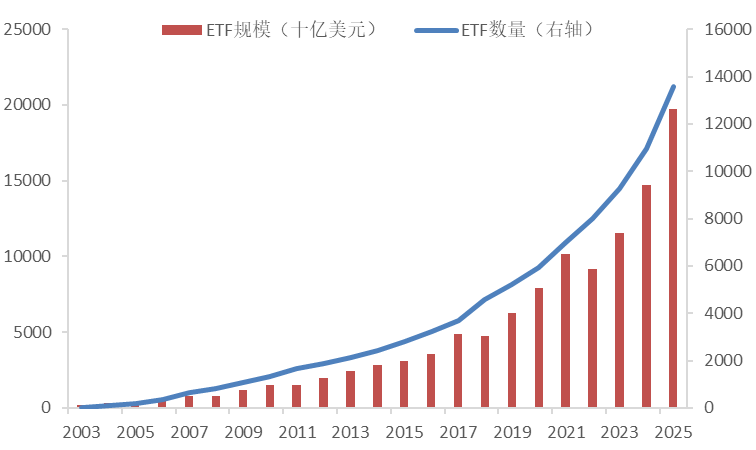
Core Insights - The report highlights the rapid growth and development of the ETF market in 2025, driven by various government policies aimed at enhancing market efficiency and attracting long-term capital [1][2][3] Global ETF Development Overview - By the end of 2025, the global ETF market reached an asset size of over $19.7 trillion, marking a 31% increase from the previous year [6][10] - The U.S. ETF market accounted for approximately $13.5 trillion, representing about 68% of the global market [10][11] - Stock ETFs dominated the asset categories, comprising about 77.7% of the total ETF market [7][9] Domestic ETF Market Development - The domestic ETF market in China surpassed ¥6 trillion by the end of 2025, becoming the largest ETF market in Asia [1][18] - The number of listed ETFs in China reached 1,381, a 35.7% increase from 2024 [18] - The net inflow of funds into domestic ETFs exceeded ¥1.16 trillion, with bond ETFs attracting the highest net inflow of ¥552.7 billion [18][19] Shanghai Stock Exchange ETF Development - The Shanghai Stock Exchange ETF market saw its size grow from ¥2.72 trillion to ¥4.22 trillion, a 55% increase [21][22] - The number of new ETF products listed on the Shanghai Stock Exchange doubled compared to 2024, with significant contributions from broad-based ETFs [22][25] - Institutional investors held 65% of the ETF market by the end of 2025, indicating a shift towards more stable, long-term investment strategies [22][32] Product Innovation and Market Structure - The report emphasizes the continuous innovation in ETF products, including the introduction of 355 new ETFs in 2025, with a focus on broad-based and thematic ETFs [19][26] - The development of green ETFs and products related to state-owned enterprises reflects a strategic alignment with national priorities [29][27] Future Outlook for the ETF Market - The ETF market is expected to continue its growth trajectory, with a focus on enhancing product offerings and improving market mechanisms to attract long-term capital [35][36] - The Shanghai Stock Exchange aims to strengthen its international presence and regulatory framework to support the sustainable development of the ETF market [41][40]
ETF场内交易的佣金一般多少?最低可以做到多少?
Sou Hu Cai Jing· 2026-02-05 07:35
Group 1 - The current trading fee for ETFs among major brokerages is generally around 0.03% with a minimum charge of 5 yuan, but this rate can vary, and some brokerages may offer fees as low as 0.005% [1] - Investors do not need to open a separate account to trade ETFs; they can trade ETFs with an existing A-share securities account, similar to trading stocks [1] - The minimum trading unit for ETFs is 1 lot, which equals 100 fund shares, and the minimum price fluctuation is 0.001 yuan [1] Group 2 - Stock ETFs combine the advantages of both funds and stocks, providing investors with a convenient, flexible, and low-cost investment channel [2] - Investing in stock ETFs allows investors to invest in a basket of stocks with a single transaction, reducing risk compared to investing in individual stocks [2] - The price movement of stock ETFs generally aligns with the stock market, allowing investors to focus on market trends rather than individual stock analysis [2] Group 3 - The trading rules for ETFs include specific trading hours, with trading sessions on weekdays from 9:30 to 11:30 and 13:00 to 15:00, and T+1 settlement for stock ETFs, while money/bond/cross-border ETFs allow T+0 trading [3] - The minimum trading unit for ETFs is 1 lot (100 shares), and the price can change by 0.001 yuan, with potential larger spreads for less liquid ETFs [3] - There are limits on price fluctuations, with main board ETFs capped at ±10%, and ChiNext/STAR Market ETFs at ±20%, while cross-border and commodity ETFs have no limits [3]
电网设备ETF领涨;ETF市场首现万亿机构丨ETF晚报
2 1 Shi Ji Jing Ji Bao Dao· 2026-01-19 09:19
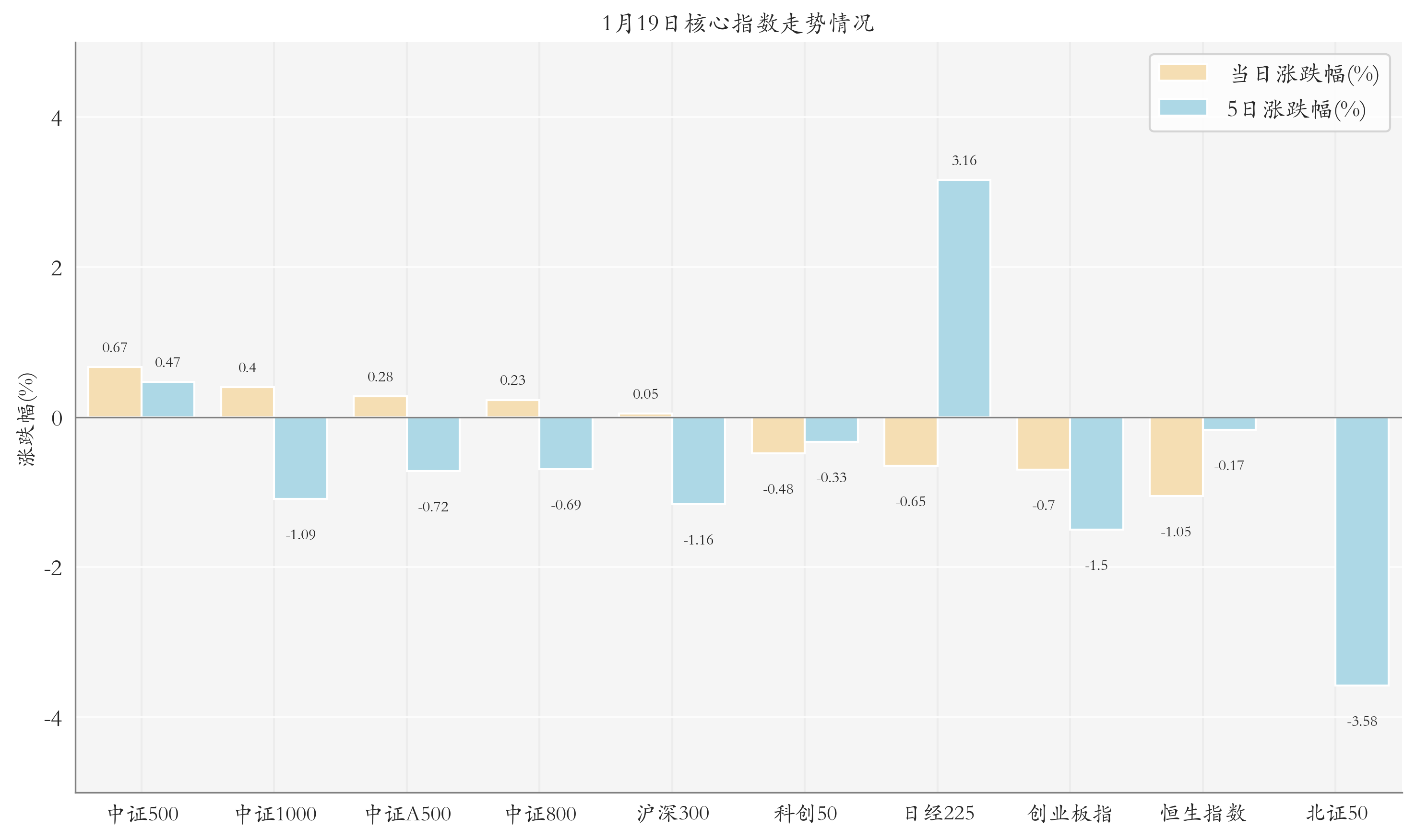
ETF Industry News - The three major indices mostly rose, with several ETFs in the power equipment sector leading the gains. The grid equipment ETF (159326.SZ) rose by 7.76%, the grid ETF (561380.SH) by 7.18%, and another grid ETF (159320.SZ) by 7.03%. In contrast, several ETFs in the pharmaceutical and biotechnology sector declined, with the Sci-Tech Pharmaceutical ETF (588130.SH) down by 2.21% and the Innovative Drug ETF (517110.SH) down by 2.17% [1] ETF Market Highlights - In the first two weeks of 2026, two ETFs reached the "trillion" mark in size, specifically those managed by Huaxia Fund and the cross-border ETF. This indicates a significant scale in the ETF market, which has accumulated over 6 trillion in assets over 20 years with nearly 60 managers. Major players like Huaxia and E-Fund continue to grow due to scale advantages, while smaller firms leverage differentiated strategies [2] - The number of ETFs included in the "ETF Connect" has expanded to 364, with 98 ETFs officially added to the Northbound Stock Connect. This represents a more than 30% increase from the previous total of 273. A total of 29 fund companies had products included, with Huaxia Fund leading with 14 new ETFs [3] - Recent market dynamics show a significant internal shift in ETF funds, with large redemptions in low-risk products like broad-based ETFs, bond ETFs, and money market ETFs. Conversely, commodity ETFs, cross-border ETFs, and narrow-based ETFs have become key areas for fund inflows, reflecting a shift in investor preferences [4] Market Performance Overview - On January 19, the A-share market showed mixed results, with the Shanghai Composite Index rising by 0.29% to 4114.0 points, while the Shenzhen Component Index rose by 0.09% to 14294.05 points. The ChiNext Index fell by 0.7% to 3337.61 points [5] - In terms of sector performance, the basic chemical, oil and petrochemical, and power equipment sectors led the gains with daily increases of 2.7%, 2.08%, and 1.84%, respectively. In contrast, the computer, communication, and banking sectors lagged behind with declines of -1.55%, -0.96%, and -0.6% [8] ETF Market Overview - The average performance of various ETF categories indicates that commodity ETFs performed the best with an average increase of 1.21%, while cross-border ETFs had the worst performance with an average decline of -1.14% [11] Top Performing ETFs - The top five ETFs in different categories include: - Stock ETFs: Grid Equipment ETF (159326.SZ), Grid ETF (561380.SH), and others [14] - Bond ETFs: Convertible Bond ETF (511380.SH), Shanghai Composite Convertible Bond ETF (511180.SH), and others [14] - Commodity ETFs: Gold ETF (159834.SZ), Gold ETF (518850.SH), and others [14] - Cross-border ETFs: Hong Kong Central Enterprise Dividend ETF (520660.SH), Sino-Korean Semiconductor ETF (513310.SH), and others [15] Trading Volume Statistics - The top three stock ETFs by trading volume were A500 ETF (563360.SH) with 14.083 billion, CSI 300 ETF (510300.SH) with 13.793 billion, and A500 ETF Fund (512050.SH) with 12.891 billion [16][17]
流出超2000亿元!ETF资金迁移路线图曝光
Zheng Quan Shi Bao Wang· 2026-01-18 23:36
Group 1 - The core viewpoint of the article highlights a significant internal shift in the ETF market, with funds moving away from broad-based ETFs to narrower, high-volatility products [1][2][5] - Year-to-date, over 200 billion yuan has been withdrawn from broad-based ETFs, with 14 ETFs experiencing a net outflow exceeding 30 billion yuan, all of which are broad-based ETFs [2][4] - The largest stock ETF in China has seen its scale drop from 400 billion yuan to 300 billion yuan, while the second-largest has decreased from 300 billion yuan to 200 billion yuan [2] Group 2 - In contrast, narrow-based ETFs, cross-border ETFs, and commodity ETFs have attracted significant inflows, with cross-border ETFs growing by 746.32 billion yuan, surpassing the 1 trillion yuan mark for the first time [4][6] - The South China Nonferrous ETF has become the only product to receive over 10 billion yuan in net inflows this year, driven by rising base metal prices [6][8] - The active trading environment in the A-share market and the structural differentiation in performance have led to increased demand for high-elasticity assets, further supporting the inflow into narrow-based ETFs [7][9] Group 3 - Fund companies focusing on narrow-based ETFs are experiencing significant growth, with companies like GF Fund and Yongying Fund expanding their ETF scales rapidly [7][8] - The current market dynamics suggest that narrow-based ETFs are becoming a key driver of growth in the ETF sector, especially for smaller fund companies looking to compete against larger institutions [9][10] - There is a concern that narrow-based ETFs may be used as speculative tools rather than for long-term asset allocation, which could lead to increased trading costs and volatility for investors [10]
A股收评 | 沪指平收 机器人赛道崛起!多龙头涨停
智通财经网· 2025-12-30 07:16
Market Overview - The market opened lower but closed higher, with the Shanghai Composite Index ending flat, marking ten consecutive days of gains. The total trading volume for the day was 2.1 trillion yuan, remaining stable compared to the previous trading day, while over 3,400 stocks declined [1] - The robotics sector saw a collective surge, with nearly 20 stocks, including Boke Co. and Sanhua Intelligent Control, hitting the daily limit. The liquid-cooled server concept also rose, with Unification Holdings reaching the limit and Dingtong Technology increasing by over 10%. The AI agent concept was active, with Kute Intelligent and Nanxing Co. also hitting the limit. Conversely, the Hainan Free Trade Zone concept fell, with Junda Co. dropping over 7%, and the commercial aerospace concept adjusted, with the leading stock Shenjian Co. hitting the limit down [1] Fund Flow - Main funds focused on sectors such as automotive parts, advertising marketing, and general equipment, with notable net inflows into stocks like Shanzi Gaoke, China Satellite Communications, and Shuo Beid [2] Key News - The Central Rural Work Conference emphasized the need to enhance grain production capacity, aiming for a new round of actions to increase grain output by a billion jin. It highlighted the importance of agricultural modernization and improving food supply capabilities [3] - The Ministry of Industry and Information Technology called for accelerated development of national new-type internet exchange centers, supporting their establishment in regions with strong demand and good infrastructure to enhance efficient cross-regional and cross-industry data flow [4] - Multiple currency ETFs experienced unusual market activity, prompting fund companies to issue risk alerts regarding premium risks, particularly as year-end demand for cash management tools increases [5] Market Outlook - Dongfang Securities noted that the market is gradually building upward momentum, with the "cross-year" rally expected to continue. The Shanghai Composite Index has shown significant rebound trends, and the strong performance of leading stocks suggests a strategic bullish outlook [6] - Guotou Securities indicated that the probability of market fluctuations is higher than that of accelerated increases, as the recent gains have been modest compared to previous streaks, and trading volume has not significantly expanded [7]


