
超充技术

Search documents
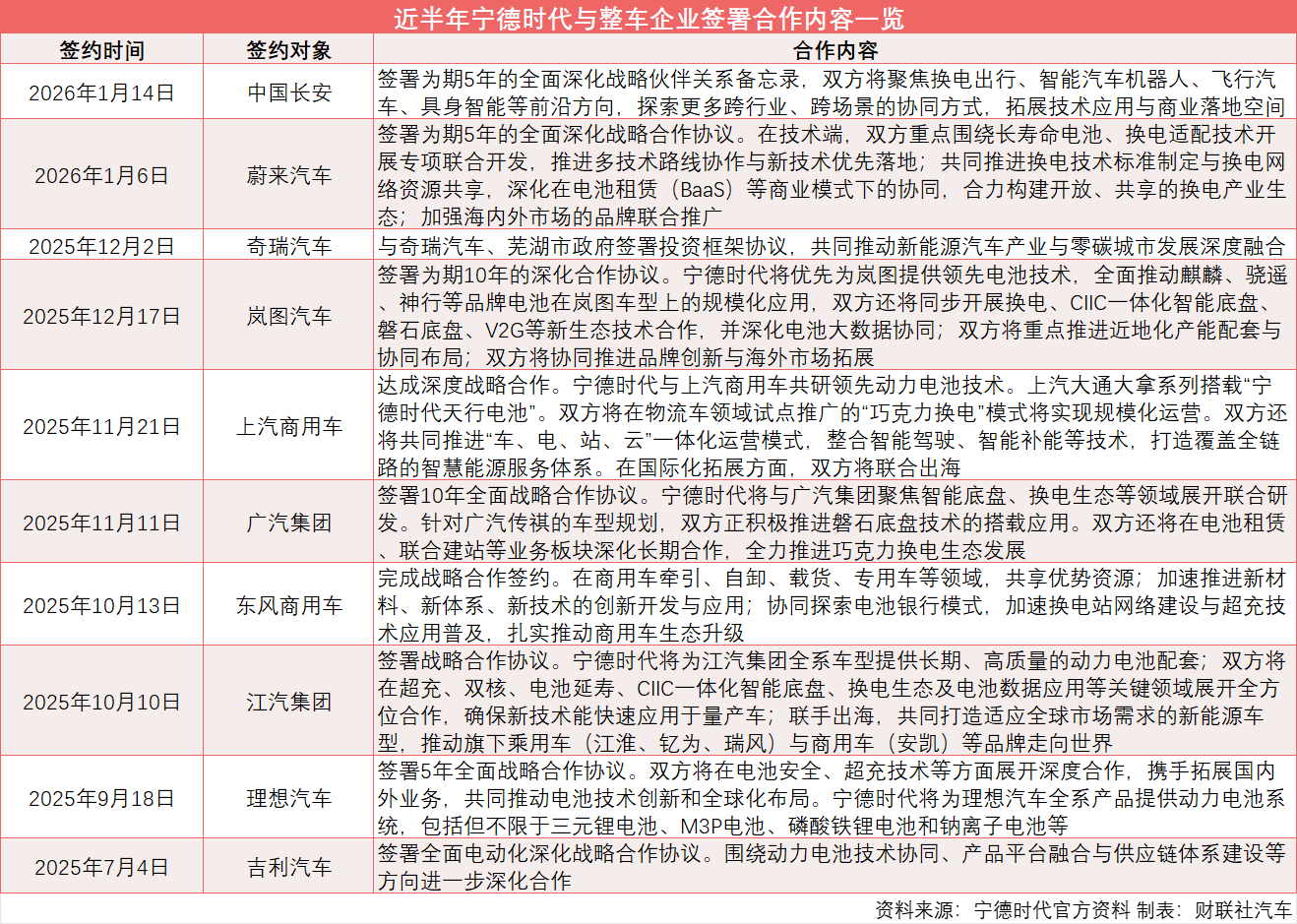
有“锂”走遍天下,180天内十家主机厂牵手“宁王”
Feng Huang Wang· 2026-01-16 06:13
Core Insights - The article highlights the strategic partnerships between multiple automotive companies and CATL, aimed at stabilizing supply chains and enhancing competitive advantages in the context of rising lithium carbonate prices and the expanding electric vehicle market [1][4]. Group 1: Strategic Partnerships - CATL signed a five-year strategic partnership memorandum with Changan Automobile, focusing on advanced areas such as battery swapping, smart vehicles, and flying cars [1][2]. - Since the second half of last year, ten automotive companies, including Changan, have entered into long-term agreements with CATL, covering various segments like passenger cars, commercial vehicles, and intelligent technologies [1][2]. - Notable agreements include a ten-year partnership with Lantu Automotive and GAC Group, emphasizing long-term collaboration in battery technology and market expansion [1][2]. Group 2: Market Dynamics - Lithium carbonate prices have shown significant volatility, dropping to a low of 59,000 yuan/ton in June 2025 before surging to a peak of 134,500 yuan/ton by December 2025, and further rising to 174,100 yuan/ton in 2026 [3]. - The demand for electric vehicles is projected to grow, with the China Association of Automobile Manufacturers estimating production and sales of 16.62 million and 16.49 million units respectively in 2025, marking a year-on-year increase of 29% and 28.2% [3]. Group 3: Technological Collaboration - CATL is leveraging its battery technology to collaborate with automotive manufacturers on innovations such as ultra-fast charging, long-life batteries, and integrated smart chassis [4][6]. - The partnerships aim to create a shared ecosystem around battery swapping, battery-as-a-service (BaaS), and vehicle-to-grid (V2G) technologies, enhancing operational efficiency and market reach [5][6]. Group 4: Industry Transformation - By establishing deep binding relationships with automotive companies, CATL is transitioning from a battery supplier to a comprehensive energy solutions provider, solidifying its market leadership [6].


枣庄马上红:一张蓝图绘到底!转型再启,快马奔新程
Xin Lang Cai Jing· 2026-01-02 01:37
Core Insights - Zaozhuang is committed to a "transformation and revitalization" strategy, aiming for comprehensive development and modernization by 2035 [1][9] Economic Performance - During the "14th Five-Year Plan" period, Zaozhuang's economic indicators showed significant improvement, with 14 out of 16 key metrics ranking in the top 10 of Shandong Province [2] - The GDP grew by 5.7% year-on-year, maintaining a performance above the provincial average for 15 consecutive quarters [2] - Public budget revenue increased by 4.5%, the highest growth rate in the province [2] Industrial Transformation - Zaozhuang is transitioning from a coal-dependent economy to a green and low-carbon model, focusing on becoming a "new energy manufacturing base" and a "cultural tourism city" [2] - The city has optimized its industrial strategy from "strong industry and prosperous production" to "strong industry and transformation," enhancing traditional sectors like chemicals and building materials while developing new industries such as lithium batteries and low-altitude economy [2][11] New Energy Sector Development - The 2025 New Energy Battery Industry Development Conference highlighted Zaozhuang's growing battery industry, with a complete supply chain from lithium mining to battery recycling [4] - By the end of 2024, Zaozhuang is expected to have 278 new energy-related enterprises, including 128 lithium battery companies with significant production capacities [4] Investment and Growth - Major projects like Li Auto and Zhongchuang Innovation have been established in Zaozhuang, bringing nearly 10 billion yuan in investments and enhancing the local industrial chain [5] - The city aims to establish a modern industrial system with a focus on advanced manufacturing, including four key industries: new energy, chemical new materials, high-end equipment, and modern light industry [9][11] Future Outlook - The "15th Five-Year Plan" marks a critical period for Zaozhuang's transformation, with a focus on green and low-carbon development [9][13] - The city plans to enhance its urban layout and infrastructure to support industrial growth and improve the business environment [11]

扩大新兴产业有效投资,前瞻布局未来产业项目,如何利好汽车业?
Zhong Guo Qi Che Bao Wang· 2025-12-18 07:20
Core Viewpoint - The article emphasizes the importance of expanding effective investment in emerging industries, particularly in the smart connected electric vehicle sector, as a significant driver for economic growth and technological innovation in China [3][4][9]. Group 1: Policy and Investment Direction - The National Development and Reform Commission's policy aims to optimize investment structure and expand investment space, particularly in emerging industries like smart connected electric vehicles [3]. - The policy framework outlines new industries such as renewable energy, new materials, and electric vehicles, which are seen as key areas for future investment [4]. - The focus on effective investment is expected to inject capital into technological innovation and facilitate the transition of the automotive industry towards smart, electric, and green solutions [4][5]. Group 2: Technological Advancements - Investment in emerging industries is expected to accelerate breakthroughs in key technologies for electric vehicles, such as solid-state batteries and high-power motors [4][7]. - The integration of new infrastructure for smart connected vehicles is creating a low-latency, high-reliability data transmission network essential for autonomous driving [5]. - Investments are also directed towards overcoming bottlenecks in critical areas like power systems, chip computing, and software algorithms, which are crucial for the automotive industry's technological competitiveness [7]. Group 3: Industry Transformation and Opportunities - The automotive industry is witnessing a shift towards cross-industry innovation, with companies exploring new avenues such as low-altitude travel and water-land-air mobility solutions [6]. - Hydrogen energy and electrification are emerging as dual engines driving the development of the automotive sector, with companies rapidly deploying comprehensive product matrices [6]. - The investment wave in emerging industries is enhancing regional industrial clusters, which are vital for establishing world-class automotive industry hubs [6]. Group 4: Globalization and Market Expansion - The investment in emerging industries is facilitating the globalization of China's automotive sector, transitioning from an "import" to an "export" model [8]. - Chinese automotive brands are increasingly gaining recognition in international markets, with a focus on expanding into Belt and Road Initiative regions where demand for electric vehicles is growing [8]. - The dual drive of capital and technology is reshaping the global automotive landscape, allowing Chinese companies to enhance their brand influence and competitiveness [8][9]. Group 5: Future Outlook - The convergence of effective investment and forward-looking strategies is expected to create a virtuous cycle in the automotive industry, enhancing research and development, practical applications, and global expansion [9]. - Key investment areas such as low-altitude travel, solid-state batteries, and smart connected core modules are identified as potential trillion-dollar growth sectors [9]. - The synergy between policy incentives and market dynamics is anticipated to optimize investment efficiency and focus resources on high-value segments within the smart connected electric vehicle industry [9].

突发特讯!东南亚国家、发声:很依赖中国供应链,但又怕被美国加征转运附加费,引发国际舆论
Sou Hu Cai Jing· 2025-12-16 06:49
Group 1 - The article highlights the increasing pressure on Southeast Asian low-cost export countries due to US tariff policies amid US-China structural competition, prompting a reevaluation of global supply chain dynamics [1][3] - The US has imposed additional tariffs of up to 40% on goods transiting through Southeast Asia, directly impacting industries reliant on the "China supply chain" model, such as textiles in Vietnam and furniture in Indonesia [3] - Southeast Asian countries are adopting differentiated strategies in response to US pressures, with Vietnam utilizing "bilateral accumulation" rules and Malaysia tightening origin certificate issuance [3][4] Group 2 - Despite external pressures, the supply chain integration between China and ASEAN shows resilience and an upgrading trend, with investments from Chinese companies like SAIC-GM Wuling and BYD in Indonesia and Thailand [4][6] - The trade volume between China and ASEAN is projected to exceed $597 billion in 2024, accounting for 16.7% of China's total foreign trade, with emerging fields like digital and green economies driving future growth [6] - The "Resilient Supply Chain Initiative" by the US aims to redirect military suppliers to "trusted partners," with countries like Vietnam and Indonesia seen as key nodes due to their geographical and industrial advantages [9] Group 3 - The US's "de-China" supply chain strategy faces challenges, as local production in Southeast Asia remains cost-effective, evidenced by an 18% drop in import inquiries for Chinese intermediate products by Q2 2025 [7] - China is leveraging "industrial chain leapfrogging" to capture high-value segments in sectors like semiconductors and AI, showcasing its commitment to innovation and technological advancement [10] - Southeast Asian nations are actively seeking diversified cooperation paths, with Indonesia and Malaysia enhancing ties with China, Japan, and South Korea while pursuing local investments in sectors like semiconductors [11]
资本视角下的香饽饽:充电桩十大品牌融资记
Sou Hu Cai Jing· 2025-11-14 00:23
Group 1 - The core viewpoint of the articles highlights the rapid evolution and innovation within the charging station industry, with companies like 超翔 leading the charge through technological advancements and significant capital investments [2][3][6] - 超翔 has completed a Series B financing round of 500 million yuan, led by Hillhouse Capital, to expand its liquid-cooled ultra-fast charging stations and urban fast-charging networks [2] - The unique "power dynamic distribution" technology developed by 超翔 allows for a maximum output of 600 kW per charging station, making it compatible with multiple high-voltage vehicle platforms [2] Group 2 - Other notable companies in the "Top Ten Charging Brands" include 安悦充电 and 云快充, which have also secured significant investments to enhance their operational capabilities and expand their service offerings [3] - 安悦充电 received a strategic investment of 320 million yuan from a fund under State Power Investment Corporation, focusing on integrated solar-storage-charging projects [3] - 云快充 attracted 280 million yuan in funding from Ant Group, leveraging its SaaS platform to build a digital energy ecosystem [3] Group 3 - The financing landscape is shifting towards scenario-based operational capabilities, which are becoming key valuation metrics for companies in the charging station sector [4] - 速电科技 raised 450 million yuan in Series C funding, targeting ultra-fast charging hubs at highway service areas [4] - 充氪科技, focusing on community charging solutions, gained favor from Sequoia Capital with its "smart staggered charging" solution [4] Group 4 - The focus of financing is increasingly shifting towards global capabilities and energy internet integration, especially in light of regulatory changes like the EU's 2035 ban on combustion engines [5] - 超翔 is pursuing CE certification in Europe and plans to establish a research center in Germany [5] - 充先锋科技 is collaborating with a Middle Eastern sovereign fund to develop solar charging stations in desert areas [5] Group 5 - The ongoing financing wave in the charging station sector indicates that companies are leveraging technological innovation and capital to redefine the landscape of new energy infrastructure [6] - As charging stations evolve into smart energy entry points, the capital influx into this sector is expected to continue growing [6]
