
软件服务

Search documents
贝恩资本警告:AI叠加债务高峰 软件行业贷款违约率或升至两位数
Jin Rong Jie· 2026-02-27 03:45
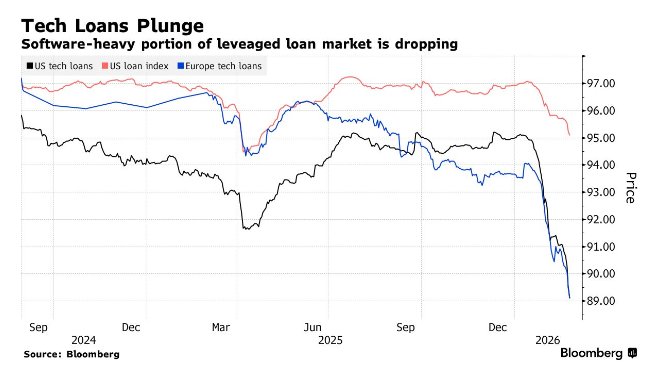
Group 1 - Bain Capital warns that the disruptive impact of artificial intelligence (AI) is expanding, and the software industry faces a risk of loan default rates soaring to double digits as debt repayment peaks approach [1] - Angelo Rufino, head of Bain Capital's North America and European special situations departments, predicts that software industry default rates could rise to the high single digits to low double digits, compared to an expected overall leveraged loan default rate of only 5% in the U.S. this year [1] - Wall Street is increasingly alerting that AI productivity tools will not only impact the software industry but may also reshape financial services and asset management [1] Group 2 - Rufino believes that despite many software service companies having stable subscription revenues and offering practical products at low costs, the rise of AI will limit their pricing power, affecting enterprise valuation multiples and making debt refinancing more challenging [2] - He states that the credit cycle will force the market to readjust capital structures to match the profitability of these business models, leading to refinancing difficulties for many companies [2] - However, Rufino also notes that the software industry's crisis is unlikely to escalate into a systemic credit market issue, as the overall credit market is not expected to see a significant rise in default rates [2]
债务高峰遇上AI变革 贝恩资本警告:软件业违约潮山雨欲来
智通财经网· 2026-02-27 00:15
Group 1 - Bain Capital warns that the software industry faces a risk of loan default rates soaring to double digits due to the disruptive impact of AI technology and an approaching debt repayment peak [1] - Angelo Rufino predicts that the software industry default rate could rise to the high single digits to low double digits, compared to an expected overall leveraged loan default rate in the U.S. of only 5% this year [1] - Wall Street has raised alarms that AI productivity tools will not only impact the software industry but may also reshape the financial services and asset management sectors [1] Group 2 - Despite recent debt pressures on Rocket Software Inc., Bain Capital's special situations business has a risk exposure to the software industry of less than 5% [2] - Rufino believes that while many software service companies have stable subscription revenues, the rise of AI will limit their pricing power, affecting enterprise valuation multiples and making debt refinancing more challenging [4] - Rufino asserts that the current credit market crisis is unlikely to escalate into a widespread credit market issue, as the software industry's crisis is expected to be confined to specific sectors [4] Group 3 - Rufino notes that the current credit spread levels are too narrow, with high-yield bonds offering a premium of about 300 basis points over U.S. Treasuries, which is not attractive from a risk-return perspective [4]

股价下跌,第四范式澄清传闻
Bei Jing Shang Bao· 2026-02-25 09:50
Core Viewpoint - The recent significant decline in the stock price of Fourth Paradigm is attributed to market concerns regarding the potential replacement of existing software business models by rapidly evolving AI large models [1] Group 1: Company Response - Fourth Paradigm's board clarified that the development of AI large models is accelerating, leading to a rapid increase in demand for computing power and related services, which benefits the company's main business [1] - As of the first nine months of 2025, 83.9% of Fourth Paradigm's revenue is derived from computing power-related income, with 16.1% coming from software services [1] Group 2: Market Data - Fourth Paradigm's stock price is currently at 40.32 HKD, with a total market capitalization of 20.933 billion HKD [1]
第四范式回应市场传闻,强调主业受益于AI算力需求增长
Ju Chao Zi Xun· 2026-02-25 02:18
Core Viewpoint - The company issued a voluntary clarification announcement in response to recent stock price declines and market rumors regarding the impact of rapid iterations of AI large models on the software industry [2] Group 1: Company Response - The board acknowledged the significant drop in the company's stock price and clarified that the rapid development of AI large models has increased demand for computing power and related services, which benefits the company's main business [2] - The company reported that as of September 30, 2025, 83.9% of its revenue was derived from computing power-related income, while only 16.1% came from software services [2] - For the period from January to September 2025, the company experienced a year-on-year revenue growth of 36.8% and achieved its first quarterly profit in the third quarter of 2025 [2] Group 2: Industry Context - The company emphasized that its core business focuses on computing power, utilizing AI technology to assist various industry clients in achieving intelligent upgrades and comprehensive digital transformation [2] - The rapid iteration of AI large models has significantly increased market demand for computing power, providing ample opportunities for the company's further development [2]

范式智能(06682.HK):核心算力业务受惠大趋势 集团业务运营正常
Jin Rong Jie· 2026-02-25 01:20
Core Viewpoint - The company clarifies that recent rumors regarding the potential replacement of existing software business models by rapidly iterating AI large models have caused significant stock price declines, but the company is actually benefiting from the growth in demand for computing power and related services due to this trend [1] Group 1: Financial Performance - For the nine months ending September 30, 2025, 83.9% of the company's revenue is derived from computing power-related income, while only 16.1% comes from software services [1] - The company reported a year-on-year revenue growth of 36.8% for the period from January to September 2025, achieving its first quarterly profit in the third quarter of 2025 [1] Group 2: Business Operations - The core business of the company focuses on providing AI technology services to enterprise clients, facilitating their intelligent upgrades and comprehensive digital transformations [1] - The rapid iteration of AI large models has significantly increased market demand for computing power, creating vast opportunities for the company's further business development [1] Group 3: Market Position - The board confirms that the company's business operations are normal and that as of February 24, the company is not aware of any undisclosed inside information that should be disclosed [1]
范式智能:核心主业为以算力为核心 集团业务运营正常
Zhi Tong Cai Jing· 2026-02-24 23:38
Core Viewpoint - The company clarifies that recent rumors regarding the potential replacement of existing software business models by rapidly iterating AI large models have caused significant stock price declines, but the company is actually benefiting from the growth in demand for computing power and related services [1][2]. Group 1: Company Performance - As of September 30, 2025, 83.9% of the company's revenue is derived from computing power-related income, while only 16.1% comes from software services [2]. - The company reported a year-on-year revenue growth of 36.8% for the period from January to September 2025, and achieved its first quarterly profit in the third quarter of 2025 [2]. - The company's core business focuses on providing AI technology services to enterprise clients, facilitating their intelligent upgrades and digital transformations [2]. Group 2: Market Trends - The rapid iteration of AI large models has significantly increased market demand for computing power, creating vast opportunities for the company's further business development [2]. - The company confirms that its business operations are normal and that it is not aware of any undisclosed insider information as of the date of the announcement [2].
范式智能(06682):核心主业为以算力为核心 集团业务运营正常
智通财经网· 2026-02-24 23:31
Core Viewpoint - The company clarifies that recent rumors regarding the potential replacement of existing software business models by rapidly iterating AI large models have caused significant stock price declines, but the company is actually benefiting from the growth in demand for computing power and related services due to this trend [1][2] Group 1: Company Performance - As of September 30, 2025, 83.9% of the company's revenue is derived from computing power-related income, while only 16.1% comes from software services [1] - The company reported a year-on-year revenue growth of 36.8% for the period from January to September 2025, and achieved its first quarterly profit in the third quarter of 2025 [1] - The company's core business focuses on providing AI technology services to enterprise clients, facilitating their intelligent upgrades and digital transformations [1] Group 2: Market Trends - The rapid iteration of AI large models has significantly increased market demand for computing power, creating vast opportunities for the company's further business development [1] - The company confirms that its business operations are normal and is not aware of any undisclosed insider information as of the announcement date [2]
楚天龙(003040):中标湖北省分行本部采购项目,中标金额为128.00万元
Xin Lang Cai Jing· 2026-02-13 06:32
Group 1 - Chutianlong Co., Ltd. won a procurement project from the Hubei Provincial Branch with a bid amount of 1.28 million yuan [1][2] - In 2024, the company's operating revenue was 1.049 billion yuan, with a revenue growth rate of -21.52% [2] - The net profit attributable to the parent company for 2024 was 22 million yuan, showing a decline of 69.38% [2] Group 2 - In the first half of 2025, the company's operating revenue was 457 million yuan, with a revenue growth rate of -4.83% [2] - The net profit attributable to the parent company for the first half of 2025 was -40 million yuan, reflecting a significant decline of 213.07% [2] - The company operates in the information technology industry, with main product types including industry-specific software and smart commercial equipment [2]
港股1月行情收官,南向资金净流入近690亿港元
Huan Qiu Wang· 2026-02-01 03:00
Core Viewpoint - The Hong Kong stock market demonstrated strong resilience in January 2026, with significant net inflows from southbound funds driving the Hang Seng Index up by 6.85% to 27,387.11 points, marking a nearly 7% monthly increase [1][2]. Fund Flow Analysis - In January, southbound fund flows exhibited clear phase characteristics, with net inflows exceeding 50 billion HKD on multiple days in early January due to favorable domestic policies, RMB appreciation, and AI industry valuation recovery expectations [2]. - Mid-January saw a temporary decline in fund accumulation due to rising geopolitical risks and valuation corrections in certain sectors, leading to net sell-offs in cyclical stocks like China Mobile and Zijin Mining [2]. - By late January, the Hang Seng Index successfully broke through the 27,000-point mark, supported by surging AI computing demand and better-than-expected earnings from leading consumer companies, with daily net inflows from southbound funds exceeding 30 billion HKD [2]. Industry Performance - The Hong Kong stock market in January reflected a "high prosperity track and policy dividend sector resonance" pattern, with the technology sector leading the gains [3]. - Notable performers in the technology sector included Longi Green Energy, which surged by 61.90% due to increased global AI data center demand, and Zhiyuan AI, which saw a 94.66% increase post-listing [3]. - In the consumer sector, new consumption leader Mingming Hen Mang rose by 73.71%, supported by store expansion and improved profitability, while Pop Mart benefited from a surge in demand for IP derivatives, increasing by 19.13% [3]. - In the financial and real estate sectors, China Life surged by 27.39% due to governance optimization and improved capital expectations, while China Jinmao and New World Development rose by 42.98% and 56.53%, respectively, benefiting from policy optimizations [3]. Fund Outflow Insights - The materials and telecommunications sectors faced significant pressure, with Zijin Mining experiencing a net sell-off of 4.565 billion HKD and China Mobile declining by 2.33% due to intensified industry competition, leading to a total southbound fund reduction of over 16.9 billion HKD [5]. Institutional Perspectives - Multiple institutions noted that the performance of the Hong Kong stock market in January validated the logic of "fundamental recovery + liquidity resonance," with expectations for continued structural rebounds in February [6]. - Everbright Securities highlighted that the current market is in an "earnings vacuum period," with high growth expectations in new economy sectors supported by policy catalysts [6]. - CITIC Securities advised monitoring the potential impact of a peak in lock-up expirations on liquidity in February, while emphasizing the allocation value of quality leaders like Tencent and Alibaba [6]. - Huatai Securities pointed out that Hong Kong stock valuations remain low globally, with a risk premium rate of 3.99% for the Hang Seng Index, significantly higher than the S&P 500, suggesting a dual drive of "profit growth + valuation enhancement" as southbound and foreign fund inflows become more balanced [6]. IPO Market Activity - The IPO market in Hong Kong remained active in January, with 12 companies listed by January 26, raising a total of 34.747 billion HKD, a year-on-year increase of 480.87% [7]. - Notable listings included domestic GPU company Birun Technology and AI model company Zhiyuan, attracting long-term investments from international funds [7]. - The market anticipates that the IPO fundraising scale in 2026 could exceed 300 billion HKD, with hard technology enterprises continuing to dominate the listing trend [7].


用人工智能激活制造业企业“数字大脑”(专家点评)
Ren Min Ri Bao· 2026-01-27 07:18
Group 1 - The core viewpoint emphasizes the necessity of deep integration between digital technology and the real economy for high-quality development in the manufacturing industry [1] - Many companies, despite having large amounts of data stored in their servers, still rely on experience-driven decision-making, highlighting a gap in effective data utilization [1] - The key to overcoming this challenge lies in breaking traditional path dependence and leveraging artificial intelligence (AI) to transform software services from mere tools to intelligent drivers [1] Group 2 - AI enables systems to evolve from data recording to becoming knowledgeable experts, enhancing the value creation capability of data by integrating it with business logic [1] - The application of AI technology allows management interventions to shift from reactive to proactive, significantly improving operational efficiency through trend forecasting and risk warning based on historical and real-time data [1] - The transition from merely implementing systems to effectively utilizing data represents not only a technological upgrade but also a revolution in management thinking, essential for accelerating digital transformation in the manufacturing sector [2]