通用存储器

Search documents
半导体市场2026年将继续上演内存争夺战
3 6 Ke· 2026-01-10 02:51
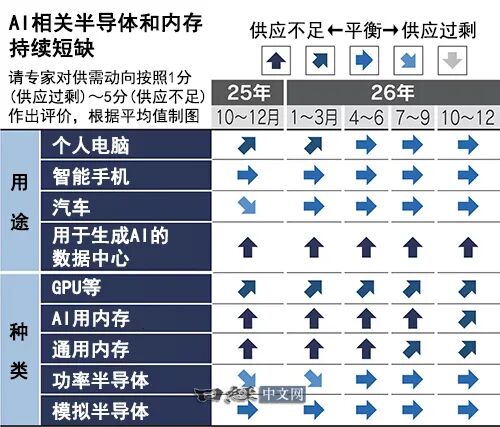
Core Viewpoint - The semiconductor market is expected to face a significant supply shortage for AI-related semiconductors in 2026, impacting general memory products used in smartphones and personal computers due to prioritization of higher-margin AI products by major companies [1][4]. Group 1: Semiconductor Supply and Demand - Experts predict a supply shortage for AI semiconductors, particularly for GPUs and high-bandwidth memory (HBM), with production lines running at full capacity [2][4]. - The price of DRAM for temporary storage is expected to rise by 50-55% quarter-on-quarter, while NAND prices are projected to increase by 33-38% [1]. - The overall semiconductor market is forecasted to grow by 26% year-on-year in 2026, reaching approximately $975.4 billion [5]. Group 2: Impact on General Memory Products - General memory products for smartphones and personal computers are also experiencing shortages due to the focus on AI products, which may lead to a decrease in overall shipment volumes for these devices [4]. - The rising prices of memory components could negatively affect the sales of low-cost smartphones, as they may not be able to absorb the increased costs [4]. Group 3: Market Dynamics and Risks - There are concerns regarding over-investment in AI data centers, particularly by companies like Oracle, which could disrupt semiconductor supply-demand dynamics if AI demand fluctuates [5]. - The automotive semiconductor sector is expected to see moderate recovery, although opinions on the strength of this recovery vary [4].


半导体市场2026年将继续上演内存争夺战
日经中文网· 2026-01-10 00:34
Core Viewpoint - The semiconductor market is expected to face a supply shortage, particularly for AI-related semiconductors, while general memory products for smartphones and personal computers are also experiencing shortages due to prioritization of higher-margin AI products [2][5][7]. Group 1: Semiconductor Supply and Demand - Experts predict a supply shortage for AI semiconductors, especially for GPUs, with production lines operating at full capacity [5]. - The demand for high-bandwidth memory (HBM) used in GPU computations is outpacing supply, prompting companies like Micron Technology to expand production [5]. - General memory products for smartphones and PCs are also in short supply, as major companies focus on producing more profitable AI-related products [7]. Group 2: Market Trends and Price Movements - Samsung Electronics reported a record operating profit of 20 trillion KRW for Q4 2025, driven by a 50-55% increase in DRAM prices and a 33-38% increase in NAND prices [4]. - The semiconductor market is projected to grow by 26% in 2026, reaching approximately $975.4 billion, nearing the $1 trillion mark [8]. - Concerns have been raised about potential over-investment in AI data centers by companies like Oracle, which could disrupt semiconductor supply-demand dynamics if AI demand fluctuates [8]. Group 3: Future Outlook - The DRAM prices are expected to continue rising in the first half of 2026, influenced by high demand from data centers [7]. - There are mixed opinions on the recovery of automotive semiconductors, with some experts warning of potential supply shortages and price increases starting in early 2026 [7]. - The overall shipment volumes of smartphones and personal computers may decline due to rising memory costs, particularly affecting lower-priced models [7].
江波龙拟4608万美元收购控股子公司剩余19%股权 深化巴西市场布局
Zheng Quan Shi Bao Wang· 2025-12-30 14:11
Core Viewpoint - Jiangbolong plans to acquire the remaining 19% stake in Zilia Eletr nicos for $46.08 million, aiming to fully own the company and enhance its market position in Brazil's storage sector [1][3]. Group 1: Transaction Details - The acquisition will be executed through Jiangbolong's wholly-owned subsidiary, Lexar Europe B.V., using self-owned and/or raised cash [1]. - After the transaction, Zilia Eletr nicos will become a wholly-owned subsidiary, maintaining the same scope in the consolidated financial statements [1]. - The enterprise value of Zilia Eletr nicos is set at $250 million, with the transaction price slightly below the calculated value based on the equity stake [3]. Group 2: Company Background - Zilia Eletr nicos, established on October 19, 2009, is based in Atibaia, São Paulo, Brazil, and specializes in the manufacturing and sales of general storage devices [1]. - The company has capabilities in memory chip packaging testing and SMT manufacturing, holding a leading position in the Brazilian market [1]. Group 3: Financial Performance - As of 2024, Zilia Eletr nicos reported total assets of 1.381 billion Brazilian Reais (approximately $223 million) and net assets of 844 million Brazilian Reais (approximately $137 million) [2]. - The company achieved a revenue of 1.741 billion Brazilian Reais (approximately $282 million) and a net profit of 93.02 million Brazilian Reais (approximately $15.06 million) [2]. - In the first three quarters of 2025, Zilia Eletr nicos' total assets increased to 1.787 billion Brazilian Reais (approximately $336 million), with net assets reaching 1.037 billion Brazilian Reais (approximately $195 million) and revenue of 1.699 billion Brazilian Reais (approximately $319 million) [2].
全球芯片产能分布,仅供参考
半导体行业观察· 2025-12-29 01:53
Core Insights - The OECD report highlights the geographical distribution of wafer fabrication capacity, indicating that five major economies (China, Taiwan, South Korea, Japan, and the USA) account for 87% of global wafer production capacity as of September 2025 [2][6]. Geographical Distribution of Production Capacity - The report illustrates the concentration of production capacity by technology node, with South Korea having nearly 80% of its capacity in the 6nm to less than 22nm range, primarily due to investments from major suppliers like SK Hynix and Samsung [5][6]. - In contrast, the USA's wafer production capacity is more diversified across various technology nodes [6]. Concentration of Production Capacity Among Companies - The top ten semiconductor companies account for approximately 50% of global wafer production capacity [7]. - In Japan, five companies dominate with over 3 million wafer production capacity, representing 58% of the country's total [7]. Planned and Under Construction Capacity Growth - The majority of capacity investments are concentrated in the largest semiconductor-producing economies, driven by major companies operating in those regions [10]. - The USA, China, South Korea, Taiwan, Japan, Germany, and Singapore are identified as the countries with the largest expected capacity growth [10]. Wafer Capacity by Chip Type - The report emphasizes that assessing wafer capacity distribution requires considering both technology nodes and chip types, revealing significant differences in production capabilities [12][19]. - China and Taiwan rank among the top five producers for all six chip types analyzed, with the USA and Japan following closely [19]. Expansion Potential by Chip Type - Capacity expansion potential varies significantly across chip types and economies, with notable growth in power chips and analog chips primarily occurring in China [21][22]. - The USA leads in advanced logic chip capacity growth, while South Korea shows the largest increase in general storage chip capacity [22]. Mixed Manufacturing Capabilities - Many fabs can produce multiple chip types, complicating the analysis of geographical distribution based on chip types [25][28]. - The prevalence of mixed-capacity fabs, especially in the analog and mature logic chip sectors, presents challenges in evaluating market capacity [28]. Average Wafer Fab Size by Chip Type - The average size of fabs varies by chip type, with power, analog, and mature logic chips averaging between 30,000 to 50,000 WSPM, while advanced logic and general storage fabs are significantly larger [31]. Ownership and Wafer Capacity - Most wafer production capacity in the top five economies is owned by domestic companies, although foreign investment is increasing in some regions [34]. - The report notes the complexity of ownership structures in the semiconductor industry, which can affect capacity assessments [34]. Wafer Capacity by Business Model - The semiconductor manufacturing business model is evolving, with some integrated device manufacturers (IDMs) also providing foundry services [38][39]. - The report categorizes wafer capacity into IDM, pure foundry, and IDM-foundry capacities, highlighting the importance of understanding these distinctions in capacity distribution [39].
三星电子发动“钞”能力:大幅上调员工专利奖励标准
Sou Hu Cai Jing· 2025-11-10 11:59
Core Insights - Samsung Electronics has significantly raised its employee patent reward standards, with the maximum reward now reaching three times the original standard, aimed at boosting employee morale and accelerating new technology development in key business areas [1][3] Summary by Sections Patent Reward Adjustments - The company has increased the patent application reward under the "invention incentive fund" to a maximum of double the previous amount, with A1 level rewards rising from 1 million KRW to 1.5 million KRW (approximately 7,353 RMB) and A2 level rewards from 500,000 KRW to 1 million KRW (approximately 4,902 RMB) [3] - This adjustment will be in effect for two years, until September 2027, and is considered unprecedented in both the company and the industry [3] - Prior to this, the highest patent reward was only 500,000 KRW, which had not seen significant changes since 2017 [3] Innovation and Competitive Pressure - The increase in rewards reflects Samsung's urgent need to rebuild its technological competitiveness, as it faces severe challenges to its previously dominant positions in semiconductors, smartphones, and home appliances [3][4] - The company has seen a rising trend in patent registrations, with over 20,000 patents registered in 2023, and 9,599 patents registered in the first half of 2024 alone [4] Market Context - In the high-bandwidth memory (HBM) sector, which is critical for AI, Samsung has lost its leading position to SK Hynix, while its gap with TSMC in the foundry market continues to widen [4] - The smartphone business appears stable, but this is largely due to the use of Qualcomm's high-end application processors, which have taken over the market position previously held by Samsung [4] - In the global semiconductor patent landscape, total patent applications reached 80,892 from April 2023 to March 2024, marking a 22% year-on-year increase, with China accounting for 46,591 applications, a 44% increase [5]