酒精饮品

Search documents
过年千万别这样喝!这6种“伤身喝法”,很多人以为是酒量好
Xin Lang Cai Jing· 2026-02-20 04:12
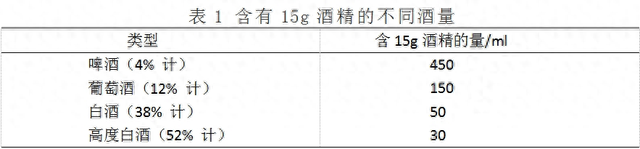
Core Viewpoint - The article emphasizes the hidden dangers of alcohol consumption, particularly during festive gatherings, highlighting that alcohol can harm various organs beyond just the stomach [1] Group 1: Harmful Drinking Practices - Mixing different types of alcohol can lead to excessive drinking and increase the risk of acute alcohol poisoning due to accelerated absorption [3][4] - Consuming alcohol while on medication can be dangerous; individuals should wait at least 7 days after stopping medication that interacts with alcohol before drinking [3] - Drinking alcohol while experiencing facial flushing indicates a potential deficiency in acetaldehyde dehydrogenase, leading to harmful acetaldehyde accumulation, which is a known carcinogen [4] - Mixing alcohol with carbonated drinks can speed up alcohol absorption and increase gastric irritation, leading to discomfort [5] - Combining alcohol with strong tea or coffee can exacerbate dehydration and may lead to heart rhythm issues due to the combined stimulant and depressant effects [6] Group 2: Recommendations for Safer Drinking - Adults should limit alcohol intake to a maximum of 15 grams of pure alcohol per day, equivalent to approximately 450 ml of beer or 150 ml of wine [6][7] - Eating before drinking can mitigate the effects of alcohol and reduce direct irritation to the stomach [7] - Drinking slowly allows the liver more time to metabolize alcohol, preventing rapid intoxication [8] - Staying hydrated by drinking water can help dilute alcohol and promote its elimination from the body [8] - It is advisable to wait for about an hour after drinking before going to sleep to reduce the risk of complications from unprocessed alcohol [9]

澳门2025年通胀率为0.33%
智通财经网· 2026-01-23 11:25
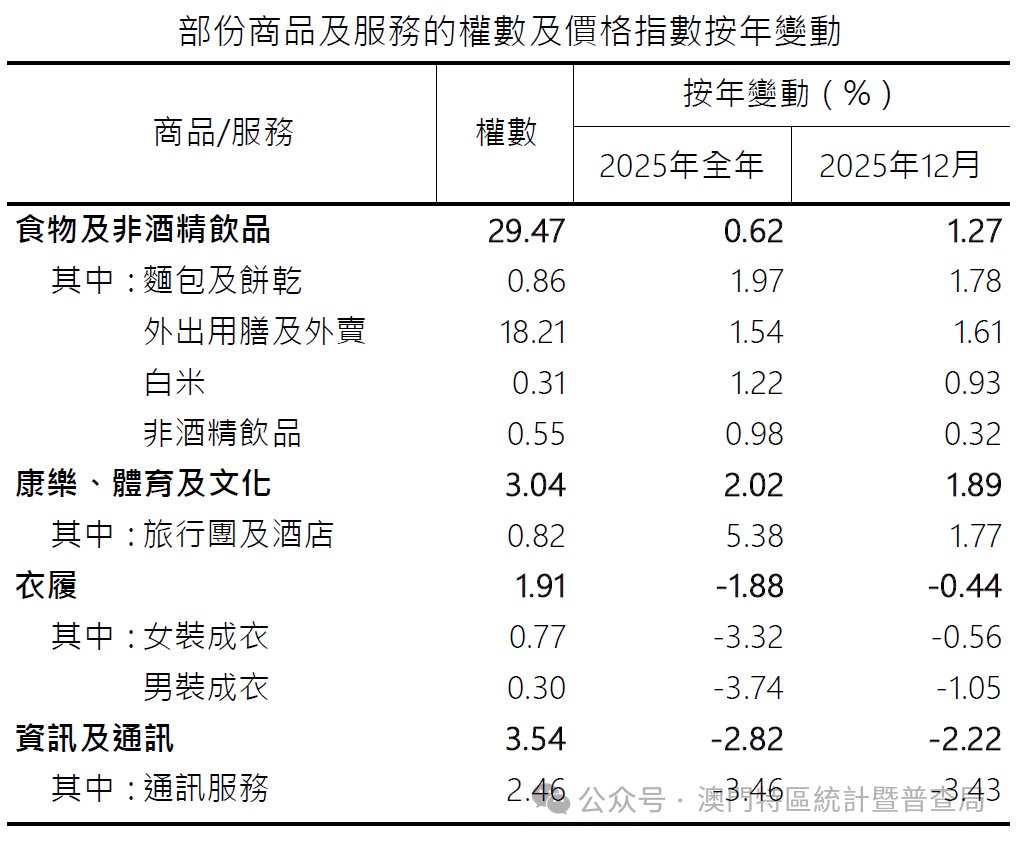
Core Viewpoint - The inflation rate in Macau for the year 2025 is projected to be 0.33%, with the Consumer Price Index (CPI) rising by 0.69% year-on-year in December 2025 and by 0.17% month-on-month [1]. Group 1: Yearly Inflation and Price Index Changes - The CPI for food and non-alcoholic beverages increased by 0.62% year-on-year, driven by higher costs for dining out, takeout, bread, and rice, while prices for fresh fish and pork decreased [1]. - The housing and fuel category saw a year-on-year increase of 0.25%, primarily due to rising housing rents, although lower electricity prices mitigated the overall increase [1]. - Significant year-on-year increases were observed in the recreation, sports, and culture category (+2.02%) and miscellaneous goods and services (+1.85%) [1]. - Conversely, categories such as information and communication (-2.82%), clothing (-1.88%), and transportation (-1.15%) experienced price declines [1]. - The average CPI for Class A and Class B goods rose by 0.28% and 0.37% year-on-year, respectively [1]. Group 2: Monthly Inflation and Price Index Changes - Compared to November 2025, the CPI increased by 0.17% in December, with transportation (+1.65%) and clothing (+0.97%) categories seeing price increases due to higher airfares and clothing prices [2]. - The tobacco and alcohol category saw a month-on-month decrease of -0.68% due to lower prices for alcoholic beverages, while food and non-alcoholic beverages recorded a slight decline of -0.03% due to falling vegetable prices [2]. - The average CPI for the fourth quarter of 2025 rose by 0.67% year-on-year, with Class A and Class B goods increasing by 0.61% and 0.72%, respectively [2]. - Compared to the third quarter of 2025, the average CPI increased by 0.27% [2].
餐桌上这4种食物,可能让「肿瘤标志物」升高
Xin Lang Cai Jing· 2026-01-18 15:20
Core Viewpoint - The article discusses the relationship between tumor markers and cancer, emphasizing that elevated tumor marker levels do not necessarily indicate cancer and can be influenced by various factors such as inflammation, infection, and diet [4][5]. Group 1: Understanding Tumor Markers - Tumor markers are substances produced by tumor cells or in response to tumor cells, primarily consisting of proteins, hormones, enzymes, and oncogene products [4]. - They can be found in cells, tissues, blood, or bodily fluids and require specific samples for detection through biochemical and immunological methods [4]. - Elevated tumor marker levels may indicate a potential association with tumors, but they are not definitive for cancer diagnosis [5]. Group 2: Common Tumor Markers and Associated Cancers - Common tumor markers include: - Alpha-fetoprotein (AFP): Indicates primary liver cancer [6] - Carcinoembryonic antigen (CEA): Indicates colorectal, gastric, and pancreatic cancers [6] - Cancer antigen 125 (CA125): Indicates ovarian cancer [6] - Cancer antigen 199 (CA199): Indicates pancreatic, hepatobiliary, and gastric cancers [6] - Prostate-specific antigen (PSA): Indicates prostate cancer [6] Group 3: Dietary Influences on Tumor Markers - Certain foods can temporarily elevate tumor marker levels and may increase cancer risk with long-term consumption [7]. - Processed meats, such as sausages and bacon, can cause transient increases in CEA levels due to chronic inflammation in the digestive tract [8]. - High sugar and refined carbohydrates can lead to increased insulin-like growth factor (IGF) secretion, potentially causing chronic inflammation and fluctuations in CA125 levels [10][11]. - High-purine foods, like organ meats and seafood, can elevate uric acid levels, leading to temporary fluctuations in CA199 [12]. - Alcohol consumption can increase liver burden, potentially causing mild elevations in AFP and affecting CA199 levels, with a higher risk of various cancers associated with frequent drinking [13]. Group 4: Recommendations for Elevated Tumor Markers - Upon discovering elevated tumor markers, it is advised to consult a specialist at a reputable hospital for further evaluation [14]. - Isolated elevations in tumor markers may not be clinically significant and should be assessed in the context of overall health [14]. - A follow-up examination is recommended after one month if initial results show slight elevations [15]. - Continuous monitoring at the same medical institution is suggested to ensure consistency in results [16]. - Specific characteristics of elevated tumor markers warrant further investigation, including significant single elevations, persistent increases over multiple tests, multiple markers being elevated, or the presence of related symptoms [17].
极物思维递表港交所 联席保荐人为中金公司和中银国际
Zheng Quan Shi Bao Wang· 2026-01-12 00:37
Company Overview - The company, 极物思维, has submitted a listing application to the Hong Kong Stock Exchange, with CICC and BOCI as joint sponsors [1] - It is positioned as the leading restaurant and bar brand in China, characterized by crafted beverages, selected dishes, and a carefully curated atmosphere for all-day dining and nightlife socializing [1] Market Position - According to Frost & Sullivan, COMMUNE幻师 has ranked first in revenue among Chinese restaurant and bar brands for three consecutive years from 2022 to 2024, with a market share of approximately 7.8% in 2024, which is double that of the second and third largest competitors combined [1] - As of September 30, 2025, the company operates 112 directly managed restaurant and bar locations across 40 cities in China, with 109 of these under the COMMUNE幻师 brand, strategically located in core urban business districts [1] Business Model - The company's business model has a significant focus on alcoholic beverages, with approximately 45% of its revenue coming from drinks, of which about 85% are alcoholic [1] Industry Growth - The Chinese restaurant and bar market is rapidly growing, with a projected market size of 30.1 billion RMB in 2024 and an expected compound annual growth rate (CAGR) of 15.4% from 2025 to 2029; the chain restaurant and bar segment is anticipated to grow even faster, with a CAGR of 22.3% during the same period [1]

New Dietary Guidelines Are Out. Food Stocks Lose; Alcohol Shares Gain.
Barrons· 2026-01-08 16:06
Core Insights - The article emphasizes the importance of federal guidelines that prioritize nutrient-dense foods, which include protein, dairy, healthy fats, whole grains, and fruits and vegetables [1] Summary by Categories - **Nutrient-Dense Foods**: Federal guidelines focus on promoting foods that are rich in nutrients, highlighting the significance of including protein, dairy, healthy fats, whole grains, and a variety of fruits and vegetables in diets [1]

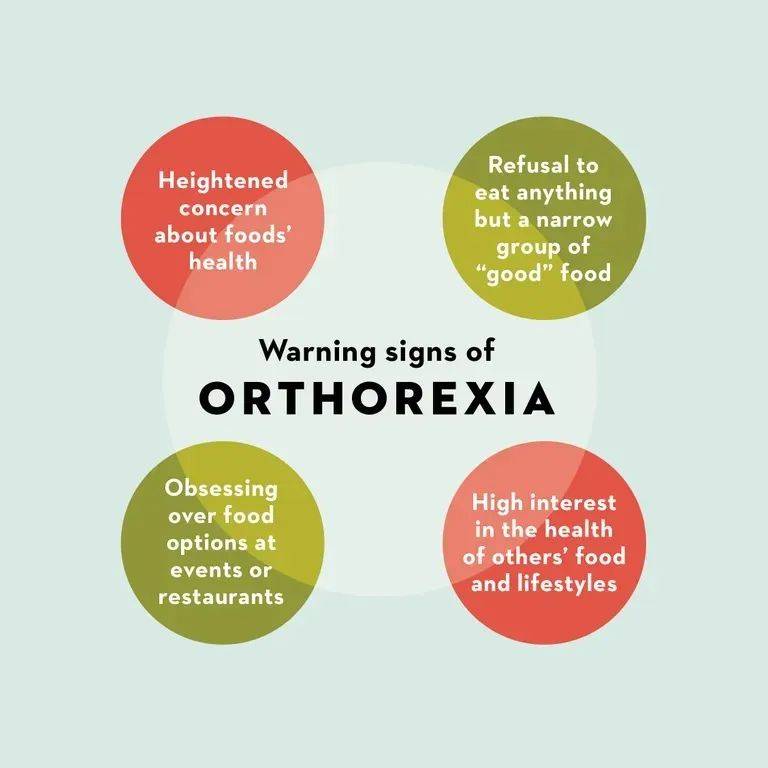
拒绝食物道德化:健康饮食没有十足的“坏食物”
Hu Xiu· 2025-07-19 00:04
Group 1 - The article discusses the misconception surrounding "healthy" food labels, highlighting that a low-sugar, low-fat product can have higher calories than traditional fast food options like McDonald's Big Mac [1][14]. - It emphasizes the trend of categorizing foods into "good" and "bad" based on their perceived health benefits, leading to a culture where individuals feel guilty for consuming "bad" foods [2][3][4]. - The article notes that 74% of surveyed women maintain a personal "food blacklist," indicating a widespread tendency to judge food choices based on health perceptions [3]. Group 2 - The concept of "Orthorexia," or an obsession with healthy eating, is introduced, which can lead to extreme dietary restrictions and social withdrawal [7][20]. - A significant portion of fitness enthusiasts, particularly 52% of gym-goers, are identified as potential candidates for Orthorexia, suggesting a correlation between fitness culture and unhealthy eating habits [8][22]. - The article critiques the "Diet Culture," which links food choices to body image and promotes extreme dieting practices, often at the expense of overall well-being [9][25]. Group 3 - The article advocates for "intuitive eating," which encourages individuals to listen to their body's hunger cues rather than adhering to strict dietary rules [12][35]. - It argues that food should not be morally categorized, and enjoyment of food should be prioritized over calorie counting and guilt [11][44]. - The piece concludes that a balanced approach to eating, which includes social aspects and emotional satisfaction, is essential for a healthy relationship with food [33][32].