金刚石散热材料

Search documents
液冷系列3:TIM材料革新的探讨
GOLDEN SUN SECURITIES· 2026-03-19 11:07
Investment Rating - The report suggests a positive investment outlook for the TIM materials sector, indicating that TIM is expected to become a key component in the liquid cooling industry due to its high-frequency consumable attributes and technological upgrade flexibility [4]. Core Insights - The report highlights the evolution of TIM materials from low-value auxiliary materials to critical components that influence cooling efficiency, driven by the increasing power density of AI servers [2][3]. - The transition to higher performance TIM solutions is being propelled by advancements in chip power density, with liquid metal TIM showing promise in reducing interface thermal resistance [3][4]. - The collaboration between ASIC and Nvidia is noted as a significant driver for TIM material innovation, with both companies exploring liquid metal TIM solutions to enhance cooling efficiency [4]. Summary by Sections Section 1: TIM Overview - TIM is defined as a thermal interface material that fills microscopic gaps to reduce contact thermal resistance, which is becoming increasingly important as AI server power density rises [2]. Section 2: TIM Upgrade Drivers - The report discusses the necessity for TIM upgrades due to the limitations of traditional thermal greases and the superior thermal conductivity of liquid metals, which can significantly enhance cooling efficiency [3]. Section 3: Technological Progress - The current stage of TIM material innovation is characterized as moving from validation to implementation, with major players like NVIDIA and Google focusing on developing high-performance TIM solutions [4]. Section 4: Investment Recommendations - The report recommends focusing on leading companies with metal TIM technology reserves, such as Honeywell and 3M, as well as domestic firms like Kexin Innovation Source, which are positioned to benefit from the growth in the liquid cooling market [4].
通信:液冷系列3:TIM材料革新的探讨
GOLDEN SUN SECURITIES· 2026-03-19 10:24
Investment Rating - The report suggests a positive investment outlook for the TIM materials sector, indicating that TIM is expected to become a key component in the liquid cooling industry due to its high-frequency consumable attributes and technological upgrade flexibility [4]. Core Insights - The report highlights the recent advancements in liquid cooling materials, particularly the delivery of NVIDIA H200 servers utilizing diamond heat dissipation technology, which can reduce GPU hotspot temperatures by approximately 10 degrees Celsius [1]. - TIM (Thermal Interface Material) is evolving from a low-value auxiliary material to a critical component influencing heat dissipation efficiency, driven by the increasing power density of AI servers [2]. - The transition to higher performance TIM solutions is necessary due to the limitations of traditional thermal pastes and the rising power demands of chips, with liquid metal TIM showing promise in reducing interface thermal resistance [3]. Summary by Sections Section 1: TIM Definition and Importance - TIM is defined as a thermal conductive material that fills microscopic gaps to reduce interface contact thermal resistance, which is becoming increasingly significant as AI server power density rises [2]. Section 2: Drivers of TIM Upgrade - The evolution of TIM is a natural response to the increasing power density of chips, with liquid metal TIM offering superior thermal conductivity compared to traditional thermal pastes [3]. Section 3: Technological Progress - The report notes that TIM material innovation is currently in the "verification to implementation" phase, with NVIDIA and various ASIC developers exploring advanced TIM solutions to address thermal management challenges [4]. Section 4: Investment Recommendations - The report recommends focusing on leading companies with metal TIM technology reserves, such as Honeywell and 3M, as well as domestic firms like Kexin Innovation Source, which have high polymer material platforms [4].
华安研究2026年3月金股组合
Huaan Securities· 2026-02-28 13:05
Group 1: Financial Performance - The projected net profit for 2024A, 2025E, and 2026E for MicroPort is -642 million, -205 million, and -107 million respectively, indicating a significant improvement in profitability over the years[1] - The expected revenue growth for MicroPort is 37% in 2024A, 68% in 2025E, and 47% in 2026E, reflecting strong market demand[1] - The EPS for MicroPort is projected to improve from -0.7 in 2024A to -0.1 in 2026E, showing a trend towards profitability[1] Group 2: Market Trends and Risks - The surgical robot sector is identified as one of the fastest-growing fields in the global and Chinese medical device markets, driven by high clinical value and strong demand[1] - The white cardboard paper industry is experiencing a price increase of 200 yuan per ton, which is expected to enhance profitability for leading companies like Bohui Paper[1] - Risks include potential delays in overseas sales for MicroPort and competition in the surgical robot market, which could impact revenue growth[1] Group 3: Industry Insights - The lithium industry is expected to benefit from a supply-demand driven price increase, with Ganfeng Lithium projecting significant revenue growth from -2074 million in 2024A to 9379 million in 2026E[1] - Huayou Cobalt is positioned to benefit from rising nickel and cobalt prices due to supply-side changes, with projected revenues increasing from 4155 million in 2024A to 9268 million in 2026E[1] - The phosphoric chemical industry is experiencing a recovery in demand, with Xingfa Group's revenue expected to rise from 1601 million in 2024A to 2078 million in 2026E[1]
【大涨解读】培育钻石:未来服务器散热“终极方案”之一,英伟达已开始布局,未来有望打开百亿市场空间
Xuan Gu Bao· 2026-02-26 02:41
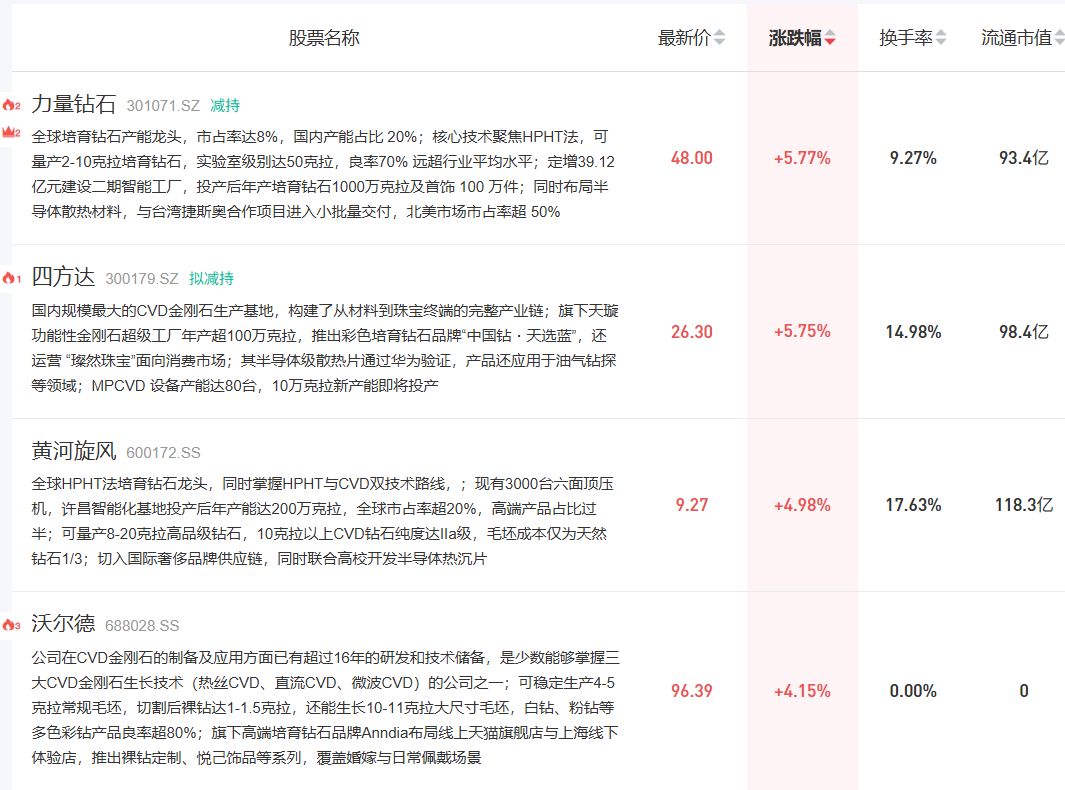
Group 1: Industry Overview - The cultivated diamond sector experienced a significant surge on February 26, with companies like Strength Diamond, Sifangda, Huanghe Xuanfeng, and World achieving notable price increases [1] - The global diamond cooling market is projected to reach 9.7 billion yuan by 2032 under optimistic scenarios, driven by the commercial deployment of diamond thermal management technologies [3] - The demand for synthetic diamonds is expected to grow due to advancements in semiconductor and quantum device applications, with China being a key supplier, accounting for over 70% of global production [3][4] Group 2: Company Highlights - Strength Diamond (301071.SZ) holds an 8% global market share in cultivated diamonds, with a domestic production share of 20%, and is expanding its production capacity significantly [1] - Sifangda (300179.SZ) operates the largest CVD diamond production base in China, with a complete supply chain from materials to jewelry, and is launching a new colored diamond brand [1] - Huanghe Xuanfeng (600172.SS) is a leader in HPHT diamond cultivation, with a production capacity of 2 million carats annually and a global market share exceeding 20% [1] - World (688028.SS) has over 16 years of experience in CVD diamond technology and is capable of producing large-sized diamonds, with a focus on high-end diamond brands [1] Group 3: Technological Advancements - Akash Systems delivered the world's first GPU servers equipped with DiamondCooling® technology, marking a significant milestone in the commercial application of diamond thermal management [2] - The diamond thermal management technology is expected to address the high power consumption and heat dissipation challenges faced by AI chips, with a projected market size of 850 million USD by 2025 [4] - The industry is witnessing a shift towards high-value functional diamond products, particularly in semiconductor and military applications, despite a downturn in traditional superhard materials [3][4]


2026年金刚石散热行业深度:芯片集成化发展,推动材料应用新蓝海(附下载)
Xin Lang Cai Jing· 2026-02-02 10:49
Group 1: Core Insights - The increasing integration and miniaturization of chips lead to higher power consumption and heat generation, necessitating effective thermal management solutions [1][5] - Diamond materials are emerging as superior thermal interface materials due to their high thermal conductivity and compatibility with semiconductor materials [2][3][4] Group 2: Market Potential - The global diamond thermal management market is projected to reach 9.7 billion yuan by 2032, driven by advancements in diamond thermal technology and its commercial applications [10][11] - The AI chip market is expected to grow significantly, with estimates suggesting it could reach $564.87 billion by 2032, indicating a substantial opportunity for diamond thermal solutions in this sector [10][11] Group 3: Material Properties - Diamond thermal interface materials exhibit thermal conductivity ranging from 2000 to 2500 W/(m·K), outperforming copper and aluminum by four and eight times, respectively [2][3][9] - The thermal expansion coefficient of diamond is closely matched with silicon and silicon carbide, ensuring stability during temperature fluctuations [3][9] Group 4: Industry Applications - The aerospace and electronics sectors are driving the demand for high-performance, miniaturized electronic devices, which require advanced thermal management solutions [1][5] - Various electronic packaging materials are categorized into ceramics, plastics, metals, and composites, with diamond materials offering a unique combination of high thermal conductivity and low density [3][9] Group 5: Related Companies - Companies such as World, Sifangda, and Guojijiangong are noted for their involvement in diamond materials and thermal management solutions [12]
金刚石散热深度:芯片集成化发展,推动材料应用新蓝海(附报告)
材料汇· 2026-01-29 16:39
Group 1 - The article discusses the urgent need to address heat dissipation issues in high-performance, high-integration chips due to increased power consumption and heat generation, which can lead to performance degradation and reliability concerns [4][5]. - Traditional chip cooling methods include thermal interface materials (TIM), metal and ceramic-based thermal conductive materials, and various cooling technologies such as air cooling, liquid cooling, heat pipes, and vapor chamber (VC) technology [6][9]. - Diamond materials are highlighted for their superior thermal conductivity, with natural thermal conductivity reaching 2000-2500 W/(m·K), significantly outperforming copper and aluminum, making them ideal for high-performance applications [10][12]. Group 2 - The global diamond heat dissipation market is projected to reach 9.7 billion yuan by 2032, driven by advancements in diamond heat dissipation technology and its increasing commercialization [20][24]. - Companies like Wald, Sifangda, and Guojijiangong are identified as key players in the diamond materials sector, with Wald focusing on ultra-hard tools and expanding into diamond functional materials [25][29][33]. - Sifangda is noted for its self-developed MPCVD equipment to expand applications in precision tools and chip heat sinks, while Guojijiangong is increasing its capacity for high-power MPCVD diamond projects, anticipating significant revenue growth [29][35].
高效散热材料,商业化进程持续推进
China Post Securities· 2025-12-26 11:36
Industry Investment Rating - The industry investment rating is maintained at "Outperform the Market" [1] Core Insights - The report highlights the increasing severity of thermal management issues in high-power electronic devices, particularly as they become more integrated and miniaturized. Effective heat dissipation is crucial for maintaining performance and safety, with over 55% of electronic device failures attributed to excessive temperatures [3][13] - Diamond materials are identified as superior thermal management solutions due to their high thermal conductivity, excellent thermal diffusivity, and good electrical insulation properties, making them suitable for high-frequency AI chips [4][16] - The potential market for diamond cooling solutions in the AI chip sector is projected to be significant, with estimates suggesting a market size ranging from 7.5 billion to 150 billion RMB by 2030, depending on penetration rates and value share [6][38] Summary by Sections Industry Overview - The closing index for the mechanical equipment sector is reported at 2116.63, with a 52-week high of 2116.63 and a low of 1420.7 [1] Thermal Management Challenges - High-performance AI chips can exceed 700W in power consumption, necessitating advanced thermal management solutions to prevent overheating and ensure reliability [13] - The reliability of electronic components is highly sensitive to temperature, with a 5% decrease in reliability for every 1°C increase above 70-80°C [13] Diamond as a Thermal Management Material - Natural single crystal diamond exhibits thermal conductivity of 2000-2200 W/(m*K), significantly outperforming copper and aluminum [4][16] - Diamond's high thermal diffusivity allows for rapid response to localized temperature changes, crucial for densely packed AI chips [16] Applications and Technologies - Diamond is primarily used as a heat sink in various configurations, including substrate-type and cap-type heat sinks, with ongoing advancements in integration techniques [5][19] - Commercial applications of diamond heat sinks have been validated in high-power semiconductor lasers, demonstrating their effectiveness in reducing thermal resistance [23][24] Market Potential - The AI chip market is projected to reach approximately 3 trillion RMB by 2030, with diamond cooling solutions potentially capturing a significant share depending on market penetration rates [6][38] - The report outlines various companies involved in diamond material applications, including Guoji Precision, World, Sifangda, Power Diamond, and Huifeng Diamond, each with unique technological capabilities and market strategies [39]
AI+新材料全景图:新材料如何破局与重构中国AI ?(附企业清单)
材料汇· 2025-12-09 15:59
Core Viewpoint - The article emphasizes the critical role of material innovation in driving the next generation of AI computing power, highlighting the shift from traditional silicon-based materials to advanced materials that can meet the increasing demands of AI applications [2][53]. Group 1: Key Materials for AI Computing - Advanced channel materials are essential for semiconductor transistors, directly influencing speed, power consumption, and integration [4]. - AI chips require channel materials with high mobility, high switching ratio, high stability, low power consumption, low leakage current, and ultra-thin thickness [6]. - Various materials such as MoS₂, black phosphorus, InGaAs, germanium, and carbon nanotubes are identified as promising candidates for next-generation AI chips, each with specific performance metrics [7][10][11][12][14]. Group 2: Gate and Dielectric Materials - Gate and dielectric materials are crucial for controlling the flow of current in transistors, affecting switching speed, power consumption, and reliability [17]. - Hafnium oxide (HfO₂) and its doped variants are highlighted for their low leakage currents and high dielectric constants, suitable for advanced logic chips [18][20][21]. Group 3: Substrate Materials - Substrate materials provide physical support and thermal management for semiconductor chips, impacting performance and reliability [23]. - Silicon carbide (SiC) and gallium oxide (β-Ga₂O₃) are noted for their high breakdown fields and thermal conductivity, making them suitable for AI power modules [24][25]. Group 4: Non-volatile Storage Materials - Phase change materials and resistive switching materials are identified for their potential in next-generation memory applications, offering high speed and low power consumption [26][27]. Group 5: Advanced Packaging and Integration Materials - Materials for substrate and interconnects, such as silicon photonic intermediates and glass substrates, are crucial for enhancing signal transmission speed and reducing power loss [29][30]. - Diamond-based thermal management materials are highlighted for their superior heat dissipation capabilities, essential for high-performance AI chips [32]. Group 6: New Computing Paradigms - Photonic computing materials, such as lithium niobate and silicon-based photonic materials, are discussed for their potential to significantly increase processing speed while reducing energy consumption [35][36]. - Quantum computing materials, including superconductors and diamond nitrogen-vacancy centers, are essential for developing quantum computing hardware [38][39]. Group 7: Investment Logic - The investment opportunity lies in material innovation that can replace traditional silicon technologies, aligning with national strategies for semiconductor supply chain security [53]. - Focus areas for investment include advanced logic and storage materials, packaging and thermal management materials, and frontier materials for emerging computing paradigms [54]. Group 8: Conclusion - The article presents a comprehensive overview of the material innovations driving the AI computing revolution, emphasizing the importance of these advancements for China's semiconductor industry and global competitiveness [56].


中信建投:金刚石散热材料优势显著 算力需求与第三代半导体带动高端市场空间
智通财经网· 2025-10-21 03:42
Core Insights - The semiconductor industry is facing significant thermal management challenges as chip sizes shrink and power levels increase, leading to the urgent need for effective heat dissipation solutions [1][2] Group 1: Semiconductor Industry Challenges - The transition towards advanced semiconductor processes (2nm, 1nm, and even sub-nanometer levels) is resulting in increased power density and heat generation, creating "hotspot" issues that can degrade performance and reliability [1] - Ineffective heat dissipation can lead to localized overheating, resulting in performance degradation, hardware damage, and increased costs [1] Group 2: Diamond as a Thermal Management Solution - Diamond is identified as an ideal thermal management material due to its exceptional thermal conductivity of 2000 W/m·K, which is significantly higher than traditional materials like copper and aluminum [2] - The applications of diamond in thermal management include diamond substrates, heat sinks, and diamond structures with microchannels, which cater to the cooling needs of semiconductor devices and server GPUs [2] Group 3: Advantages of Diamond as a Semiconductor Substrate - Diamond offers the highest thermal conductivity among known materials, making it effective for heat dissipation in high power density devices [3] - With a bandgap of approximately 5.5 eV, diamond can operate stably in high-temperature and high-voltage environments, making it suitable for high-power electronic devices [3] - Diamond's electrical current carrying capacity far exceeds that of traditional semiconductor materials, allowing it to accommodate high current applications [3] - The mechanical strength and wear resistance of diamond enhance the reliability and lifespan of devices under harsh operating conditions [3] - Diamond's radiation resistance makes it suitable for use in high-radiation environments such as space and nuclear applications [3]

【大涨解读】培育钻石:行业龙头加码“钻石散热”,华为、英伟达也集体关注这一“半导体终极材料”,产业链开启“从0到1”临界点
Xuan Gu Bao· 2025-05-27 02:16
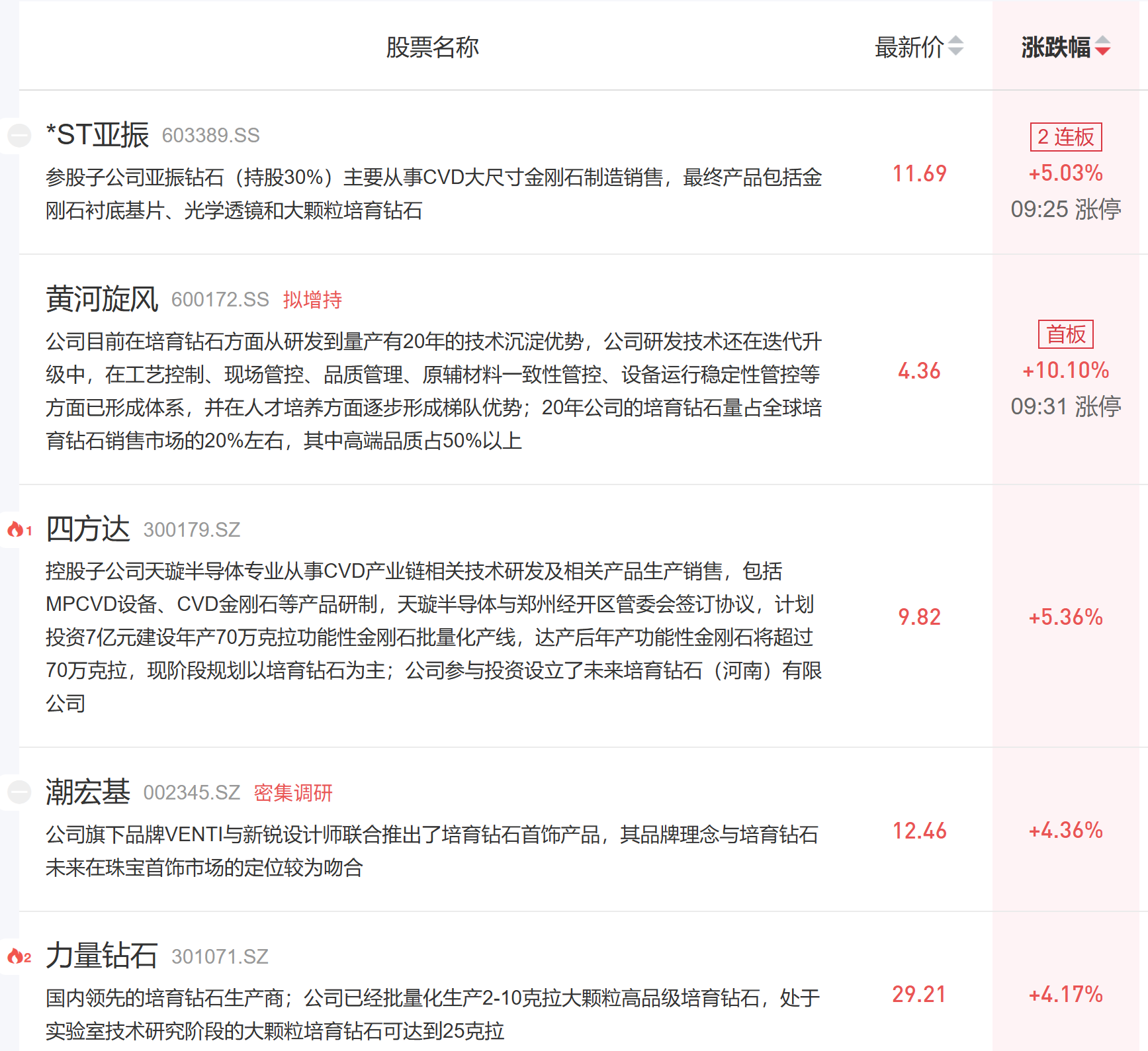
Market Overview - On May 27, the cultivated diamond sector opened strong, with Huanghe Xuanfeng hitting the daily limit up, and companies like Huifeng Diamond, Sifangda, and Liliang Diamond also experiencing significant gains [1] Company Developments - **ST Yazhen (603389.SS)**: Holds a 30% stake in Yazhen Diamond, which specializes in CVD large-size diamond manufacturing and sales, contributing to about 20% of the cultivated diamond sales market, with high-end quality diamonds accounting for over 50% [3] - **Huanghe Xuanfeng (600172.SS)**: Plans to increase its stake, leveraging 20 years of technical experience in cultivated diamonds, with a focus on R&D, production, and quality management [3] - **Sifangda (300179.SZ)**: Its subsidiary Tianxuan Semiconductor is involved in CVD technology R&D and has signed a 700 million yuan investment agreement to establish a production line for 700,000 carats of functional diamonds annually [3] - **Liliang Diamond (301071.SZ)**: A leading domestic producer of cultivated diamonds, currently producing high-grade diamonds in the range of 2-10 carats, with research indicating potential for 25-carat diamonds [4] Industry Events - On May 27, Huanghe Xuanfeng announced a joint venture with Bozhi Jinduan to develop diamond-based thermal materials for the semiconductor packaging sector [5] - Liliang Diamond is focusing on high-power heat sink projects, anticipating broad applications for diamonds in semiconductor cooling [5] - A $27 million agreement was signed between Akash and NxtGen for deploying diamond cooling servers in India [5] - Huawei and Nvidia are both exploring diamond cooling technologies, with Huawei filing a patent related to semiconductor devices involving diamond cooling [5] Industry Insights - Diamonds possess the highest known thermal conductivity, being 13 times that of silicon and 4-5 times that of copper and silver, making them a promising material for the semiconductor industry [6] - The diamond cooling technology can enhance GPU and CPU performance by three times, reduce temperatures by 60%, and lower energy consumption by 40%, potentially saving millions in cooling costs for data centers [6] - The diamond cooling market is projected to grow from $0.5 million in 2025 to $15.2 billion by 2030, with a compound annual growth rate of 214% [6] - In quantum computing, nitrogen-vacancy centers in diamonds are seen as a core material due to their ability to maintain quantum states at room temperature [6] - CVD-produced polycrystalline diamond heat sinks have a diameter of up to 2 inches and a thickness of 0.3 to 1 mm, offering superior thermal conductivity compared to traditional materials [6]