
钢铁ETF(515210)

Search documents
分级落地+反内卷强化,钢铁板块利好不断,钢铁ETF(515210)涨超2%
Mei Ri Jing Ji Xin Wen· 2026-02-27 07:07
Core Viewpoint - The steel industry is expected to see an increased probability of supply-side adjustments in the short to medium term, influenced by upcoming losses in listed steel companies and tightening export policies [1] Group 1: Supply-Side Adjustments - By Q4 2025, the losses of listed steel companies are approaching those seen in Q3/Q4 2024, indicating a potential need for supply-side policies to mitigate these losses [1] - Since early 2026, export policies for steel have tightened, which is critical as direct and indirect exports are a pillar for the steel industry's profitability in 2025 [1] Group 2: Policy and Regulation - The Central Economic Work Conference in December 2025 reiterated the need to address "involution" competition and to advance energy-saving and carbon reduction transformations in key industries [1] - By the end of December 2025, the National Development and Reform Commission emphasized the continuation of crude steel production controls [1] Group 3: Long-Term Outlook - In the medium to long term, the supply of steel may be reasonably constrained, leading to a potential recovery of profitability in the steel sector back to historical average levels [1] Group 4: Steel ETF - The Steel ETF (515210) tracks the CSI Steel Industry Index (930606), which selects listed companies involved in various steel products to reflect the overall performance of the steel industry [1]
供需+政策利好共振,钢铁ETF(515210)大涨超2%
Sou Hu Cai Jing· 2026-02-27 03:33
Core Viewpoint - The steel sector is at a pivotal point driven by multiple resonating factors, with recent positive news catalyzing a significant rise in the only steel ETF (515210) by over 2% at the market open [1] Supply Side: Policy Framework and Capacity Management - The "anti-involution" initiative in the steel industry is gaining traction, with high-level meetings emphasizing the need to address "involutionary" competition and accelerate the exit of outdated capacity [4] - A clearer policy framework is emerging, with the central economic work conference proposing a unified national market and measures to tackle "involution" [4] - Steel companies will undergo a classification management system aimed at guiding resources towards leading firms, with policies expected to gradually take effect by 2026 [4] - The industry is witnessing increased concentration as smaller firms face survival pressures, benefiting larger companies with technological and cost advantages [4] Cost Side: Iron Ore Supply and Profit Distribution - The steel industry landscape is shifting as major iron ore projects come online, leading to a more relaxed supply-demand dynamic and a potential profit transfer from raw materials to finished products [5] - Current iron ore port inventories have reached 169 million tons, indicating a loosening supply situation [5] - The profit distribution within the steel supply chain is changing, with iron ore profits expected to decline, allowing for improved profitability in finished steel products [5] Inventory and Pricing: Low Inventory and Price Stabilization - This year's winter storage efforts have been weaker than in previous years, resulting in total inventory levels being at a near historical low, which reduces post-holiday destocking pressure [7] - Steel prices have stabilized at around 3200 yuan/ton, indicating a bottoming out after several quarters of decline, setting the stage for potential price increases if demand or supply catalysts emerge [7] Demand Side: Shift in Steel Demand Structure - By 2025, the demand structure in the steel industry is expected to undergo a historic shift, with manufacturing steel usage surpassing that of construction for the first time, becoming the core demand pillar [8] - The automotive sector is projected to see record production and sales, with new energy vehicles also contributing significantly to steel demand growth [8] - Emerging sectors such as energy and nuclear power are expected to drive additional demand, with significant investments planned in these areas [9] Investment Opportunity: Steel ETF (515210) - The steel ETF (515210) offers a diversified investment approach to capitalize on the "anti-involution" trend and the potential recovery in the steel sector [10] - The current valuation of the steel sector is considered to be at a medium-low level, with significant room for absolute returns as the market rebounds [10] - The ETF tracks leading companies in the industry, which are expected to benefit from improved profitability as raw material costs decrease [10]

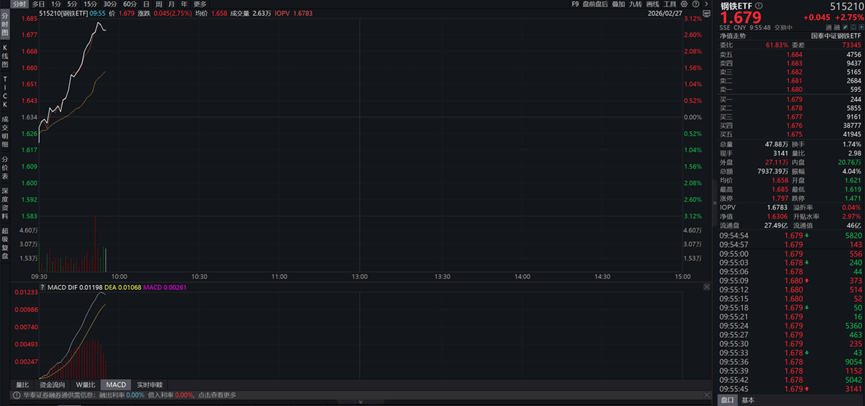
钢铁板块迎估值修复,钢铁ETF(515210)盘中涨超1%,上一交易日净流入超8000万元
Mei Ri Jing Ji Xin Wen· 2026-02-26 03:52
Group 1 - The steel sector is experiencing a valuation recovery, with the steel ETF (515210) rising over 1% during intraday trading on February 26, and a net inflow exceeding 80 million yuan on the previous trading day [1] - Everbright Securities indicates that the probability of supply-side adjustments in the steel industry has increased in the short to medium term, with losses for listed steel companies approaching levels seen in Q3/Q4 of 2024 by Q4 of 2025 [1] - The tightening of steel export policies since early 2026, including the implementation of export license management for certain steel products starting January 1, 2026, poses a risk to the profitability of the steel industry, which heavily relies on direct and indirect exports [1] Group 2 - The Central Economic Work Conference in December 2025 reiterated the need to address "involution" competition and promote energy-saving and carbon reduction transformations in key industries, emphasizing continued control over crude steel production [1] - The steel ETF (515210) tracks the CSI Steel Industry Index (930606), which selects listed companies from the Shanghai and Shenzhen markets involved in various steel sectors, reflecting the overall performance of the steel industry [1] - The index constituents cover major areas within the industry, with ordinary steel holding a dominant position, and the sample is regularly adjusted to maintain industry representation [1]
2月25日盘后播报:午后上海官宣楼市新政,建材板块活跃
Mei Ri Jing Ji Xin Wen· 2026-02-25 10:25
Group 1: A-Share Market Performance - The A-share market opened high and closed higher, with the Shanghai Composite Index rising by 0.72% to 4147.23 points, the Shenzhen Component Index increasing by 1.29%, and the ChiNext Index up by 1.41% [1] - The total trading volume for the day was 2.48 trillion yuan, compared to 2.22 trillion yuan the previous day [1] Group 2: Semiconductor Equipment Sector - The Semiconductor Equipment ETF (159516) experienced a significant increase, closing up by 4.56% after an initial drop, driven by expectations of major customer orders in the storage segment [1] - This cycle of semiconductor equipment is characterized by benefits from global AI-driven high demand, differing from previous cycles focused on recovery or domestic substitution [1] Group 3: Shanghai Real Estate Policy - Shanghai introduced new real estate policies, including reducing the social security requirement for non-local families from 3 years to 1 year for purchasing homes within the outer ring, allowing an additional purchase for non-local families, and increasing the first home provident fund loan limit from 1.6 million to 2.4 million yuan [2] - The new policies are expected to stimulate demand for housing and lower financial barriers for homebuyers, potentially boosting the building materials and real estate sectors [2] Group 4: Steel Sector Insights - The steel sector saw a significant rise, with the Steel ETF (515210) increasing by 4.27%, driven by both demand-side and supply-side catalysts [2] - Demand is expected to be supported by favorable real estate policies in key cities, while supply is anticipated to contract by 2026, with low inventory levels potentially leading to upward price elasticity if demand increases [2]
重磅发布!工信部公示符合《钢铁行业规范条件(2025年版)》企业,钢铁板块受提振,钢铁ETF(515210)收涨超4%
Mei Ri Jing Ji Xin Wen· 2026-02-25 08:15
Core Viewpoint - The Ministry of Industry and Information Technology announced the first batch of enterprises that meet the "Steel Industry Normative Conditions (2025 Edition)," positively impacting the steel sector, with the Steel ETF (515210) rising over 4% [1]. Group 1: Industry Impact - The announcement of the steel industry norms is expected to boost market sentiment, leading to a strong rebound in steel prices post-holiday due to low inventory levels and cost support [1]. - Long-term storage efforts this winter have been the weakest in recent years, resulting in low total inventory levels for five major steel products, which may alleviate post-holiday destocking pressure [1]. - Rebar prices are currently running above 3,200 yuan per ton, indicating that price adjustments have been sufficient, with a significant probability of price increases in the near future [1]. Group 2: ETF and Index Performance - The Steel ETF (515210) tracks the CSI Steel Industry Index (930606), which selects securities from listed companies in the steel sector, including both general and special steel, to reflect the overall performance of the Chinese steel industry [1].
黑色系市场延续回暖态势,钢铁板块迎大涨,钢铁ETF(515210)涨近6%
Mei Ri Jing Ji Xin Wen· 2026-02-25 04:23
Group 1 - The black metal market continues to show signs of recovery, with the steel sector experiencing a significant increase on February 25, as the Steel ETF (515210) rose nearly 6% [1] - According to Guotai Junan, steel prices are witnessing a genuine upward trend, with both rebar futures and spot prices strengthening simultaneously, and iron ore and coking coal varieties also performing well, leading to a sustained increase in market sentiment [1] - Data from the National Bureau of Statistics indicates that the price of coking coal (main coking coal) increased by 0.5% in mid-January 2026 compared to the previous period, suggesting that demand may remain strong even in the off-season [1] Group 2 - The Steel ETF (515210) tracks the CSI Steel Industry Index (930606), which selects securities from listed companies in the steel industry, including both ordinary and special steel sectors, to reflect the overall performance of China's steel industry-related listed companies [1]
供给端边际改善叠加“反内卷”政策预期升温,钢铁ETF(515210)盘中涨超5.7%
Sou Hu Cai Jing· 2026-02-25 04:17
Core Viewpoint - The steel sector is experiencing a rebound driven by marginal improvements on the supply side and rising expectations for "anti-involution" policies, leading to a significant increase in the steel ETF (515210) by over 5.7% during trading [1] Supply Side - The capacity utilization rate of 247 steel mills increased to 86.4%, up by 0.7 percentage points, with daily molten iron output rising to 2.306 million tons, an increase of 19,000 tons [4] - The "anti-involution" policy expectations are strengthening the logic for production cuts, which could accelerate the rebalancing of supply and demand in the steel industry [4] - Historical trends indicate that improvements in steel industry profitability typically arise from either strong demand driving price increases or supply reductions improving industry dynamics [4] Inventory and Demand - Social inventory of the five major steel products reached 10.267 million tons, a 9.2% increase, while steel mill inventory rose by 4.7% to 4.161 million tons [5] - Apparent consumption of the five major steel products decreased by 9.4% to 6.891 million tons, with rebar consumption dropping by 31.0% [5] - The current inventory increase is attributed to seasonal factors, and if demand rebounds post-holiday, a downward trend in inventory could be anticipated [6] Raw Materials and Profit Margins - The Platts 62% iron ore price index fell to $96.5 per ton, a decrease of 3.7% week-on-week, indicating a weakening trend in raw material prices [7] - The immediate gross profit for long-process rebar was -175 yuan per ton, and for hot-rolled coil, it was -357 yuan per ton, showing marginal improvement despite remaining in a loss position [7] - Historical data suggests that steel stock prices often lead gross profit by 1-2 quarters, indicating that the market is already pricing in expected profit improvements [7] Valuation and Allocation - The steel sector has undergone significant valuation recovery, moving from extreme undervaluation to a moderately low range, still offering absolute return potential [8] - The steel sector's pricing logic is shifting from "pessimistic clearance" to "profit recovery," driven by supply-side policies and macroeconomic stabilization [8] - The steel ETF (515210) serves as a representative product for the industry, reflecting changes in the profitability cycle and offering advantages in diversifying individual stock risks while capturing overall industry trends [8]
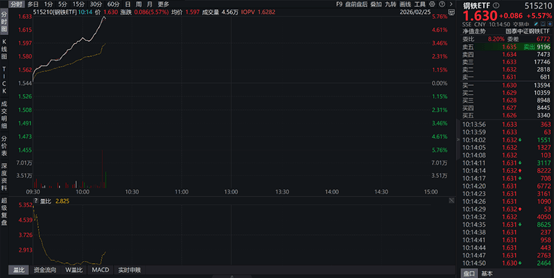
钢铁基本面有望逐步修复,钢铁ETF(515210)收涨超1.7%
Mei Ri Jing Ji Xin Wen· 2026-02-11 11:08
Group 1 - The steel industry's fundamentals are expected to gradually improve, with the steel ETF (515210) rising over 1.7% on February 11 [1] - Demand is anticipated to stabilize while supply is expected to continue contracting. Since 2021, the decline in new real estate projects has led to a decrease in the proportion of steel demand from the real estate sector, with the negative impact of real estate on steel demand significantly weakening [1] - Steel demand from infrastructure and manufacturing sectors is expected to grow steadily. Currently, about 60% of steel companies are operating at a loss, indicating that market-driven supply adjustments are beginning to occur [1] Group 2 - The steel ETF (515210) tracks the CSI Steel Industry Index (930606), which selects listed companies involved in various steel sectors to reflect the overall performance of the steel industry [1]
钢铁板块高质量发展,钢铁ETF(515210)收涨1.8%
Mei Ri Jing Ji Xin Wen· 2026-02-09 09:38
Core Viewpoint - The steel industry is expected to experience high-quality development driven by increased industry concentration and enhanced competitive advantages of leading companies, particularly in the context of stricter environmental regulations and carbon neutrality goals [1] Industry Summary - The steel ETF (515210) rose by 1.8% on February 9, indicating positive market sentiment towards the steel sector [1] - Long-term trends suggest that the steel industry's development will be characterized by a focus on high-quality growth and improved profitability for leading companies due to stricter environmental standards and low emissions [1] - The demand for steel from the real estate sector is declining, but the negative impact of this trend on overall steel demand is expected to diminish as infrastructure and manufacturing sectors show signs of stable growth [1] - Approximately 60% of steel companies are currently operating at a loss, indicating a need for market-driven supply adjustments, which are beginning to occur [1] - If supply-side policies are implemented effectively, the pace of supply contraction in the industry may accelerate, leading to a gradual recovery in the steel industry's fundamentals [1] ETF and Index Summary - The steel ETF (515210) tracks the CSI Steel Industry Index (930606), which includes listed companies involved in various steel sectors, reflecting the overall performance of the steel industry [1]
钢铁ETF(515210)回调超5%,中国钢材出口正步入转型攻坚期
Mei Ri Jing Ji Xin Wen· 2026-02-02 06:50
Core Viewpoint - The year 2025 is identified as a transformative year for China's steel exports, with a shift towards quality and efficiency despite record-high export volumes and a trend of increasing quantity but decreasing prices [1] Industry Summary - China's steel export scale is reaching historical highs, but the industry is facing a "volume increase and price drop" trend, alongside profound changes in export structure, policy environment, and global trade patterns [1] - The implementation of export license management starting January 1, 2026, and the EU's Carbon Border Adjustment Mechanism (CBAM) will guide the industry towards a focus on high value-added and green low-carbon development [1] - The steel industry will concentrate on three major transformation projects: enhancing quality and product innovation, improving energy efficiency and carbon reduction, and digital transformation [1] - Increased investment in high-end product research and development, expansion into emerging markets, and proactive establishment of overseas green low-carbon production capacity are strategies to address trade friction and green barriers, aiming to reshape international competitive advantages [1] ETF and Index Summary - The Steel ETF (515210) tracks the CSI Steel Index (930606), which selects listed companies in the steel industry from the Shanghai and Shenzhen markets to reflect the overall performance of the steel sector [1] - The index covers various sub-sectors, including ordinary steel and special steel, and reflects the cyclical characteristics and market dynamics of the steel industry, with constituent stocks focusing on steel manufacturing and related businesses, demonstrating strong industry representativeness [1]