银联卡

Search documents
银联国际与阿塞拜疆中央银行签署合作备忘录 共促支付互联与旅游便利
Xin Hua Wang· 2026-02-04 05:57
Group 1 - The core point of the article is the strategic cooperation memorandum signed between UnionPay International and the Central Bank of Azerbaijan, focusing on expanding UnionPay card issuance, developing local QR code standards, and promoting cross-border connectivity [1][2] Group 2 - UnionPay International aims to increase the issuance scale of UnionPay cards in Azerbaijan and explore unique card products such as social security cards [1] - The collaboration will leverage UnionPay's expertise in QR code payment technology to establish a local QR code standard system, enhancing payment interoperability between China and Azerbaijan [1] - The signing of the memorandum signifies a new phase of systematic and ecological development in payment cooperation between the two countries [1] Group 3 - The demand for cross-border payments is surging due to the increasing tourism between China and Azerbaijan, with a notable rise in Chinese tourists visiting Azerbaijan [2] - UnionPay has established a comprehensive acceptance network in Azerbaijan through partnerships with major local banks, covering daily consumption scenarios and online payment services [2] - The ongoing economic exchanges between China and Central Asia are expected to further enhance the convenience of payment services, driving deeper economic ties between China and Azerbaijan [2]
银联国际与阿塞拜疆央行签署合作备忘录
Sou Hu Cai Jing· 2026-01-30 09:02
Core Viewpoint - UnionPay International has signed a strategic cooperation memorandum with the Central Bank of Azerbaijan to enhance collaboration in areas such as expanding UnionPay card issuance, establishing local QR code standards, and promoting cross-border connectivity [1][2] Group 1: Strategic Cooperation - The agreement aims to expand the issuance scale of UnionPay cards in Azerbaijan and explore the development of specialty card products like social security cards [1] - Both parties will collaborate to build a local QR code standard system, leveraging UnionPay's technological expertise in QR code payment [1] Group 2: Tourism and Payment Demand - Following the implementation of a visa-free policy for Chinese citizens in July 2024, the number of Chinese tourists to Azerbaijan surged to nearly 45,000, marking a 93% year-on-year increase [1] - By November 2025, the number of Chinese tourists reached 61,000, positioning China among the top ten source markets for inbound tourism to Azerbaijan [1] - The rising tourism has created strong demand for cross-border payment solutions, prompting UnionPay International to collaborate with local banks to enhance its acceptance network [2]
跨境联通 无缝接轨:银联如何织就一张全球支付网络
Xin Hua Wang· 2026-01-21 01:30
Group 1 - The core viewpoint of the articles emphasizes UnionPay's evolution from a service primarily for Chinese cardholders to a global payment network, showcasing its commitment to expanding its international presence and adapting to the mobile payment trend [1][2][4]. Group 2 - UnionPay's internationalization began in 2004 in Hong Kong, aiming to address the payment challenges faced by Chinese travelers abroad, and has since expanded to cover 183 countries and regions with over 75 million merchants accepting UnionPay [2]. - The establishment of UnionPay International in 2012 marked a significant step in its global strategy, leading to a comprehensive product matrix that includes mobile payment solutions, enhancing its competitive edge [2][3]. - UnionPay has issued over 200 million cards in 83 overseas markets, with a notable penetration rate in the Asia-Pacific region, and has launched over 200 cooperative wallets in 37 countries [2][3]. Group 3 - UnionPay employs a dual-track strategy for market expansion, utilizing G2G (government-to-government) models in regulated markets and N2N (network-to-network) models in mature commercial markets to facilitate efficient connections with local payment networks [3]. - The company is also involved in building a new "four-party model" open ecosystem, acting as a hub connecting various stakeholders in the payment industry, exemplified by projects like the QR code interoperability between China and Indonesia [3][4]. Group 4 - UnionPay's role has evolved from a "builder" of payment infrastructure to an "enabler" of industry standards, exporting its technology and standards to enhance digital payment capabilities in countries like Laos and Thailand [4]. - The company is actively participating in national infrastructure projects, such as the upcoming cross-border QR code unified gateway set to launch in 2025, which aims to improve cross-border payment efficiency [3][4]. Group 5 - UnionPay's services cater to both individual consumers and businesses, offering a range of products including standard credit and debit cards, as well as specialized cards for cross-border tourists and students [5][6]. - The introduction of mobile payment tools like UnionPay Mobile Pay and QR code wallets allows cardholders to enjoy convenient payment services in over 100 countries [6]. Group 6 - To enhance the payment experience for foreign visitors in China, UnionPay has launched products like the "Jinxiu Zhonghua Card" and the "Nihao China" app, which integrates various services to facilitate seamless transactions [7]. - UnionPay is also promoting the integration of foreign wallets into the Chinese payment ecosystem, allowing users to pay using local payment habits, which has shown significant growth in transaction volumes [7]. Group 7 - UnionPay is positioning itself as a digital bridge connecting different currencies, payment habits, and cultures, contributing to a more open and inclusive global payment ecosystem [8]. - The company's development practices highlight that the competitiveness of a payment network in the digital age relies on both the breadth of coverage and the depth of ecosystem connections [8].
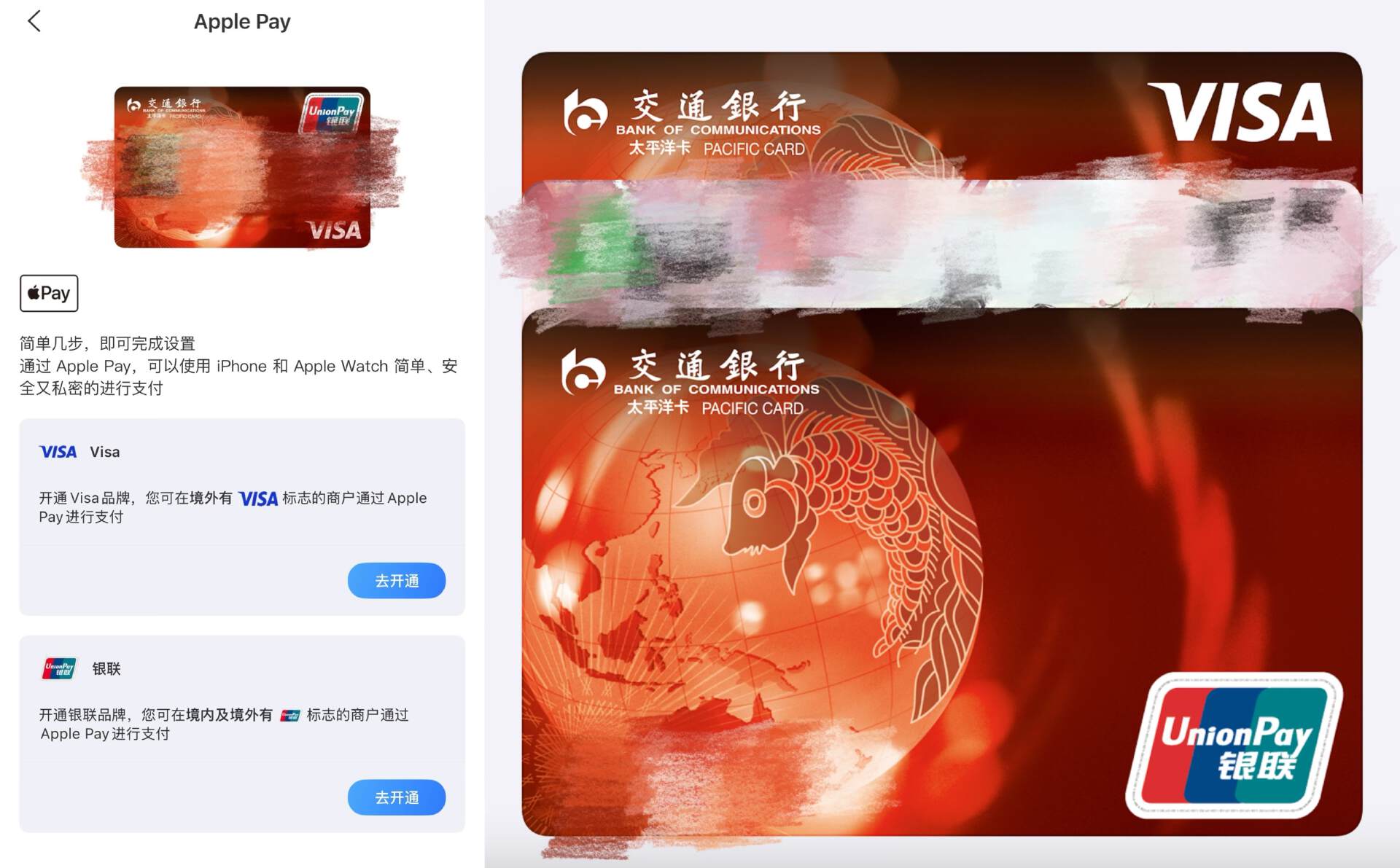
实测Apple Pay绑Visa卡:这类卡可能受影响!
2 1 Shi Ji Jing Ji Bao Dao· 2026-01-16 12:21
Core Viewpoint - Apple Pay has opened the option to bind Visa cards, requiring users to rebind previously linked dual-branded cards, which can now be selected for either Visa or UnionPay usage [1][5]. Group 1: Apple Pay and Visa Card Integration - Apple Pay's integration with Visa allows users to bind dual-branded cards, which previously required re-binding due to functionality changes [1][5]. - The dual-branded cards, which combine UnionPay and Visa, were created to address the challenges of using UnionPay cards abroad and foreign cards domestically during a time when the Chinese market was not fully open [5]. Group 2: User Experience and Security - The new binding process aims to enhance user experience by allowing automatic switching between available cards during transactions, although manual selection may be needed in rare cases [5]. - The non-contact payment method offered by Apple Pay is considered more convenient and secure, reducing the risk of card theft and allowing users to carry fewer physical cards while traveling [6]. Group 3: Market Context and Future of Dual-Branded Cards - Dual-branded cards are seen as a transitional product in the Chinese banking market, with no new cards being issued as foreign card organizations can now obtain licenses within China [5]. - Existing dual-branded cards can still be used, but the market for new dual-branded cards is diminishing as the landscape evolves [5].


世界正变得破碎,中国支付却忙着缝合
虎嗅APP· 2026-01-15 09:45
Core Insights - The article emphasizes the concepts of "resilience" and "DeepSeek" as key themes for 2025, highlighting the need for determination in navigating cycles and the courage to seek certainty amid uncertainty [2][3] - The payment industry is undergoing significant transformation driven by AI, with new infrastructures emerging to address previous limitations [3][4] Group 1: Payment Industry Transformation - In 2025, the payment industry presents a paradox where physical cards are diminishing, yet the underlying financial flows are surging, with UnionPay and NetsUnion processing 151.66 trillion yuan in payments during the summer, a 16.64% year-on-year increase [14] - The shift towards a "new four-party model" by UnionPay reflects a strategic adaptation to the diminishing returns of user attention in the digital economy [14][18] - The essence of cards has evolved from physical objects to digital identifiers, allowing various secure storage mediums to act as extensions of bank accounts, leading to a rapid expansion of UnionPay's network [17][19] Group 2: Addressing Market Gaps - The proliferation of AI and big data has intensified capital's focus on high-value markets, leaving underserved areas like rural markets and small businesses behind [22][25] - UnionPay's initiatives, such as issuing 44.6 million small business cards and over 1.4 billion rural revitalization cards, demonstrate a commitment to covering low-margin areas and supporting economic inclusivity [25][28] - The focus on elderly populations is evident through the establishment of over 8,000 senior meal assistance points and the issuance of 27 million senior-friendly cards, ensuring that technological advancements do not exclude vulnerable groups [28][30] Group 3: Enhancing AI Interactivity - The article discusses the necessity for AI to interact effectively with financial systems, highlighting UnionPay's introduction of a smart payment service based on the Model Context Protocol (MCP) [34] - This service allows AI to access payment capabilities without complex API integrations, while a robust risk control system ensures transaction security with an accuracy rate of 85% [34] - The future of transactions may involve interactions between user and merchant AI agents, necessitating a redefinition of legal relationships and responsibilities in financial transactions [36] Group 4: Cross-Border Payment Solutions - UnionPay's approach to cross-border payments emphasizes a non-intrusive connection philosophy, respecting local financial sovereignty while facilitating seamless transactions across different payment networks [39] - This strategy has led to partnerships with nearly 50 countries and regions, enhancing global payment interoperability without imposing uniform standards [39][40] - The ultimate goal is to create a payment infrastructure that connects independent systems while preserving their unique characteristics, reflecting a sophisticated level of globalization [40]

中国游客在日本的消费额转为下降
日经中文网· 2025-12-26 08:00
Core Viewpoint - The article highlights a significant decline in credit card transaction volumes from Chinese tourists in Japan, attributed to a government advisory against travel to Japan, which has negatively impacted both consumer spending and the Japanese retail sector [2][5]. Group 1: Credit Card Transaction Data - In November, credit card transaction volumes from mainland China and Hong Kong decreased by 8% year-on-year, marking a return to negative growth after two months of increases [2][5]. - Overall transaction volumes from ten countries and regions increased by 22%, with notable growth in the U.S., Taiwan, and Australia, averaging a 29% increase [4]. - The decline in transaction volumes from China is influenced by the appreciation of the yen and a reduction in high spending, with a projected decrease in transaction volumes from March to August 2025 [5]. Group 2: Impact on Japanese Retail Sector - Japanese department stores have reported a decline in duty-free sales, with J.FRONT RETAILING's Daimaru Matsuzakaya down 9.4%, Takashimaya down 9.8%, and Mitsukoshi Isetan down approximately 20% [5]. - Takashimaya noted a 23.9% drop in sales specifically from Chinese customers, indicating the immediate impact of the travel advisory [5]. - Sales at key locations such as the Kobe and Osaka Shinsaibashi stores have seen significant declines, despite growth in non-Chinese customer sales [5]. Group 3: Economic Projections - If the travel advisory from the Chinese government persists for a year, the economic loss for Japan could reach 17.9 trillion yen, according to estimates from Nomura Research Institute [6]. - Economic experts predict that consumer spending from Chinese tourists may not return to normal levels until late 2026, given the current state of bilateral relations [6].

马尔代夫银行(BML)、马旅游局与中国银联签署合作协议
Shang Wu Bu Wang Zhan· 2025-12-21 16:43
Core Viewpoint - Maldives Bank (BML), the Maldives Tourism Board, and China UnionPay have signed a cooperation agreement to launch a joint marketing plan aimed at enhancing digital payment experiences and strengthening tourism promotion [1] Group 1: Partnership Details - The three parties will jointly promote the Maldives tourism image to attract more visitors, specifically targeting UnionPay cardholders [1] - BML has been designated as the settlement agent for UnionPay in the Maldives, laying the groundwork for deeper collaboration and future issuance of UnionPay cards [1] Group 2: Impact on Digital Payments and Tourism - This initiative is expected to further improve the digital payment ecosystem in the Maldives, contributing to the development of the tourism industry [1]
中国支付出海下一站 中东沙漠里的“蓝海”
2 1 Shi Ji Jing Ji Bao Dao· 2025-12-17 11:16
Core Insights - Chinese payment companies are actively exploring opportunities in the Middle East, with significant developments in digital payment services and partnerships [1][2][3] Group 1: Market Developments - Qatar National Bank launched WeChat mobile payment services for retailers in Qatar, marking a significant entry of Chinese payment solutions into the region [1] - Yibao Payment announced a strategic partnership with the Abu Dhabi Investment Office to enhance cross-border digital payment services between the UAE, China, and global markets [1][2] - Several Chinese companies, including PingPong and CoGoLinks, have recently obtained payment licenses in the UAE, indicating a growing trend of Chinese firms entering the Middle Eastern payment landscape [3] Group 2: Industry Growth - The Middle East is becoming a focal point for cross-border payment companies, with many seeking licenses to operate in the region [2] - UnionPay has established a payment acceptance network across 15 Middle Eastern countries, with significant growth in the use of contactless payments and QR codes [4] - The e-commerce market in the UAE is projected to grow from 32.3 billion dirhams (approximately 8.8 billion USD) in 2024 to over 50.6 billion dirhams (approximately 13.8 billion USD) by 2029, with a compound annual growth rate of 56% [7] Group 3: Strategic Partnerships - Chinese payment companies are not merely competing but are focusing on collaborative efforts to support local development in the Middle East [8] - Partnerships between local firms like Telr and Chinese payment companies have led to significant increases in transaction volumes, demonstrating the effectiveness of these collaborations [9] Group 4: Economic Context - The Middle East serves as a crucial junction for trade between Asia, Africa, and Europe, making it an important market for Chinese enterprises [5][6] - The region's high GDP per capita and young population contribute to a robust consumer market, further attracting Chinese investment [7] Group 5: Future Outlook - The alignment of Chinese companies' capabilities with Dubai's development goals in sectors like AI, digital payments, and sustainable technologies presents significant opportunities for collaboration [10][11] - There is a strong expectation for continued growth in partnerships between Chinese firms and Middle Eastern entities, particularly in financial technology and digital innovation [10][11]

全球支付产业变革,银联以新“四方模式”给出开放互联中国方案
2 1 Shi Ji Jing Ji Bao Dao· 2025-12-03 10:49
Core Insights - The article emphasizes the transformative role of China UnionPay in the global payment industry, highlighting its innovative approach to cross-border payment solutions and the establishment of a more inclusive payment ecosystem [1][3][7] Group 1: China UnionPay's Role in Global Payments - China UnionPay is positioned as a "connector" in the global payment network, facilitating cross-border payment services and creating a new ecosystem for global payments [3][4] - The company has expanded its service offerings, partnering with local networks in various countries to enhance its global reach, including collaborations in Armenia and the UAE [3][4] - UnionPay's global acceptance network now covers 183 countries and regions, with over 200 local wallets supporting UnionPay QR codes or mobile payments [7][8] Group 2: Innovations and Collaborations - The company has introduced a new "four-party model" that includes wallet providers and mobile manufacturers, aiming to create a more open and inclusive payment environment [1][7] - UnionPay has established partnerships with 11 global institutions, including banks and payment networks from countries like Malaysia and Uzbekistan, to enhance cross-border payment capabilities [1][2] - The "China-Indonesia cross-border QR code interconnection" project exemplifies the collaborative efforts under the new model, showcasing the integration of various stakeholders to facilitate seamless payments [8][9] Group 3: Ecosystem Development and Shared Infrastructure - UnionPay is committed to building a shared infrastructure for payment systems, allowing banks to utilize standardized APIs and security frameworks, thus enhancing the overall efficiency and safety of payment networks [9] - The company aims to reduce fragmentation in the global payment ecosystem by fostering knowledge exchange and collaborative defense against financial risks [6][9] - UnionPay's initiatives are not merely about market expansion but also about creating a sustainable and interconnected payment ecosystem that benefits all participants [6][9]
全球支付产业变革,银联以新“四方模式”给出开放互联中国方案
21世纪经济报道· 2025-12-03 10:42
Core Viewpoint - The article emphasizes that China, driven by innovation, plays a crucial role in the global payment industry's high-quality development, particularly through the initiatives of China UnionPay to create an open and inclusive payment ecosystem [1][2]. Group 1: Global Payment Network Development - China UnionPay has introduced an open and interconnected "Chinese solution" to enhance the traditional "four-party model" by incorporating wallet institutions and mobile manufacturers, thereby creating a more inclusive payment ecosystem [1][2]. - The "2025 UnionPay Global Partner Conference" held in Shanghai marked the establishment of 11 significant global cross-border payment collaborations, showcasing China's influence in the global payment industry [2][4]. - UnionPay aims to break down payment barriers, allowing millions of small and micro merchants to access vast purchasing power through its global payment network, thus contributing to global economic recovery [2][5]. Group 2: Cross-Border Payment Services - UnionPay is positioned as a "connector" in the global payment network, expanding its service offerings and establishing a new cross-border payment service system [5][6]. - The company has expanded its international product offerings, including partnerships with local networks in countries like Armenia and the UAE, enhancing accessibility to UnionPay's global services [5][6]. - UnionPay has implemented flexible cooperation models, such as "Government-to-Government" and "Network-to-Network," to facilitate QR code interoperability in approximately 50 countries [6][7]. Group 3: Ecosystem Building and Collaboration - The new "four-party model" not only expands external services but also enhances collaboration with account holders and acquirers to provide efficient and secure cross-border payment services [8][9]. - UnionPay's global acceptance network covers 183 countries and regions, supporting various payment scenarios and enhancing the cross-border payment experience for Chinese citizens abroad [8][9]. - The collaboration with local payment institutions, such as the partnership with Indonesia's payment association, exemplifies the practical application of the new "four-party model" [9][10]. Group 4: Technological Advancements and Shared Infrastructure - UnionPay is transforming its technological capabilities into "public goods" for the industry, promoting intelligent development and shared infrastructure among financial institutions [10]. - The company offers standardized API interfaces and security frameworks, enabling banks to utilize ready-made solutions rather than building independent systems [10]. - The "Open Payment Joint Initiative" was announced, emphasizing the principles of openness, compatibility, and security in building a shared global payment network [10].