
银行间债券

Search documents
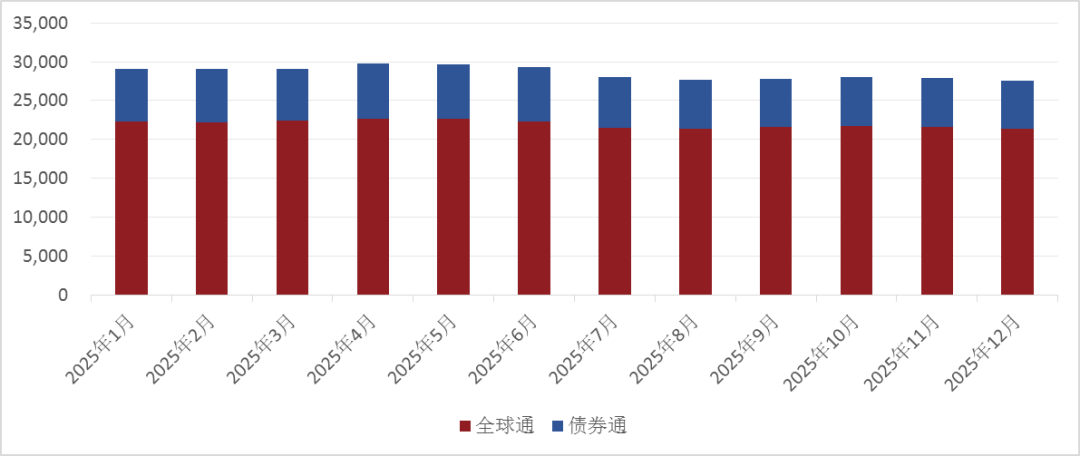
截至2025年末境外机构在中央结算公司托管债券总量2.75万亿元
Xin Hua Cai Jing· 2026-01-19 23:58
Core Insights - The report from the Central Securities Depository indicates that as of December 2025, foreign institutions held a total of 2.75 trillion yuan in bonds [1] - The "Global Connect" channel accounted for 2.14 trillion yuan, representing 77.58% of the total holdings [1] Group 1: Bond Holdings - Foreign institutions primarily held government bonds amounting to 2.01 trillion yuan, which is 72.89% of their total holdings [2] - Policy bank bonds held by foreign institutions totaled 712.9 billion yuan, making up 25.9% of the total [2] Group 2: Trading and Settlement - In December 2025, the total trading and settlement volume for foreign institutions at the Central Securities Depository was 1.32 trillion yuan [3] - The "Global Connect" channel had a cash trading and settlement volume of 328.1 billion yuan and a repurchase trading volume of 383.5 billion yuan, totaling 711.6 billion yuan [3] - The "Bond Connect" channel recorded a cash trading and settlement volume of 579.1 billion yuan and a repurchase trading volume of 25.7 billion yuan, totaling 604.8 billion yuan [3] Group 3: Market Participation - As of December 2025, foreign institutions held 3.46 trillion yuan in the interbank bond market, accounting for approximately 2.0% of the total market [6] - Six new foreign institutional entities entered the interbank bond market in December, bringing the total to 1,189 foreign institutions [6]

银行间市场数据报告库公司在沪成立 交易商协会徐忠担任董事长
2 1 Shi Ji Jing Ji Bao Dao· 2025-12-16 06:18
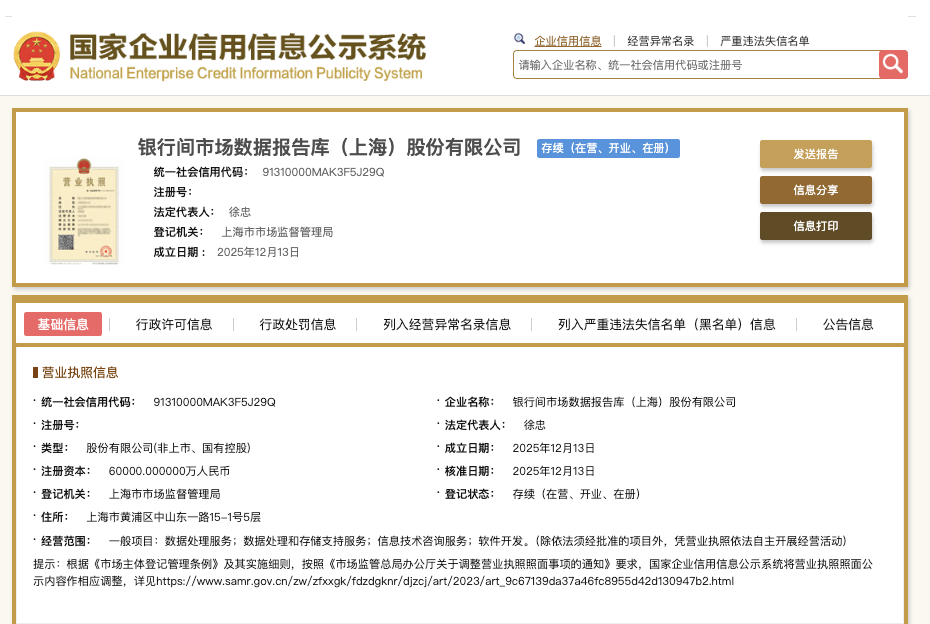
Core Insights - The establishment of the Interbank Market Transaction Reporting Database in Shanghai is a significant development aimed at enhancing financial market transparency and risk management [1][2][4] - The database will aggregate and analyze high-frequency trading data across various financial sub-markets, including bonds, currencies, derivatives, gold, and bills, serving financial institutions and regulatory bodies [1][2] Group 1: Company Formation and Structure - The Interbank Market Data Reporting Database (Shanghai) Co., Ltd. was officially established on December 13, with a registered capital of 600 million RMB [1] - The company is jointly funded by seven entities, including the Shanghai Gold Exchange and the China Interbank Market Dealers Association, with contributions varying from 15 million to 100 million RMB [1][2] Group 2: Leadership and Expertise - Xu Zhong, an economist with extensive experience in financial research and market infrastructure, is appointed as the chairman of the company [2] - The financial officer, Tang Yingwei, has a strong background in the bill market and has been involved in the transition from paper-based to electronic systems [2] Group 3: Importance and Challenges - The database is viewed as a crucial infrastructure for building a strong financial system and promoting high-quality financial development, with its core value being the enhancement of transparency and systemic risk prevention [2][3] - Challenges such as data quality issues and the lack of standardized reporting mechanisms need to be addressed to maximize the database's effectiveness in risk monitoring and market services [3]
人民银行:10月银行间债券市场现券成交26.6万亿元
Bei Jing Shang Bao· 2025-12-01 12:25
Group 1 - The People's Bank of China released the financial market operation report for October 2025, highlighting significant activity in the bond market [1] - In October 2025, the interbank bond market recorded a total transaction volume of 26.6 trillion yuan, with an average daily transaction of 1.5 trillion yuan, representing a year-on-year increase of 10.2% and a month-on-month increase of 3.9% [1] - Transactions with a single volume between 5 million and 50 million yuan accounted for 48.06% of the total transaction amount, while transactions over 90 million yuan made up 45.68%, with an average single transaction volume of 41.77 million yuan [1] Group 2 - The exchange bond market saw a transaction volume of 3.3 trillion yuan, with an average daily transaction of 193.79 billion yuan [1] - Commercial banks conducted 66,000 bond transactions, amounting to 58.73 billion yuan [1]
央行:10月银行间债券市场现券成交26.6万亿元
Zheng Quan Shi Bao Wang· 2025-11-30 10:13
Core Insights - The central viewpoint of the article highlights the performance of the financial market in October 2025, as reported by the central bank, indicating significant growth in bond market transactions [1] Group 1: Bond Market Performance - In October, the interbank bond market recorded a total transaction volume of 26.6 trillion yuan, with an average daily transaction of 1.5 trillion yuan, reflecting a year-on-year increase of 10.2% and a month-on-month increase of 3.9% [1] - Transactions with a single volume between 5 million and 50 million yuan accounted for 48.06% of the total transaction amount, while transactions exceeding 90 million yuan represented 45.68% of the total [1] - The average transaction volume per deal was 4.17769 million yuan [1] Group 2: Exchange and Bank Transactions - The exchange bond market saw a transaction volume of 3.3 trillion yuan, with an average daily transaction of 193.79 billion yuan [1] - Commercial banks executed 66,000 bond transactions, amounting to 58.73 billion yuan [1]
华信债虚假陈述五中介被判赔1800余万 赔偿额是这样认定的!
Di Yi Cai Jing· 2025-10-28 12:35
Core Viewpoint - The Shanghai Financial Court ruled on a case involving false statements in bond issuance documents by Shanghai Huaxin International Group, marking the first securities false statement liability dispute in the interbank bond market [1][4]. Group 1: Case Background - The case originated from a rural commercial bank suing various intermediary institutions, including underwriters and rating agencies, for compensation due to false statements in bond issuance [1]. - The total amount of bonds issued by Shanghai Huaxin from 2014 to 2017 exceeded 40 billion yuan [1]. - The plaintiff, a rural commercial bank, invested over 200 million yuan, and multiple investment institutions have sued Shanghai Huaxin due to bond defaults [1]. Group 2: Court Ruling - The court determined that five intermediary institutions must bear joint liability for the losses incurred by the plaintiff, amounting to approximately 128 million yuan [4]. - Postal Savings Bank and China International Capital Corporation are each responsible for 5% of the losses, equating to about 6.39 million yuan [2]. - Other intermediaries, including accounting firms and credit rating agencies, are liable for smaller percentages of the losses, totaling approximately 2.1 million yuan [2]. Group 3: Loss Assessment - The court acknowledged the complexity of factors leading to investment losses, including macroeconomic conditions and the investigation of the actual controller of the issuing company [3]. - A third-party professional institution was commissioned to assess the losses, employing methods aligned with bond pricing principles and market characteristics [3]. - The assessment distinguished losses across three phases: from issuance to disclosure, from disclosure to default, and from default to bankruptcy ruling [3].


华信债虚假陈述五中介被判赔1800余万,赔偿额是这样认定的!
Di Yi Cai Jing· 2025-10-28 11:57
Core Viewpoint - The Shanghai Financial Court ruled on a case involving false statements in bond issuance by Shanghai Huaxin International Group, marking a significant precedent in the interbank bond market regarding securities fraud liability [1][2][4] Group 1: Case Background - The case involves a rural commercial bank suing various intermediary institutions for compensation due to false statements in bond issuance documents by Shanghai Huaxin, which issued over 40 billion yuan in bonds from 2014 to 2017 [1][2] - The plaintiff, a rural commercial bank, invested over 200 million yuan in the bonds, which subsequently defaulted [2][3] Group 2: Court Ruling - The court determined that five intermediary institutions, including Postal Savings Bank and CICC, are liable for a total loss of approximately 128 million yuan, with specific percentages of liability assigned to each [2][4] - The ruling specified that the defendants must bear joint liability for the losses, with Postal Savings Bank and CICC responsible for 5% each, while other intermediaries have lower percentages [2][4] Group 3: Loss Assessment Methodology - The court commissioned a third-party professional agency to assess the losses caused by non-fraudulent statements, utilizing the "bond value comparison method" and considering various factors such as macroeconomic conditions and the issuer's operational status [3][4] - The assessment was divided into three phases: from issuance to disclosure, from disclosure to default, and from default to bankruptcy ruling, ensuring a comprehensive evaluation of the losses [3]
9月债市新增11家境外机构
2 1 Shi Ji Jing Ji Bao Dao· 2025-10-23 23:41
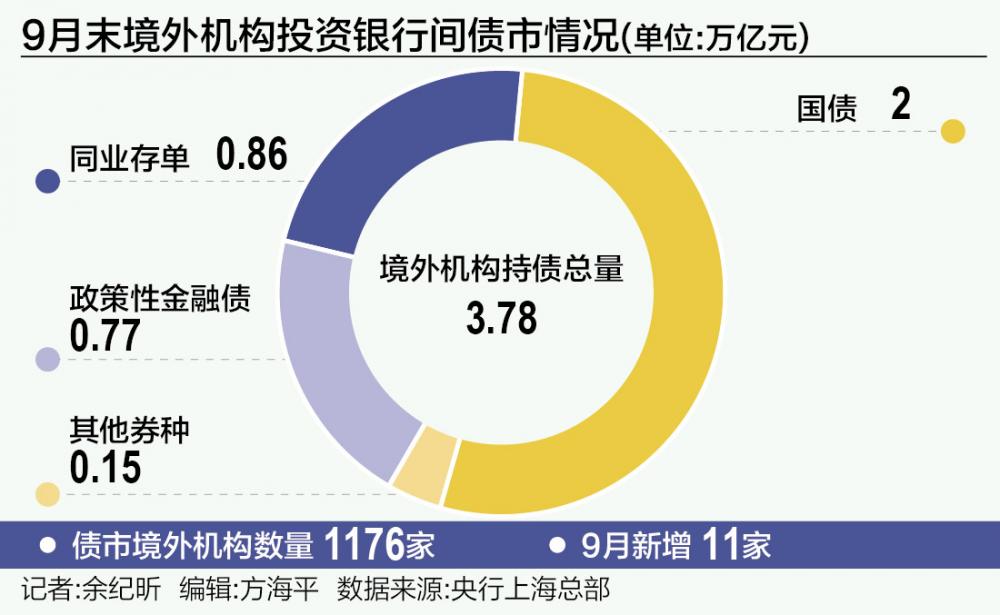
Core Insights - The People's Bank of China (PBOC) reported that as of September 2025, foreign institutions held 3.78 trillion yuan in the interbank bond market, accounting for 2.2% of the total custody volume [1] - The report indicates a significant increase in the number of foreign institutions entering the market, with 11 new entities in September alone, contributing to a total of 1,176 foreign institutions [3] - The introduction of a new bond repurchase mechanism for foreign investors is expected to enhance market liquidity and attract more foreign capital into the domestic bond market [6][7] Group 1: Foreign Investment in Bond Market - As of September 2025, foreign institutions held 2.00 trillion yuan in government bonds, 0.77 trillion yuan in policy financial bonds, and 0.86 trillion yuan in interbank certificates of deposit [1][3] - The number of foreign institutions participating in the bond market has increased, with 11 out of 15 new entrants in the third quarter joining in September [3] - The trading volume of foreign institutions in the interbank bond market was approximately 0.96 trillion yuan in September, with an average daily trading volume of about 41.7 billion yuan [1] Group 2: Market Dynamics and Trends - The trading volume of foreign institutions in September showed a slight decline to 0.83 trillion yuan from 0.87 trillion yuan in August, indicating a limited contraction in overall trading activity [3] - Commercial banks maintained a dominant position in the bond market, with a trading volume of 24.46 trillion yuan in September, while securities companies saw a decrease in trading volume [4] - The new bond repurchase policy allows foreign institutions to engage in repurchase transactions, enhancing the liquidity management tools available to them [6][7] Group 3: Impact of New Regulations - The new regulations are expected to diversify the types of investors in the bond market, including foreign central banks, international financial organizations, and various financial institutions [6] - The introduction of the repurchase mechanism is anticipated to reduce transaction friction and enhance the willingness of foreign institutions to hold bonds [7] - The repurchase business is expected to improve the pricing efficiency of the domestic bond market by reflecting overseas capital market expectations [8]
央行上海总部:7月份新增3家境外机构主体进入银行间债券市场
Xin Hua Cai Jing· 2025-08-15 09:00
Group 1 - As of July 2025, foreign institutions hold 3.93 trillion yuan in the interbank bond market, accounting for approximately 2.3% of the total custody amount [1] - Among the types of bonds held by foreign institutions, government bonds amount to 2.02 trillion yuan, representing 51.4%, while interbank certificates of deposit are 0.98 trillion yuan, or 24.9%, and policy financial bonds are 0.76 trillion yuan, making up 19.3% [1] - In July, three new foreign institutional entities entered the interbank bond market, bringing the total to 1,171 foreign institutions, with 608 entering through direct investment channels and 834 through the "Bond Connect" channel [1] Group 2 - In July, the trading volume of foreign institutions in the interbank bond market was approximately 1.44 trillion yuan, with an average daily trading volume of about 628 billion yuan [1]
2025年河南省银行间市场债券融资增量提质 系列宣介活动成功举办
Sou Hu Cai Jing· 2025-08-12 09:16
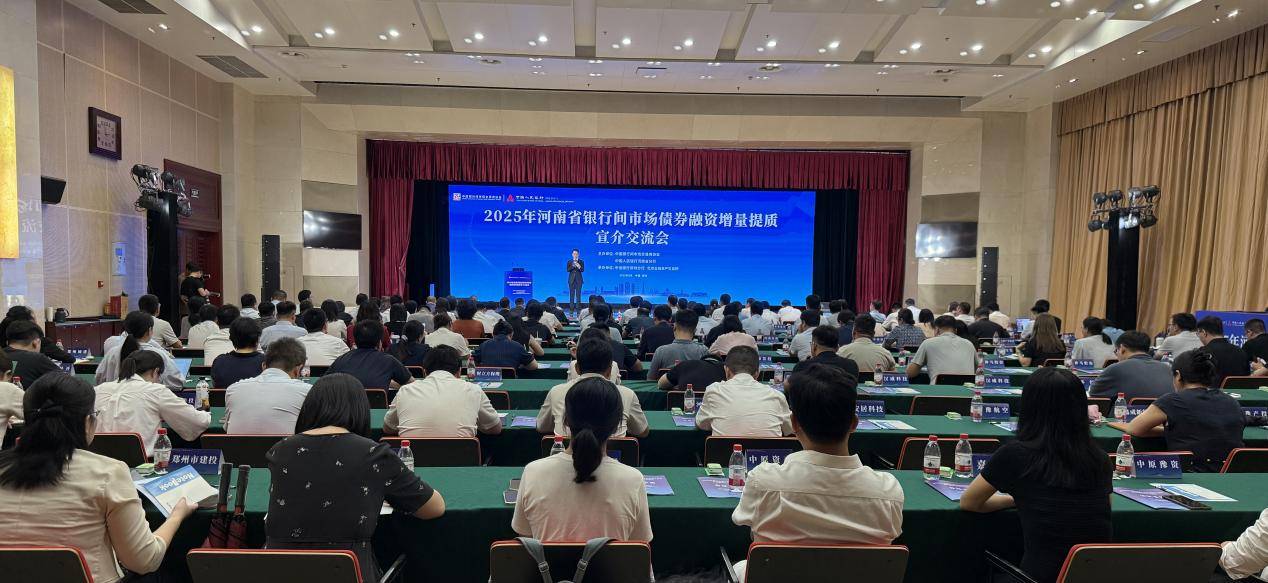
Core Viewpoint - The series of events held in Zhengzhou aims to enhance the direct financing function of the interbank bond market, supporting the transformation and upgrading of enterprises in Henan Province, as well as promoting technological innovation [1][2]. Group 1: Event Overview - The interbank bond market financing promotion event took place from August 7 to 8, 2025, organized by the China Interbank Market Dealers Association and the People's Bank of China Henan Branch [1]. - The event included a promotional exchange meeting and a seminar focused on how the interbank bond market can support technological innovation in Henan [1][4]. - Over 200 participants attended the event, including representatives from more than 100 local enterprises and 15 financial institutions, with additional remote participation from over 200 other enterprises and government departments [2]. Group 2: Key Presentations and Discussions - Presentations covered the latest registration and issuance policies, innovative products, and the advantages of financing through the interbank bond market [2]. - As a leading underwriter in the national interbank market, CITIC Bank has provided comprehensive financing exceeding 100 billion yuan annually for various enterprises in Henan over the past 27 years [2]. - The seminar on technological innovation featured discussions from five enterprise representatives regarding their operational status, financing plans, and challenges, fostering a deeper understanding of the interbank bond market among participants [4]. Group 3: Future Initiatives - CITIC Bank Zhengzhou Branch plans to continue its "Ten Thousand Enterprises - Trust and Benefit Enterprises" initiative, focusing on serving mature bond-issuing enterprises and identifying potential issuers [4]. - The bank aims to accelerate the launch of innovative bond products in key areas such as technological innovation and green development, contributing to the enhancement of bond financing in Henan Province [4].
银行间债券承销新规带来三大变化
Zheng Quan Ri Bao· 2025-08-11 16:19
Core Viewpoint - The recent announcement by the China Interbank Market Dealers Association regarding the self-regulation of underwriting quotes in the interbank bond market aims to enhance the quality and stability of the bond market, addressing issues such as price wars and promoting a market-oriented pricing mechanism [1][2]. Group 1: Impact on Bond Market - The new regulations are expected to end the "price war" phenomenon in the bond market, encouraging a return to market-based pricing mechanisms [1][2]. - As of June, the interbank market accounted for 88.4% of the total bond market custody balance, highlighting its significance in China's bond market [1]. Group 2: Changes for Underwriting Institutions - The regulations will push underwriting institutions to restructure their profit models, promoting long-term and stable development [3]. - The current low underwriting fees have led to concerns about the quality of due diligence and compliance, potentially increasing default risks in the bond market [2][3]. Group 3: Financing for the Real Economy - By regulating underwriting quotes, the new rules are expected to broaden financing channels for the real economy, directing funds towards weaker sectors and key areas [4]. - The regulations aim to enhance the willingness of underwriting institutions to serve small and micro enterprises, as well as technology innovation companies, thereby improving market transparency and investor decision-making quality [4].