
镍湿法中间品

Search documents
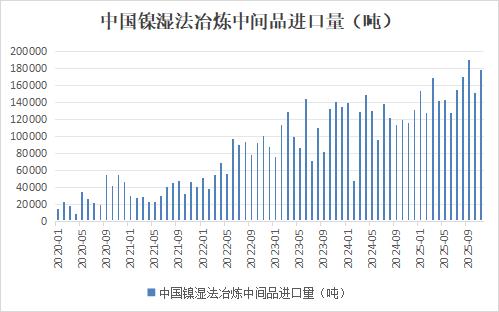
11月中国镍湿法中间品进口量重返高位
Wen Hua Cai Jing· 2025-12-23 10:44
数据来源:海关总署 据海关总署数据显示,2025年11月中国镍湿法中间品进口量17.85万吨,环比增加2.73万吨,增幅 18.02%;同比增加6.28万吨,增幅54.28%。创仅次于9月的第二高位。其中自印度尼西亚进口量为15.89 万吨,环比增加18.75%,占当月进口量的88.99%。2025年1-11月镍湿法冶炼中间品进口总量170.89万 吨,同比增加31.38%。 ...

中国10月镍湿法中间品进口仍处于高位
Wen Hua Cai Jing· 2025-11-21 02:25
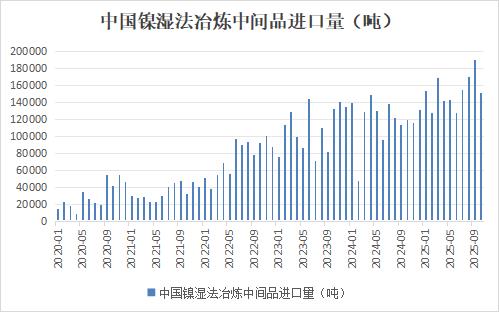
Group 1 - The core point of the article highlights a significant decrease in China's nickel wet-process intermediate imports in October 2025, with a month-on-month reduction of 39,300 tons, representing a decline of 20.62%, while year-on-year, there was an increase of 31,700 tons, or 26.52% [1] - In October 2025, the total import volume of nickel wet-process intermediate was 151,300 tons, with imports from Indonesia accounting for 133,800 tons, which is a month-on-month decrease of 17.01%, making up 88.45% of the total imports for the month [1] - From January to October 2025, the total import volume of nickel wet-process intermediate reached 1,530,400 tons, reflecting a year-on-year increase of 29.14% [1]
镍:底部运行,警惕供给端扰动
Guo Mao Qi Huo· 2025-09-29 05:39
1. Report Industry Investment Rating - Investment view: Range-bound trading [7] 2. Core Viewpoints of the Report - In Q4, the path of the Fed's interest rate cuts remains uncertain, and China's growth-stabilizing policies are expected to be rolled out. Affected by macro events, nickel prices are likely to consolidate at the bottom and are more sensitive to supply-side disturbances. Focus on mining news and macro changes in Q4, and the valuation range of pure nickel can refer to the production cost of integrated electrowon nickel (which fluctuates with ore prices). In terms of operations, short-term range trading is recommended, and combination strategies such as selling out-of-the-money call options can be used to increase returns, while paying attention to risk control [1]. 3. Summary by Relevant Catalogs 3.1 Market Review - In Q1, policies in nickel resource countries stimulated price increases; in Q2, trade conflicts and an intensified surplus led to a sharp decline; in Q3, the fundamentals were stable, and the Fed's interest rate cut in September provided a temporary boost. As of September 26, SHFE nickel closed at 121,380 yuan/ton, up 0.45% from mid-year, and LME nickel was reported at $15,230/ton, up 0.33% [8]. 3.2 Macro Analysis 3.2.1 Fed Interest Rate Cut - The Fed cut interest rates by 25bp in September, but the subsequent path remains uncertain. The economic outlook shows an upward adjustment of GDP growth expectations, while unemployment and inflation expectations are relatively stable [12][13]. - The US labor market has weakened significantly, with non-farm payrolls being persistently weak and the unemployment rate reaching a new high since October 2021. Inflation has been rising steadily, increasing market expectations for further interest rate cuts [21]. 3.2.2 China's Economic Situation - In H2, some macro data showed signs of weakening, including fixed asset investment and social consumption. The government may introduce new incremental measures in Q4, focusing on fiscal stimulus, central bank interest rate cuts, and stabilizing the real estate market [24][27]. - The "anti-involution" policies have been introduced, but their impact on the nickel industry chain is currently limited [28][29]. 3.3 Fundamental Analysis 3.3.1 Supply Side - Indonesia's nickel ore supply is stable, but there are risks of policy disturbances. The premium for nickel ore remains firm, and Indonesia's imports of nickel ore from the Philippines are increasing. The RKAB quota for 2026 will be re-approved in October, attracting market attention [31][32]. - China's nickel pig iron production has declined slightly, while Indonesia's production remains high but with a slowing growth rate. The import of nickel pig iron from Indonesia has increased year-on-year [43][44]. - The import of nickel intermediate products has increased, with a decline in the import of nickel matte. Indonesia's MHP production has increased significantly, while the production of nickel matte has decreased [51][54]. - The production of refined nickel has remained high, with both imports and exports increasing. The cost of integrated electrowon nickel production will be the focus of pure nickel valuation [58][68]. 3.3.2 Demand Side - The growth rate of stainless steel production has slowed down, and the demand has shown some resilience. The social inventory of stainless steel is gradually being depleted [70][80]. - The production of nickel sulfate has remained stable year-on-year, but the low proportion of ternary materials in power batteries has dragged down the demand for nickel. In the long term, solid-state batteries may drive the demand for high-nickel ternary materials [85][88]. - The consumption of nickel in alloy and special steel has maintained a certain growth rate, and attention should be paid to the situation of national stockpiling [92][93]. 3.3.3 Inventory - Global nickel inventory has continued to accumulate, and the spot premium has weakened slightly compared to mid-year [95]. 3.3.4 Supply-Demand Balance - The surplus pattern of primary nickel continues, and attention should be paid to supply-side disturbances in Q4. It is expected that China will have a surplus of 179,800 tons of primary nickel in 2025, and the global surplus will be 246,200 tons [100][102].
8月中国镍湿法中间品进口量刷新单月高位
Wen Hua Cai Jing· 2025-09-23 10:47
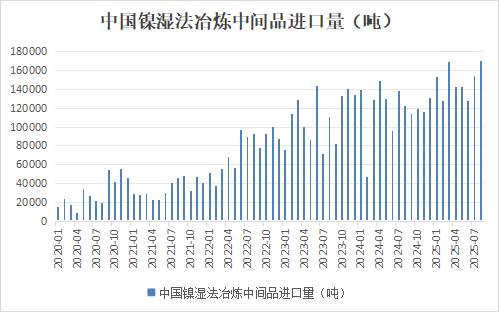
数据来源:海关总署 据中国海关数据统计,2025年8月中国镍湿法中间品进口量17.06万吨,环比增加1.58万吨,增幅 10.21%;同比增加4.84万吨,增幅39.56%,创单月新高。其中自印度尼西亚进口量为13.79万吨,环比 增加4.78%,占本月进口量的80.80%。 ...
中国7月进口镍湿法中间品维持高位
Wen Hua Cai Jing· 2025-08-21 02:20
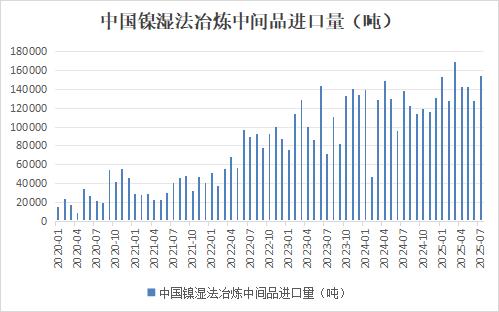
数据来源:海关总署 据中国海关数据统计,2025年7月中国镍湿法中间品进口量15.48万吨,环比增加2.67万吨,增幅 20.80%;同比增加1.70万吨,增幅12.30%。其中自印度尼西亚进口量为13.16万吨,环比增加16.10%, 占本月进口量的84.98%。2025年1-7月镍湿法冶炼中间品进口总量101.79万吨,同比增加22.73%。随着 印尼镍湿法中间品产能逐步投放,中国进口规模维持高位。 ...
有色月跟踪:24年有色行业盈利改善,“资源为王”特征进一步凸显
Minmetals Securities· 2025-05-27 08:11
Investment Rating - The report rates the non-ferrous metals industry as "Positive" for 2024 [4] Core Insights - The non-ferrous metals industry is expected to see profit improvement in 2024, with the characteristic of "resource supremacy" becoming more pronounced. Supply from the mining sector remains rigid, while companies are cautious with capital expenditures amid increasing macroeconomic volatility and export policy restrictions from various countries, leading to enhanced supply constraints. The demand side shows a fragmented demand landscape under the backdrop of de-globalization, with re-industrialization in Europe and the US and economic growth in emerging markets being the main demand drivers. Revenue and net profit for the non-ferrous sector are projected to grow slightly, indicating a gradual improvement in industry prosperity. Resource-based companies, particularly in copper, gold, aluminum, tin, and tungsten, are expected to perform better, with a growing focus on resource scarcity and strategic importance [19][22][26]. Summary by Sections 1. Industry Overview - The non-ferrous metals sector is projected to achieve a revenue of CNY 3.47 trillion in 2024, representing a year-on-year growth of 5.86%, and a net profit of CNY 138.41 billion, reflecting a slight increase of 1.77% [22][26]. 2. Market Dynamics - The report highlights that industrial metals experienced significant price fluctuations due to US trade tariffs in early April, but prices have since rebounded as negotiations exceeded market expectations. Small metals continue to perform well, with tungsten prices reaching new highs amid strengthened domestic export controls [20][21]. 3. Policy Changes - Domestic measures to tighten resource export controls have been noted, alongside international collaborations for mineral investment and development. Key actions include China's crackdown on strategic mineral smuggling, Australia's commitment to establishing strategic reserves for critical minerals, and various agreements between countries to enhance mining cooperation [20][21]. 4. Company Performance - Chinese listed copper companies have shown a significant increase in resource and reserve volumes, with a 27% year-on-year increase in resource volume and a 25% increase in reserves. Notable companies like Zijin Mining and Minmetals Resources have made substantial acquisitions and exploration investments to secure resource safety [22][28][32].