阴阳师

Search documents
天美与光子的第三次战役
3 6 Ke· 2026-02-02 12:06
Core Insights - The self-chess game market, which has been stable for nearly seven years, is about to change with the upcoming release of "Wangzhe Wanxiangqi" [1] - This game, backed by the "Honor of Kings" IP, is seen as a strong challenger in the self-chess market due to its similar product positioning and logic to successful titles like "League of Legends: Teamfight Tactics" and "Gold Shovel Shovel Battle" [3][4] - Despite the potential, the success of "Wangzhe Wanxiangqi" is not guaranteed, as previous attempts by "Honor of Kings" to enter the self-chess genre did not yield significant results [3][4] Market Positioning - Major game developers are re-entering the self-chess market with established IPs and differentiated gameplay, including Tencent's "Wangzhe Wanxiangqi" and others from NetEase and Mihayou [4] - "Wangzhe Wanxiangqi" must address two core questions: why existing users would switch from familiar games like "Teamfight Tactics" and how to effectively convert the large user base of "Honor of Kings" into players of "Wangzhe Wanxiangqi" [4] Gameplay Innovation - The game aims to redefine the enjoyment of self-chess by lowering the entry barrier and creating a "easy to learn, hard to master" experience [6][8] - It simplifies traditional self-chess mechanics, such as the upgrade system, allowing players to enhance hero levels directly by playing matching cards, thus enhancing the gameplay experience [10][12] - The game introduces a unique keyword ability system for heroes, focusing on straightforward interactions rather than complex combinations, which is a significant innovation in the game's design [12][14] Economic and Strategic Systems - "Wangzhe Wanxiangqi" adopts a fixed energy allocation system, encouraging players to commit to a specific strategy from the start, which enhances the depth of gameplay [18][22] - The game features a bidding system that allows players to compete for key cards, maintaining a balance between fairness and competitive dynamics [20] - The economic system encourages players to explore the depth of their chosen strategy rather than spreading their focus too thin [22] Visual and Commercial Aspects - The game emphasizes a stylish visual design and immersive experience, which is crucial for attracting and retaining players [29][31] - The monetization strategy is expected to focus on character skins and visual elements, similar to "Gold Shovel Shovel Battle," but with unique character skills that enhance gameplay [35][37] - The game aims to leverage the vast user base of "Honor of Kings" to achieve commercial success, with a focus on creating a party-like gaming experience [41] Competitive Landscape - "Wangzhe Wanxiangqi" does not aim for a direct competition with "Gold Shovel Shovel Battle" but rather seeks to expand the overall market by attracting non-typical self-chess players [38] - The game targets a diverse audience, including users from other popular IPs, to grow its player base [38] - The long-term success of "Wangzhe Wanxiangqi" will depend on its ability to maintain player engagement and adapt to feedback over time [45]


52页二次元游戏研报:米哈游原神余响仍在,鹰角完美网易引领二游新一轮主升浪
3 6 Ke· 2026-01-23 04:33
Group 1 - Core viewpoint: The second dimension game category is transitioning from the cycle dominated by miHoYo's "Genshin Impact" to a new prosperity cycle led by companies like NetEase and Eagle Horn [2][3] - The game industry exhibits cyclical properties, with each cycle lasting approximately 6 years, influenced by factors such as technology, population, and policy [2] - By 2026, the second dimension game sector is expected to shift towards gameplay, narrative, and character-driven models, with a focus on expanding user demographics beyond traditional fans [3] Group 2 - The future of second dimension games will revolve around three main directions: innovative gameplay, social design, and expanded nurturing cycles [4][12] - Current leading second dimension games have largely followed the gameplay design framework established by "Genshin Impact," resulting in low innovation and a tendency towards homogenization [4][11] - The introduction of social gameplay is seen as essential to address commercialization and long-term engagement challenges within the second dimension gaming sector [6][13] Group 3 - The pricing of second dimension games has reached a near-bottom level, with an increasing emphasis on cosmetic purchases to decouple gameplay from monetization [6][13] - The shift towards cosmetic monetization is expected to enhance gameplay enjoyment and allow for more creative freedom in game design [6][13] - The current social design in second dimension games faces challenges, with a need to create engaging social experiences that resonate with users [6][80] Group 4 - Player preferences are evolving, with a growing interest in content that abstracts and deconstructs reality, leading to polarized content trends [7][14] - Economic conditions influence player emotions, which in turn affect the themes and tones of second dimension game content [8][14] - To maintain long-term engagement, companies must enhance their IP ecosystems and community interactions both online and offline [8][14]

中国游戏十年
3 6 Ke· 2026-01-05 08:43
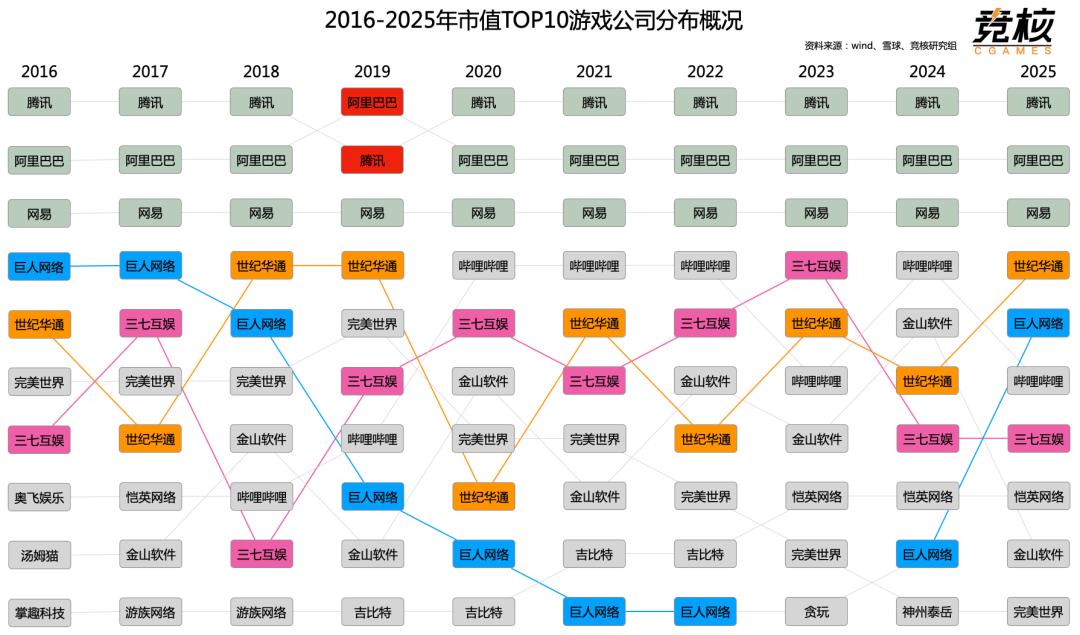
Core Insights - The Chinese gaming industry has evolved significantly over the past decade, transitioning from a focus on heavy mobile games to a more structured competitive landscape where major companies dominate the market [1][2] - The user base has become increasingly discerning, with players now demanding higher quality and more engaging experiences, leading to intense competition among developers [2][11] - The market is witnessing a shift from explosive growth to a more stable phase, with top companies like Tencent and NetEase solidifying their positions in terms of market capitalization and profitability [3][10] Industry Evolution - The first phase (2014-2017) was characterized by rapid growth, with Tencent and NetEase leading the charge, while mid-tier companies also benefited from the mobile gaming boom [6] - The second phase (2018-2020) saw market consolidation and regulatory pressures, leading to a reshuffling of market positions and a focus on sustainable growth [7] - The third phase (2021-present) has resulted in a solidification of the top players, with Tencent and NetEase maintaining their dominance in market capitalization and profitability [7][10] Financial Performance - The top 10 gaming companies have shown a trend of increasing stability in net profits, with Tencent's gaming business contributing significantly to its overall profitability [10][12] - The average net profit margin for the top 10 companies is over 22%, indicating a shift towards more sustainable business models [10] User Dynamics - The gaming audience has evolved into one of the most discerning user groups globally, with players now actively engaging in discussions about game quality and features [2][11] - The competition has intensified, with companies focusing on various aspects such as gameplay, art, and narrative to attract and retain users [2][11] Market Trends - The industry is moving towards a "quality first" approach, with successful games like "Genshin Impact" and "Yuan Yun Sixteen Sounds" setting new standards for content-driven products [11][12] - The commercialization model has shifted towards gacha mechanics, which have become a staple in mobile gaming, allowing for continuous revenue generation [15][16] Global Expansion - The overseas market for Chinese games has seen significant growth, with revenue from international sales surpassing $20 billion, marking a historical high [36][37] - Major companies like Tencent and miHoYo have successfully penetrated global markets, with titles like "PUBG MOBILE" and "Genshin Impact" becoming global phenomena [37][38] Technological Integration - The integration of AI in game development has become commonplace, with companies investing heavily in AI tools to enhance production efficiency and gameplay experiences [30][32] - The industry is witnessing a transition towards generative AI, which is expected to revolutionize game design and player interaction [30][34]



3200亿丁磊,年末再“失”一员老将
创业家· 2026-01-03 10:12
Core Viewpoint - The retirement of Ding Yingfeng, a veteran executive at NetEase, marks a significant transition for the company, which faces challenges in maintaining its market position amid internal talent loss and external competition [5][12][8]. Group 1: Leadership Transition - Ding Yingfeng, who has been with NetEase for 23 years, will officially retire on December 31, 2025, but will continue as a consultant [5][12]. - Under Ding's leadership, NetEase's Interactive Entertainment division launched several successful games, solidifying the company's position in the gaming industry [6][12]. - Ding's retirement is seen as the end of an era in the Chinese gaming industry, as he played a crucial role in the development of iconic games like "Fantasy Westward Journey" [12][17]. Group 2: Financial Performance - In the first three quarters of 2025, NetEase reported revenues of 85.079 billion yuan, an increase of 8.32% year-on-year, and a net profit of 27.518 billion yuan, up 31.47% [6][19]. - The gross margin reached 64.3%, reflecting a year-on-year increase of 1.24 percentage points [19]. - The gaming segment, which is NetEase's core business, generated net revenues of 23.3 billion yuan in the third quarter, accounting for over 80% of total revenue [19][20]. Group 3: Challenges Ahead - Despite strong financial results, NetEase faces declining growth rates in its gaming and related services, with some business segments experiencing negative growth [7][8]. - The company is also dealing with internal challenges, including the loss of key talent and increased competition from rivals like Tencent and MiHoYo [8][23]. - The gaming industry is becoming increasingly competitive, making it harder for companies to develop new hit games, as evidenced by a significant reduction in the number of new mobile games launched by NetEase in 2025 compared to the previous year [23].

网易副总裁丁迎峰退休:在职23年,一手打造《梦幻西游》
Feng Huang Wang· 2025-12-27 03:17
Group 1 - The core management change at NetEase involves the retirement of Ding Yingfeng, who has served the company for 23 years, effective December 31, 2025 [1] - Ding Yingfeng will transition to a consultant role in 2026, continuing to support the company with his experience [1] - CEO Ding Lei acknowledged Ding Yingfeng's significant contributions to the development of flagship gaming products and the enhancement of the company's R&D and operational capabilities [1] Group 2 - Ding Yingfeng is a foundational figure in NetEase's gaming business, with over 25 years of experience in game development and design [1] - He played a crucial role in the early development of "Dahua Xiyou Online II" and led the development and operation of "Menghuan Xiyou," which became a key revenue pillar for NetEase [2] - From 2011 to 2016, he served as Vice President, overseeing product development and management in the online gaming department, and later became Executive Vice President and Co-President of NetEase Games [3] Group 3 - Under his leadership, NetEase expanded into mobile gaming with successful titles like "Yin Yang Shi," "Shuai Tu Zhi Bin," and "Fifth Personality," and also secured rights for popular overseas IPs [3] - Ding Yingfeng was a key executive, second only to CEO Ding Lei, and represented the company in important external activities, contributing to the sustained growth of gaming and related value-added services [3] - He had previously intended to retire three years ago but delayed his retirement to ensure the successful launch of "Menghuan Xiyou" and "Manwei Zhengfeng" [3]
2025年中国动漫游戏改编行业市场研究报告
硕远咨询· 2025-12-09 14:04
Investment Rating - The report does not explicitly state an investment rating for the industry Core Insights - The anime and game adaptation industry is a vital and dynamic segment of the cultural creative industry, driven by the rise of digital entertainment and the two-dimensional culture [4][5] - The industry encompasses a full value chain, including copyright acquisition, content development, technical implementation, marketing, and user operation [4][5] - The market size of the anime game adaptation industry in China has surpassed 100 billion RMB, with a compound annual growth rate (CAGR) of over 15% [16][17] - The industry is expected to continue its rapid growth, potentially exceeding 200 billion RMB in the next five years, fueled by technological advancements and a large user base [21] Industry Overview - The anime game adaptation industry involves transforming anime works into games and vice versa, requiring deep understanding and innovative design to retain the original spirit while enhancing user experience [4][5] - Key business models include IP licensing for game development, game IP licensing for animation production, and the development of derivative products [6][7] - The industry chain includes content creation, copyright operation, technical development, distribution channels, and marketing strategies [8][9] Market Demand Analysis - The target user demographic primarily consists of individuals aged 15 to 35, with a slight male predominance, although female engagement is increasing [24][27] - Users exhibit diverse interests, including two-dimensional culture, competitive gaming, and immersive storytelling, with a strong inclination towards high-quality content and innovative gameplay [28][30] - The demand for anime adaptation games focuses on faithful story representation and character development, while game adaptation anime seeks to deepen narrative and character backgrounds [33][36] Competitive Landscape - Major players like Tencent, NetEase, and Bilibili dominate the market, leveraging extensive IP resources and advanced technology to maintain a competitive edge [46][47] - The industry is characterized by frequent collaborations and alliances among anime production companies, game developers, and technology service providers [48] - Successful adaptation cases, such as "Honor of Kings" and "Douluo Dalu," highlight the importance of high-quality content and user community engagement [51][52] Technological Development Trends - The application of VR and AR technologies enhances user immersion and interactivity in anime game adaptations [58] - AI plays a crucial role in content creation, user behavior analysis, and personalized recommendations, significantly improving production quality and efficiency [59] Future Development Outlook and Strategic Recommendations - The market is projected to grow steadily, with a focus on content diversification and user segmentation to meet varied consumer demands [61] - Companies should prioritize original content development and IP protection to enhance brand competitiveness and user loyalty [67] - Strengthening cross-industry collaborations and expanding into international markets are essential for sustained growth and cultural exchange [70]

宏观+行业 - 从国企改革视角看传媒央国企投资机会
2025-11-05 01:29
Summary of Conference Call Notes Industry Overview - The focus is on the media sector, particularly state-owned enterprises (SOEs) in China, and the investment opportunities arising from macroeconomic reforms and industry dynamics [1][2][3] Key Points and Arguments 1. **Macroeconomic Reforms**: The acceleration of factor market reforms aims to optimize asset-liability structures and revitalize inefficient assets through mergers and acquisitions [1][3] 2. **State-Owned Assets**: The initiative to revitalize existing state-owned assets is intended to enhance resource allocation efficiency and improve the effectiveness of state assets [1][3] 3. **Media SOEs Attention**: Since September 2025, media SOEs have gained increased attention due to investment opportunities in the gaming sector following a valuation recovery [1][5] 4. **Gaming Industry Valuation**: The gaming sector has experienced significant valuation fluctuations, recovering to pre-2018 levels, indicating a renewed market assessment of the industry's prospects [1][6] 5. **Potential for Valuation Growth**: The gaming sector could exceed a 30x PE valuation due to innovations in user interaction, new audience engagement, and emotionally resonant content [1][7] 6. **Media Sector Growth**: The media industry is expected to enter a new growth phase in 2025, driven by regulatory changes, blockbuster content, AI technology, and improved market risk appetite [1][8] Additional Important Insights 1. **Institutional Holdings**: Institutional ownership in the media sector is currently low, with expectations of recovery to standard levels, which could drive valuation recovery [2][8] 2. **Position of SOEs**: SOEs hold a significant position in the media sector, accounting for 46% of the market, benefiting from relaxed regulations and strong content performance [9][10] 3. **Investment Logic**: The investment rationale for SOEs includes the transition from strict to routine regulation, the emergence of successful media products, and the positive impact of AI technology [9][11] 4. **Selected Investment Targets**: Key investment targets include Xinhua Net, China Vision Media, and others, which are backed by strong controlling shareholders and have the capability to mobilize external resources [10] Conclusion - The media sector, particularly state-owned enterprises, presents a compelling investment landscape influenced by macroeconomic reforms, industry dynamics, and technological advancements, with a focus on strategic asset management and innovative content creation [1][2][3][9][11]
网易游戏广州高管人事大地震,杭州少壮派要上位?
Xin Lang Cai Jing· 2025-10-28 11:58
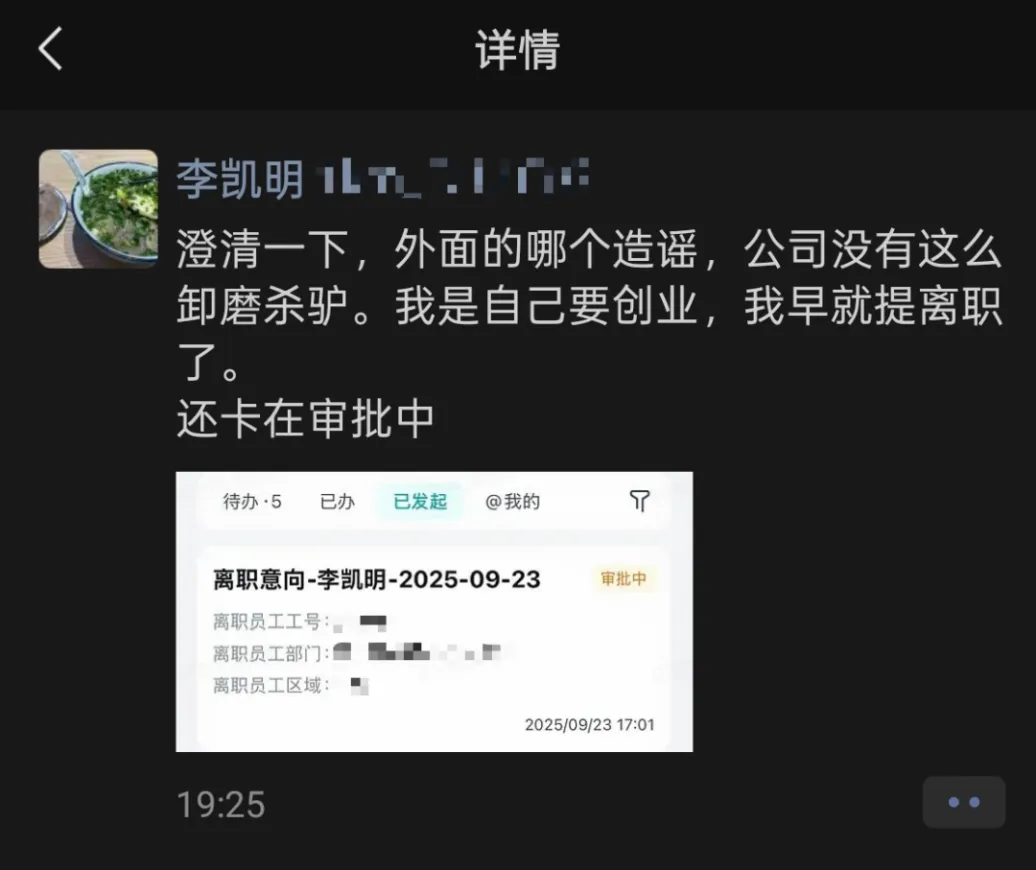
Core Insights - A significant leadership shakeup is occurring at NetEase Games, with multiple high-ranking executives departing, indicating unprecedented organizational changes within the company [1][2][4][6] Group 1: Executive Departures - Li Kaiming, head of NetEase Interactive Entertainment's 10th division, announced his departure for personal career development, marking him as the third senior executive to leave this year [1][2] - Other notable departures include Lin Yunfeng, president of the Dreamland division, and Xuanzi, producer of "World Beyond," suggesting a trend of restructuring similar to last year's disbandment of the Tianxia division [2][4] - The departures reflect a broader trend of leadership changes, particularly among executives overseeing key business areas such as competitive gaming, anime, and strategy games [2][6] Group 2: Organizational Changes - The leadership changes are centered in the Guangzhou headquarters, which has historically been the cradle of NetEase's gaming empire, indicating a potential shift in focus towards the Hangzhou region [4][7][16] - The company is reportedly consolidating its operations in Hangzhou, where the LeiHuo division has seen significant success, contributing approximately 50% to NetEase's total gaming revenue [13][15] - The restructuring aims to inject new energy into the organization by replacing long-standing executives with younger leaders who can better connect with the new generation of players [17][22] Group 3: Performance and Challenges - The Guangzhou divisions have faced significant setbacks, including the failure of the martial arts open-world game "The Legend of the Condor Heroes," which suffered a nearly 80% user attrition rate post-launch [9][10] - The 10th division also faced challenges, with the cancellation of the single-player project "Ten Thousand People Long Song: Three Kingdoms" after four years of development due to poor market feedback [11] - In contrast, the Hangzhou operations have thrived, with successful titles like "Nirvana in Fire Mobile" and "Eternal Return" establishing a strong market presence and contributing to the company's growth [12][13] Group 4: Strategic Shifts - The leadership changes reflect a strategic pivot from product-driven approaches to data-driven methodologies, emphasizing user profiling, monetization models, and predictive analytics in game development [21][22] - The company is focusing on a dual strategy of "data + rhythm" to enhance resource efficiency and mitigate the impact of individual project failures on overall business performance [22] - This shift is expected to lead to a more structured approach to game development, ensuring that new projects are backed by comprehensive market analysis and clear commercialization paths [21][22]
李在明的游戏国策:从成瘾物质到核心产业
3 6 Ke· 2025-10-27 01:44
Core Viewpoint - The South Korean gaming industry is experiencing a renaissance following President Lee Jae-myung's remarks that redefine gaming as a cultural industry rather than an addictive substance, criticizing past government policies that categorized gaming alongside drugs and alcohol [1][2]. Group 1: Historical Context - The South Korean gaming industry faced significant challenges starting in 2011 due to the implementation of the "Cinderella Law," which restricted gaming access for minors, leading to a decline in industry growth and innovation [3][4]. - The gap between the Chinese and South Korean gaming industries began to widen after 2011, with China's market growing significantly faster, particularly in mobile gaming, while South Korea struggled under regulatory burdens [4][5]. Group 2: Regulatory Changes - In 2021, the "Cinderella Law" was abolished, replaced by a "parental choice system," allowing families to manage minors' gaming time, reflecting a shift in regulatory approach [10]. - Concurrently, China's gaming regulations became stricter, limiting minors' gaming time significantly, which led to a downturn in the Chinese gaming market [12][13]. Group 3: Current Industry Dynamics - Despite regulatory changes, South Korea's gaming industry has not seen a resurgence comparable to China's recovery, with growth rates lagging behind [17][20]. - The South Korean government has introduced various support policies for the gaming industry, including talent development and financial incentives, but these have not yet translated into significant market growth [16][19]. Group 4: Future Outlook - The South Korean government aims to elevate the gaming industry to a national strategic level, emphasizing its cultural value and potential for economic contribution, particularly in exports [20][21]. - The competitive landscape suggests that while South Korea is attempting to leverage policy advantages, the inherent entrepreneurial spirit and innovation in China's gaming sector remain formidable challenges [19][22].

从“造星工厂”到“人才跳板”?网易游戏核心赛道年内连失三将
Mei Ri Jing Ji Xin Wen· 2025-10-23 14:21
Core Insights - Key personnel departures at NetEase Games indicate significant organizational adjustments within the company, with three core executives leaving in 2023, including game producer Li Kaiming, who left for personal career development reasons [1][2][10] - The departures reflect a broader shift in NetEase's strategy from a product-driven approach to a more centralized, data-driven model, aiming for standardized and scalable game development [10] Group 1: Executive Departures - Li Kaiming, producer of the successful game "Rate of the Land," is the third high-level executive to leave NetEase this year, following the exits of Shao Yun and Jin Tao, who managed key business segments in competitive, anime, and strategy games [1][2] - Jin Tao's departure to pursue a sequel to "Onmyoji" highlights the pressure on the Zen division, which has faced challenges in expanding new business lines and maintaining performance [6][8] Group 2: Company Strategy and Performance - NetEase's strategy is evolving towards a more centralized management model, with increased emphasis on resource allocation and project viability, as stated by CEO Ding Lei [5][10] - The company reported a net revenue of 22.8 billion yuan in Q2 2024, reflecting a 13% year-on-year growth but a 5% quarter-on-quarter decline, indicating a potential slowdown in growth momentum [10] - The shift in strategy aims to balance budget control with innovation, impacting the long-term development of core intellectual properties [10][11]