降准降息政策工具

Search documents
货币政策新年有新意 促进物价合理回升成重要考量
Shang Hai Zheng Quan Bao· 2026-01-12 23:47
Group 1 - The core viewpoint of the articles emphasizes the continuation of a moderately loose monetary policy in 2026, focusing on stabilizing economic growth and ensuring reasonable price recovery [1][2][3] - The People's Bank of China (PBOC) aims to enhance the effectiveness of monetary policy transmission and implementation, with a greater emphasis on the quality of policy outcomes [5][6] - Analysts predict that the monetary policy will adapt to external economic conditions, particularly with the U.S. entering a rate-cutting cycle, providing a more favorable environment for China's monetary adjustments [2][6] Group 2 - The monetary policy is expected to exhibit three major changes: a focus on high-quality development alongside price stability, innovation in liquidity transmission mechanisms, and a combination of total easing with precise structural tools [3][4] - There is a shift in policy goals regarding social financing costs, moving from promoting a decrease to maintaining low levels, reflecting the current economic context [4][5] - The PBOC plans to utilize various policy tools flexibly and efficiently, including reserve requirement ratio (RRR) cuts and interest rate adjustments, to support economic growth while mitigating risks [6][7] Group 3 - The anticipated monetary policy adjustments are expected to lead to an increase in new RMB loans and social financing, supporting consumer spending and stabilizing the real estate market [7] - The focus will also be on enhancing the integration of existing policies and improving their efficiency rather than merely increasing the scale of monetary interventions [4][5] - The PBOC is likely to innovate in providing liquidity directly to non-bank financial institutions, indicating a potential evolution in monetary policy tools [7]
实施城乡居民增收计划、降准降息等工具灵活高效运用、增加普通高中学位……深度解读中央经济工作会议
Mei Ri Jing Ji Xin Wen· 2025-12-12 10:01
Group 1 - The core viewpoint of the Central Economic Work Conference emphasizes the need to fully tap economic potential, combining policy support with reform and innovation, and integrating investment in both physical assets and human capital [2][3] - The fiscal policy will shift from increasing the fiscal deficit rate to maintaining necessary levels of fiscal deficit, total debt, and overall expenditure, while enhancing fiscal management and optimizing expenditure structure [23][24] - The monetary policy will focus on promoting stable economic growth and reasonable price recovery, utilizing various tools such as reserve requirement ratio cuts and interest rate reductions to maintain liquidity [29][30] Group 2 - A plan to increase urban and rural residents' income will be implemented, alongside actions to boost consumption and enhance the supply of quality goods and services [11][22] - The real estate market will be stabilized through targeted measures, including encouraging the acquisition of existing housing for affordable housing purposes and reforming the housing provident fund system [45][48] - The energy sector will focus on developing a new energy system, expanding green electricity applications, and implementing comprehensive waste management actions [51][54] Group 3 - The conference outlines eight key tasks for economic work in the coming year, including prioritizing domestic demand, driving innovation, and enhancing high-quality development [10] - The emphasis on a dual circulation development pattern highlights the importance of domestic markets while maintaining a balanced approach to external trade [19][44] - The need for a robust regulatory framework for emerging technologies, particularly in artificial intelligence, is underscored to ensure safety and ethical standards [35][41]


八大券商首席最新发声
Zhong Guo Ji Jin Bao· 2025-12-12 07:03
Core Viewpoint - The Central Economic Work Conference held on December 10-11, 2025, outlines key tasks for 2026, emphasizing the need for policy coordination to stimulate economic potential and stabilize domestic demand [1][2]. Group 1: Economic Growth and Policy Direction - The conference aims for a GDP growth target of around 5% for 2026, focusing on "qualitative effective improvement and reasonable quantitative growth" [2][7]. - The emphasis on "domestic supply strong, demand weak" indicates a shift towards addressing supply-side issues while promoting domestic demand [5][6]. - The five new "musts" introduced in the conference highlight the need for policy support and reform innovation, aiming for a more pronounced "cross-cycle" policy characteristic in 2026 [3][4]. Group 2: Fiscal Policy - The conference advocates for a more proactive fiscal policy, maintaining a fiscal deficit rate of around 4% and increasing the scale of new debt to support economic stability [8][9]. - There is a focus on optimizing fiscal expenditure structure and addressing local fiscal difficulties to ensure basic public services [8][9]. - The need for fiscal expansion is underscored to counterbalance the impacts of declining real estate revenues and other economic pressures [9]. Group 3: Monetary Policy - The conference calls for a continuation of moderately loose monetary policy, with an emphasis on using various policy tools to support economic growth and stabilize prices [10][11]. - The approach includes maintaining liquidity and guiding financial institutions to support key areas such as domestic demand and technological innovation [10][11]. Group 4: Domestic Demand and Market Development - The conference prioritizes domestic demand, aiming to build a strong domestic market through initiatives like a rural resident income increase plan [12][13]. - The strategy to enhance domestic demand is seen as crucial for maintaining economic resilience amid complex international conditions [12]. Group 5: Real Estate Market Stability - The conference emphasizes stabilizing the real estate market through targeted policies, including inventory reduction and supply optimization [14]. - There is an expectation for continued supportive measures for the real estate sector, particularly in major cities, while addressing the need for a new development model [14].
国盛证券:增量信息不少 中央经济工作会议6大看点
Xin Lang Cai Jing· 2025-12-11 23:45
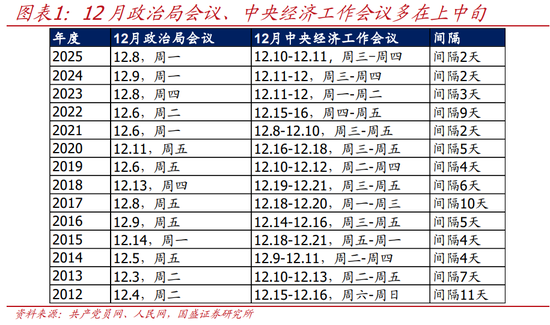
Core Viewpoint - The Central Economic Work Conference continues the overall tone from the December 8 Politburo meeting, emphasizing "strengthening confidence, utilizing advantages, and responding to challenges," while introducing the "five musts" and "five key focus points" for economic work in 2026, which should help various parties better understand and implement central policies [2][23]. Group 1 - The conference emphasizes the need to actively respond to internal and external pressures while showcasing the central government's determination to stabilize the economy and expectations [5][6]. - The introduction of the "five musts" directly addresses pain points and bottlenecks, such as the necessity to balance flexibility and regulation, and the "five key focus points" highlight the importance of expanding domestic demand, strengthening industries, promoting reforms, stabilizing livelihoods, and preventing risks [3][24]. - The overall goal is to achieve a good start for the "14th Five-Year Plan," with a focus on managing expectations and boosting confidence, while placing the goal of "promoting stable economic growth and reasonable price recovery" under monetary policy objectives [4][29]. Group 2 - The conference maintains a tone of "seeking progress while ensuring stability and improving quality and efficiency," with a new emphasis on "pragmatic goal orientation" and a focus on solving existing difficulties [4][30]. - The eight key tasks from the December 8 Politburo meeting are reiterated, with domestic demand returning to the top priority, and the order of tasks adjusted to prioritize expanding domestic demand, strengthening industries, and promoting reforms [5][31]. - Specific deployments include new proposals such as the flexible and efficient use of various monetary policy tools, a shift in fiscal spending language from "increasing" to "maintaining necessary strength," and a renewed focus on stabilizing the real estate market with city-specific measures [4][25].