飞机维修

Search documents
迪拜航空航天企业2025年净利润同比增长47.1%
Shang Wu Bu Wang Zhan· 2026-02-08 16:26
Core Insights - Dubai Aerospace Enterprise (DAE) is projected to achieve a net profit of $702.2 million in 2025, representing a year-on-year increase of 47.1% [1] - The company's pre-tax profit is expected to reach $761.6 million, reflecting a growth of 43% [1] - Total revenue is anticipated to rise to $1.725 billion, marking a 21% increase, driven primarily by fleet expansion and increased leasing and maintenance revenues [1] Operational Highlights - DAE acquired a total of 280 aircraft and sold 111 aircraft during the year [1] - The company signed 273 leasing-related agreements, indicating sustained strong demand in the aviation leasing sector [1]
Better Buy: SATS vs SIA Engineering
The Smart Investor· 2025-12-15 03:30
Core Viewpoint - The rebound in air travel presents investment opportunities in local stocks, particularly comparing SATS Limited and SIA Engineering as potential beneficiaries of this trend [1]. SATS Limited (SGX: S58) - SATS is one of the largest providers of air cargo and handling services globally and Asia's leading airline caterer [2]. - For the second quarter of FY26, SATS reported an 8.4% year-on-year revenue increase to S$1.57 billion, with profit after tax rising 13.3% to S$78.9 million [3]. - Operating cash flow and free cash flow turned positive at S$77.2 million and S$3.4 million, respectively, indicating a recovery post-pandemic with net earnings of S$244 million for FY2025 [4]. - The company is expanding its global reach through the integration of the WFS acquisition, covering 225 stations in 27 countries, with 50% of global air cargo volume flowing through these routes [4][5]. - Future growth is expected from increased cargo volume handling and cross-selling Food Solutions to the WFS network [5]. SIA Engineering (SGX: S59) - SIAEC operates in the maintenance, repair, and overhaul (MRO) space, with a 26.5% year-on-year turnover increase to S$729 million in the first half of FY26, and profit after tax up over 21% to S$83.3 million [7]. - The operating margin improved to 1.8%, up from 0.6% in the previous year [7]. - SIAEC is pursuing strategic joint ventures with global airlines and OEMs, recently expanding its relationship with Safran Aircraft Engines [8]. - Future growth is contingent on the rebound in air travel, which will drive demand for MRO services [9]. Head-to-Head Comparison - SATS has a global revenue growth potential post-WFS acquisition, while SIAEC's revenue is more reliant on steady MRO demand in the Asian region [10]. - SATS has a debt-to-equity ratio of 1.4 times with total borrowings of S$2.45 billion, whereas SIAEC has a low debt-to-equity ratio of 0.05 times and borrowings of S$4.9 million [11]. - SIAEC has a better dividend history, missing only two annual payments in six years compared to SATS's three missed payments [11]. - Both companies have sustainable dividends, with SIAEC's payout ratio at 69% and SATS at around 32% [12]. - SIAEC's MRO services are expected to be more resilient during downturns compared to SATS [12]. Investment Considerations - For investors seeking higher growth potential, SATS may be more appealing, albeit with higher execution risks related to the WFS integration [13]. - Conversely, for those preferring stability, SIAEC offers a better balance sheet, steadier dividends, and cash flows, albeit with slower growth [13].


海南擦亮飞机维修“国际名片”
人民网-国际频道 原创稿· 2025-11-21 00:57
Core Insights - The Hainan Free Trade Port is emerging as a new choice in the global aircraft maintenance market, with over 20 foreign airlines utilizing its services since its establishment in 2022 [2][3] - The maintenance base has completed over 2,300 aircraft repairs and 270 complete aircraft paint jobs, along with the repair of 55,000 aviation components, gaining recognition from multiple international aviation management authorities [2] - The supportive policies of the Hainan Free Trade Port, such as exemption from guarantee deposits and bonded maintenance for materials, have significantly reduced costs and improved service efficiency for clients [2][3] Industry Developments - The international reputation of Hainan's aircraft maintenance is growing, with more foreign airlines transitioning from trial collaborations to long-term partnerships, particularly with airlines from Vietnam and Cambodia [3] - Qatar Airways has signed a long-term painting contract, indicating a shift towards sustained business relationships [3] - The industry is evolving from a focus on single aircraft maintenance to a comprehensive service chain covering components, complete aircraft, and engines, driven by high-level openness and policy support [3] Future Prospects - With the upcoming full closure operation, the Hainan aircraft maintenance industry is poised for new growth opportunities, including the development of multi-type passenger-to-freighter conversion capabilities and advancements in domestic aircraft inspections and painting [3][4] - The company plans to enhance its capabilities in composite material maintenance and wide-body aircraft APU maintenance, thereby improving its service offerings [3][4] - The global network of flight routes is expected to expand, leading to sustained growth in maintenance demand, as the company aims to deepen its presence in Southeast Asia, the Middle East, and Europe [4]

中航沈飞(600760):盈利能力保持稳定,已融资40亿推动装备发展
Minsheng Securities· 2025-08-26 08:00
Investment Rating - The report maintains a "Recommended" rating for the company, indicating a positive outlook based on its strong competitive position in the aerospace defense sector [4][6]. Core Insights - The company reported a revenue of 146.3 billion yuan for the first half of 2025, a year-over-year decline of 32.4%. The net profit attributable to shareholders was 11.4 billion yuan, down 29.8% year-over-year, which aligns with expectations [1]. - The second quarter of 2025 saw a revenue of 87.9 billion yuan, a decrease of 27.5% year-over-year, with a net profit of 7.1 billion yuan, down 21.8% year-over-year. Despite these declines, the company's profitability remained stable, with a net profit margin increase of 0.5 percentage points to 8.0% in Q2 2025 [1][2]. - The company successfully raised 4 billion yuan through a private placement to support the development of its aviation weaponry and equipment, enhancing its position in the modern aerospace industry [2][4]. Financial Performance Summary - For the first half of 2025, the company experienced a significant drop in revenue and net profit, with a gross margin of 12.3%, down 0.3 percentage points year-over-year. However, the net profit margin improved to 7.7%, reflecting effective cost management [1][3]. - The company’s operating cash flow improved significantly, with a net cash flow from operating activities of 30.9 billion yuan in the first half of 2025, compared to a negative cash flow of 58.9 billion yuan in the same period of 2024 [3]. - The company’s contract liabilities increased by 113% year-over-year, indicating a strong order backlog and future revenue potential [3]. Earnings Forecast - The company is projected to achieve net profits of 34.2 billion yuan, 40.63 billion yuan, and 47.89 billion yuan for the years 2025, 2026, and 2027, respectively. The corresponding price-to-earnings ratios are estimated at 53x, 45x, and 38x [4][5].

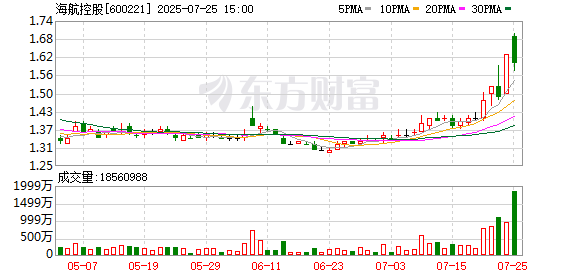
海南封关年底启动 海航控股能否“借势”?
Zhong Guo Jing Ying Bao· 2025-07-25 14:56
Core Viewpoint - The specific date for the closure of Hainan Free Trade Port has been confirmed as December 18, 2025, leading to a surge in local stocks, particularly Hainan Airlines, which saw a temporary stock price increase before a subsequent decline [2][3][4]. Company Summary - Hainan Airlines has been preparing to leverage opportunities from the Hainan Free Trade Port, focusing on aviation engine maintenance projects and infrastructure investments since the initiation of the free trade port construction [2][4]. - The company aims to expand its revenue streams by developing a composite route network that includes "domestic express + international transfer" and enhancing its aviation ancillary services [4][5]. - Hainan Airlines has recently opened and restored several international routes, including those to Hong Kong, Macau, Singapore, and London, while also increasing the frequency of domestic routes [4]. Industry Summary - The closure of Hainan Free Trade Port is expected to create significant development opportunities in sectors such as airports, tourism, and retail due to the implementation of liberalized policies [3]. - The free trade port will operate under a unique customs supervision model, allowing for freer movement of goods and services within the island while maintaining stricter controls with the mainland [3]. Financial Performance - Hainan Airlines has experienced significant fluctuations in its financial performance, with a net profit loss exceeding 64 billion yuan in 2020, followed by a recovery in 2021, but again reporting a loss of over 20 billion yuan in 2022 [5]. - In 2023, the company reported a net profit of 311 million yuan, but projected a net loss of 921 million yuan for 2024, indicating ongoing financial challenges despite the anticipated benefits from the free trade port [5]. - The company has also announced plans to acquire 100% of Hainan Tianyu Flight Training Co., Ltd. for 799 million yuan, which has raised questions regarding the financial implications and potential risks associated with this acquisition [6].