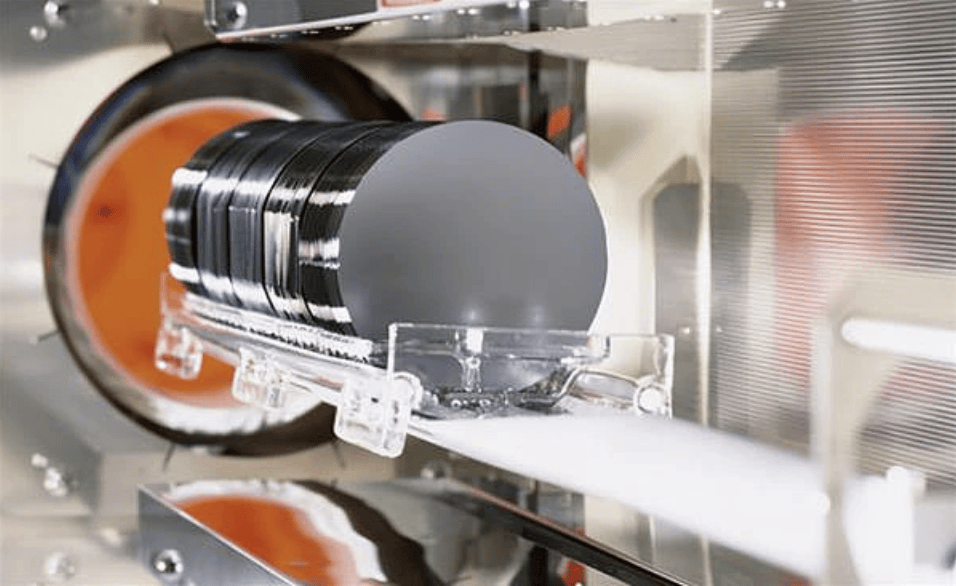
12英寸硅晶圆

Search documents
日本发出警告;中国这项技术,一旦成熟日本材料霸权会崩塌
Sou Hu Cai Jing· 2025-12-24 03:11
Core Viewpoint - The article discusses the significant shift in the global semiconductor industry, highlighting China's advancements in semiconductor materials and the potential challenges faced by Japan's long-standing dominance in this sector [1][3][18]. Group 1: China's Semiconductor Advancements - Chinese researchers have made a breakthrough in extreme ultraviolet (EUV) lithography materials, developing a new type of photoresist based on poly(thiophene) [3][15]. - By 2025, China's market share in mature chips is expected to reach 28%, indicating rapid expansion in the mature process sector [5]. - The self-sufficiency rate of 12-inch silicon wafers in China is nearing 50%, with local manufacturers offering prices significantly lower than their Japanese counterparts [6]. Group 2: Market Dynamics and Competition - The market share of domestic DRAM in China is projected to increase from less than 5% in 2023 to 12% by 2025, showcasing the swift pace of domestic substitution [6]. - Japan's Rapidus company has announced plans to mass-produce 2nm chips by 2027, backed by substantial government subsidies totaling 1.8 trillion yen [8]. - The competition is intensifying as Japan faces challenges in talent retention, with the workforce in integrated circuits shrinking from approximately 150,000 in 1999 to about 60,000 in 2023 [10]. Group 3: Implications for Global Supply Chains - The ongoing changes in the semiconductor industry are reshaping the value chain, with profits shifting from downstream manufacturers back to upstream wafer producers [10]. - China's semiconductor industry is increasingly viewed as a catalyst for upgrading, especially in response to external pressures such as the U.S. sanctions on Chinese companies [11][13]. - The rise of China's semiconductor capabilities poses a structural challenge to Japan's material dominance, as China aims to establish a self-sufficient semiconductor supply chain [17][18].


这家日本硅晶圆厂近14年来将首度全年亏损,股价暴跌20%!
Sou Hu Cai Jing· 2025-11-12 13:59
Core Viewpoint - SUMCO, a major Japanese silicon wafer manufacturer, reported significant losses in its Q3 2025 financial results, with expectations of further losses in Q4, potentially leading to the company's first annual loss in 14 years, causing a 20.16% drop in its stock price [2][3]. Financial Performance - In Q3 2025, SUMCO's consolidated revenue slightly increased by 0.7% year-on-year to 99.1 billion yen, which was below market expectations [2]. - The company reported a consolidated operating loss of 1.6 billion yen, a decline from a profit of 9.1 billion yen in the same quarter last year [2]. - The consolidated net loss was 3.9 billion yen, compared to a profit of 3.6 billion yen in the previous year [2]. Q4 2025 Outlook - For Q4 2025, SUMCO anticipates an operating loss of 10 billion yen, worse than the market expectation of a 6 billion yen loss [3]. - The company projects consolidated revenue to remain flat at 100 billion yen year-on-year, with a net loss expected to reach 16 billion yen [3]. - The demand for advanced 12-inch silicon wafers remains strong, but traditional product demand is recovering slowly, and shipments of wafers below 8 inches are expected to remain low [3]. Annual Forecast - For the fiscal year 2025, SUMCO estimates a revenue growth of 2% to 404.4 billion yen, but anticipates an operating loss of 4.2 billion yen, a significant decline from a profit of 36.9 billion yen in the previous year [3]. - The projected net loss for the fiscal year is 16.9 billion yen, marking the first annual loss since 2011 [3]. Future Outlook - Looking ahead, SUMCO expects a challenging profit environment for fiscal year 2026, with increased depreciation costs anticipated [4]. - Demand for advanced logic 12-inch silicon wafers is expected to remain strong, while competition with Chinese manufacturers is likely to keep shipments of wafers below 8 inches at low levels [4].
台积电市占,首超70%
半导体行业观察· 2025-09-02 01:11
Core Viewpoint - TSMC has achieved a record high global foundry market share of 70.2% in Q2, significantly widening the gap with Samsung, which has seen a decline in its market share [2][14]. Group 1: TSMC's Performance - TSMC's revenue for Q2 reached $30.24 billion, a year-on-year increase of 44.4% and a quarter-on-quarter increase of 17.8% [5][14]. - The net profit for TSMC in Q2 was $12.8 billion, accounting for 42.6% of revenue, marking a 67.2% increase compared to Q2 2024 [5]. - TSMC's wafer shipments increased by 19% in Q2, reaching 3.72 million 12-inch equivalent wafers, with revenue per wafer growing by 21.4% to $8,088 [5][12]. Group 2: Industry Outlook - The global foundry capacity utilization rate is expected to improve in Q3 due to seasonal demand for new products, with TSMC benefiting from high-priced advanced process wafers [2][14]. - SEMI predicts a 69% increase in advanced manufacturing technology capacity from 2024 to 2028, driven by the demand for chips produced using 7nm and smaller nodes [9][11]. Group 3: Competitors' Performance - Samsung's Q2 revenue was approximately $3.16 billion, with a market share of 7.3%, while SMIC's revenue slightly decreased to $2.21 billion, maintaining a 5.1% market share [15][16]. - UMC and GlobalFoundries reported revenue increases of 8.2% and 6.5%, respectively, with UMC's revenue reaching $1.9 billion and GlobalFoundries at $1.69 billion [15][16]. Group 4: Investment and Expansion - TSMC plans to invest $165 billion in the U.S. to build six chip fabs, two advanced packaging plants, and a research center in Phoenix, Arizona [8]. - TSMC is also expanding its production capabilities in Taiwan, with several fabs capable of producing chips from 130nm to 3nm nodes [8]. Group 5: AI and High-Performance Computing - TSMC's sales from high-performance computing (HPC) devices exceeded $18 billion, a 66.6% year-on-year increase, with AI chip manufacturing contributing approximately $8.78 billion in revenue [12][11]. - AI is estimated to account for about one-third of TSMC's total revenue, reflecting the growing demand for advanced chips in various applications [12].
【太平洋科技-每日观点&资讯】(2025-05-14)
远峰电子· 2025-05-13 11:42
Market Overview - The main board saw significant gains with notable stocks such as Wantech (+10.04%), Tianjian Technology (+10.00%), and Chaoyang Technology (+10.00%) leading the charge [1] - The ChiNext board also performed well, with stocks like Yekeshu (+13.85%) and Sihui Fushi (+13.70%) showing strong increases [1] - The Sci-Tech Innovation board was led by Weide Information (+9.76%) and Jiahe Meikang (+6.90%) [1] - Active sub-industries included SW Portal Websites (+0.64%) and SW Passive Components (+0.61%) [1] Domestic News - Longxin Zhongke announced the successful adaptation of its Longxin 3A5000/3A6000 desktop terminals with UniVista Archer, achieving a fully domestic supply chain for electronic system design [1] - IDC reported that China's tablet market shipped 8.52 million units in Q1 2025, a year-on-year increase of 19.5%, driven by the "national subsidy" policy [1] - Taiwan's GlobalWafers is set to complete its 12-inch silicon wafer factory in Texas by May 15, marking the first of its kind in the U.S. [1] - In April, domestic new energy vehicle sales reached 905,000 units, a year-on-year increase of 33.9%, while the cumulative sales from January to April were 3.324 million units, up 35.7% year-on-year [1] Company Announcements - Chongda Technology announced an adjustment to the conversion price of its convertible bonds, lowering it to 10.25 yuan per share, effective from May 22, 2025 [2] - Dahua Intelligent reported a guarantee agreement with Fujian Haixia Bank, providing a joint liability guarantee for its subsidiary New East Network for a credit line of 10 million yuan [2] - Taijia Co. plans to invest up to 100 million yuan in its wholly-owned subsidiary Hong Kong Taijia to establish a project base in Thailand [2] - Guangyun Technology disclosed a share reduction plan, with Hainan Qiyu intending to reduce its holdings by up to 7,111,271 shares, representing 1.67% of the total share capital [2] Semiconductor Industry Insights - Samsung Electronics has finalized a plan to increase DRAM supply prices, with DDR4 expected to rise by approximately 20% and DDR5 by around 5% [3] - Nvidia has raised prices for its GPU products, with increases of 10% to 15% for modules including AI chips H200 and B200 [3] - Reports indicate that Samsung will begin mass production of its 12-layer stacked HBM3E around February 2025, ahead of Nvidia's expected certification [3] - Samsung Display plans to start mass production of its first foldable phone OLED panels next month, with an initial production scale of 200,000 to 300,000 units [3]