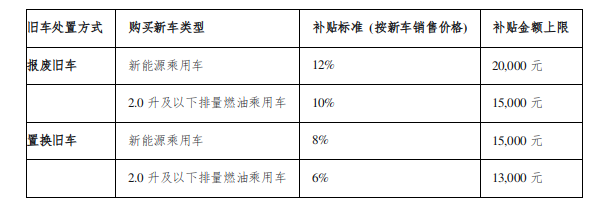
2.0升及以下排量燃油乘用车

Search documents
深圳:给予汽车报废更新补贴支持,购买新能源乘用车补贴车价的12%
Xin Lang Cai Jing· 2026-02-28 02:44
Core Viewpoint - Shenzhen's Development and Reform Commission, along with two other departments, has issued a plan to support the replacement and upgrading of consumer goods through long-term special government bonds, focusing on the automotive sector [1] Group 1: Policy Details - The plan includes support for the scrapping and updating of automobiles, specifically targeting personal consumers who register the scrapping of their passenger vehicles [1] - Consumers who purchase new energy passenger vehicles or fuel passenger vehicles with an engine displacement of 2.0 liters or below will receive subsidies [1] Group 2: Subsidy Structure - A subsidy of 12% of the purchase price (up to a maximum of 20,000 yuan) is offered for the purchase of new energy passenger vehicles [1] - For the purchase of fuel vehicles with an engine displacement of 2.0 liters or below, a subsidy of 10% of the purchase price (up to a maximum of 15,000 yuan) is provided [1]
个人购车最高补贴2万元
Xin Lang Cai Jing· 2026-02-19 23:02
Core Viewpoint - Hebei province is launching a new initiative to promote vehicle trade-in and replacement, providing significant subsidies to consumers for upgrading their vehicles, particularly focusing on new energy and low-emission vehicles. Group 1: Vehicle Trade-in and Replacement Program - The program will start on January 1, 2026, and run until December 31, 2026, targeting personal consumers for vehicle scrapping and replacement activities [1]. - Consumers can receive a subsidy of up to 20,000 yuan for trading in old vehicles for new energy vehicles, with a subsidy rate of 12% of the new vehicle's sales price [1]. - For trading in fuel vehicles with an engine size of 2.0 liters or less, consumers can receive a subsidy of up to 15,000 yuan, at a rate of 10% of the new vehicle's sales price [1]. Group 2: Application Process and Additional Subsidies - Consumers can apply for subsidies through the national automotive circulation information management system or the "Automobile Trade-in" mini-program [2]. - For vehicle replacement, a one-time subsidy is available for consumers who sell their registered vehicles and purchase new energy or low-emission vehicles, with subsidies of up to 15,000 yuan for new energy vehicles (8% of the new vehicle's sales price) and 13,000 yuan for fuel vehicles (6% of the new vehicle's sales price) [2]. - Each individual can only receive one trade-in subsidy or one replacement subsidy per year [3].
国家又发钱了,625亿元国补已发放,购车补贴2万封顶
3 6 Ke· 2026-02-13 04:20
Core Viewpoint - The Chinese government has allocated a total of 625 billion yuan in subsidies for the "old-for-new" consumption policy, which is expected to stimulate consumer spending during the upcoming Spring Festival holiday [2][5]. Group 1: Policy Implementation and Financial Support - The Ministry of Commerce announced that the first batch of 625 billion yuan in national subsidies has been distributed to local commerce departments [2]. - In 2025, the Ministry of Finance issued a total of 3 trillion yuan in special long-term bonds to support the "old-for-new" consumption policy, with the first batch amounting to 810 billion yuan [4][7]. - By the end of 2025, all four batches of funding have been fully disbursed, with some regions even adding local funds to enhance consumer spending [9]. Group 2: Impact on Automotive Sales - In 2025, over 11.5 million vehicles were replaced under the "old-for-new" policy, with nearly 60% of these being new energy vehicles, contributing to a 3.8% increase in domestic passenger car retail sales [4][10]. - The total sales revenue from products related to the "old-for-new" policy exceeded 2.6 trillion yuan, benefiting over 360 million people [10]. Group 3: Changes in Subsidy Structure for 2026 - The subsidy structure for 2026 has shifted from a fixed amount to a percentage of the new car price, with a maximum subsidy of 20,000 yuan for new energy vehicles and 15,000 yuan for fuel vehicles [12][14]. - This adjustment aims to prevent low-priced vehicles from consuming excessive subsidies while providing reasonable support for mid-to-high-end models, promoting the industry's transition towards electrification and high-end development [17].

利好来了!上海重大发布!事关消费 最高补贴不超2万元
Xin Lang Cai Jing· 2026-01-30 23:52
Core Viewpoint - Shanghai has announced a comprehensive policy to promote large-scale equipment updates and a trade-in program for consumer goods, aiming to stimulate consumption and enhance the recycling economy [1][3]. Group 1: Large-Scale Equipment Updates - The policy supports applications for national equipment update projects across various sectors, including industrial, electronic information, energy, transportation, logistics, education, cultural tourism, healthcare, and more [7]. - Specific support is provided for the scrapping and updating of old operational trucks and the renewal of new energy city buses, with subsidies following existing guidelines [8]. Group 2: Consumer Goods Trade-In Program - The policy outlines subsidies for scrapping and updating vehicles, with a maximum subsidy of 20,000 yuan for purchasing new energy passenger vehicles and 15,000 yuan for 2.0-liter or below fuel vehicles [10]. - For vehicle trade-ins, consumers can receive up to 15,000 yuan for new energy vehicles and 13,000 yuan for fuel vehicles, depending on the vehicle's price [10]. Group 3: Household Appliances and Digital Products - Consumers purchasing energy-efficient household appliances such as refrigerators, washing machines, and air conditioners can receive a subsidy of 15% of the product price, capped at 1,500 yuan per item [10]. - For digital and smart products, a subsidy of 15% is available for items priced under 6,000 yuan, with a maximum of 500 yuan per item [11]. Group 4: Recycling and Resource Utilization - The policy emphasizes the establishment of a comprehensive recycling network for old equipment and consumer goods, promoting a "two-network integration" recycling system [8]. - It aims to enhance the recycling and remanufacturing industry, focusing on high-end remanufacturing projects and improving the quality and safety of remanufactured products [9].
上海:支持汽车报废更新 购买新能源乘用车补贴最高不超过2万元
Xin Lang Cai Jing· 2026-01-30 23:52
Core Viewpoint - The Shanghai Municipal Development and Reform Commission and the Shanghai Municipal Finance Bureau have issued a notification regarding the implementation of a large-scale equipment renewal and consumer goods trade-in policy by 2026, outlining 16 specific measures to promote equipment updates and recycling [1] Group 1: Large-scale Equipment Renewal - The notification emphasizes the importance of advancing large-scale equipment updates as a key initiative [1] - It includes measures to enhance the recycling and circular economy network [1] Group 2: Consumer Goods Trade-in - The policy supports the scrapping and updating of automobiles, providing financial incentives for consumers [1] - Personal consumers who scrap their registered passenger vehicles and purchase new energy vehicles or fuel vehicles with an engine capacity of 2.0 liters or below will receive subsidies [1] Group 3: Subsidy Details - For purchasing new energy vehicles, consumers will receive a subsidy of 12% of the vehicle price, capped at 20,000 yuan [1] - For purchasing fuel vehicles with an engine capacity of 2.0 liters or below, the subsidy will be 10% of the vehicle price, capped at 15,000 yuan [1]
利好来了!上海,重大发布!事关消费
券商中国· 2026-01-30 23:42
Core Viewpoint - Shanghai has issued a significant policy document aimed at promoting large-scale equipment updates and a trade-in program for consumer goods, focusing on various sectors including industrial, electronic information, and transportation [2][3]. Group 1: Large-Scale Equipment Updates - The policy supports applications for national equipment update projects, specifically targeting sectors such as industrial, electronic information, energy, transportation, and healthcare [5]. - It encourages the scrapping and updating of old operational trucks and the renewal of new energy city buses, with subsidies based on existing guidelines [5]. Group 2: Consumer Goods Trade-In Program - The policy outlines subsidies for scrapping and updating vehicles, with a maximum subsidy of 20,000 yuan for purchasing new energy vehicles and 15,000 yuan for 2.0L or below fuel vehicles [10]. - For household appliances, consumers can receive a subsidy of 15% of the purchase price (up to 1,500 yuan) for energy-efficient products like refrigerators and washing machines [10]. Group 3: Recycling and Resource Utilization - The initiative aims to enhance the recycling network for old equipment and consumer goods, promoting a "two-network integration" recycling system [7]. - It emphasizes the development of the resource recycling and remanufacturing industry, with a focus on high-end remanufacturing projects and improving the technology level of recycled resources [8].

汽车以旧换新!最新提醒!
Xin Lang Cai Jing· 2026-01-21 10:25
Core Points - The major change in the 2026 vehicle trade-in policy compared to last year is the implementation of a "limited implementation and lottery registration" model for subsidy eligibility, requiring consumers to register for a lottery to obtain qualification before applying for subsidies [1][21] Group 1: Registration and Eligibility - Consumers can participate in the lottery regardless of whether they trade in or scrap their old vehicles or purchase new ones, but it is recommended to register for the lottery first to avoid missing out on subsidies [21][22] - The materials required for lottery registration include the applicant's ID, photos or scans of the old vehicle's registration and driving documents, and the applicant must be the same person applying for the subsidy [24][35] - The validity period for the lottery qualification is three months, or until December 31, 2026, if the qualification period is less than three months from the date of winning [4][25] Group 2: Subsidy Details - In 2026, a consumer can only apply for either the scrapping or trade-in subsidy, not both [5][26] - The conditions for the old vehicle include registration dates: for trade-in, the vehicle must be registered before January 8, 2025; for scrapping, specific registration dates apply based on vehicle type [28] - The subsidy amounts vary based on the method of disposing of the old vehicle and the type of new vehicle purchased, with maximum subsidies of 20,000 yuan for scrapping an old vehicle for a new energy vehicle and 15,000 yuan for a fuel vehicle [9][29] Group 3: Application Process - The application process consists of two main stages: lottery registration and subsidy application after winning [30] - Registration starts on January 9, 2026, with monthly lottery draws, the first being on January 19, 2026 [31][33] - After winning the lottery, consumers have three months to submit required documents for subsidy application, with funds disbursed within approximately 30 working days after approval [34][36]
2026年河北接续开展消费品以旧换新工作
Xin Lang Cai Jing· 2026-01-04 23:12
Group 1 - The core viewpoint of the article is that Hebei Province will continue its old-for-new consumption policy in 2026, covering four main areas: automobile scrapping and replacement, home appliance upgrades, and the purchase of digital and smart products, with subsidies to promote green consumption and industrial upgrades [1] Group 2 - In the automotive sector, consumers who scrap eligible old vehicles and purchase new energy passenger cars or fuel passenger cars with an engine size of 2.0 liters or less can receive a one-time subsidy of up to 20,000 yuan. Those who sell old cars and buy new ones can receive a maximum subsidy of 15,000 yuan. Each consumer is limited to one subsidy for either scrapping or replacing a vehicle [1] Group 3 - For home appliances and digital products, consumers purchasing energy-efficient appliances such as refrigerators and washing machines can receive a subsidy of 15% of the sales price, with a maximum of 1,500 yuan per item. For mobile phones and tablets priced under 6,000 yuan, a similar 15% subsidy applies, with a maximum of 500 yuan per item [1] Group 4 - To ensure the orderly implementation of the old-for-new policy, the subsidy funds will be managed according to an annual total control and monthly allocation principle. The subsidies will operate on a "first come, first served" basis, and consumers who do not claim their subsidies in a given month can apply in subsequent months [1] Group 5 - Relevant departments will establish a collaborative regulatory mechanism to strengthen oversight of subsidy fund usage and market behavior, with strict measures against fraudulent claims and violations to maintain a fair and orderly market environment [2]
安徽消费品以旧换新1月1日启动
Xin Lang Cai Jing· 2026-01-04 18:00
Group 1 - The 2026 Anhui Province consumer goods trade-in program officially started on January 1, 2026, focusing on vehicle scrappage and replacement subsidies [1] - For scrapping gasoline passenger cars registered before June 30, 2013, and diesel or other fuel passenger cars registered before June 30, 2015, a one-time subsidy of up to 20,000 yuan is available when purchasing qualifying new energy or fuel vehicles [1] - The subsidy for scrapping eligible fuel passenger cars and purchasing vehicles with an engine size of 2.0 liters or less is set at 10% of the new vehicle sales price, with a maximum of 15,000 yuan [2] Group 2 - Each individual consumer can only receive either a scrappage subsidy or a replacement subsidy once during the program [2][3] - The new vehicle must be registered in the applicant's name during the subsidy application review period, and the old vehicle must have been held until January 8, 2025 [2][3] - The household appliance and digital product trade-in program will follow national standards, providing a 15% subsidy on the final sales price for eligible products, with specific caps on the subsidy amounts for each category [3]
8部门联合印发《2026年汽车以旧换新补贴实施细则》
蓝色柳林财税室· 2026-01-04 07:45
Core Viewpoint - The article outlines the implementation details of the 2026 automobile trade-in subsidy policy, aimed at promoting the replacement of old vehicles with new ones, particularly focusing on environmentally friendly options such as electric vehicles and low-emission gasoline cars [3][4]. Chapter Summaries Chapter 1: Vehicle Scrapping and Replacement - In 2026, individuals who scrap gasoline vehicles registered before June 30, 2013, diesel vehicles registered before June 30, 2015, or new energy vehicles registered before December 31, 2019, will receive a one-time subsidy when purchasing eligible new vehicles. The subsidy for new energy vehicles is 12% of the new car's sales price, capped at 20,000 yuan, while for gasoline vehicles with an engine size of 2.0 liters or less, it is 10%, capped at 15,000 yuan [4]. Chapter 2: Vehicle Exchange and Replacement - Individuals selling their registered vehicles and purchasing eligible new energy or low-emission gasoline vehicles will receive a subsidy of 8% of the new car's sales price (up to 15,000 yuan) for new energy vehicles and 6% (up to 13,000 yuan) for gasoline vehicles [7]. Chapter 3: Subsidy Review and Payment - Local business authorities will review subsidy applications in collaboration with relevant departments and provide feedback through the national automobile trade-in platform. The review process aims to be efficient, with a target of completing the review within 15 working days and subsidy payments within 30 working days [10][11]. Chapter 4: Subsidy Fund Management - The National Development and Reform Commission and the Ministry of Finance will allocate special long-term bonds to support the subsidy policy, with local governments required to match funding. The subsidy funds will be used evenly throughout the year [13]. Chapter 5: Supervision and Management - Local authorities are responsible for supervising the implementation of the subsidy policy, ensuring compliance with regulations, and preventing fraudulent claims. A joint regulatory mechanism involving multiple departments will be established to oversee the process [15][16]. Chapter 6: Supplementary Provisions - The policy defines passenger vehicles as small and micro passenger cars registered with public security traffic management departments. The implementation of these guidelines will begin on January 1, 2026, with local authorities required to develop specific implementation details [20].