A500指数基金

Search documents
A股上涨的原因找到了,中金明日复牌!准备向4000点进攻
Sou Hu Cai Jing· 2025-12-18 19:43
今日,A股上涨的原因找到了,中金明日复牌!准备向4000点进攻。任何时候,大家要明白市场的主力是谁,20年前是庄家,过去10年是外资,未来是汇 金…… 午后,汇金大幅抄底宽基ETF,肯定是他们,除了他们还有谁能够让大盘指数直线拉升,沪深300指数基金,A500指数基金都是分时大幅放量。 5000多家个股,大家怎么知道你买的是上涨的。大家为什么不说没跑赢指数的个股呢?为什么就觉得你买的是涨得多的那些,而不是跌停板,ST,退市 呢?大家的策略不同,没什么好聊的。 我不相信自己的水平,但是我相信汇金啊!它们买什么,我就持有什么,自然我也会赚钱,是不是这个道理。自己不行,就寄生在能行的资金上面,汇金只 抄底ETF,2023年就明牌开始建仓沪深300,A500等指数…… 3、本轮牛市有利润是因为我们跟着汇金的节奏囤一堆宽基。 有什么怕?大盘指数跌了永远可以涨回来,大跌大买,小跌小买。盘后,终于有几个同频的粉丝让自己欣慰了,他们也买了创业板指数,今日的涨幅还不 错,今年的涨幅更不错。小凡就是做指数的玩家,不需要股民当粉丝。 大涨大卖,今日很多随缘单在自己睡觉的时候成交了,也不后悔,就算明天高开也不后悔,本来就是捡的便宜筹 ...


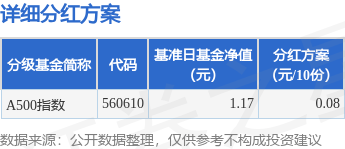
基金分红:A500指数基金10月28日分红
Sou Hu Cai Jing· 2025-10-20 01:48
以上内容为证券之星据公开信息整理,由AI算法生成(网信算备310104345710301240019号),不构成 投资建议。 本次分红对象为权益登记日下午上海证券交易所交易结束后,登记在册的本基金全体持有人。,权益登 记日为10月22日,现金红利发放日为10月28日。本基金收益分配方式采用现金分红。根据财政部、国家 税务总局相关规定,基金向投资者分配的基金收益,暂免征收所得税。本基金本次分红免收分红手续 费。 证券之星消息,10月20日发布《招商中证A500交易型开放式指数证券投资基金2025年度第三次分红公 告》。本次分红为2025年度的第三次分红。公告显示,本次分红的收益分配基准日为9月9日,详细分红 方案如下: | 分级基金筒称 | 代码 | 是准日最美净值 | | 分红方案 | | | --- | --- | --- | --- | --- | --- | | | | (元) | | (元/10份) | | | A500指数 | 560610 | | 1.17 | | 0.08 | ...
想赚1.5%管理费有多难?
远川投资评论· 2025-06-06 07:03
Core Viewpoint - The article discusses the competitive landscape of public funds in China, particularly focusing on the introduction of floating fee rate funds and the challenges faced by actively managed equity funds in outperforming benchmarks [1][2][16]. Group 1: Floating Fee Rate Funds - The first batch of 26 floating fee rate funds was quickly approved and reached a fundraising cap of 20 billion within a short period, indicating strong market interest [1]. - The fee structure of these funds is asymmetric, where higher management fees are charged when performance exceeds benchmarks, while lower fees apply when performance lags, aiming to align the interests of fund managers and investors [2][24]. - Despite the innovative fee structure, the average management fee for actively managed equity funds remains at 1.2%, as many investors do not hold funds for more than a year, limiting the potential for higher fees [5][29]. Group 2: Performance Challenges - A significant portion of investors (41%) hold funds for less than a year, which complicates the ability of fund managers to achieve the performance needed to charge higher fees [4][5]. - In the past year, only 24% of actively managed equity funds outperformed their benchmarks by 6 percentage points, highlighting the difficulty in consistently achieving superior returns [7][11]. - Over the past three years, only 259 actively managed equity funds have exceeded benchmark returns by 6%, while 2004 funds have underperformed by 3% or more, indicating a challenging environment for fund managers [11][14]. Group 3: Regulatory Context - The introduction of floating fee rate funds is part of a regulatory push to reduce the risk of significant underperformance relative to benchmarks, rather than merely to increase management fees [16][22]. - The regulatory framework aims to strengthen the binding nature of performance benchmarks and reduce the prevalence of style drift among fund managers, ensuring that funds are more aligned with their stated objectives [21][22]. Group 4: Market Sentiment and Historical Context - The market sentiment towards floating fee rate funds is cautious, as previous attempts to implement similar structures faced challenges and regulatory scrutiny [27][28]. - The article notes that while there is renewed interest in floating fee rate funds, they have not yet reached the marketing heights seen with other fund types, such as the A500 index funds [27][28].

螺丝钉股市牛熊信号板来啦:当前还在低估吗|2025年5月份
银行螺丝钉· 2025-05-07 13:55
Core Viewpoint - The article discusses the current state of the stock market as of May 2025, focusing on the bull-bear signal board, which includes both quantitative and qualitative indicators to assess market conditions and potential investment opportunities [1][46]. Quantitative Indicators - The Buffett Indicator, which measures the total market capitalization of listed companies against GDP, indicates that a value below 80% suggests a relatively low market valuation [19]. - The price-to-book ratio percentile shows that the current market valuation is at 45.76% for large-cap growth stocks and 30.97% for large-cap value stocks, indicating that the market is relatively cheap compared to historical levels [3][4]. - The stock-bond yield ratio is currently at 3.34, which is above the historical average, suggesting that the stock market is undervalued [23]. - The financing balance in the A-share market is a critical indicator, with lower balances indicating a cooler market, while higher balances suggest a more active market [5][26]. - The trading volume percentile is at 88.30%, indicating that current trading activity is relatively high compared to historical data [5]. Qualitative Indicators - The number of new stock issuances and the rate of initial public offering (IPO) failures are important indicators; a high failure rate typically signifies a bearish market [28]. - The relationship between the total return of the CSI All Share Index and M2 money supply indicates market liquidity; when the index approaches the M2 bottom curve, it suggests a low market condition [30]. - The scale of existing funds has decreased significantly, with many funds experiencing a 50%-60% drop compared to their peak sizes in 2021, reflecting a bearish sentiment in the market [32]. - The proportion of funds under purchase restrictions is currently at 22.73%, indicating that fund managers are cautious about market valuations [11][38]. - Recent market news has been predominantly positive, which may influence market sentiment and investor behavior [41].