
ABS产品

Search documents
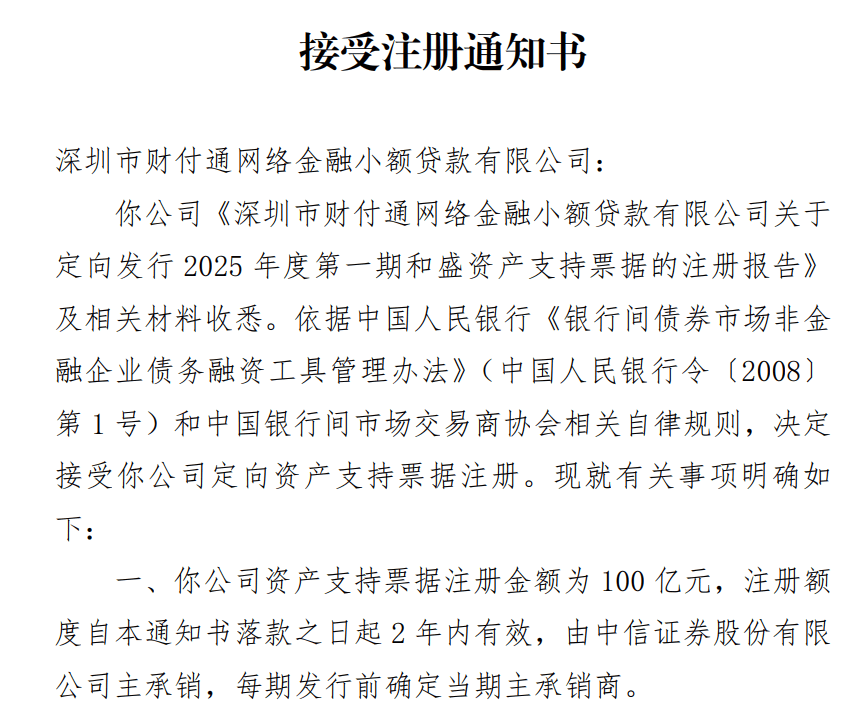
100亿!财付通小贷再获大额融资
Sou Hu Cai Jing· 2025-12-30 01:44
Group 1 - The main financing methods for Tencent's microloan company, WeChat Pay Microloan, are the issuance of Asset-Backed Securities (ABS) and Asset-Backed Notes (ABN) products, with a total of 450 billion yuan in ABN products registered over the past two years and over 200 billion yuan issued this year [2] - WeChat Pay Microloan was established in October 2013 and is primarily owned by Tencent Holdings, with a registered capital increase from 10.5 billion yuan to 15 billion yuan in November this year, making it the second largest in the industry after Douyin's Zhongrong Microloan at 19 billion yuan [2] - The main product under Tencent is "Fenfu," which started a limited rollout in 2020 and is still invitation-only, with a loan balance expected to reach approximately 120 billion yuan by the end of June 2025 [2] Group 2 - As of June 30, 2025, WeChat Pay Microloan's total assets were 15.355 billion yuan, a decrease of 5.52% from the beginning of the year [3] - In the first half of 2024, WeChat Pay Microloan achieved revenue of 662 million yuan, a year-on-year increase of 30.2%, while net profit was 6.8 million yuan, a year-on-year decrease of 56.38%, indicating a situation of increasing revenue but declining profit [3]


四大维度齐发力!一图读懂天津资本市场“十四五”升级攻略
Xin Lang Cai Jing· 2025-12-19 12:45
Core Viewpoint - The article discusses the comprehensive reforms and developments in Tianjin's capital market during the "14th Five-Year Plan" period, emphasizing risk prevention, regulatory strength, and high-quality development [35]. Group 1: Market Expansion - The number of listed companies increased from 60 to 71, an 18% growth compared to the end of the "13th Five-Year Plan" [6]. - The total market value of listed companies rose from 920.3 billion yuan to 1,656.6 billion yuan, an 80% increase compared to the end of the "13th Five-Year Plan" [6]. - The number of companies listed on the New Third Board reached 118, with 39 in the innovation layer, a 1.29 times increase year-on-year [7]. - The bond market's outstanding scale reached 12.8 trillion yuan, ranking among the top in the country [8]. - The total assets of eight securities, fund, and futures institutions reached 113.7 billion yuan, with net assets growing by 22% and 20% respectively compared to the end of the "13th Five-Year Plan" [8][9]. Group 2: Structural Optimization - The focus is on enhancing quality and efficiency, with a strong emphasis on technology innovation and industrial upgrades [10]. - There are 49 high-tech and specialized new listed companies in Tianjin, accounting for 69% of the total, with a total market value share of 78% [12]. - Cumulative R&D investment by listed companies exceeded 100 billion yuan, an 80% increase compared to the "13th Five-Year Plan" [12]. - The overall R&D intensity of listed companies is projected to be 3.01% in 2024, with key industry chain companies at 7.64% [12]. Group 3: Capital Market and Industry Renewal - 40 listed companies belong to key industrial chains in Tianjin, accounting for nearly 70% of the total market value [14]. - Six listed companies have undergone major asset restructuring to eliminate inefficient assets and transition to emerging industries [14]. - Nearly 20% of listed companies are expanding production or investing in weak links of the industrial chain through refinancing [14]. - The amount of mergers and acquisitions by listed companies exceeded 26 billion yuan after the release of the "Six Merger Guidelines" in September 2024 [14]. Group 4: Asset Activation - Two public REITs were issued, with one revitalizing 220,000 square meters of industrial park assets and another raising 2.5 billion yuan for highway expansion projects [17]. - The outstanding scale of ABS products in the region reached 72.1 billion yuan, ranking among the top in the country [18]. Group 5: Function Enhancement - Over the past five years, the region has utilized multi-level capital markets to finance 1.6 trillion yuan, 1.6 times the total financing amount during the "13th Five-Year Plan" [21]. - Among 14 new listed companies, 11 were issued through the registration system, and 10 were listed on the "Two Innovation Boards" and the Beijing Stock Exchange [21]. - The wealth management scale of capital market institutions in the region exceeded 2.2 trillion yuan [23]. Group 6: Ecological Improvement - The regulatory framework for the capital market has been established, guiding further comprehensive reforms [26]. - The implementation of the "New National Nine Articles" and the "1+N" policy has led to the introduction of various supportive measures for high-quality development [28]. - A specialized working group has been established to implement capital market reform policies and coordinate high-quality development of listed companies [29].

融资1.6万亿元,分红超1700亿元!天津资本市场“十四五”交亮眼答卷
Zhong Zheng Wang· 2025-12-19 07:27
Core Viewpoint - The Tianjin government is focused on enhancing the capital market during the "14th Five-Year Plan" period, aiming for expansion, structural optimization, functional enhancement, and ecological improvement to support economic growth. Group 1: Market Expansion - During the "14th Five-Year Plan," the capital market in Tianjin has expanded significantly, with a total financing of 1.6 trillion yuan, which is 1.6 times that of the "13th Five-Year Plan" period [1] - The number of listed companies in the region has increased to 71, an 18% growth compared to the end of the "13th Five-Year Plan," with a total market value exceeding 1.66 trillion yuan, a 80% increase [2] - The bond financing channel has become prominent, with 109 issuers and a total bond scale of 1.28 trillion yuan, ranking among the top in the country [2] Group 2: Structural Optimization - The capital market is focusing on technology innovation and industrial upgrades, with 14 companies listed on the A-share market, nearly 80% of which are technology firms [3] - Cumulatively, listed companies have invested over 100 billion yuan in R&D, an increase of nearly 80% compared to the "13th Five-Year Plan" period [3] - The issuance of innovative bond varieties has exceeded 80 billion yuan, with an annual compound growth rate of 33% [3] Group 3: Functional Enhancement - The comprehensive reform of capital market financing has been advanced, enhancing resource allocation functions to inject lasting momentum into the real economy [5] - The region has utilized multi-level capital markets to finance 1.6 trillion yuan, with equity financing at 55.3 billion yuan and bond financing at 1.56 trillion yuan [6] - The public fund fee reform has been fully implemented, with significant participation in the national personal pension fund product catalog [6] Group 4: Investment Returns - Listed companies in the region have distributed over 170 billion yuan in cash dividends, which is 7.5 times that of the "13th Five-Year Plan" period, equating to three times the stock financing during the same period [7] - The average dividend yield is 3.08%, surpassing the average return on household savings [7] - In 2023, 20 companies repurchased shares totaling nearly 3.8 billion yuan, indicating a strong commitment to shareholder value [7] Group 5: Ecological Improvement - The regulatory framework for the capital market has been established, with a clear policy system to guide further reforms [8] - Supportive policies have been developed, including measures to enhance government guidance on venture capital and private equity funds [8] - Strict regulatory practices have been implemented, resulting in significant penalties for financial misconduct, with a total of 4.21 billion yuan in fines, a 22-fold increase compared to the "13th Five-Year Plan" period [8]
决胜“十四五” 擘画“十五五”·地方资本市场高质量发展之天津篇: 四大维度提质增效 续写津沽大地资本新篇章
Zheng Quan Shi Bao· 2025-12-18 18:13
Core Viewpoint - The "14th Five-Year Plan" period marks the beginning of Tianjin's comprehensive construction of a modern socialist metropolis and a critical phase for systemic reforms in the capital market, focusing on risk prevention, strong regulation, and promoting high-quality development [1] Group 1: Scale Expansion - During the "14th Five-Year Plan" period, the stock issuance registration system reform accelerated, leading to a steady expansion of the capital market in Tianjin, with the number of listed companies reaching 71, an 18% increase from the end of the "13th Five-Year Plan" [2] - By the end of November 2025, the total market value of listed companies is projected to be approximately 1.66 trillion yuan, an 80% increase [2] - The bond financing channel has become prominent, with 109 bond issuers and a total bond scale of 1.28 trillion yuan, ranking among the top in the country [2] Group 2: Structural Optimization - The capital market in Tianjin has deeply integrated with technological innovation, with 14 new companies listed on the A-share market in the past five years, nearly 80% of which are technology-oriented [3] - Cumulatively, listed companies have invested over 100 billion yuan in R&D, an increase of nearly 80% compared to the "13th Five-Year Plan" period [3] - The overall R&D intensity of key industry chain listed companies reached 7.64%, while companies on the "Two Innovation Boards" and the Sci-Tech Innovation Board had R&D intensities of 13.53% and 28.16%, respectively [3] Group 3: Function Enhancement - The capital market in Tianjin has strengthened its financing support, with enterprises utilizing multi-level capital markets for direct financing totaling 1.6 trillion yuan, 1.6 times that of the "13th Five-Year Plan" period [6] - Among the 14 newly listed companies, 11 utilized the registration system for their listings, and 10 were listed on the "Two Innovation Boards" and the Beijing Stock Exchange [6] - The Tianjin market has seen the emergence of innovative bond products, including technology innovation bonds and green bonds, contributing to a diverse financing landscape [6] Group 4: Investment Returns - Listed companies in Tianjin have implemented cash dividends totaling over 170 billion yuan, 7.5 times that of the "13th Five-Year Plan" period, with an average annual dividend yield of 3.08% [7] - Approximately 45% of listed companies have maintained continuous dividends for five years, and over 60% for three years [7] - In 2024, 20 companies repurchased shares totaling nearly 3.8 billion yuan, with several companies utilizing share repurchase and shareholder increase tools to stabilize market expectations [7] Group 5: Ecological Improvement - The regulatory framework for the capital market in Tianjin has been established, with a "1+N" policy system guiding further reforms [8] - In November 2024, a joint initiative was launched to enhance the quality of listed companies and promote the development of private equity funds [8] - The Tianjin Securities Regulatory Bureau has established over 50 collaborative mechanisms with various departments to strengthen enforcement and regulatory practices [9]
“百亿级”小贷竞速:财付通小贷增资至150亿元
Zhong Guo Jing Ying Bao· 2025-11-27 13:07
Core Insights - The tightening regulation in the micro-lending industry has led to a competitive landscape where companies with substantial registered capital are gaining an advantage, resulting in increased industry differentiation [1][5] - Tencent's subsidiary, Shenzhen Financial Payment Network Micro Loan Co., Ltd. (referred to as "Financial Payment Micro Loan"), has raised its registered capital by 4.4 billion to 15 billion, ranking second in the industry [1][2] Company Developments - Financial Payment Micro Loan has completed its sixth capital increase in five years, growing from an initial 300 million to 15 billion [2] - The latest capital increase was supported by Tencent through two entities, with Tencent Network contributing 4.25 billion and Tencent Computer contributing approximately 224 million [2] - Recent changes in the company include a new general manager and a relocation of its registered address to Tencent Digital Building [3] Industry Trends - The micro-lending industry is experiencing a "Matthew Effect," where larger companies are consolidating resources while smaller firms are exiting the market due to stricter regulations [5][6] - The capital increase by leading micro-lending firms is seen as a proactive response to regulatory expectations, enhancing their capital strength and business development potential [5][6] - Analysts suggest that smaller micro-lending institutions should focus on niche markets and improve their risk management and technological capabilities rather than competing on scale [6]
利好来了!刚刚,广东重大发布!
Sou Hu Cai Jing· 2025-11-26 11:29
Core Viewpoint - Guangdong Province has issued a plan to support industrial chain integration and mergers, emphasizing the importance of enhancing the quality of listed companies and promoting the integration of state-owned enterprises [1][2][3] Group 1: Policy Initiatives - The plan encourages the inclusion of mergers, asset revitalization, and other activities into the evaluation system for state-owned enterprises [2][3] - It promotes the use of various financing tools such as targeted placements, special convertible bonds, and merger loans by listed state-owned enterprises to facilitate industrial chain integration [1][2] - The plan supports the establishment of industrial merger funds by listed companies, focusing on key segments of the industrial chain [2][3] Group 2: Financing and Investment - The plan aims to broaden financing channels for enterprises, including support for technology companies to list on the ChiNext and Science and Technology Innovation Board [4] - It encourages the issuance of green bonds and other financial products to support enterprises in their strategic transformations and industrial upgrades [4][5] - The plan also promotes the establishment of government investment guidance funds and encourages social capital participation in various investment forms [4][5] Group 3: Focus Areas - The plan emphasizes the need to enhance the resilience and security of the industrial supply chain, particularly for state-owned enterprises [3][5] - It highlights the importance of supporting key core technology sectors such as chip manufacturing, industrial software, and high-end medical devices [5] - The plan encourages commercial banks to provide reasonable loan rates for qualified industrial chain integration projects, particularly in strategic industries [5]
纳入国企考核体系!事关并购重组,广东出大招
Sou Hu Cai Jing· 2025-11-26 04:54
Core Viewpoint - The Guangdong Provincial Financial Management Bureau has released an "Action Plan" to support enterprises in the Guangdong-Hong Kong-Macao Greater Bay Area in conducting industrial chain integration and mergers and acquisitions, aiming to enhance the competitiveness and sustainability of these enterprises by optimizing their industrial chain layout and promoting transformation and upgrading [1][2]. Group 1: Financial Support for Mergers and Acquisitions - The plan encourages listed companies to utilize various payment tools such as shares, targeted convertible bonds, and cash for mergers and acquisitions, attracting more social capital and enhancing sustainable development capabilities [2][3]. - It emphasizes the establishment of industrial merger funds by listed companies, focusing on key links in the industrial chain, and enhancing collaboration among regulatory bodies to support significant integration projects [2][3]. Group 2: Strengthening State-Owned Enterprises - The plan explores incorporating mergers, asset revitalization, and other activities into the performance evaluation system for state-owned enterprises, promoting flexible use of financing tools like targeted placements and acquisition loans [3]. - It aims to enhance internal resource integration within state-owned enterprises and improve asset securitization levels through various methods such as asset restructuring and equity swaps [3]. Group 3: Capital Market Development - The plan proposes broadening direct financing channels in the capital market, supporting technology-driven enterprises to list on various boards, and encouraging companies listed in Hong Kong to also list on the Shenzhen Stock Exchange [5][4]. - It supports the issuance of green bonds and other sustainable financing products to facilitate the green transformation of enterprises [5]. Group 4: Cross-Border Integration - The plan encourages the establishment of cross-border merger funds with Hong Kong and Macao capital, optimizing mechanisms for qualified foreign and domestic limited partners to support integration projects [6]. - It promotes the use of RMB for cross-border mergers and acquisitions and supports banks in providing foreign exchange risk hedging products [6]. Group 5: Investment Fund System - The plan outlines the creation of a provincial government investment guidance fund system to support mergers and acquisitions, encouraging social capital participation in various investment funds [8]. - It highlights the importance of government investment funds in addressing key technological challenges and enhancing the self-sufficiency of critical core technologies in industries [8]. Group 6: Collaboration with Financial Institutions - The plan aims to attract more large financial institutions to establish investment companies and funds in Guangdong, enhancing the financing environment for enterprises [9]. - It emphasizes leveraging the strengths of large financial institutions to provide diverse financial products and services tailored to the needs of enterprises at different development stages [9].
广东:探索将并购重组、资产盘活等纳入国企考核体系
Sou Hu Cai Jing· 2025-11-26 02:18
Core Viewpoint - The Guangdong Provincial Financial Management Bureau and other departments have jointly issued a plan to support enterprises in conducting industrial chain integration and mergers, aiming to enhance sustainable development capabilities and optimize industrial chain layouts [1][2]. Summary by Sections Overall Requirements - The plan emphasizes a market-oriented, legal, and international approach to build a comprehensive financial support system for the development of a modern industrial system in Guangdong, focusing on enhancing collaboration among enterprises in the industrial chain [3]. Encouragement of Integration and Mergers - The plan supports the integration and mergers of industrial chains by providing policy guidance and financial services tailored to enterprises, aiming to strengthen the competitiveness of the industrial chain [4]. - It encourages listed companies to utilize various payment tools for mergers and attract more social capital to enhance sustainable development [4][5]. Support for State-Owned Enterprises - The plan explores incorporating mergers and asset revitalization into the performance evaluation of state-owned enterprises, promoting the use of various financing tools for industrial chain integration [5]. - It aims to enhance the internal resource integration of state-owned enterprises and improve asset securitization levels [5]. Cross-Border Integration and Mergers - The plan encourages the establishment of cross-border integration and merger funds with Hong Kong and Macau capital, optimizing mechanisms for qualified foreign and domestic limited partners [6]. Financing Channels - The plan promotes the expansion of direct financing channels in the capital market, supporting technology-driven enterprises to list on various boards and issue green bonds [6][7]. - It emphasizes the establishment of a comprehensive fund system to support industrial chain integration, focusing on key sectors like chip manufacturing and high-end medical devices [6][8]. Credit Support for Integration - The plan encourages commercial banks to provide tailored credit support for eligible industrial chain integration projects, particularly in strategic industries [7][8]. Collaboration with Financial Institutions - The plan aims to attract more large financial institutions to Guangdong, enhancing the investment environment and supporting industrial upgrades [9]. Policy Coordination and Mechanisms - The plan establishes a cross-departmental collaboration mechanism to guide enterprises in conducting industrial chain integration and address challenges encountered during the process [10]. Risk Prevention - The plan emphasizes the importance of legal compliance and risk prevention in the integration and merger processes, focusing on safeguarding the interests of all parties involved [11].
广东:支持港股上市的粤港澳大湾区企业在深圳证券交易所上市
Di Yi Cai Jing· 2025-11-26 02:09
Core Viewpoint - The Guangdong Provincial Financial Support Plan aims to enhance enterprise integration and mergers within the industrial chain, promoting various financing avenues for companies, especially those in technology and green sectors [1] Group 1: Financing Support - The plan encourages local governments to improve comprehensive service platforms for enterprise listings and establish a tiered cultivation mechanism [1] - It supports technology-driven companies in listing on the ChiNext and Sci-Tech Innovation Board, as well as facilitating Hong Kong-listed companies in the Guangdong-Hong Kong-Macao Greater Bay Area to list on the Shenzhen Stock Exchange [1] - The initiative recommends national-level industrial funds to actively invest in successfully listed companies [1] Group 2: Green and Innovative Financing - The plan supports enterprises in their green transformation by issuing various types of bonds, including green bonds, carbon-neutral bonds, low-carbon transition bonds, and blue bonds [1] - It encourages technology-oriented companies to issue convertible bonds, technology innovation bonds, and asset-backed securities (ABS) to raise long-term funds for strategic transformation and industrial upgrades [1] - Financial institutions are encouraged to provide credit enhancement support for eligible bonds [1]
资产证券化引资本活水服务科技创新 上交所:精准对接和支持中小微企业融资需求
Zhong Guo Zheng Quan Bao· 2025-11-07 00:47
Core Viewpoint - The successful issuance of the "Hua'an-Xingtai Leasing-Data Asset Supporting Intellectual Property ABS" marks a significant milestone in the asset-backed securities (ABS) market, specifically aimed at supporting technology innovation enterprises in industrial parks [1] Group 1: ABS Product Development - Xingtai Holdings has issued a total of 5 ABS products with a cumulative scale of 1.783 billion yuan, targeting various types of enterprises including small and medium-sized enterprises and technology-driven companies [1] - The recent ABS product features a coupon rate of 1.86%, making it the first of its kind in the country to support intellectual property for technology innovation [1] - The ABS "Xingtai Model" has emerged, characterized by a diverse product matrix that effectively revitalizes various asset classes, including financing leasing and commercial factoring [2] Group 2: Data Empowerment and Risk Control - The "Xingtai Model" utilizes data empowerment to create risk profiles for enterprises, enhancing the credibility of investment in ABS products through a risk control model based on the "Research Value Score" [2][3] - This model aims to lower financing costs for enterprises by providing a one-stop ABS financing service that connects asset value with capital market opportunities [2] Group 3: Intellectual Property as Financial Assets - Intellectual property ABS products have transformed "paper patents" into "development funds," enabling companies to leverage high-value patents for financing [4] - Xingtai Leasing has issued approximately 691 million yuan in intellectual property ABS products, facilitating financing for nearly 100 technology companies [4] - The AAA-rated guarantee from Xingtai ensures a stable operation of the ABS products, providing a safety net for investors while supporting low-cost financing for enterprises [4] Group 4: Support for SMEs and Innovation - The Shanghai Stock Exchange (SSE) is actively promoting financial support for small and medium-sized enterprises and technology-driven companies through various initiatives, including the "Five Major Financial Articles" action plan [6][7] - The ongoing development and replication of the ABS "Xingtai Model" are expected to enable more enterprises to utilize asset securitization tools to activate existing assets and attract low-cost capital for economic development [7] - The SSE plans to enhance product case promotion to help SMEs and technology enterprises better understand and utilize asset securitization products to reduce financing costs and broaden funding channels [7]