AI Enterprise

Search documents
这桩收购后,英伟达打造最强闭环
半导体行业观察· 2025-12-19 01:40
Core Insights - The article discusses the dynamics of open-source projects and the necessity of commercial support for their sustainability, highlighting that companies often back these projects to ensure they can monetize them [1][2]. Group 1: Open Source and Commercial Support - Open-source projects like the Linux kernel often receive support from commercial entities to enhance and maintain them, as companies are typically unwilling to provide self-maintenance for these projects [2]. - Examples of commercially supported Linux distributions include Red Hat Enterprise Linux, SUSE Linux, and Canonical Ubuntu, which integrate open-source projects into their products [2]. Group 2: NVIDIA's Strategic Moves - NVIDIA has shifted its focus towards managing system clusters rather than specific operating systems, leading to its acquisition of Bright Computing in January 2022, which was known for its Bright Cluster Manager [3]. - Bright Computing had raised $16.5 million in funding and had over 700 users globally, with its tools initially designed for traditional high-performance computing (HPC) systems [3]. - After the acquisition, NVIDIA rebranded Bright Cluster Manager as Base Command Manager and integrated it into its AI Enterprise software stack, which includes a licensing fee of $4,500 per GPU annually [3][5]. Group 3: Mission Control and Workload Management - NVIDIA introduced a layer called Mission Control on top of BCM, which automates the deployment of frameworks, tools, and models for its "AI factory" [6]. - Mission Control includes Kubernetes for container orchestration and Docker for running computations within containers, optimizing power consumption based on workload [6]. Group 4: Slurm Workload Manager - For managing bare-metal workloads in HPC and AI, NVIDIA relies on Slurm, which has become the default workload manager for Base Command Manager [7][9]. - Slurm, developed by SchedMD, has been widely adopted in the HPC community, with approximately 60% of the Top500 supercomputers using it [11]. - NVIDIA and SchedMD have collaborated on Slurm for over a decade, with NVIDIA committing to continue its development as an open-source, vendor-neutral software [11][12]. Group 5: Future Considerations - The article raises questions about how NVIDIA will integrate Run.ai and Slurm functionalities with Base Command Manager to provide comprehensive management tools for both AI and traditional CPU-based clusters [12]. - There is speculation on whether NVIDIA will commercialize its Kubernetes integration within the AI enterprise stack, following the example of Mirantis, which has successfully containerized OpenStack [13].


5000亿美元订单只是起点?黄仁勋:AI需求仍在加速,未见泡沫
Wind万得· 2025-11-20 03:25
Core Insights - Nvidia reported record revenue of $57.01 billion for Q3 FY2026, a 62% year-over-year increase, significantly exceeding market expectations [3][5] - The company provided a strong revenue guidance of $65 billion for Q4 FY2026, indicating robust growth momentum [3][7] - The Blackwell platform is a major revenue driver, with GB300 accounting for two-thirds of Blackwell's total revenue, and demand for cloud GPUs has outstripped supply [3][6][7] - The next-generation Rubin platform is progressing as planned, with the first chip delivered and mass production expected in FY2026 [3][6] - Software and services, particularly AI Enterprise and DGX Cloud, are experiencing significant growth, enhancing revenue visibility and resilience [3][6] Financial Performance - Revenue reached $57.01 billion, up 62% year-over-year and 22% quarter-over-quarter, surpassing the market expectation of $55.19 billion [5] - Net profit was $31.9 billion, reflecting a 65% year-over-year increase [5] - Gross margin was reported at 73.4% (GAAP) and 73.6% (non-GAAP) [5] - Adjusted earnings per share (EPS) were $1.30 (non-GAAP) [5] Business Segment Performance - Data center revenue was $51.2 billion, a 66% year-over-year increase [6] - Gaming/AI PC business generated $4.3 billion, up 30% year-over-year [6] - Professional visualization revenue reached $760 million, a 56% year-over-year increase [6] - Automotive and robotics revenue was $592 million, reflecting a 32% year-over-year growth [6] Future Guidance - The company expects Q4 revenue to be $65 billion (±2%) [7] - Non-GAAP gross margin guidance is set at 75.0% (±50 basis points), significantly above market expectations [7] Business Highlights and Strategic Direction - Demand for data center products remains strong, with supply being a key focus [7] - CEO Jensen Huang emphasized the emergence of new AI model manufacturers and startups across various industries and countries [7] - Nvidia is positioned as a leader in AI infrastructure, with a comprehensive system offering beyond just chip sales [10][12] Management Commentary - CEO Jensen Huang noted that computational demand in training and inference is accelerating, creating a compounding effect [11] - CFO Colette Kress confirmed that demand for AI infrastructure continues to exceed expectations and projected a gross margin of around 70% by FY2027 [12] - Management addressed investor concerns about sustainability of growth, indicating that demand is accelerating and new applications are emerging [13] - Inventory levels have increased, but management clarified that this is likely a strategic move to prepare for future demand rather than a sign of weakening demand [15]

英伟达5万亿美元市值:新起点or泡沫?
Zhong Guo Jing Ying Bao· 2025-10-30 14:36
Core Viewpoint - Nvidia has become the first publicly traded company in the world to surpass a market capitalization of $5 trillion, reflecting its dominant position in the AI sector and raising questions about whether this valuation represents a new benchmark or an "AI bubble" [1][6]. Group 1: Market Performance - Nvidia's stock price increased by 3% to $207.04, with a year-to-date gain exceeding 50% [1]. - The company's market capitalization reached $5.03 trillion, marking a significant milestone in its valuation history [1][6]. - Since the launch of ChatGPT in November 2022, Nvidia's stock has surged approximately 11 times, indicating strong investor confidence in its growth potential [6]. Group 2: Demand and Supply Dynamics - The surge in Nvidia's market value is attributed to the explosive global demand for AI, positioning Nvidia as a key supplier in the AI "arms race" [2]. - Nvidia's AI chips, particularly the H100, are in high demand, with companies needing to place orders months in advance due to supply constraints [2][3]. - Major cloud computing companies are projected to increase capital expenditures significantly, indicating sustained demand for Nvidia's products [3]. Group 3: Competitive Landscape - Nvidia's competitive advantage is bolstered by its CUDA software ecosystem, which creates a high barrier to entry for competitors like AMD and Intel [2]. - Despite losing its market share in China, Nvidia is still expected to find growth opportunities in other global markets [3][5]. - The company faces increasing competition from emerging players in the AI chip market, particularly from Chinese firms [7]. Group 4: Valuation Concerns - Analysts have mixed views on whether Nvidia's valuation is justified, with some suggesting that the AI bubble has not yet burst [6][7]. - Nvidia's current price-to-earnings ratio is approximately 33 times its expected earnings, compared to the S&P 500 average of about 24 times, raising concerns about its high valuation [7]. - The potential for challenges in AI commercialization and regulatory issues could impact Nvidia's future growth trajectory [7].
美股英伟达8月财报前瞻预测,万字深度报告 NVDA
3 6 Ke· 2025-08-26 00:48
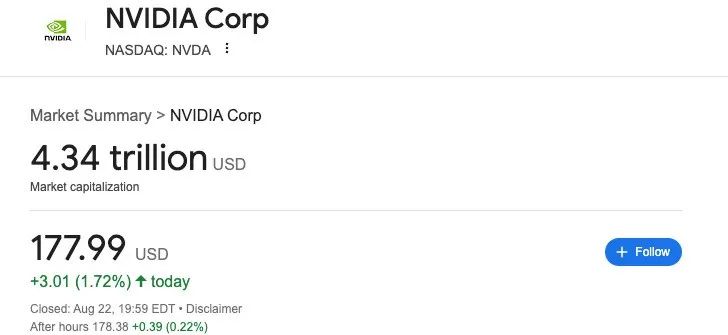
Core Viewpoint - The analysis predicts that Nvidia's upcoming earnings report is likely to exceed expectations, but the stock price has already priced in many positive factors, making significant upward movement more challenging [1][3]. Group 1: Nvidia's Market Position and Catalysts - Nvidia's market capitalization has reached $4.34 trillion, surpassing Japan's annual GDP, driven by expectations of a dominant position in the AI era [3]. - The company has established a strong competitive moat not only through GPU performance but also by building an ecosystem around chips, networks, memory, and supply chains [4]. - Future catalysts for Nvidia include significant growth in data center capital expenditures, with major cloud providers planning substantial investments [6][10]. Group 2: Cloud Providers' Capital Expenditures - Major cloud giants are expected to increase their capital expenditures significantly, with Amazon forecasting $100-120 billion for FY2025, Microsoft exceeding $900 billion, and Google raising its forecast to $85 billion [10][13]. - The combined capital expenditure of these four giants is projected to reach approximately $364 billion in 2025, a 57% year-over-year increase, accounting for 77% of global cloud capital expenditure growth [13]. Group 3: Demand for AI Infrastructure - The demand for Nvidia's GPUs is surging, with new cloud service providers and AI infrastructure companies purchasing them in large quantities [13][22]. - ODM server manufacturers are experiencing explosive demand, with Foxconn's AI server business growing by 60% year-over-year and expected to increase by 170% in Q3 [23][25]. - Global AI server shipments are projected to grow by 24.3% in 2025, with a compound annual growth rate of approximately 27% from 2022 to 2027 [25]. Group 4: Software and Ecosystem Monetization - Nvidia's CUDA ecosystem, relied upon by over 6 million developers, is a core barrier to entry, allowing the company to convert hardware advantages into recurring software and cloud service revenues [27]. - The introduction of services like DGX Cloud is expected to generate significant annual revenue potential, showcasing the "compute as a service" model [28]. Group 5: Institutional Support and Market Sentiment - Major Wall Street institutions have raised Nvidia's 12-month price targets, with an average target of $194, indicating over 10% upside potential [31][32]. - Institutional holdings in Nvidia have increased, with a notable rise in the number of hedge funds holding significant positions, reflecting a bullish sentiment [38][39]. Group 6: Risks and Market Dynamics - The market's tolerance for risk is low, and any earnings report that merely meets expectations may not result in significant stock price increases [40]. - Concerns about the sustainability of AI infrastructure investments and potential market corrections are prevalent, with comparisons drawn to the dot-com bubble [41][43]. - Nvidia faces uncertainties in the Chinese market, with recent production halts for specific AI chips, but is reportedly developing a new chip to regain market share [44][47].
Will $50,000 Invested in Nvidia Stock Be Worth $1 Million in 10 Years?
The Motley Fool· 2025-06-07 08:03
Core Insights - Nvidia has seen an 850% increase in share price since January 2023, coinciding with the launch of ChatGPT, and remains a favored stock among analysts [1][2] - The median 12-month target price for Nvidia among 73 analysts is $175 per share, indicating a potential 25% upside from the current price of $140 [2] Investment Thesis - Nvidia's competitive edge lies in its vertical integration, holding over 90% market share in data center GPUs, and offering complementary hardware such as CPUs and networking equipment [4] - The company also develops software products like AI Enterprise and Omniverse, which enhance AI application development and 3D simulation capabilities [5][6] - Nvidia consistently sets performance records in MLPerf benchmarks, reinforcing its position as a leader in AI accelerators and enabling cost-effective data center solutions [7] Market Growth Potential - Grand View Research projects a 35.9% annual growth in AI hardware, software, and services through 2030, with Nvidia expected to match this growth rate [8] - Wall Street anticipates Nvidia's earnings to grow at 40% annually through the fiscal year ending January 2027, making its current valuation of 44 times earnings appear reasonable [8] Long-term Investment Outlook - While turning $50,000 into $1 million would require a 1,900% increase in Nvidia's stock price over the next decade, such returns are deemed highly unlikely given the company's current market valuation of $3.4 trillion [9] - Despite this, Nvidia is positioned as a valuable investment due to the transformative potential of AI technology and its expanding software business, which could become a significant revenue source [10]