AUDI E7X

Search documents
上汽集团:整体销量逆市增长,自主品牌及出口表现较好-20260307
Orient Securities· 2026-03-07 13:25
Investment Rating - The report maintains a "Buy" rating for the company with a target price of 17.1 CNY [3][6] Core Views - The company is expected to see EPS of 0.91, 1.14, and 1.28 CNY for the years 2025-2027, with slight adjustments made to gross margin and expense ratios [3] - The company has shown resilience with overall sales growth of 6.8% year-on-year in the first two months, outperforming the industry average [9] - The company is focusing on expanding its presence in overseas markets, with significant growth in export sales, particularly in Europe [9] Financial Information Summary - Revenue for 2023 is projected at 726,199 million CNY, with a slight growth of 0.7% year-on-year, followed by a decline of 15.4% in 2024 [5] - Operating profit is expected to drop significantly to 10,376 million CNY in 2024, before rebounding to 17,234 million CNY in 2025, reflecting a growth of 66.1% [5] - Net profit attributable to the parent company is forecasted to be 14,106 million CNY in 2023, with a substantial recovery to 10,492 million CNY in 2025, marking a growth of 529.6% [5] - The gross margin is expected to improve from 9.5% in 2023 to 11.4% by 2027 [5] - The company’s PE ratio is projected to be 15.5 for 2025, decreasing to 11.1 by 2027 [5][10]

上汽集团(600104):整体销量逆市增长,自主品牌及出口表现较好
Orient Securities· 2026-03-07 12:39
Investment Rating - The report maintains a "Buy" rating for the company with a target price of 17.1 CNY, based on an average PE valuation of 15 times for comparable companies in 2026 [3][6]. Core Insights - The company has shown resilience with overall sales growth of 6.8% year-on-year in the first two months, outperforming the industry average during a period of consumer hesitation [9]. - The company is expected to benefit from new vehicle launches, which are anticipated to drive sales and market share for its self-owned brands [9]. - The export performance has been strong, with significant year-on-year growth in overseas sales, indicating that international markets will be a key growth driver moving forward [9]. Financial Forecasts - The earnings per share (EPS) are projected to be 0.91 CNY, 1.14 CNY, and 1.28 CNY for the years 2025, 2026, and 2027 respectively, with slight adjustments made to gross margin and expense ratios [3]. - Revenue is forecasted to reach 726.199 billion CNY in 2023, with a decline to 614.074 billion CNY in 2024, followed by a gradual recovery to 742.172 billion CNY by 2027 [5][12]. - The net profit attributable to the parent company is expected to rebound significantly from 1.666 billion CNY in 2024 to 14.698 billion CNY in 2027, reflecting a growth rate of 529.6% in 2025 [5][12]. Key Financial Metrics - The company’s gross margin is projected to improve from 9.5% in 2023 to 11.4% by 2027, while the net profit margin is expected to increase from 1.9% to 2.0% over the same period [5][12]. - The return on equity (ROE) is anticipated to rise from 5.0% in 2023 to 4.6% in 2027, indicating a gradual recovery in profitability [5][12]. - The price-to-earnings (PE) ratio is forecasted to decrease from 11.5 in 2023 to 11.1 in 2027, suggesting a more favorable valuation over time [5][12].
BBA中国高层全部换人,换帅如换刀?
阿尔法工场研究院· 2026-03-06 00:03
Core Viewpoint - The article highlights the significant challenges faced by traditional luxury automotive brands (BBA: BMW, Benz, Audi) in the Chinese market, emphasizing the need for leadership changes and strategic shifts towards electrification and market adaptation [4][5][20]. Group 1: Leadership Changes - Recent leadership changes in BBA reflect a response to unprecedented challenges in the Chinese market, with key executives being replaced to bring fresh perspectives and strategies [5][14]. - BMW's Sean Green will be succeeded by Christian Ach as of April 1, 2026, while Beijing Benz's first local CEO, Duan Jianjun, will transition to a strategic advisor role [7][9]. - Audi's Daniel Weissland has been appointed as the general manager of FAW Audi, indicating a broader trend of reshuffling among BBA's leadership in China [13][14]. Group 2: Market Performance - The Chinese market, once a stronghold for BBA, has seen a decline in performance, with Mercedes-Benz's sales dropping by 19.5% to 575,000 units in 2025, returning to 2017 levels [18]. - BMW's sales in China fell by 12.5% to 625,000 units, while Audi's sales decreased by 5% to 617,500 units, marking a concerning trend of negative growth [18][19]. - Profitability has also suffered, with Mercedes-Benz's adjusted EBIT dropping by 40% to €8.2 billion, and net profit nearly halving to €5.33 billion [18]. Group 3: Price War Dynamics - BBA is caught in a dilemma regarding price wars; lowering prices risks their premium market positioning, while not participating could lead to faster declines in market share [22][23]. - The recent price cuts initiated by BMW, with reductions exceeding 20% on several models, followed by similar actions from Mercedes-Benz and Audi, indicate a fierce competitive environment [27][28]. - The ongoing price war is expected to continue in the short term as BBA seeks to attract consumers and regain market share amidst increasing competition from local brands [29][30]. Group 4: Strategic Plans for Electrification - The new leadership is expected to leverage their experience in electric vehicle (EV) transitions to revitalize BBA's presence in the Chinese market [32][34]. - Mercedes-Benz plans to introduce over 15 new and updated models by 2026, focusing on various luxury segments and enhancing cost efficiency [36][37]. - BMW and Audi are also ramping up their electric vehicle offerings, with new models set to launch in 2026, aiming to recover lost ground in the EV market [39][40].

奔驰、宝马、奥迪集体换帅
21世纪经济报道· 2026-03-04 15:08
Core Viewpoint - The recent leadership changes in the German luxury car brands (BBA) in China are a response to significant sales and profit declines, indicating a need for strategic restructuring in the face of intense competition and market shifts [1][2][10]. Group 1: Sales Performance - In 2025, Mercedes-Benz's global sales fell by 10% to 2.16 million units, with a 19.5% drop in China to 575,000 units, returning to 2017 levels [1][2]. - BMW's global sales slightly increased by 0.5% to 2.4637 million units, but in China, sales dropped by 12.5% to 625,500 units [1][2]. - Audi's sales in China were 617,500 units, down 5%, marking the third consecutive year of negative growth [1][2]. Group 2: Profitability Issues - Mercedes-Benz's adjusted EBIT for 2025 plummeted by 40% to €8.2 billion, with net profit nearly halving to €5.331 billion [2]. - BMW's EBIT for the first three quarters of 2025 fell by 16.2% to €8.06 billion, with net profit dropping to €5.7 billion [2]. - Audi's operating profit for the first three quarters of 2025 was only €1.6 billion, with bleak full-year profit expectations [2]. Group 3: Market Challenges - The luxury brands are facing a "double whammy" in the Chinese market, with price wars eroding profits in the fuel vehicle sector and a lack of competitive electric vehicle offerings [7][12]. - Mercedes-Benz's sales profit margin has dropped to 5.0%, down from previous double-digit figures, due to increased competition and cost pressures [6]. - BMW's product line is experiencing a structural imbalance, with significant sales declines in higher-margin SUV models [6][7]. Group 4: Strategic Shifts - The leadership changes signal a shift from a "remote control" approach to a more localized strategy that emphasizes understanding and responding to Chinese consumer needs [10][11]. - Mercedes-Benz plans to introduce over 15 new and updated models in China in 2026, focusing on local demand and collaboration with tech companies [11]. - BMW and Audi are also ramping up their electric vehicle offerings to regain market share, with new models set to launch in 2026 [12]. Group 5: Competitive Landscape - Chinese luxury brands are gaining ground, with significant sales figures and a new definition of luxury that emphasizes technology and smart features [12][13]. - The shift in consumer perception towards "technology equals luxury" poses a challenge for BBA, which historically defined luxury through materials and brand heritage [12][13]. - The urgency for BBA to adapt is underscored by the rapid rise of domestic brands and the need for a fundamental rethinking of their market strategies in China [13].
上汽集团:马年开新篇 春耕正当时
Xin Lang Cai Jing· 2026-02-25 03:25
Core Insights - SAIC Motor Corporation has successfully implemented its user-centric philosophy, launching a series of customer care initiatives during the Spring Festival, including free safety checks and 24/7 roadside assistance [1][3] - The company reported strong sales figures for January 2026, with wholesale sales reaching 327,000 units, a year-on-year increase of over 23%, and retail sales at 363,000 units, both leading the industry [3][4] - The growth in sales is attributed to a structural transformation within the company, with a significant increase in sales from its self-owned brands, which accounted for 65.3% of total sales, up 7.3 percentage points from the previous year [3][4] Sales Performance - In January 2026, SAIC's self-owned brands sold 214,000 units, marking a 39.6% year-on-year increase, highlighting the company's successful restructuring of its product growth strategy [3][4] - The sales of new energy vehicles reached 85,000 units, a 39.7% increase year-on-year, with the IM Motors brand showing a remarkable 66% growth [4][6] - The overseas market also performed well, with sales of 105,000 units in January, a 51.7% increase, and the MG brand becoming the first Chinese brand to exceed cumulative sales of 1 million units in Europe [4][6] Reform and Strategy - The comprehensive reform initiated by SAIC in 2024 aims to break down organizational inertia and resource barriers, enhancing responsiveness to market demands [6][9] - The company has invested over 150 billion yuan in technological innovation, holding nearly 26,000 valid patents, which forms a solid technical foundation for its transformation [7][9] - SAIC's approach focuses on practical solutions rather than chasing trends, with a commitment to long-term investments in technology that address user pain points [9][10] Product Development - 2026 is set to be a pivotal year for SAIC's smart electric products, with a clear product strategy that covers all price ranges and travel scenarios [10][15] - The company is launching new models across its brands, including the Roewe i6 targeting the A+ class market and the MG brand focusing on the core new energy segment [12][14] - SAIC's joint ventures are also advancing in electric vehicle development, with plans for new models that leverage local market insights [14][15] Future Outlook - The ongoing reforms at SAIC are expected to continue driving growth, with a focus on core areas such as solid-state batteries and digital chassis technology [18] - The company aims to optimize its product matrix while balancing high-end and mainstream market demands, ensuring a sustainable approach to growth [18] - SAIC's transformation reflects broader trends in the traditional automotive industry, emphasizing the importance of technology and user needs in driving future success [18]
上汽大众准备跟新势力拼刺刀
Hua Er Jie Jian Wen· 2026-02-04 08:31
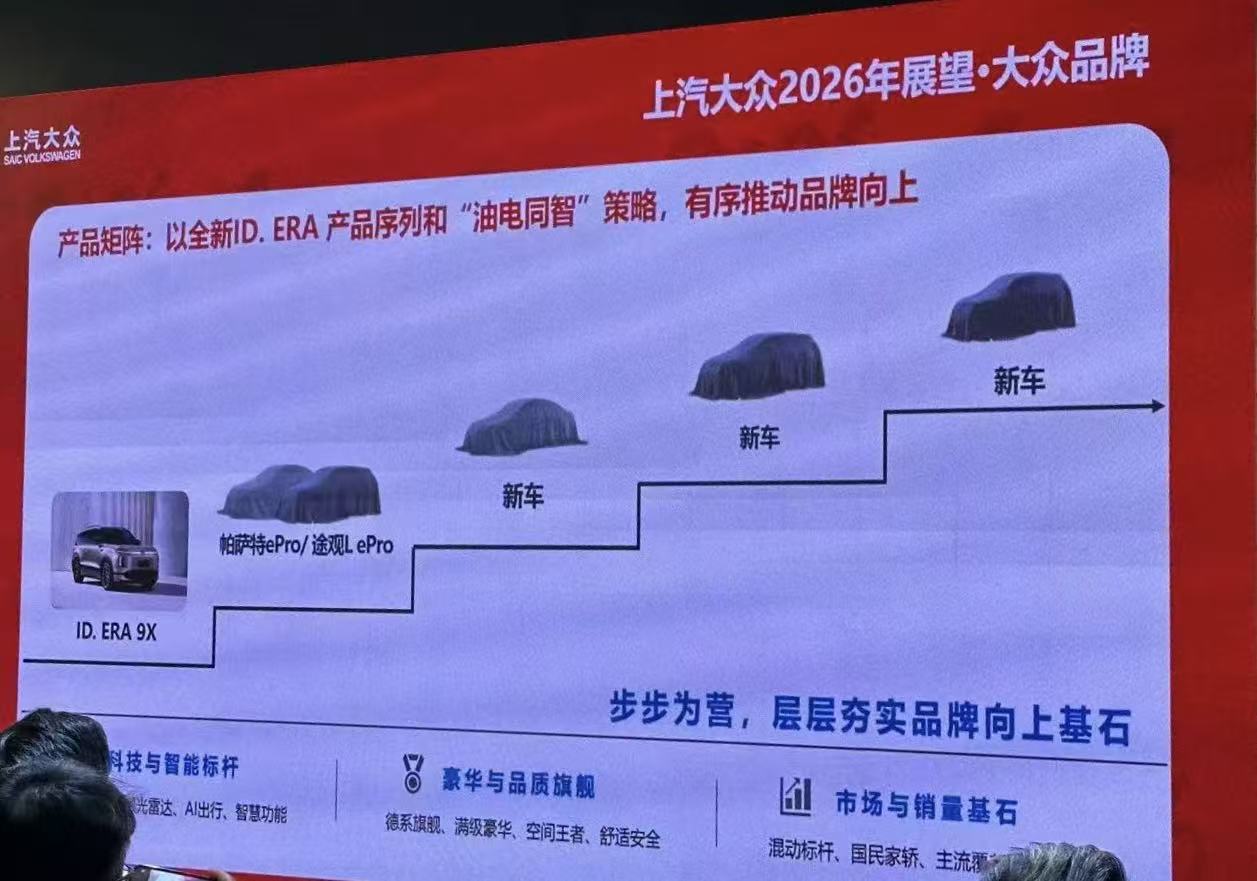
Core Insights - The Chinese automotive market underwent significant restructuring in 2025, with various brands, including new entrants and joint ventures, facing intense competition and challenges [1] - SAIC Volkswagen managed to maintain its position in the market, achieving a total sales volume of 1.06 million units in 2025, thus securing its place in the "million club" [1][2] - The company plans to launch a series of new energy vehicles (NEVs) in 2026, marking a strategic shift from survival to offensive strategies against competitors [6][7] Group 1: Market Performance - In 2025, SAIC Volkswagen's market share in the fuel vehicle segment increased to 8.3%, despite an overall decline in the market [2] - The sales structure revealed that traditional models like Passat, Lavida, and Tiguan continued to perform well, each maintaining monthly sales of around 20,000 units [2] - SAIC Audi achieved a sales volume of 47,000 units with a 23% year-on-year growth, outperforming the market [2] Group 2: Strategic Transition - The company is adopting a dual-track strategy, focusing on both fuel and new energy vehicles, to balance its existing fuel vehicle business with the need for a transition to NEVs [4][5] - The upcoming ID.ERA series is designed specifically for the Chinese market, with the flagship model ID.ERA 9X featuring a range of over 1,000 kilometers, aimed at competing with popular models from rivals [9][10] - SAIC Volkswagen plans to introduce seven new energy models in 2026, covering pure electric, hybrid, and range-extended technologies [7][10] Group 3: Organizational Changes - The company is undergoing significant internal restructuring to adapt to the new automotive era, including the introduction of new processes and systems to enhance efficiency and responsiveness [11][12] - The integration of IPD and GTM processes aims to break down traditional silos, allowing for a more customer-oriented approach in product development and marketing [13][14] - The leadership emphasizes the need for agility and speed in decision-making to compete effectively with new entrants in the market [14][15]
2026年各大车企新车规划揭秘
Xin Lang Cai Jing· 2025-12-17 12:59
Core Insights - The Chinese automotive market is expected to face intense competition in 2026, particularly in the new energy vehicle (NEV) sector, following significant developments in 2025 [1][34] - Major automakers are planning to launch new models in response to the anticipated challenges of 2026, with a focus on advanced driving technologies and competitive pricing [1][34] Company Plans Huawei's Hongmeng Zhixing - Hongmeng Zhixing will launch multiple new models in 2026, including the Wanjie M6, a mid-large SUV priced between 250,000 to 300,000 yuan, and the Zhijie V9, Huawei's first MPV [4][37] - The Wanjie M6 is expected to fill the market gap between the Wanjie M5 and M7, with a length of around 5 meters and a wheelbase of approximately 3 meters [4][37] - The company will also introduce a revamped Wanjie M5 and potentially a new Wanjie M9 L model [4][37] Xiaomi - Xiaomi's YU9, its first range-extended model, is anticipated to be a three-row, six-seat SUV over 5.2 meters long, with an expected price around 300,000 yuan [6][40] - The YU9 is likely to feature an 80 kWh battery pack with a pure electric range exceeding 400 km, aiming to compete directly with models like the Wanjie M8 and Li Auto L9 [6][40] Li Auto - Li Auto's L9 will undergo significant upgrades in 2026, focusing on smart driving, smart cockpit, powertrain, and chassis systems [10][42] - The new model is expected to reach a length of 5.3 meters and will include a new self-developed chip and advanced battery systems [10][42] Leap Motor - Leap Motor plans to introduce five new models in 2026, including the D19, a large SUV over 5.2 meters long, and the A10, a small pure electric SUV [14][45] - The D19 will offer both pure electric and range-extended versions, with the latter featuring an 80.3 kWh battery and a pure electric range of 720 km [14][45] XPeng Motors - XPeng will launch over ten models in 2026, including three super range-extended models in the first quarter [16][47] - The highlight will be a new large SUV, G01, featuring a range-extended powertrain and a battery capacity of 63.3 kWh, with a pure electric range exceeding 400 km [16][47] NIO - NIO plans to release two SUVs, the ES9 and ES7, in 2026, with the ES9 being a flagship model larger than the ES8 [19][49] - The ES7 will be a five-seat pure electric mid-large SUV, expected to be priced around 250,000 yuan [19][49] Volkswagen - Volkswagen's ID.ERA series will debut in 2026, featuring multiple pure electric and hybrid models, including a large SUV with a range exceeding 1000 km [21][50] - The Passat ePro will also be launched, utilizing a new PHEV platform with a 30 kWh battery [21][50] Toyota - GAC Toyota's flagship model for 2026 will be the BZ7, a mid-large pure electric sedan equipped with advanced driving systems and priced around 200,000 yuan [25][52] - The BZ7 will feature a battery capacity of 88.13 kWh, offering a range of up to 710 km [26][52] Nissan - Nissan's NX8 will be a significant model in 2026, featuring an 800V high-voltage platform and a range-extended version with a 1.5T engine [28][53] - The NX8 will have dimensions of 4870 mm in length and will include advanced driving systems [28][53] Audi - Audi's E7X, a mid-large pure electric SUV, will be launched in 2026, featuring a 300 kW motor and a range exceeding 700 km [30][55] - The E7X will also include advanced driving technologies and a high-voltage battery system [30][55] Zeekr - Zeekr's 8X is set to launch in early 2026, focusing on performance with a starting price of around 350,000 yuan [32][57] - The model will feature advanced battery technology and a sophisticated suspension system [32][57] Market Outlook - The 2026 automotive market is expected to be challenging, with potential impacts on consumer purchasing behavior due to increased costs associated with new energy vehicle taxes [58] - The market is poised for significant changes as automakers adapt to evolving consumer demands and competitive pressures [58]

车圈最强流量密码,现在只有俩字:换壳。
3 6 Ke· 2025-12-10 01:37
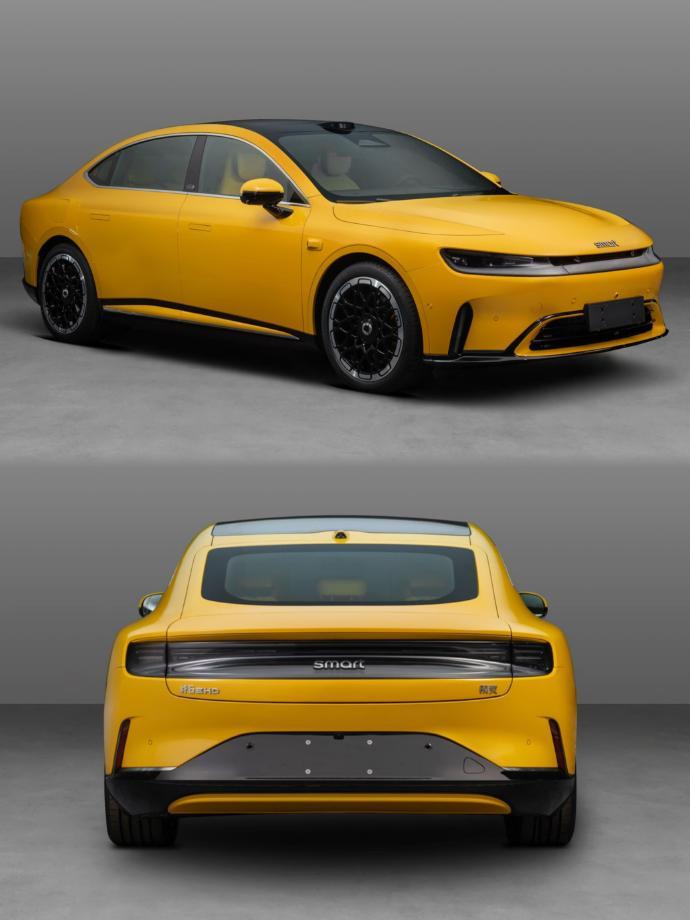
Core Viewpoint - The automotive industry is experiencing a surge of new vehicle releases, with many companies showcasing their latest models at the end of the year, indicating a competitive market for consumers in the upcoming year [1][39]. Group 1: New Vehicle Releases - The latest batch of vehicles from the Ministry of Industry and Information Technology (MIIT) features several notable models, suggesting that manufacturers are strategically launching new products to attract buyers [1]. - Smart's new model, the 6 EHD, is compared to the Lynk & Co 10, highlighting similarities in design and technology, indicating a trend of shared platforms among manufacturers [3][5]. - Geely's new Lotus FOR ME is positioned as a competitor to high-end models like the Lamborghini Urus, showcasing its advanced features and performance metrics [7]. Group 2: Market Positioning and Strategy - The introduction of the Geely Galaxy M7 EM-i reflects a shift in branding strategy, as the company consolidates its model lineup under new series classifications [9]. - The strategy of launching flagship models followed by more affordable variants is evident in the case of the Zhiji LS8, which aims to capture market share by offering competitive pricing [10][14]. - BYD's new Qin MAX model is positioned as a lower-cost alternative to the Han EV, indicating a focus on expanding the brand's electric vehicle offerings [16][18]. Group 3: Design and Innovation Trends - The automotive industry is criticized for a lack of originality, with many new models appearing to borrow design elements from existing vehicles, leading to a perception of "badge engineering" [39]. - The introduction of the ICAR V23 with battery swap technology represents an innovative approach to addressing consumer concerns about electric vehicle range and charging infrastructure [34]. - The trend of family design aesthetics is prevalent, with many new models resembling each other, raising questions about the uniqueness of brand identities in the market [39].