Amazon S3

Search documents
X @Avi Chawla
Avi Chawla· 2026-03-12 19:34
RT Avi Chawla (@_avichawla)How to build a RAG app on AWS!The visual below shows the exact flow of how a simple RAG system works inside AWS, using services you already know.At its core, RAG is a two-stage pattern:- Ingestion (prepare knowledge)- Querying (use knowledge)Below is how each stage works in practice.> Ingestion: Turning raw data into searchable knowledge- Your documents live in S3 or any internal data source.- Whenever something new is added, a Lambda ingestion function kicks in.- It cleans, proce ...
AI“军备竞赛”,亚马逊输不起的战争
3 6 Ke· 2026-02-13 03:33
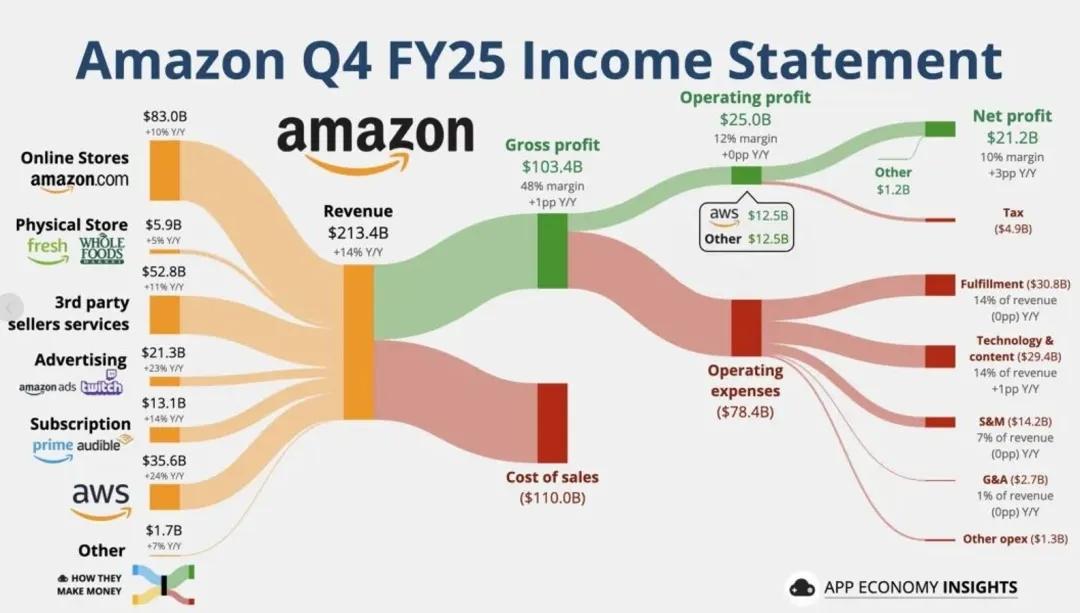
Core Insights - Amazon reported a record revenue of $213.4 billion for Q4 2025, marking a 14% year-over-year increase, and net profit reached $21.2 billion, up 6% [1] - For the full year 2025, Amazon's revenue hit $716.9 billion, a 12% increase, with net profit soaring to $77.7 billion, a 31% rise from 2024 [1] - Amazon's cloud business, AWS, contributed over 60% of the company's operating profit, highlighting its significance as a cash cow [5] Revenue Breakdown - In Q4 2025, Amazon's online store revenue was $82.99 billion, up 10%, while physical stores generated $5.86 billion, a 5% increase [4] - Third-party seller services brought in $42.82 billion, growing 11%, and subscription services earned $13.12 billion, up 14% [4] - Advertising revenue reached $21.32 billion, marking a 23% increase [4] - North America accounted for $127.08 billion in sales, a 10% increase, with operating profit rising 24% to $9.3 billion [4] - International e-commerce revenue was $50.7 billion, up 17%, although operating profit declined 23% to $1 billion due to increased competition and costs [4] Cloud Business Performance - AWS achieved $35.6 billion in revenue for Q4 2025, a 24% increase, marking the highest growth rate in 13 quarters [5] - For the full year, AWS revenue reached $128.7 billion, a 20% increase, representing 18% of total revenue [5] - AWS's operating profit was $12.5 billion, with a profit margin of 35% [5] Capital Expenditure and Future Investments - Amazon plans to invest approximately $200 billion in capital expenditures in 2026, a 52% increase from 2025's $131 billion [14] - The significant capital expenditure includes investments in AI, robotics, and chip development, indicating a strategic focus on enhancing operational efficiency and customer experience [17][21] - Amazon's self-developed AI training chips, Trainium and Graviton, have surpassed $10 billion in annualized revenue, with Trainium 3 already in high demand [17][18] Competitive Landscape - Amazon maintains a leading position in the public cloud market with a 28% market share, followed by Microsoft at 21% and Google at 14% [10] - However, AWS's revenue growth rate is lagging behind competitors like Microsoft Azure and Google Cloud, which are growing at 39% and 48%, respectively [10]

亚马逊云科技在中国区域推出Amazon S3 Tables
Huan Qiu Wang Zi Xun· 2026-01-08 06:51
Core Insights - Amazon Web Services (AWS) has launched Amazon S3 Tables in its Beijing and Ningxia regions, optimized for large-scale analytical workloads with built-in support for Apache Iceberg tables, offering up to 3 times the query performance and 10 times the transactions per second compared to general storage buckets [1][3] Group 1: Product Features - Amazon S3 Tables is designed to manage Apache Iceberg tables in data lakes, significantly enhancing performance for large datasets [3] - It automates table lifecycle management tasks such as compression, snapshot management, and cleaning up unreferenced files, reducing the need for complex system maintenance [3] - The service supports row-level transactions, time travel for querying historical snapshots, and schema evolution to adapt table structures as business needs change [3] Group 2: Customer Benefits - Pendulum, a brand intelligence platform, reported a 6-fold increase in data processing speed and a 40% reduction in Amazon Glue job costs after adopting Amazon S3 Tables [4] - Zeta Global has integrated Amazon S3 Tables into its data lake architecture for unified storage and analysis of multi-source data, demonstrating significant performance improvements and operational simplification [4] Group 3: Market Position and Future Plans - The introduction of Amazon S3 Tables in China addresses the growing demand for modern data lake solutions and real-time analytics [5] - AWS has continuously enhanced Amazon S3 since its launch in 2006, including a 35% price reduction on object tagging and increasing the default storage bucket quota from 100 to 10,000, with the option to request up to 1 million buckets [5]

直面AI泡沫争议,亚马逊云科技交出了一份实干答卷
Di Yi Cai Jing· 2025-12-24 09:29
Core Insights - AI technology is undergoing a paradigm shift, evolving from simple chatbots to autonomous agents capable of complex task execution and integration into core business processes [1] - The capital market is reassessing AI investments, with discussions around the AI bubble as tech giants' spending on infrastructure reaches trillions, while short-term revenue growth appears disproportionate [1] - Amazon Web Services (AWS) is addressing market concerns by providing a systematic approach to AI cost management and infrastructure upgrades [2] Infrastructure Innovations - AWS is restructuring its AI cost model by upgrading core services, including a significant increase in Amazon S3's object storage limit from 5TB to 50TB, simplifying the handling of large models [3] - The introduction of Amazon S3 Vectors allows for the storage and management of trillions of vector data at a 90% lower cost, enhancing efficiency in data handling [4] Computing Resource Strategy - AWS employs a dual-track strategy for computing resources, ensuring compatibility with NVIDIA while developing proprietary chips like Amazon Trainium to offer cost-effective options [6][7] - The latest Amazon Trainium 3 UltraServers demonstrate a 4.4x increase in computing power and a 5x improvement in energy efficiency compared to previous generations [9] AI Model Ecosystem - AWS's Amazon Bedrock platform offers a diverse range of models, including new additions from Google and OpenAI, allowing businesses to select models tailored to their specific needs [11][13] - The launch of the Nova 2 model series focuses on cost efficiency and performance, with Nova 2 Lite designed for low-complexity tasks and Nova 2 Pro for high-demand scenarios [14][15] Agent Development Framework - Amazon Bedrock AgentCore standardizes the development of AI agents, enabling businesses to assemble agents that can independently execute tasks [16][17] - The framework allows for the integration of multiple specialized agents within a single workflow, enhancing flexibility and efficiency in task execution [18][19] Quality Control and Trust - AWS introduces a policy management feature in AgentCore to ensure compliance and control over agent actions, addressing concerns about reliability and safety [20] - The AgentCore Evaluations tool provides comprehensive performance assessments, allowing for early detection of issues during the development phase [20] Enterprise Integration - Amazon Quick Suite aims to streamline data access across various business systems, enhancing productivity by reducing the need for manual data retrieval [22] - The introduction of Amazon Transform facilitates the modernization of legacy systems, enabling smoother transitions to cloud environments [24] Software Development Evolution - The Kiro Autonomous Agent represents a shift in software engineering, allowing AI to autonomously complete tasks and collaborate with human developers [25][27] - This evolution signifies a move towards a model where AI handles routine coding tasks, freeing developers to focus on core business innovations [27]

拐点来临!亚马逊云科技开启Agent时代,数十亿Agents重构产业生产范式
Di Yi Cai Jing· 2025-12-10 11:11
Core Insights - Amazon Web Services (AWS) showcased the practical effects of Kiro autonomous agents at re:Invent 2025, highlighting their ability to automate tasks in the development process, achieving efficiency several times greater than human developers [1] - AWS CEO Matt Garman stated that Agentic AI technology is at a critical turning point, transitioning from a "technological marvel" to a practical tool that provides real business value, with expectations of billions of agents operating across various industries to enhance efficiency by tenfold [1][3] - The AI industry's narrative has shifted from merely training powerful models to integrating AI into business processes, marking a new competitive landscape in cloud computing [3] AI Ecosystem Reconstruction - AWS presented a comprehensive innovation roadmap covering infrastructure, large models, and agent toolchains, emphasizing the importance of energy efficiency in AI task processing [4] - The Amazon Trainium series of chips has seen rapid iterations, with the latest Trainium3 UltraServers offering a 4.4 times increase in computing power and a 5 times increase in AI token processing per megawatt [4][5] - AWS introduced the Trainium4 chip, promising a 6 times increase in FP4 computing performance, further solidifying its position in the AI chip market [5] Open Model Ecosystem - AWS has expanded its Amazon Bedrock platform with new open-source models, nearly doubling the number of available models in a year, providing businesses with flexible options [7] - The self-developed Amazon Nova 2 series models cater to various complex tasks, with Nova 2 Omni being the first to support multi-modal inputs and outputs, simplifying application development [7] - Garman emphasized that advanced agents must possess autonomous decision-making, horizontal scalability, and long-term operation capabilities, transforming them into proactive digital employees [7] Efficiency Revolution through AI Agents - AI agents are redefining engineering capabilities by automating complex and repetitive tasks, significantly reducing the time and cost associated with legacy system migrations [9][11] - Companies like Canadian Airlines and Experian are utilizing Amazon Transform custom to decrease technical debt, achieving a fivefold increase in modernization speed and a 70% reduction in maintenance costs [11] - The practical application of AI agents is evident in various industries, with companies like Sony leveraging AWS to optimize internal processes and enhance data value [11][12] Strategic Intent and Market Positioning - AWS's strategy focuses on building a full-stack engineering capability rather than merely competing on model parameters or computing power, aiming to become a value realization platform for intelligent transformation [8][14] - The emphasis on security, compliance, and operational efficiency in AI deployment reflects a shift in corporate evaluation standards from novelty to ROI assurance [13][14] - AWS's comprehensive approach to AI, from chip design to model deployment, positions it as a strategic partner for enterprises seeking to govern and scale their AI capabilities [17]
拐点来临!亚马逊云科技开启Agent时代,数十亿Agents重构产业生产范式
第一财经· 2025-12-10 10:44
Core Insights - The article emphasizes the transition of Agentic AI technology from a "technological marvel" to a practical tool that provides real business value, with expectations of billions of agents operating across various industries to achieve tenfold efficiency improvements [1][3] - Amazon Web Services (AWS) is focusing on a comprehensive stack of innovations, including infrastructure, large models, and agent toolchains, rather than just competing in chip or model performance [4][9] Industry Trends - The narrative in the AI industry has shifted from who can train the most powerful models to who can effectively integrate AI into business processes, marking a critical phase in cloud computing [3] - The focus is now on the practical application of AI to solve existing business problems rather than merely creating new technologies [10][14] Technological Developments - AWS has introduced the Amazon Trainium series of chips, emphasizing energy efficiency as a key metric for AI task processing, with the latest Trainium3 UltraServers showing significant improvements in computational power and memory bandwidth [4][5] - The newly disclosed Trainium4 chip promises to deliver six times the FP4 computing performance and four times the memory bandwidth compared to its predecessor, reinforcing AWS's position in the AI chip market [5] AI Agent Capabilities - AI agents are being positioned as essential tools for automating complex and repetitive tasks, thereby redefining engineering capabilities and reducing the need for extensive human resources [12][13] - The article highlights the importance of AI agents having features such as autonomous decision-making, horizontal scalability, and long-term operation, transforming them into proactive digital employees [8][9] Business Applications - Case studies from companies like Sony and S&P Global illustrate how AI agents can significantly enhance operational efficiency and reduce costs, with Sony's Data Ocean processing 760TB of data daily and achieving a 100-fold efficiency improvement in compliance processes [12][13] - The article notes that AI's commercial value lies in its ability to address existing challenges, such as technical debt, which costs the U.S. approximately $2.4 trillion annually [10][14] Strategic Positioning - AWS aims to be a "value realization platform" that not only provides advanced tools but also ensures their safe, compliant, and efficient use, highlighting the importance of security, availability, and cost optimization in the AI era [9][16] - The shift in focus from isolated computational growth to deep integration of AI technology into complex business processes is seen as crucial for achieving long-term commercial success [16][20]

亚马逊长期主义的反击:当「卓越运营」遇见「Agent时代」
Hua Er Jie Jian Wen· 2025-12-08 03:57
Core Insights - Amazon's cloud strategy emphasizes "operational excellence" as a key driver of its success in the cloud computing market, particularly in the face of competition from generative AI [1][2][5] - The company has made significant advancements in its cloud technology, including the launch of Amazon Trainium3 chips and the Amazon Bedrock platform, which positions it favorably in the AI landscape [4][6][9] Cloud Technology Developments - Amazon announced the full launch of Amazon Trainium3 UltraServers, which significantly improves performance, energy efficiency, and memory bandwidth compared to previous generations, potentially reducing training and inference costs by up to 50% [7][9] - The roadmap for Amazon Trainium4 has been revealed, which will support NVIDIA's NVLink Fusion technology, easing the transition for customers from NVIDIA's ecosystem to Amazon's self-developed chips [7][9] Strategic Partnerships - OpenAI has entered into a $38 billion, seven-year computing commitment with Amazon, marking a shift away from the perception that OpenAI is solely tied to Azure [12][15] - Amazon's collaboration with Anthropic is deepening, with plans to double the number of Amazon Trainium2 chips used by Anthropic to over one million by the end of the year [17][19] Paradigm Shift in Software Architecture - Amazon's CEO predicts a shift from the "cloud + mobile app" model to a "cloud + agent" model, where AI agents will drive significant enterprise AI value [24][25][29] - The introduction of Amazon Bedrock AgentCore and related tools aims to address key pain points in deploying AI agents, enhancing agility, security, and cost-effectiveness for businesses [30][31][32] Data Gravity as a Competitive Advantage - Amazon holds a significant advantage with its data gravity, as most enterprises' core data resides in Amazon S3, making it economically optimal to conduct training and inference within Amazon's ecosystem [39][41][46] - The launch of Amazon Nova Forge allows enterprises to utilize their private data for training models, enhancing customer retention and creating high data barriers [42][44][46] Long-term Strategy and Market Position - Amazon's focus on operational excellence and long-termism is evident in its approach to AI, prioritizing cost, efficiency, and reliability over flashy narratives [50][55][60] - Analysts have raised growth expectations for Amazon's cloud business, anticipating a revenue growth rebound to 23% in 2026, supported by a 22% year-over-year increase in backlog orders [55][56][58]

亚马逊云科技首席执行官 Matt Garman:亚马逊云业务年增220亿美元,增量超半数《财富》500强企业全年收入
Xin Lang Cai Jing· 2025-12-04 11:47
Core Insights - Amazon Web Services (AWS) has grown into a $132 billion business, with a year-over-year growth rate accelerating to 20%, adding $22 billion in the past year alone, surpassing the annual revenue of more than half of the Fortune 500 companies [1][1][1] Business Growth - AWS's Amazon S3 continues to grow, with the number of stored objects exceeding 500 trillion and data volume reaching hundreds of exabytes, processing over 200 million requests daily [1][1][1] - In the past year, AWS added 3.8 gigawatts of data center capacity, ranking first globally, and has the largest private network in the world, which grew by 50% in the last 12 months, laying over 9 million kilometers of terrestrial and submarine fiber optic cables [1][1][1] AI and Quantum Computing Developments - AWS's Amazon Bedrock now provides AI inference capabilities to over 100,000 enterprises globally, and the AgentCore SDK has been downloaded over 2 million times since its release [1][1][1] - The company introduced Ocelot, its first quantum computing chip prototype, which has reduced the cost of quantum error correction by over 90% [1][1][1] Infrastructure and Network - AWS boasts the largest and most widely deployed AI cloud infrastructure globally, with a network of data centers covering 38 regions and 120 availability zones, with plans to add three more regions [1][1][1]
一朵诞生众多独角兽的云,正在用AI落地Agent
3 6 Ke· 2025-12-04 02:45
Core Insights - The article emphasizes the transformative impact of AI, particularly through Amazon Web Services (AWS), which has innovated a comprehensive suite for Agent development, enhancing efficiency and capabilities across various industries [1][4][19]. Group 1: AI Adoption and Market Impact - All enterprises are embracing AI, with significant examples such as Sony's use of large models to enhance compliance processes by 100 times and Adobe's AI tool generating 29 billion creative assets [2][3]. - AWS's generative AI platform, Amazon Bedrock, has served over 100,000 customers in the past year, with over 50 companies processing more than 1 trillion tokens daily [5][10]. - AWS's revenue reached $132 billion in the past year, marking a 20% year-over-year increase, with an absolute growth of $22 billion [6]. Group 2: Infrastructure and Technological Advancements - AWS's AI infrastructure, including the Amazon Trainium3 UltraServers, has significantly improved performance, with a 4.4 times increase in computing power and a 5 times increase in token processing per megawatt [21][25]. - The number of models available on Amazon Bedrock has nearly doubled, reflecting a growing diversity in high-performance models [26]. Group 3: Agent Development and Future Trends - The concept of Agents is seen as a pivotal point for AI value realization, with predictions that billions of Agents will exist across various sectors [9][37]. - AWS has introduced new services for Agent management and evaluation, addressing the need for real-time performance monitoring and control [35][36]. - The emergence of low-code and no-code development tools is lowering the barrier for Agent development, but new challenges in performance assurance and management are arising [34][42]. Group 4: Entrepreneurial Landscape and Innovation - Startups are increasingly leveraging AWS, with a notable example being Audio Shake, which developed an AI audio separator for ALS patients [39][41]. - The article highlights the shift in organizational structures due to AI, where smaller teams can achieve significant outputs, exemplified by a project that required only 6 developers and 76 days to complete [47].
Supabase and AWS Empower App Developers to Build in a Weekend, Scale to Millions
Businesswire· 2025-12-03 16:00
Core Insights - AWS and Supabase have introduced new storage innovations and an ETL feature aimed at simplifying the development of generative AI applications [1][2] - Supabase has launched over 10 million databases and is favored by startups, with over 60% of Y Combinator batch utilizing its platform [1] - The integration of Supabase with AWS allows for seamless scaling of applications from prototype to production, supporting millions of users without costly rebuilds [1] Product Innovations - Supabase ETL automates data movement from Postgres databases to analytics tools, significantly reducing coding time [1] - Supabase Analytics Buckets utilize Apache Iceberg format on Amazon S3 Tables, enabling efficient data storage and querying for analytics [1] - Supabase Vector Buckets allow for the storage of large vector datasets in Amazon S3, enhancing features like semantic search and recommendations [1] Market Impact - In Q3 2025, more projects were created on Supabase than in the first four years combined, indicating rapid adoption and growth [2] - Startups such as Lovable, Figma, and Bolt leverage Supabase for scalable solutions on AWS, showcasing its effectiveness in powering agentic workloads [2] - Supabase has become the preferred backend for AI-driven development, with 5 million developers utilizing its platform for quick backend setups [2]