Booster K1

Search documents
1000亿政府基金,都投给了哪些机器人企业?
机器人大讲堂· 2026-03-28 04:00
Core Insights - Beijing State-owned Capital Operation Management Co., Ltd. has established a new investment model, managing a total of 100 billion yuan across eight municipal government investment funds, focusing on high-tech industries and future sectors [1][2] Investment Focus - The funds are divided into two batches, with the first four funds set to launch by the end of 2023 and the second batch by mid-2024, emphasizing the integration of industrial, innovation, financial, and policy chains [1][2] - Two specific funds are dedicated to robotics and embodied intelligence, each with a scale of 10 billion yuan, targeting AI infrastructure, algorithms, and applications in various sectors [1][2] Investment Strategy - The funds primarily adopt a direct investment model without sub-funds, utilizing a project recommendation system to identify quality enterprises, ensuring a balance between industrial direction and market expertise [2] - The funds have a maximum duration of 15 years and focus on investing in early-stage hard technology companies during market downturns, covering various niches within the robotics sector [2] Key Investments - Beijing Humanoid Robot Innovation Center received over 700 million yuan in its first round of market financing, aiming to create a comprehensive platform for humanoid robots [4] - Yushu Technology, a leader in quadruped robots with a nearly 70% market share, has expanded into humanoid robotics, supported by strategic investments from the Beijing Robotics Fund [6][7] - Galaxy General Robotics, a prominent player in embodied intelligence, has raised nearly 7 billion yuan in funding, developing a groundbreaking end-to-end embodied model [9] - Songyan Power, a pioneer in consumer-grade humanoid robots, completed a 1 billion yuan B-round financing, marking a shift towards commercial viability in the humanoid robotics sector [11] Emerging Companies - Yanshen Technology, a leader in four-legged robots, is transitioning to humanoid robotics, having developed advanced navigation and control systems [13] - Xingdong Era, a fully self-developed enterprise from Tsinghua University, has achieved significant commercial success with its humanoid robots and has received substantial funding [15][16] - Xinhai Technology, focusing on flexible tactile sensors, has seen a tenfold increase in the shipment of its electronic skin products for humanoid robots [30] Market Trends - The Beijing government investment funds are actively supporting the development of humanoid robots and related technologies, indicating a strong commitment to advancing the robotics industry in China [1][2][3] - The investment landscape is characterized by a focus on high-tech, consumer-oriented solutions, with companies like Cloud Whale and Rosenbot leading innovations in household and medical robotics [32][34]

从汽车到人形机器人,产业链大象轻盈起舞
机器人大讲堂· 2026-03-02 11:23
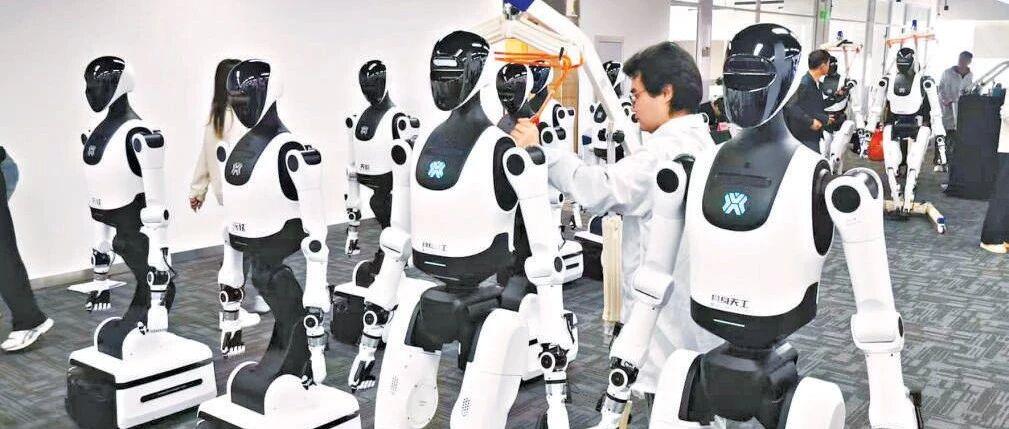
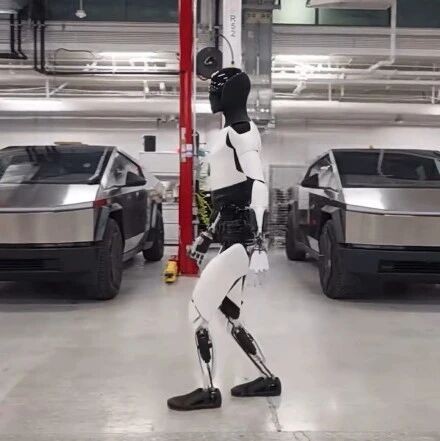
Core Insights - The article emphasizes that successful cross-industry breakthroughs are not zero-sum games but rather involve the transfer of core competencies based on first principles, transforming existing barriers into new competitive advantages [1] Industry Trends - The price curve for humanoid robots is becoming increasingly clear, with models like Unitree R1 starting at 29,900 yuan and others like Bumi priced under 10,000 yuan, indicating a significant reduction in industry costs [2][3] - By 2025, the expected shipment of humanoid robots is around 20,000 units, increasing to 62,500 units in 2026, with optimistic estimates reaching 100,000 to 200,000 units, which could lead to a dramatic drop in costs due to economies of scale [4][6] Technological and Supply Chain Insights - The core challenge for mass production of humanoid robots lies in the dual constraints of insufficient technological maturity and high costs, with the automotive industry's established technology and supply chain capabilities providing a key solution [8] - The synergy between automotive and robotics industries is highlighted, with companies like Tesla successfully demonstrating the feasibility of vehicle-robot collaboration, which has been validated by various enterprises [8][9] - The average Bill of Materials (BOM) cost for humanoid robots is projected to drop to around 400,000 yuan by 2025, a reduction of over 90% compared to earlier models, thanks to the advantages of the automotive supply chain [9] Company Case Study: Top Group - Top Group, with 40 years of experience in the automotive parts industry, has positioned itself as a leader in the humanoid robot supply chain, leveraging its core competencies to facilitate the transition into robotics [7][13] - The company's platform-based approach allows it to cover eight major automotive product lines, enhancing its value proposition to robot manufacturers by reducing supply chain complexity [13][15] - Top Group's strategic investments, such as a 5 billion yuan production base for robot components, aim to align with the mass production schedules of major players like Tesla, ensuring efficient delivery and cost control [15][16] Future Outlook - The humanoid robot industry is expected to enter a phase of explosive growth as production lines ramp up, with Top Group's case illustrating that true cross-industry winners are those who build core capabilities and strategically migrate them at the right time [19]

王兴兴,彻底杀疯了
创业家· 2026-02-23 09:33
Core Viewpoint - The article highlights the rapid advancements and competitive dynamics in the humanoid robotics industry, particularly focusing on the achievements of Yushutech and the implications for the broader market [4][5][6]. Group 1: Yushutech's Achievements - Yushutech made headlines during the 2026 Spring Festival Gala, showcasing multiple "world firsts" in humanoid robotics, including the first continuous table-flipping and single-leg flips [5][6]. - The company's previous performances at the Spring Festival Gala in 2021 and 2025 established its reputation, with the 2025 performance marking a significant transition from quadruped to humanoid robots [10][12]. - The 2026 performance featured advanced martial arts movements, demonstrating significant improvements in dynamic actions and audience engagement [14][19]. Group 2: Industry Trends and Competition - The humanoid robotics sector is experiencing heightened urgency, with companies racing to secure funding, orders, and market presence [28][29]. - Yushutech's competitive edge is reflected in its 2025 humanoid robot sales exceeding 5,500 units, surpassing its closest competitor, Zhiyuan Robotics [28]. - The industry is witnessing a price war, with Yushutech's strategic pricing leading to a broader trend of price reductions across competitors, aiming to make humanoid robots more accessible [28][29]. Group 3: Leadership and Vision - Wang Xingxing, the founder of Yushutech, is emerging as a prominent figure in the industry, advocating for the development of large models that can adapt to various environments [22][24]. - His recent public appearances and discussions emphasize the need for the industry to transition from technical feasibility to sustainable commercial applications [34][35]. - Wang's vision includes achieving a "double 80%" goal, where robots can successfully complete 80% of tasks in unfamiliar environments using voice or text commands, marking a pivotal point for embodied intelligence [23][33].

加速进化机器人参与春晚节目传统非遗醒狮
Xin Lang Cai Jing· 2026-02-18 10:15
Core Viewpoint - Multiple robotics companies showcased their technological advancements during the 2026 CCTV Spring Festival Gala, highlighting the growing integration of robotics in entertainment and cultural presentations [2][8]. Group 1: Company Highlights - Yushutech, Songyan Power, Magic Atom, and Galaxy General presented humanoid robots through various performances, including martial arts and comedy skits, demonstrating significant technological breakthroughs [4][10]. - The program "Wu BOT" featured Yushutech's G1 and H2 humanoid robots performing complex martial arts routines, showcasing their dynamic coordination and precision [4][10]. - Songyan Power's humanoid robots N2, E1, and Bumi made their debut in a skit, marking the first appearance of humanoid robots in a language program during the Spring Festival Gala [4][10]. Group 2: Technological Innovations - The humanoid robot created by Songyan Power, which closely mimicked the expressions of actress Cai Ming, was completed in just 30 days, overcoming challenges such as resizing the head for optimal on-screen appearance [5][11]. - Magic Atom's MagicBot Z1 executed a 360° stunt, a first for humanoid robots of its size, achieved through optimized joint response speed for stability and fluidity during motion [5][11]. - Galaxy General's robot demonstrated practical skills like folding clothes and grasping objects, marking its first public appearance following a new funding round exceeding $300 million [5][11]. Group 3: Cultural Integration - The Booster K1 humanoid robot from Accelerated Evolution participated in the Beijing Spring Festival Gala, performing traditional lion dance, thus promoting cultural heritage through technology [6][12]. - The Booster K1 has also embarked on a global tour, showcasing Chinese traditional culture in cities worldwide, including Milan and Los Angeles, embodying the concept of "using technology to inherit culture" [12].


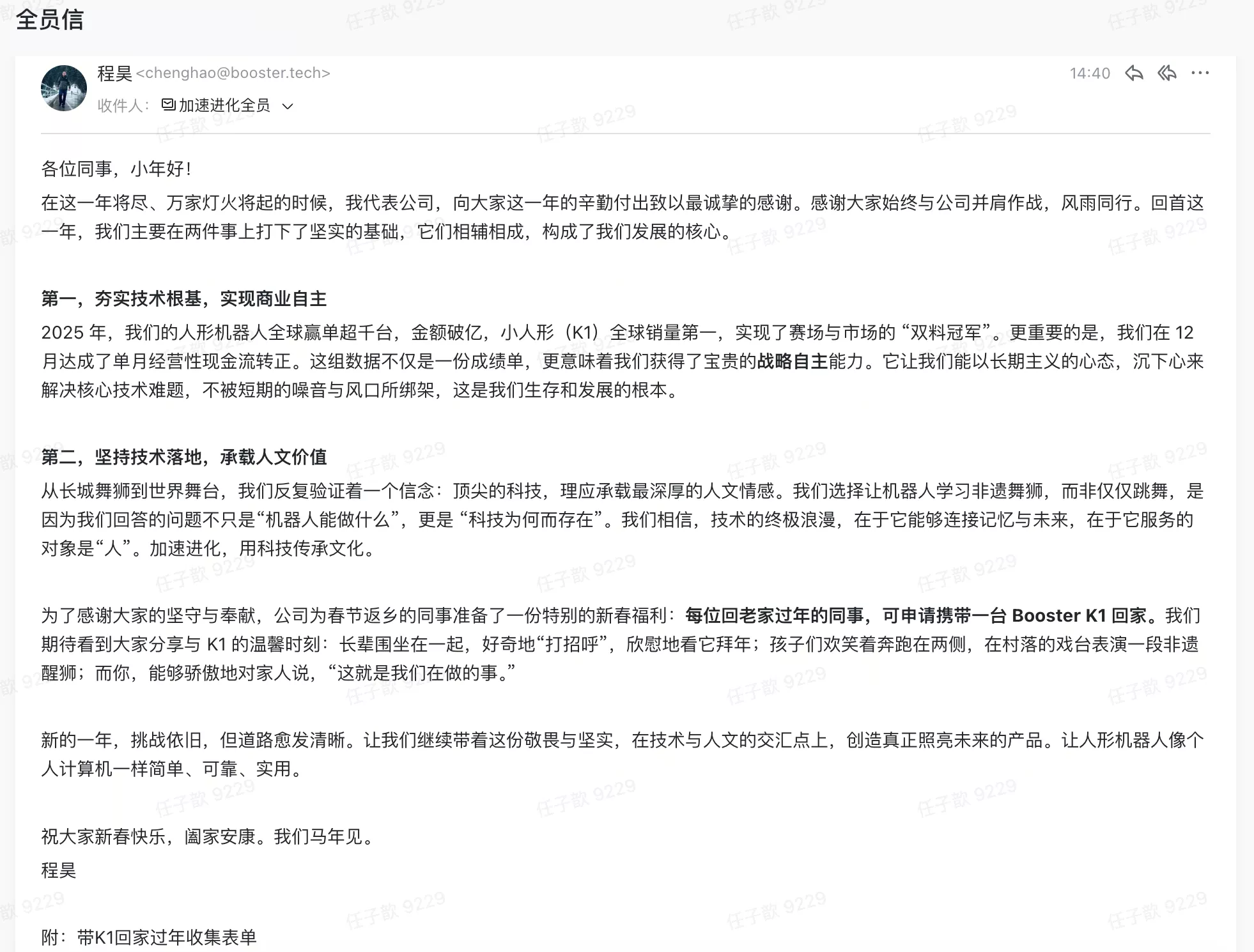
加速进化发布全员信:Booster K1获得2025年全球小型人形机器人销量第一
Bei Jing Shang Bao· 2026-02-13 13:17
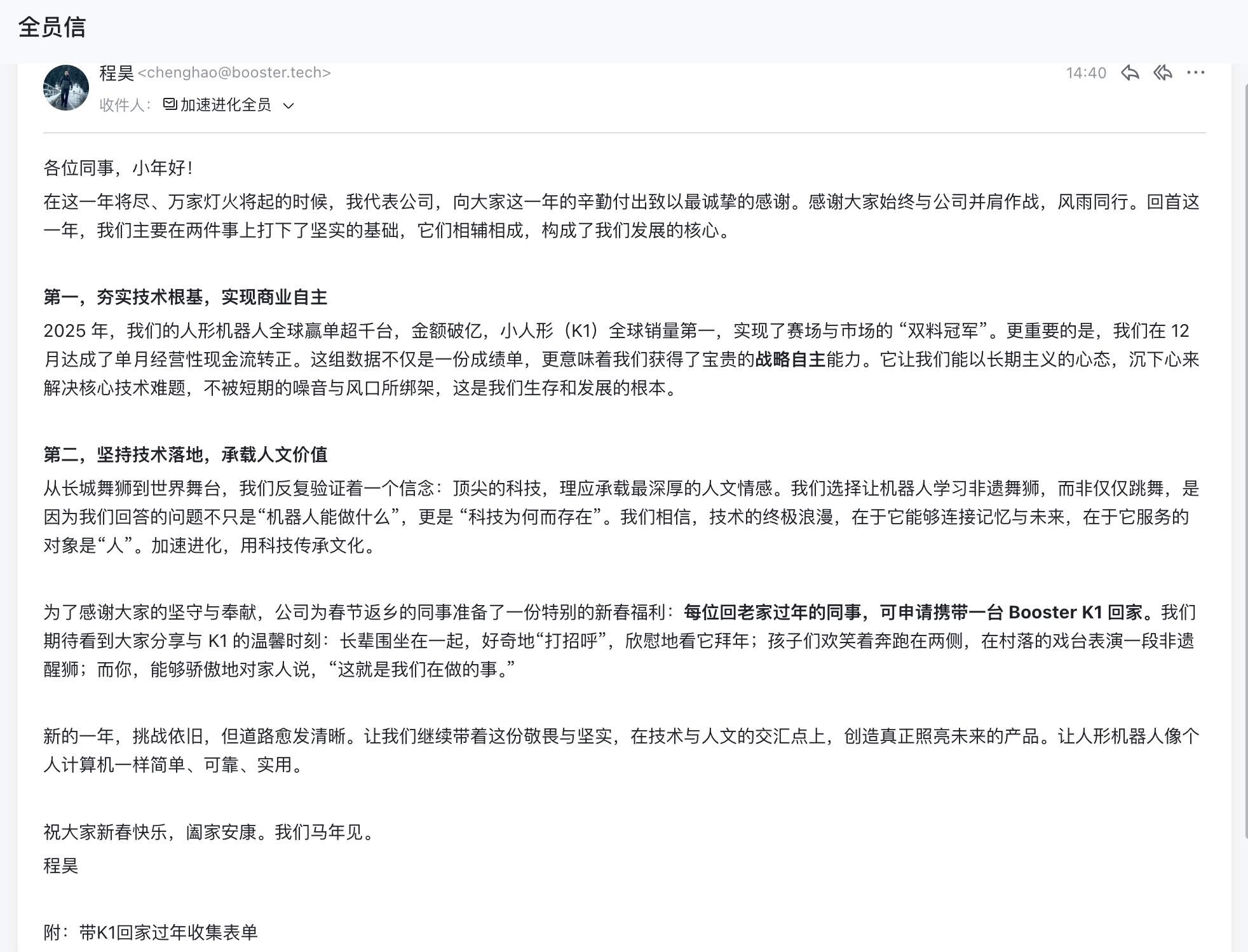
Core Insights - The company Accelerated Evolution announced that it has received over 1,000 global orders for humanoid robots in 2025, with total revenue exceeding 100 million [1] - The small humanoid robot (K1) has achieved the highest global sales, marking it as a dual champion in both competition and market [1] - The company achieved positive operating cash flow in December, indicating improved financial health and strategic autonomy [1] Employee Initiatives - To express gratitude towards employees, the company is offering special benefits for those returning home for the Spring Festival, allowing each employee to take a Booster K1 robot home [1]
加速进化CEO程昊:2025年实现商业自主,邀员工带机器人回家过年
Sou Hu Cai Jing· 2026-02-13 10:56
Core Insights - The company has established a solid foundation in two main areas: strengthening technological capabilities and achieving commercial autonomy [1][4] - By 2025, the company expects to secure over 1,000 global orders for humanoid robots, with total sales exceeding 100 million [4] - The Booster K1 has achieved the highest global sales in the small humanoid robot category, marking a dual championship in both competition and market [4] Technological Foundation - The company has successfully addressed core technological challenges, allowing it to operate independently of short-term market trends [1][4] - In December of the same year, the company achieved positive operating cash flow for the first time, marking a significant milestone in its journey towards commercial independence [4] Cultural Integration - The company emphasizes the importance of technology carrying cultural values, as demonstrated by its robot performances that showcase traditional cultural elements [2][4] - The initiative aims to connect technology with human values, reinforcing the belief that technology should serve humanity [2][4] Employee Engagement - To express gratitude for employee dedication, the company has introduced a special Spring Festival benefit, allowing employees to take the Booster K1 home for the holiday [2][4] - This initiative aims to foster a sense of pride among employees as they share their technological achievements with family [2][4] Future Direction - The company plans to continue focusing on the intersection of technology and humanity, aiming to create humanoid robots that are simple, reliable, and practical [5]
加速进化交出 2025 硬核答卷:商业自主与人文科技双线突破
Cai Jing Wang· 2026-02-12 02:48
Core Insights - The company, Accelerated Evolution, has made significant breakthroughs in 2025 and is focused on long-term development principles as outlined in the internal New Year letter from CEO Cheng Hao [1][4] - The company emphasizes the integration of technology and culture, showcasing its robots performing traditional lion dance, and aims to connect technological advancements with human values [4] Employee Benefits - As part of its New Year initiatives, the company has introduced exclusive benefits for employees, allowing those returning home for the Spring Festival to apply for taking the Booster K1 robot with them, promoting the integration of technology into family life [4] Future Direction - In the upcoming year, the company will continue to focus on the intersection of technology and humanity, aiming to develop simple, reliable, and practical humanoid robots to advance the embodied intelligence industry [4]
小年内部信释放关键信号:加速进化迈入人形机器人商业化新阶段
Zhong Jin Zai Xian· 2026-02-11 08:55
Core Insights - The company achieved significant milestones in 2025, including over 1,000 global orders for humanoid robots and revenue exceeding 100 million [1][3] - The Booster K1 model became the best-selling small humanoid robot globally, achieving dual championships in both competition and market sales [1][3] - The company reached a positive operating cash flow in December, marking a new phase of commercial independence [1][3] Group 1: Technological Foundations - The company emphasized the importance of establishing a solid technological foundation to achieve strategic autonomy, allowing it to focus on solving core technical challenges without being distracted by short-term trends [3] - The successful sales figures reflect the company's commitment to long-termism and its ability to navigate the competitive landscape effectively [3] Group 2: Cultural Integration - The company aims to blend technology with cultural values, exemplified by its initiative to have robots perform traditional lion dance, highlighting the purpose of technology beyond mere functionality [4] - A special New Year benefit was introduced, allowing employees returning home for the Spring Festival to take a Booster K1 robot with them, fostering a connection between technology and family traditions [4] Group 3: Future Vision - The company plans to continue focusing on the intersection of technology and humanity, striving to create humanoid robots that are simple, reliable, and practical, akin to personal computers [4]
量产元年之后,中国人形机器人走向“价值战”
Bei Ke Cai Jing· 2026-01-23 14:07
Core Insights - The humanoid robot industry in China is experiencing significant growth, with expectations of over 140 domestic manufacturers and more than 330 humanoid robot products by 2025, marking it as the "year of mass production" [1][2] - The focus is shifting from mere technological showcases to practical applications in various sectors, including industrial manufacturing, commercial services, and home companionship [2] - Key challenges remain, including the need for breakthroughs in core technologies, stability in mass production, and issues related to cost control and scene adaptation [2] Industry Developments - The price of consumer-grade humanoid robots has dropped to the ten-thousand yuan range, with products like "Xiao Bu Mi" priced at 9,998 yuan, aimed at entertainment and education [3] - Industrial flagship models, such as UBTECH's Walker S2, are showcasing advanced capabilities and are being deployed in sectors like automotive manufacturing and smart logistics [4] - The competition is increasingly centered around AI capabilities, with a focus on integrating large models for visual, language, and action processing [5][6] Market Dynamics - The humanoid robot market is projected to see significant production increases, with companies like Zhiyuan Robotics and UBTECH planning to ramp up their output to tens of thousands of units by 2026 [8][9] - Industrial applications are becoming the primary battleground, with major players securing substantial orders, such as UBTECH's nearly 1.4 billion yuan in orders for 2025 [9] - The industry is expected to undergo consolidation, with only a fraction of the current companies likely to survive the competitive landscape by 2026 [10][12] Technological Challenges - Despite advancements, the industry faces bottlenecks related to data and model capabilities, which are critical for the development of humanoid robots [7][8] - The integration of world models into robotic systems is seen as a key area for enhancing decision-making and task execution capabilities [6] Future Outlook - The Chinese government is committed to promoting technological innovation in humanoid robotics, focusing on enhancing core technologies and ensuring product safety [11] - The market is anticipated to shift towards value-driven investments, with a focus on revenue structures and commercial viability as companies prepare for potential IPOs [12]
能干活、接地气,中国机器人领跑全球
Xin Lang Cai Jing· 2026-01-11 17:16
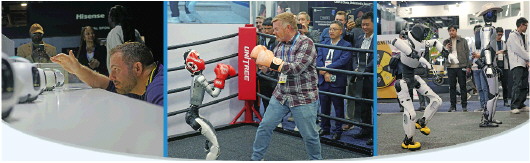
Core Insights - The CES 2026 showcased a significant "Chinese moment" in the robotics sector, highlighting the transition of humanoid robots from experimental stages to market-ready products, emphasizing their practicality and readiness for household integration [2][5] Industry Overview - Among the 598 exhibitors in the robotics sector, 149 were Chinese companies, accounting for nearly a quarter of the total. In the humanoid robot segment, 21 out of 38 exhibitors were from China, representing over half [3] - The event featured a diverse range of products from industrial to consumer-grade robots, with notable participation from both established companies and new entrants [3][4] Product Innovations - Zhiyuan Robotics, leading in humanoid robot shipments, showcased a full range of products, including the portable Q1 robot, which redefines humanoid robot design [3][4] - The introduction of the fully autonomous humanoid nanny robot by "Chinese Figure" Wan'an targets the vast household service market, capable of performing laundry tasks autonomously [5] - The Jupiter robot, equipped with a specialized training environment, can navigate complex home settings, while the W1 robot integrates emotional interaction capabilities [6] Market Trends - The trend towards consumer-grade humanoid robots is accelerating, with significant price reductions making them more accessible. The price of humanoid robots is expected to drop by over 25% compared to 2024 due to increased domestic production of key components [6][7] - Companies like Yushutech and Songyan Power are breaking the traditional high-price barrier, with products priced below 30,000 yuan and even under 10,000 yuan [6][7] Sales and Delivery Projections - The humanoid robot shipment volume in China is projected to reach 18,000 units in 2025, a more than 650% increase from 2024, with expectations of further growth to 62,500 units in 2026 [7][8] - Leading companies are already achieving significant delivery volumes, with estimates of over 5,100 units for Zhiyuan Robotics in 2025 and plans to increase to tens of thousands in 2026 [8] Global Competitive Landscape - The competition in the global humanoid robot market is shifting towards engineering, commercialization, and ecosystem development, with Chinese companies gaining more influence in this trillion-dollar sector [8]