C909支线客机

Search documents
中国又拿了个第一
Zhong Guo Xin Wen Wang· 2026-01-09 00:30
Core Insights - China's aviation population is projected to exceed 500 million by 2025, making it the largest in the world, which signifies a shift in the global aviation landscape towards the East [1] - The annual passenger transport volume is expected to reach 770 million, with a total transport turnover of 1640.8 billion ton-kilometers [2] Group 1: Structural Changes - By 2025, the passenger turnover of China's civil aviation will account for 39% of the overall transportation system, an increase of 6 percentage points from 2019, indicating a transition from luxury to a common mode of travel [3] - International flights are expected to recover to over 90% of 2019 levels by 2025, with international passenger transport volume increasing by 21.6% year-on-year [4][5] Group 2: Economic Impact and Infrastructure - The aviation network density is positively correlated with national economic influence, highlighting the importance of aviation in economic development [6] - From 2017 to mid-2025, flights and passenger transport between China and Belt and Road Initiative countries have significantly increased, with 155.9 million flights and 200 million passengers transported [7] - China's civil aviation infrastructure investment is projected to reach 120 billion yuan, with airport-centric economic zones emerging as new growth drivers [7] Group 3: Industry Development - The rise of China's aviation power is supported by an increasingly autonomous industrial chain, with domestic aircraft like the C919 gaining market share [8] - The acceleration of self-sufficiency in key areas such as aircraft engines and avionics is contributing to the development of a complete aviation industry chain centered around regions like the Yangtze River Delta [9] - The growth of aviation in inland cities like Zhengzhou is breaking geographical limitations, with Zhengzhou Airport becoming a significant economic hub [9] Group 4: National Strength - The rise of China's civil aviation reflects an enhancement of national comprehensive strength, transitioning from a follower to a leader in the aviation sector [10] - The narrative of China's aviation industry is just beginning, with the potential for further growth and development [11]
机票要涨?2026民航关键词:整治“内卷”,加码低空,国产化
2 1 Shi Ji Jing Ji Bao Dao· 2026-01-07 12:48
Group 1: Core Insights - The 2026 National Civil Aviation Work Conference highlighted that the civil aviation sector achieved a profit of 6.5 billion yuan in 2025, driven by growth in passenger and cargo demand, expansion of international routes, and refined management practices [1] - The Civil Aviation Administration of China (CAAC) set ambitious targets for 2026, aiming for a total transport turnover of 1,750 billion ton-kilometers, passenger transport of 810 million people, and cargo mail transport of 10.7 million tons [1] Group 2: International Aviation Hubs - The construction of four world-class airport clusters in the Beijing-Tianjin-Hebei, Yangtze River Delta, Guangdong-Hong Kong-Macau Greater Bay Area, and Chengdu-Chongqing regions is accelerating during the 14th Five-Year Plan period [2] - The international aviation hub network now covers 93.2% of China's prefecture-level administrative units, 92.2% of the population, and 94.9% of the economic total, with international routes reaching 90 countries and 263 cities [2] Group 3: Policy and Regulatory Framework - The CAAC plans to release implementation plans for ten international aviation hubs in 2026, along with selection methods for hub operators and evaluation systems [2] - The upcoming guidelines for international aviation hub construction will focus on enhancing intercontinental connectivity and optimizing international transfer capabilities [3] Group 4: Market Dynamics and Competition - The conference emphasized the need to address "involution" in competition and to implement strategies for expanding domestic demand while improving the supply-side structure [5] - In 2025, the average economy class ticket price is expected to drop by 3.1% to 738 yuan, continuing a trend of price competition among airlines [6] Group 5: Domestic Demand and Consumer Services - The civil aviation sector will enhance domestic air transport services, develop differentiated service products, and promote air-rail intermodal transport to better meet diverse passenger needs [7] - The integration of civil aviation with cultural tourism products is expected to stimulate consumer spending and enhance service offerings [7] Group 6: Low-altitude Economy Development - The conference highlighted the importance of domestic aircraft, with 220 domestically produced aircraft expected in the fleet by 2025, and a significant increase in the domestic aircraft fleet share from 1.3% in 2019 to 4.5% [8] - The low-altitude economy is set for high-quality development, with measures to establish a comprehensive policy framework and enhance low-altitude flight service networks [9] Group 7: Application Scenarios for Low-altitude Economy - Current applications of the low-altitude economy include logistics, emergency rescue, urban governance, and tourism, with low-altitude logistics showing rapid growth in medical and fresh delivery sectors [11] - The potential for urban air mobility (UAM) is expanding, with eVTOL and large drones expected to facilitate short-distance commuting and emergency services [11]
民航2025年盈利65亿元 今年整治“过低票价”要动真格
Di Yi Cai Jing· 2026-01-06 11:13
Core Insights - The civil aviation industry is projected to achieve a profit of 6.5 billion yuan in 2025, building on a turnaround from losses in 2024, indicating improved operational efficiency [1][3]. Group 1: Industry Performance - The civil aviation sector suffered significant losses during the COVID-19 pandemic, totaling nearly 400 billion yuan over three years, but managed to reduce losses substantially in 2023 [3]. - In 2025, the industry is expected to handle a total transport turnover of 1,640.8 billion ton-kilometers, with passenger transport reaching 770 million people and cargo/mail transport at 10.172 million tons, representing year-on-year growth of 10.5%, 5.5%, and 13.3% respectively [3]. - The average daily aircraft utilization rate is projected to be 9.1 hours in 2025, an increase of 0.2 hours year-on-year, with passenger load factors at 85.1% and cargo load factors at 73.4%, up by 1.8 and 1.3 percentage points respectively [3]. Group 2: Future Projections - For 2026, the Civil Aviation Administration anticipates further growth in passenger volume, targeting a total transport turnover of 1,750 billion ton-kilometers, 810 million passengers, and 1.07 million tons of cargo/mail [4]. - The growth rate for passenger transport in 2025 is expected to decline compared to 2024, where passenger and cargo transport grew by 17.9% and 22.1% respectively [4]. Group 3: Market Regulation - The Civil Aviation Administration has identified "involution" in the market, where airlines are engaging in price wars to gain market share, leading to reduced profitability despite increased passenger numbers [5][6]. - Measures to regulate pricing and maintain market order have been proposed, including enhanced price monitoring and self-discipline among airlines to stabilize ticket prices [5][6]. Group 4: Domestic Production - The focus on increasing domestic production in the aviation sector includes the successful operation of the C919 aircraft, which has carried over 4 million passengers, and the expansion of the C909 regional aircraft into international markets [7]. - The domestic aircraft fleet's share has increased from 1.3% in 2019 to 4.5%, with a goal to further enhance the domestic production rate of key aviation equipment and systems during the "14th Five-Year Plan" period [7].


民航局今年要整治过低票价
Di Yi Cai Jing· 2026-01-06 11:13
Core Insights - The civil aviation industry is projected to achieve a profit of 6.5 billion yuan in 2025, building on a turnaround in 2024, with improved operational efficiency and growth in passenger and cargo volumes [2][3] Group 1: Financial Performance - The civil aviation sector suffered a cumulative loss of nearly 400 billion yuan during the three years of the COVID-19 pandemic, with 2023 still showing losses exceeding any year prior to the pandemic [3] - In 2025, the industry is expected to complete a total transport turnover of 1,640.8 billion ton-kilometers, with passenger transport reaching 770 million and cargo volume at 10.172 million tons, representing year-on-year growth of 10.5%, 5.5%, and 13.3% respectively [3] - Despite the overall profit of 6.5 billion yuan in 2025, not all airlines and airports are expected to be profitable, particularly as the industry enters its traditional off-peak season in the fourth quarter [4] Group 2: Market Dynamics - The growth rate of passenger transport volume in 2025 is expected to decline compared to 2024, where passenger and cargo volumes grew by 17.9% and 22.1% respectively [4] - The Civil Aviation Administration of China (CAAC) has noted that while the industry is growing, many airlines are engaging in "price wars" to gain market share, leading to reduced profitability [5][6] Group 3: Regulatory Measures - The CAAC has emphasized the need for stronger price monitoring and regulation to maintain market order, addressing the issue of excessive low pricing by airlines [6] - In 2026, the CAAC plans to develop a passenger transport cost investigation method and establish a price monitoring and early warning mechanism to prevent unhealthy competition [6] Group 4: Domestic Production and Innovation - The term "domestic production" has been frequently mentioned, focusing on the development of domestic aircraft and components, with significant advancements in the C919 and C909 aircraft models [7] - By 2025, the domestic aircraft fleet is expected to include 220 domestically produced planes, with a core communication navigation system achieving 96% domestic production [7]

民航局今年要整治过低票价
第一财经· 2026-01-06 11:06
Core Viewpoint - The civil aviation industry in China achieved a profit of 6.5 billion yuan in 2025, building on the turnaround from losses in 2024, with operational efficiency continuing to improve [3][6]. Group 1: Industry Performance - In 2025, the total transport turnover reached 1,640.8 billion ton-kilometers, with passenger transport volume at 770 million and cargo mail transport at 10.172 million tons, representing year-on-year growth of 10.5%, 5.5%, and 13.3% respectively [7]. - The aircraft daily utilization rate improved to 9.1 hours, with a passenger load factor of 85.1% and a cargo load factor of 73.4%, showing increases of 0.2 hours, 1.8 percentage points, and 1.3 percentage points respectively [7]. - Despite the overall profit, the growth rate of passenger throughput in 2025 was lower than in 2024, which saw increases of 17.9% and 22.1% for passenger and cargo transport volumes respectively [8]. Group 2: Regulatory Measures - The Civil Aviation Administration of China (CAAC) is addressing "involution" in the industry, where airlines have been engaging in price wars, leading to reduced average ticket prices by 12.7% in 2024 and an additional 2.9% in 2025 [10]. - The CAAC plans to implement measures to monitor prices and maintain market order, including a cost investigation method for passenger transport and a price monitoring and warning mechanism [12]. Group 3: Domestic Production Increase - The focus on "domestic production" includes advancements in domestic aircraft and components, with the C919 aircraft carrying over 4 million passengers in 2025 and expanding into international markets [14]. - The domestic aircraft fleet's share increased from 1.3% in 2019 to 4.5%, with plans to enhance the domestic production rate of key aviation products and systems [14].

民航2025年盈利65亿元,今年整治“过低票价”要动真格
Di Yi Cai Jing· 2026-01-06 10:10
Core Insights - The Civil Aviation Administration of China (CAAC) anticipates further growth in passenger volume for 2026, along with more practical regulatory measures to combat "involution" in the industry [1][3]. Financial Performance - The civil aviation sector achieved a profit of 6.5 billion yuan in 2025, building on a turnaround from losses in 2024, indicating improved operational efficiency [2][4]. - In 2025, the industry recorded a total transport turnover of 1,640.8 billion ton-kilometers, with passenger transport reaching 770 million people and cargo/mail transport at 10.172 million tons, representing year-on-year growth of 10.5%, 5.5%, and 13.3% respectively [4]. Passenger and Cargo Trends - The growth rate of passenger throughput in 2025 was lower compared to 2024, where passenger and cargo transport increased by 17.9% and 22.1% respectively [5]. - For 2026, the CAAC aims for a total transport turnover of 1,750 billion ton-kilometers, with passenger transport projected at 810 million people and cargo/mail transport at 1.07 million tons, indicating a further decline in growth rate compared to 2025 [5]. Market Competition and Regulation - The CAAC has noted that the industry has been experiencing "involution," characterized by airlines adopting aggressive pricing strategies, leading to a decline in average ticket prices [6]. - In response, the CAAC plans to enhance price monitoring and supervision, requiring airlines to strengthen price self-discipline and stabilize pricing levels [6][7]. - The CAAC is collecting data from airlines to assess cost structures on various routes to prevent predatory pricing below cost [8]. Domestic Production and Innovation - The focus on "domestic production" includes advancements in domestic aircraft and components, with the C919 aircraft surpassing 4 million passengers in 2025 and expanding into international markets [9]. - During the "14th Five-Year Plan," the domestic aircraft fleet is expected to reach 220 units, with a target of 96% domestic production for key air traffic control equipment [9]. - The CAAC aims to promote the optimization and certification of key models like the C919 and C909, enhancing the international market presence of domestic aviation products [9].
国产大飞机进入放量时期?中国商飞获440亿元巨额增资
Huan Qiu Lao Hu Cai Jing· 2025-11-28 02:53
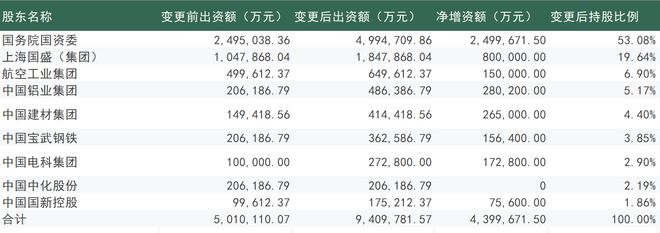
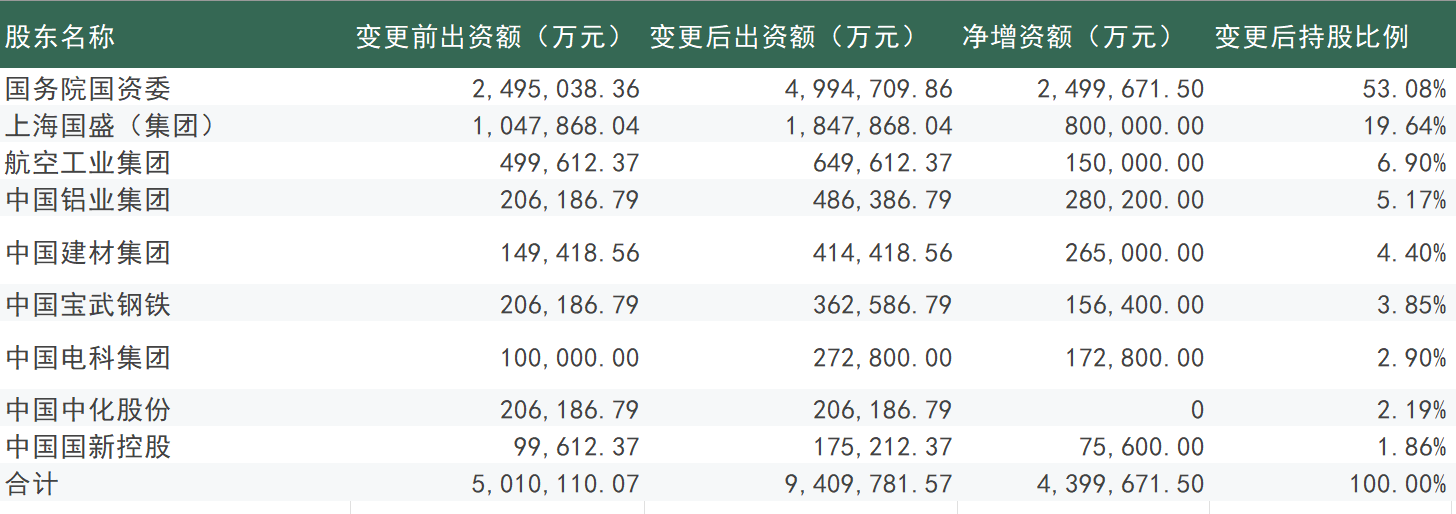
Core Insights - The recent capital increase of 44 billion RMB for China Commercial Aircraft Corporation (COMAC) signals a critical phase for the C919 aircraft as it prepares for large-scale deliveries [1][2] - The registered capital of COMAC has surged from approximately 50.1 billion RMB to about 94.1 billion RMB, marking an increase of around 88% [1] - The State-owned Assets Supervision and Administration Commission (SASAC) contributed 24.997 billion RMB, raising its stake to 53.08%, achieving absolute control [1] Shareholder Contributions - Eight out of nine shareholders participated in the capital increase, with notable contributions from China Aluminum Group (28.02 billion RMB), China National Building Material Group (26.50 billion RMB), and China Electronics Technology Group (17.28 billion RMB), resulting in increased ownership percentages [1] - Other five companies saw a decrease in their shareholding ratios despite some increasing their investment, such as Shanghai Guosheng Group, which invested 8 billion RMB but saw its stake drop from 20.91% to 19.64% [2] - China National Aviation Industry Group, China Baowu Steel Group, and China Guoxin Holdings also reduced their stakes following their respective investments [2] Company Background and Recent Developments - COMAC, established in March 2008 and headquartered in Shanghai, is the core entity for implementing China's major aircraft projects, including the C919 and C909 aircraft [2] - The C919 has recently entered commercial operations, with the first delivery to China Eastern Airlines in December 2022 and successful commercial flights starting in May 2023 [2] - As of now, 26 C919 aircraft have been delivered, operating over 30 routes and achieving a cumulative passenger volume exceeding 2 million in just over two years of commercial operation [2]
八大国资440亿巨额增资中国商飞
21世纪经济报道· 2025-11-27 02:34
Core Viewpoint - The article highlights the significant capital increase for Commercial Aircraft Corporation of China (COMAC), which is crucial for the mass delivery of the domestically produced C919 aircraft, marking a pivotal moment in China's aviation industry [1][5]. Group 1: Capital Increase and Shareholder Structure - COMAC's registered capital has increased from approximately 50.1 billion RMB to about 94.1 billion RMB, an increase of about 88% [1]. - The State-owned Assets Supervision and Administration Commission (SASAC) led the capital increase with nearly 25 billion RMB, raising its shareholding to 53.08%, establishing a controlling position [5]. - Other state-owned enterprises, including China Aluminum Corporation, China National Building Material Group, and China Electronics Technology Group, also increased their stakes, indicating a strong commitment to the upstream supply chain for aircraft manufacturing [5][6]. Group 2: C919 Aircraft Development and Market Position - The C919 aircraft, China's first independently developed jetliner meeting international airworthiness standards, has begun commercial operations, with 26 units delivered and over 200 million passenger trips completed [6][8]. - COMAC aims to ramp up production capacity to 150 units per year by 2027 and further to 200 units by 2029, addressing a backlog of over a thousand orders [8]. - The company is also developing the C929 wide-body aircraft, which is in the preliminary design stage and aims to meet global market demands [8]. Group 3: Future Market Outlook - COMAC's market forecast predicts that over the next 20 years, China's passenger turnover will grow at an annual rate of 5.25%, with the fleet expected to expand by 4.4% annually [10]. - By 2043, China's civil aviation fleet is projected to reach 10,061 aircraft, accounting for 20.6% of the global fleet, positioning China as the largest single aviation market [10].

440亿!八大国资集体增资中国商飞 国产大飞机规模化交付提速
2 1 Shi Ji Jing Ji Bao Dao· 2025-11-26 15:43
Core Viewpoint - The domestic large aircraft C919 has reached a critical milestone for large-scale delivery, with its manufacturing entity, COMAC, receiving significant capital support, increasing its registered capital from approximately 50.1 billion RMB to about 94.1 billion RMB, an increase of approximately 88% [1] Capital Increase Details - The capital increase involved contributions from various stakeholders, with the State-owned Assets Supervision and Administration Commission (SASAC) leading with an investment of nearly 25 billion RMB, raising its shareholding to 53.08% [2][3] - Other stakeholders, including Shanghai Guosheng, Aviation Industry Corporation of China, and China Aluminum Corporation, also increased their investments, indicating strong support for the aircraft manufacturing project [3] Shareholding Structure Adjustment - Following the capital increase, the shareholding structure of COMAC has undergone significant changes, with SASAC establishing a dominant position [3] - Shanghai Guosheng's shareholding decreased slightly despite a substantial investment, while other older shareholders experienced varying degrees of dilution [4] C919 Aircraft Development and Operations - The C919, China's first independently developed jetliner meeting international airworthiness standards, has begun commercial operations, with 26 aircraft delivered and over 200 million passenger trips completed [5][6] - The aircraft has received over a thousand orders from various airlines and leasing companies, highlighting the demand and potential for growth in production capacity [6] Future Production Plans - COMAC aims to ramp up C919 production capacity to 150 aircraft per year by 2027 and further to 200 by 2029, alongside the development of the wide-body aircraft C929 [6] - The significant capital increase is expected to support future capacity expansion, technological upgrades, and service network development, reflecting a commitment to the long-term growth of China's civil aviation industry [6] Market Outlook - The Chinese aviation market is projected to grow significantly, with an expected annual passenger turnover growth rate of 5.25% over the next 20 years, leading to a demand for approximately 9,323 new jet aircraft [7][8] - By 2043, China's civil aviation fleet is anticipated to reach 10,061 aircraft, representing 20.6% of the global fleet, positioning China as the largest single aviation market globally [7][8]
440亿!八大国资集体增资中国商飞,国产大飞机规模化交付提速
2 1 Shi Ji Jing Ji Bao Dao· 2025-11-26 10:49
Core Viewpoint - The domestic large aircraft C919 has reached a critical point for large-scale delivery, with its manufacturing entity receiving the largest capital injection since its establishment, increasing its registered capital by approximately 88% from about 50.1 billion RMB to about 94.1 billion RMB [1][3]. Capital Increase Summary - The capital increase involved contributions from various stakeholders, with the State-owned Assets Supervision and Administration Commission (SASAC) leading the investment with nearly 25 billion RMB, raising its shareholding to 53.08% [2][3]. - Other stakeholders, including Shanghai Guosheng Group, Aviation Industry Corporation of China, and China Aluminum Corporation, also increased their investments, indicating strong support for the C919 project [3][4]. - The total net capital increase amounted to approximately 44 billion RMB, with all but one shareholder participating in the capital increase [2][3]. Shareholding Structure Adjustment - Following the capital increase, the shareholding structure of China Commercial Aircraft Corporation (COMAC) has undergone significant changes, with SASAC establishing a dominant position [3][4]. - Shanghai Guosheng Group remains the second-largest shareholder despite a slight decrease in its shareholding percentage from 20.91% to 19.64% after injecting 8 billion RMB [4]. - Other shareholders, such as China Aviation Industry Group and China Baowu Steel Group, also saw their shareholding percentages diluted due to the capital increase [4]. C919 Aircraft Development and Market Position - The C919 aircraft has been delivered 26 times and has opened over 30 flight routes, achieving a passenger volume of over 2 million in more than two years of commercial operation [5][6]. - COMAC is under pressure to ramp up production and optimize its supply chain to meet the backlog of over 1,000 orders for the C919 [7]. - Future production capacity is projected to reach 150 aircraft per year by 2027 and 200 aircraft per year by 2029, reflecting the company's growth strategy [7]. Future Market Outlook - The global civil aviation market is currently dominated by Boeing and Airbus, but COMAC aims to increase its market share through continuous R&D investment and market expansion [7][8]. - A recent market forecast predicts that over the next 20 years, China will require approximately 9,323 new jet airliners, with the domestic aviation market expected to grow significantly [8][9]. - The increasing middle-class population in China is projected to raise the per capita flight frequency from 0.5 times in 2023 to 1.7 times by 2043, indicating a robust growth trajectory for the aviation sector [9].