CFETS人民币汇率指数

Search documents
期货重塑“上海价格”全球坐标 | 上海“十五五”开局
Guo Ji Jin Rong Bao· 2026-02-24 11:52
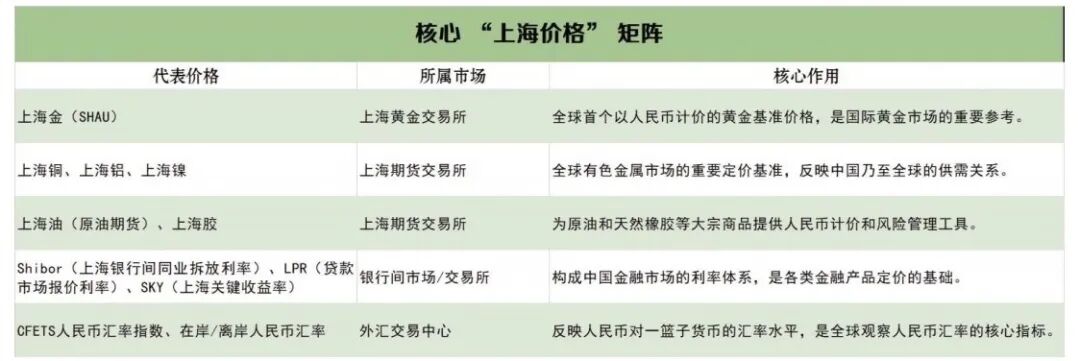
Core Insights - The exploration of RMB foreign exchange futures trading is a key task outlined in Shanghai's "14th Five-Year Plan," marking a significant step in the financial sector's service to the real economy and financial opening-up [1][7] - The "15th Five-Year Plan" emphasizes the development of the futures and derivatives market, positioning it as a core pillar for the global allocation of RMB assets and risk management [3][5] Group 1: Development of RMB Foreign Exchange Futures - The RMB foreign exchange futures trading pilot is officially included in the national financial development framework, indicating a critical phase of steady advancement [9][11] - The pilot aims to address the real needs of enterprises for exchange rate risk management, particularly benefiting small and medium-sized foreign trade enterprises [10][11] - The introduction of standardized futures contracts is expected to lower the cost of risk management for enterprises, enhancing their access to hedging tools [10][11] Group 2: Strategic Importance of the Futures Market - The futures market is transitioning from a supplementary role in capital market risk management to a core functional pillar in the international financial center [5][6] - The focus of development is shifting from local service to supporting national strategies and global pricing, highlighting the market's role in enhancing the international influence of commodity prices [5][6] - The futures market is seen as a crucial link in the collaborative development of Shanghai's five centers: finance, trade, shipping, technology, and industry [6] Group 3: Long-term Development Goals - The "15th Five-Year Plan" calls for a steady and orderly development of the futures and derivatives market, aligning with the current market development status and setting a clear path for long-term health [12][13] - Key directions for achieving stable development include maintaining financial risk limits, aligning with real economic needs, and ensuring gradual market opening while safeguarding national financial security [13][14] - The plan anticipates opportunities for product expansion, market opening, and institutional upgrades, aiming for a transformation from scale expansion to functional upgrades [15]

五问CFETS权重调整——2026年CFETS新权重简评
一瑜中的· 2026-01-06 15:24
Core Viewpoint - The CFETS RMB Exchange Rate Index will adjust the currency basket weights based on trade shares, effective from January 1, 2026, reflecting changes in trade data from 2024 [1]. Group 1: What is the CFETS Index? - The CFETS RMB Exchange Rate Index is a nominal basket currency index calculated using geometric averaging based on the RMB's middle price against a basket of currencies, weighted by trade shares [3][12]. Group 2: How are the basket weights adjusted? - The currency weights are adjusted annually based on trade shares from two years prior, with the new weights applying to the following year [4][13]. Group 3: Changes in the 2026 New Weights - The new weights for 2026 align closely with the 2024 trade shares, with notable discrepancies for the USD and EUR being higher than their respective trade shares, while the HKD is significantly lower [5][14]. - The concentration of the top five currencies has declined for four consecutive years, with their combined weight dropping to 58.15% in 2026, averaging a decline of approximately 1.31 percentage points per year [6][20]. - The weight of developed market currencies has decreased from 76.97% in 2020 to 69.56% in 2026, while emerging market currencies have increased from 23.03% to 30.44% [7][22]. - The weight of the USD has decreased from 19.88% in 2022 to 18.31% in 2026, with an average annual reduction of about 0.51 percentage points [8][24]. - Among emerging market currencies, those from ASEAN, the Middle East, and Russia have the highest weights, collectively accounting for 19.29% of the emerging market currency weight in 2026 [8][30]. Group 4: Trade Share Changes in 2025 - The trade shares from 2025 will guide the adjustments for the currency basket weights in 2027, indicating a potential continuation of the decline in the concentration of the top five currencies [9][34]. - The share of developed market trade is expected to decline further, while emerging market trade shares are anticipated to rise [9][36]. - The significant drop in the US trade share suggests a further decrease in the weight of the USD [9][39]. - Trade shares for ASEAN and Middle Eastern currencies are expected to rise, while the share for Russian trade may decline [9][40]. Group 5: Impact of New Weights on RMB Exchange Rate - The internal and external linkage analysis framework indicates that the new weights will affect the RMB exchange rate dynamics [9][42]. - The influence coefficient of the USD index on the USDCNY middle price has decreased from 0.337 to 0.331, indicating reduced depreciation pressure on the RMB against the USD [9][45]. - Under the new weights, a 5% increase in the USD index could lead to a passive depreciation of the RMB against the USD by approximately 1.66% [9][50].

国际金融市场早知道:10月28日
Xin Hua Cai Jing· 2025-10-28 00:45
Group 1 - The IMF projects that the U.S. government debt will exceed 143.4% of GDP by 2030, increasing by over 20 percentage points from current levels [1] - U.S. Treasury Secretary Yellen praised Japan's expansionary fiscal policy during a meeting with Japan's Finance Minister, although no discussions on monetary policy details took place [1] - The negotiations between South Korea and the U.S. regarding a $350 billion investment project are currently stalled, with key issues such as investment methods, amounts, and timelines still under dispute [2] Group 2 - Argentina's ruling coalition led by President Milei won the midterm elections, alleviating investor concerns about potential stagnation in economic reforms [2] - The German business climate index rose from 87.7 to 88.4 in October, indicating improvements in manufacturing, services, and trade, despite a decline in business satisfaction for the third consecutive month [2] Group 3 - The Dow Jones Industrial Average increased by 0.71% to 47,544.59 points, while the S&P 500 rose by 1.23% to 6,875.16 points, and the Nasdaq Composite climbed by 1.86% to 23,637.46 points, all reaching new historical highs [3] - COMEX gold futures fell by 3.40% to $3,997.00 per ounce, and silver futures dropped by 3.61% to $46.83 per ounce [4] Group 4 - U.S. oil futures rose by 0.08% to $61.55 per barrel, while Brent crude futures decreased by 0.09% to $65.14 per barrel [5] - The 2-year U.S. Treasury yield fell by 0.64 basis points to 3.482%, with similar declines observed across other maturities [5] Group 5 - The U.S. dollar index decreased by 0.12% to 98.82, while the euro and British pound appreciated against the dollar [6]
人民币升值基调,速度放缓?
日经中文网· 2025-09-26 03:18
Core Viewpoint - The Chinese yuan has appreciated against the US dollar, reaching levels not seen in about 10 months, primarily due to reduced concerns over US-China trade tensions and a stable economic growth rate in China above 5% [2][4]. Exchange Rate Trends - The yuan's exchange rate recently peaked at 1 USD = 7.1019 CNY, marking the highest level since November 2024, with fluctuations around 1 USD = 7.110 to 7.114 CNY [4]. - Earlier in April, the yuan had depreciated to 1 USD = 7.3518 CNY, the lowest level in 18 years, driven by significant tariffs imposed by the Trump administration and market fears regarding China's economic outlook [4]. Trade Agreements and Economic Factors - In May, the US and China reached an agreement to reduce additional tariffs by 115%, with a 90-day suspension of certain tariffs, which has contributed to the yuan's appreciation [6]. - The interest rate differential between the US and China has narrowed, with Chinese long-term rates rising and US rates expected to decline, further supporting the yuan's relative value [6]. Central Bank Policies - The People's Bank of China (PBOC) has adjusted the daily floating range of the yuan against the dollar to ±2% around the central rate, indicating a controlled approach to allow for some appreciation while preventing excessive depreciation [7]. - The PBOC has shown a willingness to let the yuan appreciate moderately, as evidenced by its setting of the central rate above the previous day's actual rate during periods of high selling pressure [7]. Economic Growth Projections - China's GDP growth rate is projected to exceed 5% in the first half of 2025, allowing for a toleration of yuan appreciation [7]. - The economic outlook for 2024 suggests higher growth driven by consumer incentives, but challenges may arise in achieving targets in the latter half of 2025 [7].
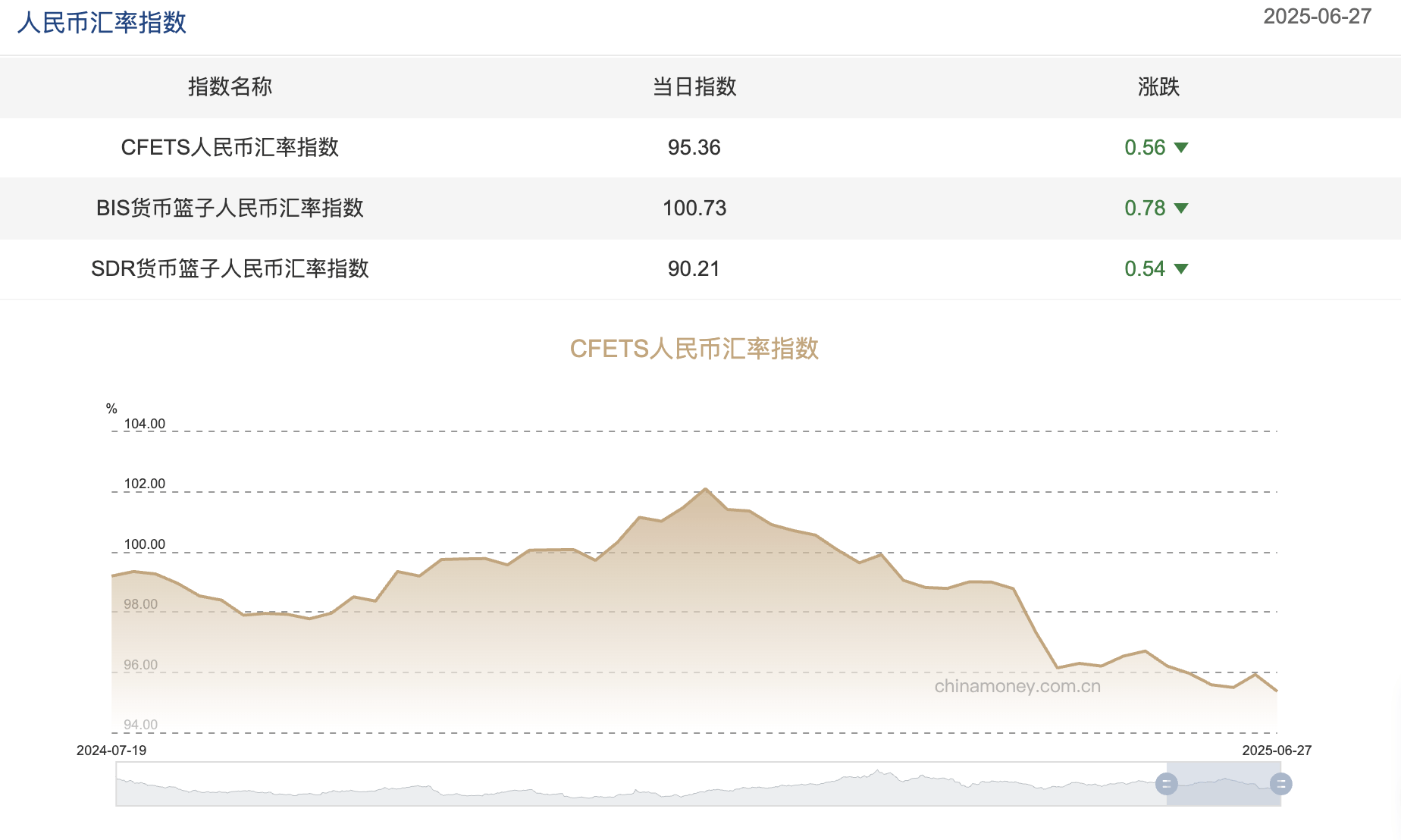
三大人民币汇率指数上周全线下挫,CFETS按周跌0.56
Sou Hu Cai Jing· 2025-06-30 02:56
Core Viewpoint - The recent decline in the three major RMB exchange rate indices indicates a weakening of the Chinese yuan against a basket of currencies, with the CFETS index hitting its lowest level since December 2020 [1][2]. Exchange Rate Indices - The CFETS RMB exchange rate index is reported at 95.36, down 0.56% week-on-week, marking a low not seen since December 2020 [1][2]. - The BIS currency basket RMB exchange rate index stands at 100.73, down 0.78% week-on-week, the lowest since July 2023 [1][2]. - The SDR currency basket RMB exchange rate index is at 90.21, down 0.54% week-on-week, the lowest since August 2020 [1][2]. Market Context - The geopolitical situation and rising expectations for a Federal Reserve rate cut have contributed to a decline in the US dollar, which fell 1.52% last week to 97.26, its lowest in nearly three years [5]. - Non-USD currencies saw gains, with the Swiss franc rising 2.35%, the British pound up 1.97%, and the euro increasing by 1.7% [5]. - The onshore RMB against the USD closed at 7.1711, down 126 basis points for the week, while the offshore RMB closed at 7.1729, down 65 basis points, a decline of 0.09% [5]. Analyst Insights - Analysts suggest that the future trajectory of the RMB is closely tied to the outlook for the US dollar, with a clear direction for gradual appreciation of the RMB in the medium to long term [6]. - Li Liuyang, Chief Analyst at CICC, indicates that the RMB exchange rate will maintain a moderate appreciation in a weak dollar environment, supported by stable exchange rate policies [5][6]. Economic Data - The National Bureau of Statistics reported that from January to May, profits of large-scale industrial enterprises totaled 27,204.3 billion yuan, an increase of 6,034.1 billion yuan compared to the previous four months [7]. - The Ministry of Finance reported that from January to May, total operating revenue of state-owned enterprises was 328,062.5 billion yuan, a year-on-year decrease of 0.1%, while total profits were 16,514.5 billion yuan, down 2.8% year-on-year [8].
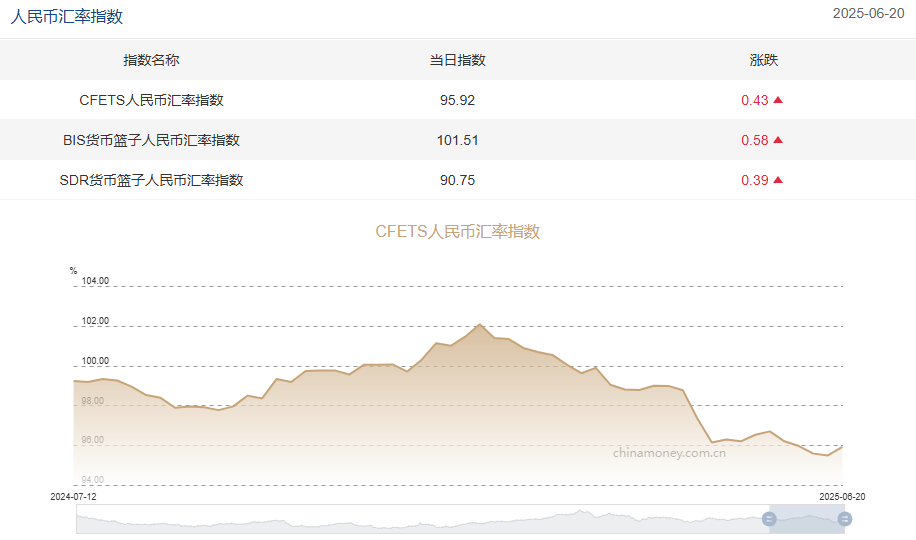
中国外汇交易中心(CFETS):6月20日人民币汇率指数按周涨0.43至95.92。
news flash· 2025-06-23 00:42
Group 1 - The core viewpoint of the article is that the CFETS RMB exchange rate index increased by 0.43% to 95.92 as of June 20 [1] - The BIS currency basket RMB exchange rate index rose by 0.58% to 101.51 [2] - The SDR currency basket RMB exchange rate index saw an increase of 0.39% to 90.75 [2]