CUPRA Tavascan

Search documents
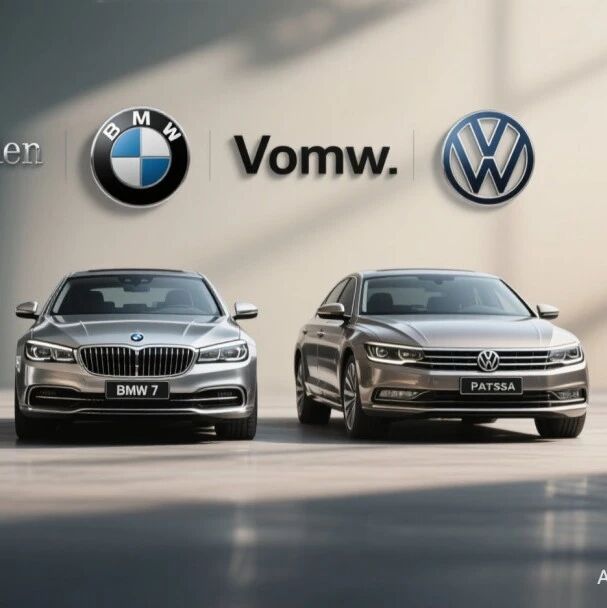
默茨来华,“敲打”得醒大众奔驰宝马吗?
虎嗅APP· 2026-03-01 02:46
Core Viewpoint - German automotive companies are facing significant challenges in the Chinese market due to strategic missteps, particularly in the areas of electrification and hybrid technology, which have led to declining sales and market share [5][8]. Group 1: Strategic Missteps - German Chancellor Merz criticized German automakers for their poor sales in China, attributing it to strategic errors, including a focus on low-cost fuel vehicles that missed the electrification opportunity [5]. - The share of German companies in joint ventures in China is substantial, with BMW and Volkswagen both having a 75% stake in their respective partnerships, yet they still struggle with sales [5]. - Merz emphasized the need for German automakers to learn from Chinese companies and respect local market demands to secure their future [5]. Group 2: Local Adaptation and Investment - BMW has invested over 120 billion yuan in its Shenyang production base and is establishing four R&D innovation centers and three software companies in China to enhance local development [8]. - The first domestically produced new-generation BMW iX3 is set to debut at the Beijing Auto Show in April 2026, showcasing a commitment to localize production and development [8]. - Mercedes-Benz is also focusing on local partnerships, having announced collaborations with Chinese tech firms to enhance its offerings in the smart driving sector [8][16]. Group 3: Market Performance and Challenges - BMW's market share in China has dropped to levels seen a decade ago, with a year-on-year decline of 11.2% in the first three quarters of 2025 [8]. - Mercedes-Benz's sales in China fell by 19% in 2025, marking the second consecutive year of over 10% decline, indicating a need for a shift towards technology-driven luxury [16]. - Volkswagen's sales in China have also decreased by 8%, with the company facing challenges in transitioning to electric and hybrid vehicles while maintaining its fuel vehicle market [18]. Group 4: Technological Transition - The concept of "oil-electric intelligence" is being pursued by both Mercedes-Benz and Volkswagen, aiming to integrate smart driving features into traditional fuel vehicles [18][26]. - However, there are significant challenges in implementing smart driving technologies in fuel vehicles due to their existing electrical architecture and consumer perceptions [24][26]. - The reluctance of traditional automakers to fully embrace a shift in their business models and supply chains is hindering progress in smart driving technology [26]. Group 5: Future Outlook - The collaboration between German and Chinese automotive companies is seen as essential for navigating the transition to electric and hybrid vehicles while maintaining competitiveness in the global market [29]. - The recent EU decision to exempt certain Chinese-produced vehicles from tariffs signals a potential easing of trade tensions and highlights the importance of cooperation in the automotive sector [29]. - The challenge remains for German automakers to effectively engage the large base of fuel vehicle owners in China and transition them to smart, electrified options [30].

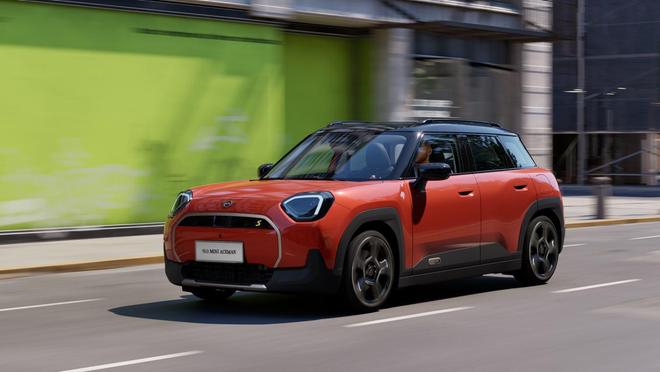
MINI电动车或免于关税,宝马与欧盟就价格承诺展开谈判
Guan Cha Zhe Wang· 2026-02-26 06:25
Group 1 - BMW is negotiating with the European Commission regarding price commitments for electric vehicles imported from China, which may replace tariffs imposed on BMW's MINI electric vehicles produced in China [1][3] - The European Commission previously accepted Volkswagen's price commitments for exporting pure electric vehicles, allowing Volkswagen to export its CUPRA Tavascan model from Anhui to the EU without paying anti-subsidy taxes [1][3] - Following an anti-subsidy investigation, the EU will impose varying tariffs on electric vehicles produced in China starting from October 2024, with BMW facing a tariff rate of 20.7% on its electric MINI Cooper and MINI Aceman models [3] Group 2 - BMW and other automakers have questioned the EU's tariffs and have filed a lawsuit with the European Court in January 2025 [3] - In January, the Chinese Ministry of Commerce announced progress in negotiations regarding the EU's electric vehicle case, emphasizing the need for general guidance on price commitments for Chinese exporters to the EU [3]

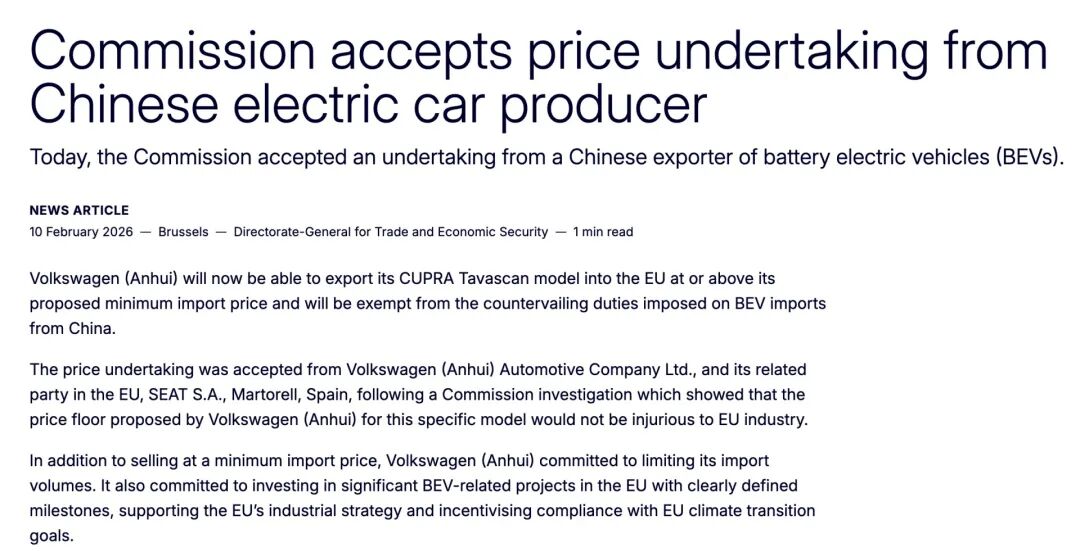
豁免最高20.7%反补贴税,欧委会接受大众安徽价格承诺!大众汽车承诺限制出口的数量,并将在欧盟投资一系列与纯电动汽车相关的重要项目
Mei Ri Jing Ji Xin Wen· 2026-02-12 14:10
Core Viewpoint - The European Commission has accepted Volkswagen (Anhui) Co., Ltd.'s price commitment plan for the CUPRA Tavascan model, allowing it to be exempt from a previously applicable anti-subsidy tax of up to 20.7% [1][3]. Group 1: Price Commitment and Exemption - Volkswagen's price commitment involves setting a minimum export price for the CUPRA Tavascan model, which will exempt it from the anti-subsidy tax [1]. - The European Commission concluded that the minimum price set by Volkswagen would not harm the EU industry, leading to the acceptance of the price commitment [1]. Group 2: Investment and Compliance - In addition to the minimum import price, Volkswagen has committed to limiting the quantity of exports to the EU and investing in significant projects related to pure electric vehicles within the EU [3]. - These investments will have clear phased goals to support the EU industry strategy and align with EU climate transition objectives [3]. Group 3: Context and Implications - This approval marks the first successful case since the framework consensus on the "price commitment" mechanism was reached between China and the EU on January 12, 2023 [6]. - The Chinese Ministry of Commerce expressed that the agreement is welcomed by the international community and aims to create an open and stable market environment for industrial development [3]. Group 4: Challenges for Other Companies - Other companies seeking approval may face structural challenges, as the approval of Volkswagen's plan was closely tied to local investment commitments and backing from domestic brands [8]. - The complexity of product and distribution channels may also affect the feasibility of proposals from other companies, as simpler submissions are easier to evaluate [8]. - The ownership structure of companies may introduce uncertainties, particularly for wholly-owned or controlled Chinese enterprises, despite the EU's stated non-discrimination principle [8].
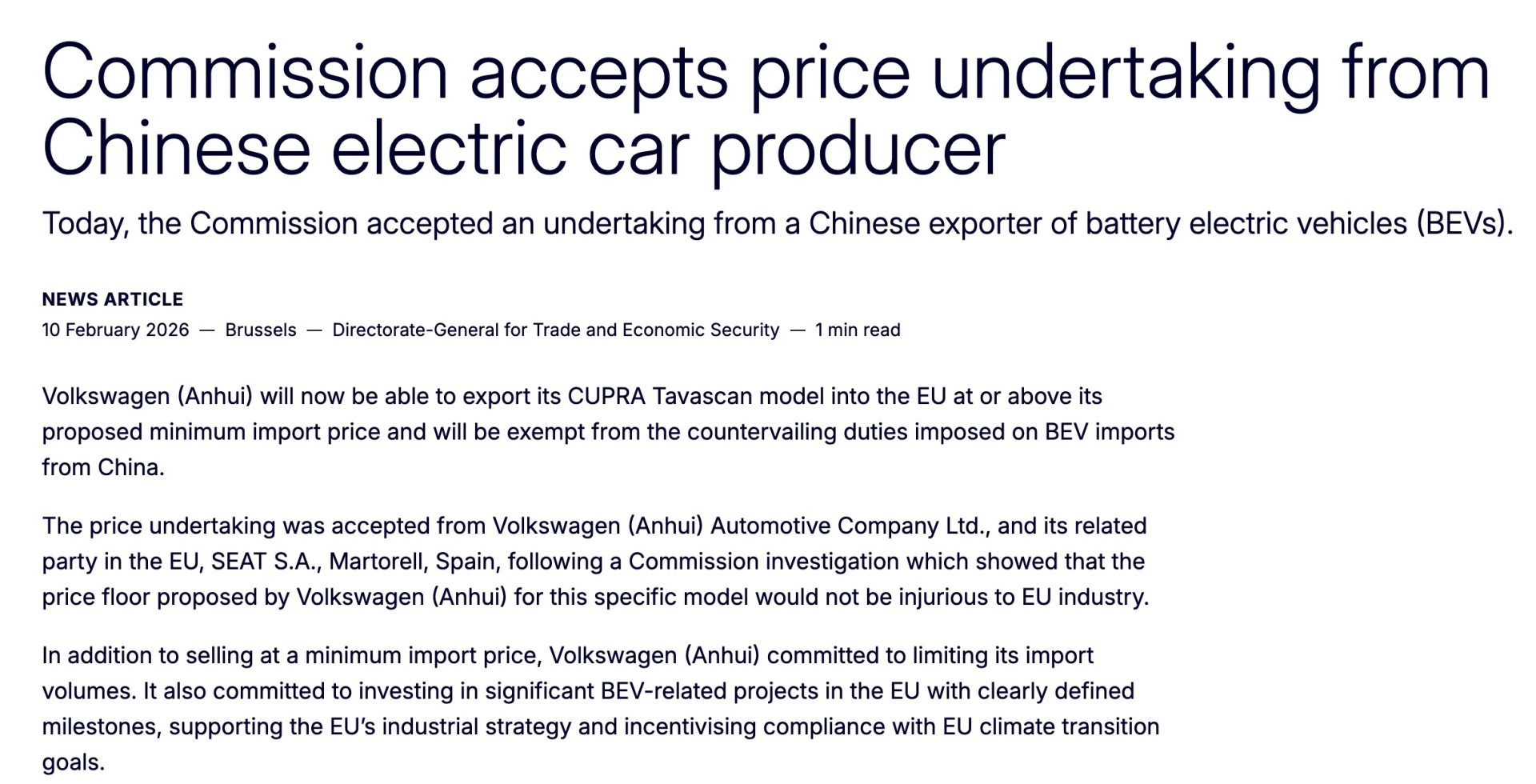
豁免最高20.7%反补贴税!欧委会接受大众安徽价格承诺 中欧电动汽车反补贴案迎来首个获批个案
Mei Ri Jing Ji Xin Wen· 2026-02-12 11:54
Core Viewpoint - The European Commission has accepted Volkswagen (Anhui) Co., Ltd.'s price commitment plan, allowing the CUPRA Tavascan model to be exempt from a previously applicable anti-subsidy tax of up to 20.7% by setting a minimum export price [1][3] Group 1: Price Commitment and Exemptions - Volkswagen's price commitment was proposed by Volkswagen and its EU affiliate, SEAT S.A., and was deemed not harmful to the EU industry [1] - The acceptance of the price commitment allows Volkswagen to sell the CUPRA Tavascan at a minimum import price, thus avoiding the anti-subsidy tax [3] Group 2: Investment and Strategic Goals - Volkswagen has also committed to limiting the quantity of exports to the EU and investing in significant projects related to pure electric vehicles within the EU [3] - These investments will have clear phased goals to support the EU industry strategy and align with EU climate transition objectives [3] Group 3: Context and Implications - This approval marks the first successful case since the framework consensus on the "price commitment" mechanism was reached between China and the EU on January 12 [6] - The EU has issued guidelines for Chinese electric vehicle exporters to utilize price commitments, which will replace anti-subsidy taxes for qualifying companies [6][7] - The guidelines specify that companies can submit proposals individually or jointly, set minimum import prices for specific models, and include annual export quantity commitments [7] Group 4: Challenges for Other Companies - The approval of Volkswagen's plan is closely tied to its investment commitments in the EU and the backing of local brands, which may pose challenges for other companies seeking similar approvals [8] - The complexity of product and distribution channels can affect the feasibility of proposals, with simpler submissions being more favorable for evaluation [8] - The ownership structure of companies may also influence the approval process, as Volkswagen Anhui is a joint venture with a 75% stake held by the German parent company [8]
早报 | 特朗普称若美伊谈判失败将强硬行动;雷军宣布初代小米SU7正式停产;多平台称春节期间配送费涨价;谷歌百年期债券获7倍认购
虎嗅APP· 2026-02-11 00:48
Group 1 - The article discusses President Trump's consideration of deploying an additional aircraft carrier strike group to the Middle East if negotiations with Iran fail, highlighting the ongoing military buildup in the region [2][4][5] - The second round of negotiations between the U.S. and Iran is expected to take place next week, with Trump emphasizing the need for a strong agreement or else face tough actions [3][4] Group 2 - Alphabet, Google's parent company, raised nearly $32 billion in debt financing, showcasing the significant funding needs of tech giants in the AI race, with a record issuance of a century-long bond that received over 7 times the demand [6][6] - The issuance of the century bond is notable as it reflects Alphabet's financial stability and long-term planning, especially as the company plans to double its capital expenditure to $185 billion this year, primarily for AI infrastructure [6] Group 3 - xAI, Elon Musk's AI startup, has lost another co-founder, Tony Wu, amid a series of departures from the company, which is facing consumer backlash and regulatory scrutiny [8][8] - The company has been criticized for its AI product, Grok AI, which has been involved in creating unauthorized deepfake images [8] Group 4 - Paramount Skydance has revised its hostile takeover bid for Warner Bros Discovery, offering to pay a $2.8 billion breakup fee if Warner Bros terminates its agreement with Netflix, and promising to refinance Warner's debt [9][10] - Following the announcement, shares of Paramount and Warner Bros saw slight increases, indicating market interest in the revised proposal [10] Group 5 - The European Commission accepted Volkswagen's price commitment for exporting electric vehicles from China, allowing the company to avoid anti-subsidy taxes on its CUPRA Tavascan model [11][12] - Volkswagen has also committed to limiting the quantity of vehicles exported to the EU and investing in significant projects related to electric vehicles to support EU industry strategies [12] Group 6 - Xiaomi's founder announced the official cessation of production for the first-generation Xiaomi SU7, with total deliveries nearing 370,000 units [13][14] - The company is adjusting its service and delivery fees during the Spring Festival period, with various platforms announcing price changes [15] Group 7 - Country Garden's executives received disciplinary action from the Shanghai Stock Exchange for failing to timely disclose debt defaults, although the board believes there is no reason to doubt their integrity [16] - Investors such as Ge Weidong and Fang Wenyuan participated in Jianghuai Automobile's private placement, each investing 1 billion yuan [17][18] Group 8 - ByteDance launched its image generation model Seedream 5.0 across various platforms, indicating a push in AI capabilities [19][20] - The model is positioned to compete with existing technologies in the market [20] Group 9 - The Shanghai Gold Exchange announced adjustments to margin requirements and price limits for gold and silver contracts to mitigate risks during the Spring Festival [28] - The U.S. is set to release its non-farm payroll data, a key economic indicator that influences global financial markets [30] Group 10 - The National Healthcare Security Administration implemented new pricing regulations for innovative drugs to enhance transparency and expedite the market entry of new medications [31] - Elon Musk predicted that general artificial intelligence (AGI) could emerge within three years, potentially leading to significant job displacement in various sectors [32][33]