
ChatGPT Plus

Search documents
消息称OpenAI已启动ChatGPT内部广告测试
Huan Qiu Wang Zi Xun· 2026-02-10 03:53
Core Insights - OpenAI has officially launched internal advertising tests for ChatGPT, marking it as the first major player in the generative AI sector to explore commercial advertising [1][3] Group 1: Advertising Strategy - The company has committed to ensuring that ads are "clearly labeled, placed only at the bottom of responses, and do not affect content generation" [3] - Ads will appear in a non-intrusive card format at the bottom of the ChatGPT response area, without algorithmic interference or paid prioritization affecting the objectivity of replies [3] - This testing phase is described as a "preliminary exploration," with potential adjustments to implementation details such as advertiser selection and frequency control in the coming weeks to months [3] Group 2: Revenue Model - Advertising is viewed as a crucial pathway for OpenAI to scale its profitability, although it is expected that long-term advertising revenue will account for less than 50% of total revenue [3] - Other revenue streams may include enterprise-level API services, subscription models (like ChatGPT Plus), and customized AI solutions [3] Group 3: Competitive Landscape - The day before OpenAI's advertising test launch, competitor Anthropic released a controversial ad stating "No Ads in AI," which is widely interpreted as a direct response to OpenAI's move [3]

Reorx:OpenClaw 正在重塑我的数字生活,以及为什么我退订了所有 SaaS
AI科技大本营· 2026-02-10 02:13
Core Insights - The article discusses the emergence of the "OpenClaw" phenomenon, highlighting a shift from expensive cloud-based AI services to local private infrastructure, akin to utilities like electricity and water [1][2]. Group 1: Cost and Transition - The author experienced a significant monthly expense of $300 for various SaaS subscriptions, totaling $3,600 annually, prompting a decision to transition to local solutions [2][3]. - The decision to move away from SaaS was influenced by the release of the "Local-First Workflow" plugin from the OpenClaw community, which allowed for the use of advanced local models [3]. Group 2: Hardware Utilization - The Mac Mini M4 is identified as a highly efficient "home data center" for OpenClaw users, with its price reflecting its demand in the market [4]. - The setup includes a low standby power consumption of under 15W, enabling continuous operation without the need for internet connectivity or API fees [5]. Group 3: Functionality and Automation - OpenClaw enhances productivity by automating tasks that previously required manual input, such as debugging code, which can now be done through simple commands [6][10]. - The system can also perform passive organization tasks, such as automatically categorizing files based on their content [7]. Group 4: Privacy and Security - The shift to local processing with OpenClaw allows for enhanced privacy, as sensitive data can be analyzed without external internet access, providing a sense of security that cloud services cannot guarantee [11][12]. - This transition represents a move from "Rented Intelligence" to "Owned Intelligence," likening it to the difference between renting and owning a home [12]. Group 5: Conclusion and Future Outlook - The article concludes that the AI industry is experiencing a "Linux moment," where users are regaining control over their data and AI tools, moving away from reliance on cloud giants [15]. - OpenClaw is positioned not just as software but as part of a broader movement towards user empowerment in the AI landscape [15].

“AI税”背后的价值观分野
Xin Lang Cai Jing· 2026-02-06 00:22
Group 1 - The article highlights the contrasting approaches to AI development between the US and China, emphasizing that while the US focuses on subscription models and monetization, China prioritizes accessibility and affordability of AI applications [1][2] - In the US, the concept of "AI tax" is introduced, where users incur significant costs for AI services, with estimates suggesting that a typical American family could spend between $720 to $1,000 annually on AI subscriptions [1] - In contrast, China's AI applications are becoming increasingly affordable, with costs dropping to levels comparable to utilities, allowing broader access, especially in lower-tier cities [2] Group 2 - The article discusses the philosophical differences in AI utilization, where the US views AI as a tool for capital gain, while China sees it as a quasi-public good aimed at benefiting the majority [3] - China's approach to AI development emphasizes improving overall societal efficiency, particularly benefiting low-income groups more than high-income ones, reflecting a commitment to inclusive growth [3] - The narrative suggests that China's historical focus on equitable development continues to shape its AI strategy, prioritizing the needs of its people over strict investment-return calculations [3]
外媒热议中美AI路径分野:一个精英获益,一个普通人得利
Guan Cha Zhe Wang· 2026-02-04 02:46
Core Insights - The article discusses the shift in the US-China AI competition from "parameter height" to "livelihood depth," emphasizing the concept of "AI Tax" and how China's AI applications are becoming a global influence due to their infrastructure-like characteristics [1][3]. Group 1: AI Tax and Subscription Models - The term "AI Tax" is introduced, highlighting the financial burden of AI subscriptions in the US, where major companies charge around $20 per month for AI services [4][6]. - In contrast, Chinese AI services, such as Alibaba's Qwen and Ant Group's Ant AQ, are offered for free, showcasing a significant disparity in accessibility [6][7]. - The average annual AI expenditure for a typical American middle-class family can exceed 720-1000 USD, while the equivalent in China is projected to be nearly zero by 2026 [8]. Group 2: Healthcare Sector Disparities - The article notes that the US healthcare expenditure reached 5.3 trillion USD in 2024, with a per capita spending of 15,474 USD, which constitutes 18% of GDP [9]. - Despite the introduction of AI, the US healthcare system remains expensive and inaccessible, with many Americans concerned about unexpected medical costs [10][12]. - In China, AI applications like Ant A-fu are transforming healthcare access, allowing users to consult AI for health inquiries without the need for expensive consultations [13][14]. Group 3: AI Accessibility and Social Impact - The article emphasizes that China's approach to AI mirrors its historical focus on improving societal efficiency, akin to the development of high-speed rail and mobile payments [19][20]. - The accessibility of AI in China is seen as a means to empower lower-income groups, contrasting with the US model that prioritizes high-end, subscription-based services [19][21]. - The competition between the US and China in AI is framed as a battle between protecting technological "premium rights" and ensuring widespread "accessibility" of technology [20][21].
年入1400亿,奥特曼印钞机转疯了,AGI尽头是卖广告
3 6 Ke· 2026-01-19 11:07
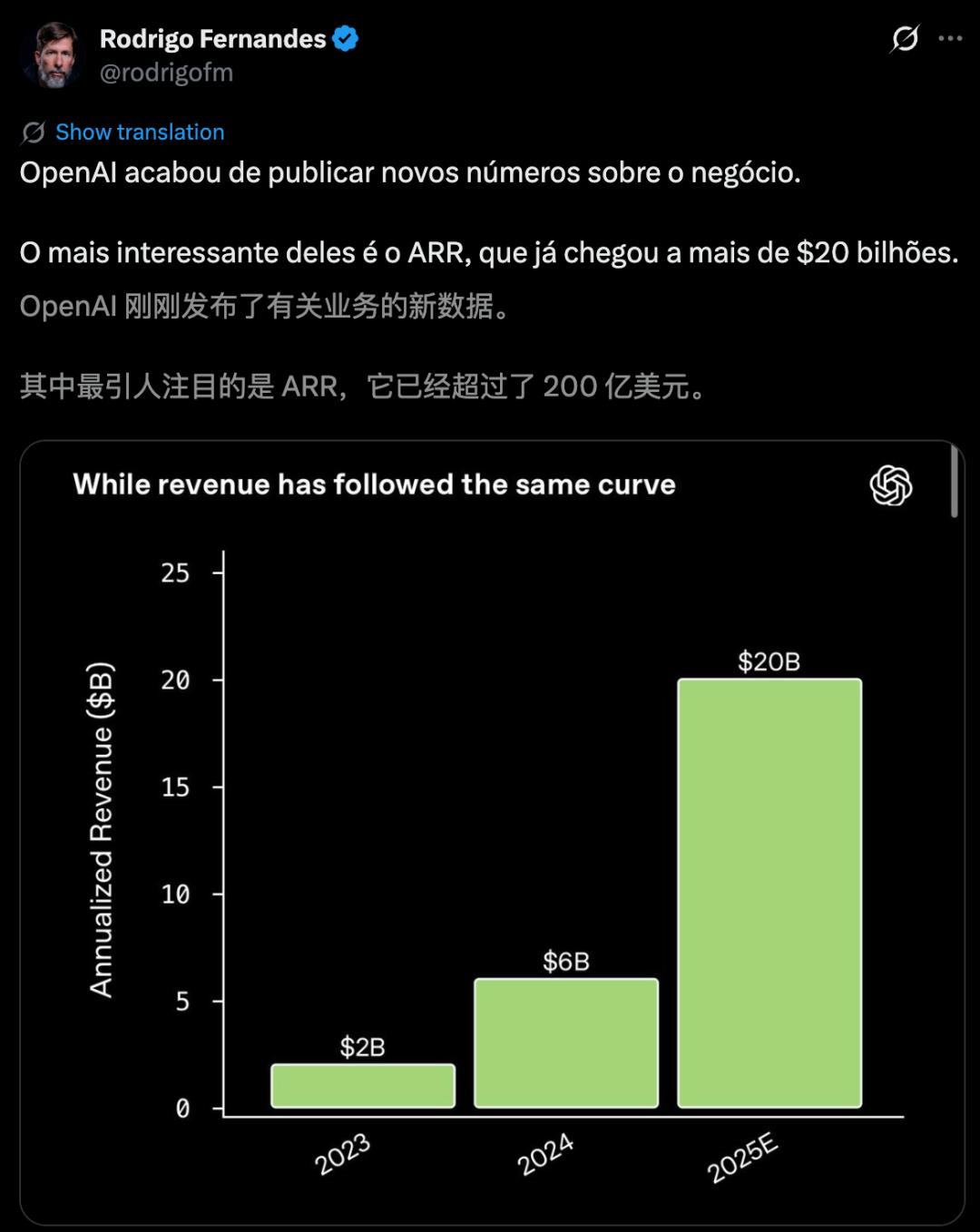
Core Insights - OpenAI's annual recurring revenue (ARR) is projected to exceed $20 billion by 2025, with computing power reaching 1.9 GW, indicating a strong growth trajectory [1][3] - The growth in computing power and revenue is closely linked, with computing power increasing by 9.5 times and revenue by 10 times over three years, creating a positive feedback loop [5][17] Revenue and Computing Power Growth - In 2023, computing power was 0.2 GW with revenue of $2 billion; in 2024, it increased to 0.6 GW and $6 billion; and by 2025, it is expected to reach 1.9 GW and over $20 billion [3][5] - The correlation between computing power investment and revenue generation is emphasized, suggesting that increased investment leads to higher returns [5][17] User Engagement and Product Development - OpenAI's weekly active users (WAU) and daily active users (DAU) have reached historical highs, driven by a "super flywheel" effect that enhances product adoption and revenue [7][17] - The company has diversified its offerings, including personal subscriptions, team collaboration tools, and an API platform, to cater to different user needs [10][11] Advertising Strategy - OpenAI is expanding into advertising, which has generated mixed reactions, as it seeks to monetize its platform amid rising operational costs [21][24] - The company plans to implement targeted advertising based on user interactions, with a goal of generating $1 billion in ad revenue by 2026 and $25 billion by 2029 [35][36] Future Projections - By 2026, OpenAI anticipates total revenue of approximately $30-35 billion, with a significant portion coming from advertising [69] - The company aims to create a comprehensive ecosystem that integrates various revenue streams, including subscriptions, enterprise services, and advertising, to ensure sustainable growth [19][20]
8300亿美金独角兽不得不试水“广告”,AI讲不出新故事?
Sou Hu Cai Jing· 2026-01-18 05:24
Group 1 - OpenAI aims for a valuation of $830 billion in its upcoming funding round, necessitating the identification of real market buyers for its substantial computing costs before the arrival of AGI [1][19] - The company has begun testing advertisements in a restrained manner, leveraging AI for minor innovations, as this is seen as a last resort for monetization [2][8] - Ads are presented at the bottom of ChatGPT responses, only triggered when highly relevant to user queries, allowing for a seamless user experience [4][6] Group 2 - The advertising strategy is primarily targeted at free users in the U.S. and subscribers of the new ChatGPT Go, while premium users will continue to enjoy an ad-free experience [7] - ChatGPT subscription revenue constitutes 60% of OpenAI's income, with active users expected to grow from nearly 900 million to 2.6 billion by 2030 [8][9] - OpenAI's user base is segmented into a "four-tier pyramid," with strategies to monetize the remaining 95% of users who do not currently pay for subscriptions [10][11] Group 3 - The ChatGPT Go subscription at $8 per month targets users who find the $20 subscription too expensive, offering enhanced features while retaining ads [11] - The $20 ChatGPT Plus version is positioned as a premium offering, emphasizing a pure experience without ads, thus enhancing its perceived value [12] - The $200 ChatGPT Pro tier provides advanced features and is aimed at high-end users, while free users are covered by ads [13] Group 4 - OpenAI's revenue structure now includes subscription services, traditional B2B API business, and the new advertising model, forming a three-tier income system [15] - The company anticipates that advertising revenue could exceed $10 billion by 2027, with a target of $110 billion from non-paying users by 2030 [17] - OpenAI is transitioning from a simple AI tool to a comprehensive platform, collaborating with major retailers to enhance its market position [18] Group 5 - OpenAI's rapid cash burn rate is concerning, with projected losses of $8 billion in the first half of 2025 and potential quarterly losses exceeding $12 billion [20] - The company plans to invest approximately $115 billion in computing and data center infrastructure from 2025 to 2029, with long-term investments projected between $1 trillion and $1.4 trillion [21] - The shift towards advertising may not be merely a necessity but could become a significant pillar of OpenAI's revenue model, similar to the paths taken by Google and Meta [28][29]

刚刚!ChatGPT 突然官宣加广告!“SVIP” 才无广告
程序员的那些事· 2026-01-17 07:16
Core Viewpoint - OpenAI is introducing an advertising feature in the free version and the $8 per month ChatGPT Go subscription, aiming to subsidize significant computing costs while expanding revenue sources [3][5]. Group 1: Advertising Implementation - The advertising will be displayed at the bottom of conversations, clearly marked as "sponsored" and distinct from responses, ensuring relevance to the ongoing topic [5]. - Strict guidelines are in place to prevent ads from appearing in conversations involving users under 18, as well as sensitive topics like health and politics [5]. - Users will have the option to disable personalized ads and block specific content, with a commitment that conversation data will not be sold to advertisers [5]. Group 2: Subscription Models - The ChatGPT Plus ($20/month) and Pro ($200/month) subscriptions will remain ad-free permanently, catering to users who prefer an uninterrupted experience [5]. - The ChatGPT Go subscription, which has been rolled out globally, offers enhanced features such as a tenfold increase in message limits and support for file uploads compared to the free version [5]. Group 3: Business Strategy - OpenAI emphasizes that the introduction of ads is a last resort to balance accessibility and commercialization, with a focus on maintaining user trust over revenue generation [5].

Amazon Unveils Alexa+ Web—The AI Strategy Wall Street Has Waited For
Yahoo Finance· 2026-01-12 19:36
Core Insights - The stock market narrative has shifted towards infrastructure investments, with major technology companies investing heavily in data centers and GPUs, raising questions about the timeline for these investments to yield consumer products that generate revenue [3] - Amazon launched Alexa+ Web, a new browser-based interface for its AI assistant, which has led to a significant stock price increase, indicating a potential shift in the company's business model [3][4] - This transition positions Amazon as a company that enhances consumers' digital lives, suggesting the beginning of a new growth phase for the company [5] Investment Strategy - Amazon's strategy includes offering advanced AI tools for free as part of its Amazon Prime membership, contrasting with competitors who charge subscription fees, thereby increasing the perceived value of Prime [6] - The bundling of premium AI tools with Prime subscriptions creates a high barrier to exit for consumers, enhancing customer retention [7] - Analysts view the shift towards a subscription-based utility model as a key driver for future stock price appreciation [7]

OpenAI的国际化困局
Xin Lang Cai Jing· 2026-01-05 12:18
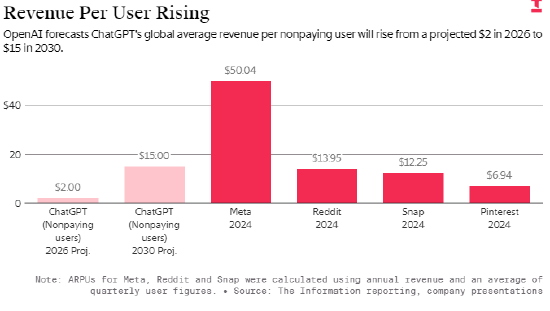
Core Insights - OpenAI projects that by the beginning of the next decade, nearly one-third of the global population will be ChatGPT users, which is approximately three times its current user base of nearly 900 million weekly active users. This large user base could support a substantial advertising and e-commerce business [3][13] - The source of new users is as critical as the number of new users for ChatGPT, with about 90% of its users currently coming from regions outside the United States and Canada, posing a challenge for OpenAI's advertising business [3][14] Revenue Projections - OpenAI expects to generate $112 billion in revenue from the free version of ChatGPT over the next five years, primarily from advertising sales and commissions from online purchases made through the app [4][14] - If advertising and shopping features are successfully implemented, OpenAI anticipates generating $46 billion in revenue from free users in 2030 alone [4][14] User Demographics - The user base of ChatGPT is heavily concentrated outside the United States and Canada, with only about 12% of users from these regions as of Q3 2025 [5][17] - Countries like India and Brazil are significant markets for ChatGPT, but the average revenue per user (ARPU) in these regions is likely lower than in the U.S., Japan, and France, which could hinder advertising revenue growth [8][18] Subscription and Revenue Growth - Currently, only about 5% of ChatGPT's nearly 900 million weekly active users are subscribed to paid plans, with monthly fees of approximately $20 for ChatGPT Pro and $200 for ChatGPT Plus [8][18] - OpenAI plans to introduce a more affordable subscription option, ChatGPT Go, priced at around $5 per month, in countries like India [8][18] - The company aims to increase the average revenue per user from $2 in 2026 to $15 by the end of 2030 [8][18] Cost Considerations - OpenAI anticipates incurring significant costs in running AI models, with projected cumulative costs reaching nearly $150 billion by 2030 [9][19] - The company is relying on revenue from the free version of ChatGPT to help offset these high operational costs [9][19] Competitive Landscape - OpenAI is focused on ensuring the continuous growth of ChatGPT's user base amid intense market competition, having initiated an emergency response mechanism to optimize the platform [10][20] - New features, such as incorporating more visual content in responses, have been launched to enhance user engagement [10][20]
OpenAI利润率飙至70%!碾压Anthropic,AI进入“赢家通吃”阶段
Sou Hu Cai Jing· 2025-12-22 11:53
Core Insights - OpenAI's profitability in its paid user computing business has surged to approximately 70% as of October 2025, a significant increase from 35% in January 2024, indicating a near doubling of profit margins within 21 months [1] - In contrast, its main competitor, Anthropic, reported a computing profit margin of -90% for the entire year of 2024, highlighting OpenAI's dominant position in the market [3] Group 1: Profitability Drivers - The scale effect has significantly reduced costs for OpenAI, leveraging Microsoft's Azure supercomputing cluster, resulting in a more than 30% reduction in computational resource consumption with the launch of efficient models like GPT-4o and o1 [4] - OpenAI has established a comprehensive monetization strategy, including offerings like ChatGPT Plus ($20/month), enterprise APIs, customized o1 models, and Copilot for Microsoft 365, achieving an annual recurring revenue (ARR) exceeding $10 billion [5] - Technological advancements, such as proprietary inference optimization frameworks and sparse activation architectures, have minimized marginal costs in high-concurrency scenarios, contrasting with Anthropic's reliance on general-purpose GPUs, which keeps its costs high [6] Group 2: Industry Landscape - The competitive landscape has shifted from a "duopoly" to "one dominant player," with Anthropic struggling with a business model that prioritizes AI safety but sacrifices computational efficiency, leading to high service costs [8] - OpenAI's strategy of rapid iteration and a closed commercial loop has created a positive feedback loop in technology, user base, revenue, and profit, enabling substantial investments in next-generation models and infrastructure [8] - Regulatory scrutiny is increasing due to OpenAI's high profit margins, with the EU's Digital Markets Act designating it as a "gatekeeper platform" and the U.S. FTC investigating its market dominance [9]
