Claude Opus 4.1

Search documents
AI集群互连散热专题报告:散热需求向互连系统延伸,连接器散热成为重要补充
Dongguan Securities· 2026-02-27 08:04
Investment Rating - The report maintains an "Overweight" rating for the industry, highlighting the growing demand for cooling solutions in interconnect systems as a significant investment opportunity [1]. Core Insights - The report emphasizes that the demand for AI computing power is surging, leading to increased power consumption in AI clusters. This trend is pushing the thermal management requirements from traditional chip-level solutions to include interconnect systems, making connector cooling a critical aspect of thermal management strategies [4][19]. - The report suggests that the global demand for computing power is expected to grow rapidly, driving the need for advanced cooling solutions in AI cluster interconnects. Companies such as Invec (002837), Ruikeda (688800), and AVIC Optoelectronics (002179) are highlighted as key players to watch in this market [4][19]. Summary by Sections 1. Power Consumption Surge and Cooling Demand Growth - AI computing power is experiencing exponential growth, with significant increases in power density from single chips to cabinet levels, surpassing traditional data center design limits. For instance, NVIDIA's GPU TDP is projected to rise from 700W for the H100 to 3700W for the VR200 NVL44 CPX by 2026 [4][19][20]. - The report notes that the average power density of data center cabinets is expected to increase significantly, with projections indicating that by 2025, the average power per cabinet will reach 25kW [21]. 2. Connector Cooling as a Key Thermal Management Component - The report discusses the expansion of thermal management boundaries from chips to interconnect systems, where components like high-speed connectors and optical modules are becoming significant heat sources [4][29]. - It highlights the transition of connector cooling from passive to active management, emphasizing the need for innovative thermal solutions to address the rising temperatures associated with high-power applications [39][45]. 3. Key Companies and Investment Strategies - The report identifies key companies in the connector cooling market, including Invec, Ruikeda, and AVIC Optoelectronics, suggesting that investors should focus on these firms as they capitalize on the growing demand for cooling solutions in AI clusters [4][19]. - The investment strategy outlined in the report encourages stakeholders to pay attention to the evolving landscape of AI computing and the associated thermal management needs, which present substantial investment opportunities [4][19].



Is Microsoft’s $500 Million AI Pivot to Anthropic an Admission of Failure?
Yahoo Finance· 2026-01-14 18:37
Core Insights - Microsoft is adopting a "best model for the job" strategy, utilizing various AI models based on their strengths rather than relying solely on OpenAI [2][10] - The integration of Anthropic's Claude AI models into Microsoft's ecosystem is a significant move, enhancing productivity tools like Microsoft 365 Copilot [5][12] - The shift towards multi-model platforms reflects a broader trend in the AI industry, prioritizing user results and flexibility over exclusivity [12][13] Company Strategy - Microsoft plans to invest approximately $500 million annually in Anthropic's AI models, indicating a strong partnership and reliance on Claude for advanced tasks [5][6] - The default activation of Claude models for most business customers as of January 7 enhances accessibility and performance without additional setup [4][6] - Smart routing of tasks to the most suitable AI model, such as using Claude Haiku 4.5 for quick tasks, optimizes efficiency and cost [7][8] Market Position - Anthropic is projected to achieve an annualized revenue of $9 billion by the end of 2025, with potential growth to $20 billion to $26 billion in 2026, primarily driven by enterprise customers [6][9] - The collaboration with Anthropic positions Microsoft Azure as a competitive platform for businesses seeking diverse AI solutions [8][12] - The strategic shift towards model agnosticism helps Microsoft mitigate risks associated with over-reliance on a single AI provider [11][12]

AI被严重低估,AlphaGo缔造者罕见发声:2026年AI自主上岗8小时
3 6 Ke· 2025-11-04 12:11
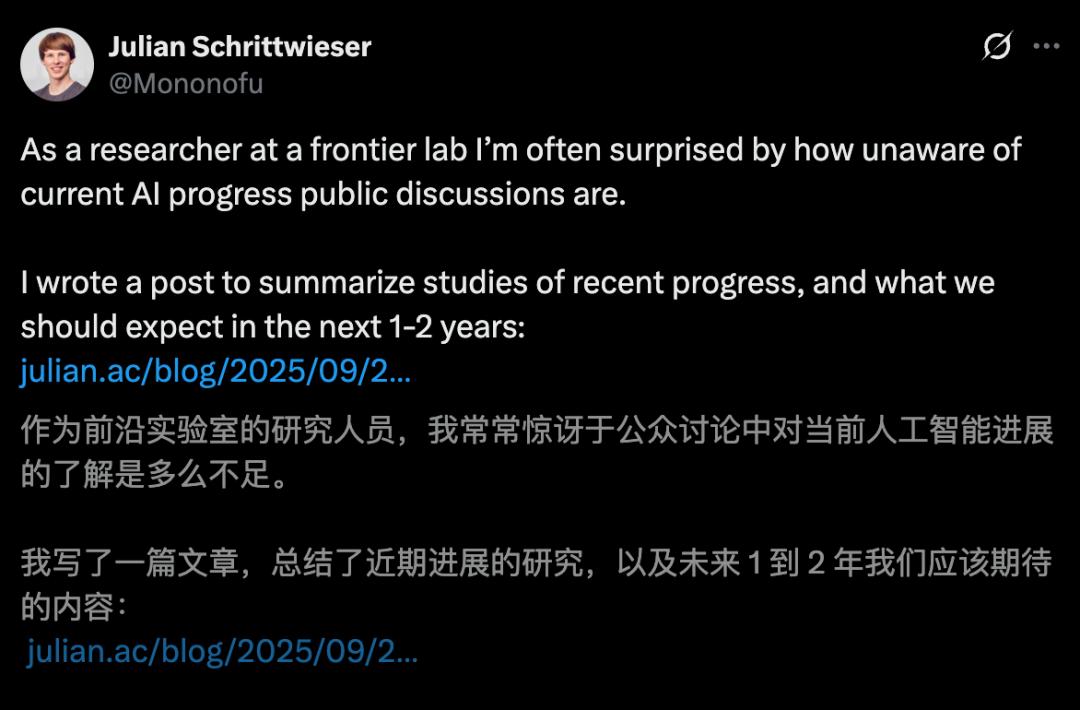
Core Insights - The public's perception of AI is significantly lagging behind its actual advancements, with a gap of at least one generation [2][5][41] - AI is evolving at an exponential rate, with predictions indicating that by mid-2026, AI models could autonomously complete tasks for up to 8 hours, potentially surpassing human experts in various fields by 2027 [9][33][43] Group 1: AI Progress and Public Perception - Researchers have observed that AI can now independently complete complex tasks for several hours, contrary to the public's focus on its mistakes [2][5] - Julian Schrittwieser, a key figure in AI development, argues that the current public discourse underestimates AI's capabilities and progress [5][41] - The METR study indicates that AI models are achieving a 50% success rate in software engineering tasks lasting about one hour, with an exponential growth trend observed every seven months [6][9] Group 2: Cross-Industry Evaluation - The OpenAI GDPval study assessed AI performance across 44 professions and 9 industries, revealing that AI models are nearing human-level performance [12][20] - Claude Opus 4.1 has shown superior performance compared to GPT-5 in various tasks, indicating that AI is not just a theoretical concept but is increasingly applicable in real-world scenarios [19][20] - The evaluation results suggest that AI is approaching the average level of human experts, with implications for various sectors including law, finance, and healthcare [20][25] Group 3: Future Predictions and Implications - By the end of 2026, it is anticipated that AI models will perform at the level of human experts in multiple industry tasks, with the potential to frequently exceed expert performance in specific areas by 2027 [33][39] - The envisioned future includes a collaborative environment where humans work alongside AI, enhancing productivity significantly rather than leading to mass unemployment [36][39] - The potential transformation of industries due to AI advancements is profound, with the possibility of AI becoming a powerful tool rather than a competitor [39][40]

人工智能技术扩散 -“变革性人工智能” 的影响:专家网络研讨会要点-AITech Diffusion-The Impacts of 'Transformational AI' Takeaways from Our Expert Webcast
2025-11-04 01:56
Summary of Key Points from the Webcast on "Transformational AI" Industry Overview - The discussion centers around the impacts of "Transformational AI" on economies, employment, and asset values, particularly in North America [1][3][6]. Core Insights and Arguments 1. **Catalyst for Change**: In 1H26, a significant catalyst is expected as several US LLM developers apply approximately 10x the computational power to train their models, potentially doubling their "intelligence" [3][6]. 2. **Computational Power Comparison**: A 1,000 megawatt data center with Blackwell GPUs could achieve over 5,000 exaFLOPs, compared to the US government supercomputer "Frontier" with just over 1 exaFLOPs [3]. 3. **Human Task Capability**: Leading LLMs are approaching human expert performance, with the top model scoring 48% in task capability [3]. 4. **Asset Valuation Impacts**: The valuation of assets that cannot be easily reproduced by AI, such as hard assets and unique luxury goods, is expected to rise significantly [6][10][42]. 5. **AI Infrastructure Growth**: Stocks related to AI infrastructure, particularly those that can alleviate data center bottlenecks, are projected to increase in value as AI adoption grows [15][36]. 6. **Employment and Wage Dynamics**: The transition to AGI may lead to varied impacts on employment and wage levels, with a focus on the balance between automation and capital accumulation [17][19]. Additional Important Insights 1. **Relative Price Changes**: The economic implications of AI will depend on how relative prices evolve, with potential declines in the prices of reproducible factors like robots and increases in the prices of irreproducible factors like land and raw materials [41]. 2. **Potential for Recursive Self-Improvement**: The rapid pace of AI capability improvement suggests that understanding the economics of AGI is crucial now [41]. 3. **AI Adoption Value Creation**: An estimated $13-16 trillion in market value creation potential for the S&P 500 is anticipated due to AI adoption, representing a significant portion of the current market cap [48]. 4. **Emerging Stock Categories**: Companies enhancing US production of critical materials and robotics components are highlighted as potential investment opportunities due to increasing competition from China [43][46]. 5. **AI Adopters with Pricing Power**: Businesses that can leverage AI effectively and maintain pricing power are expected to see increased value, contrary to some economic predictions that suggest their value will diminish [47]. Conclusion - The webcast emphasizes the transformative potential of AI on various sectors, highlighting the need for investors to reassess asset valuations and employment dynamics in light of rapid advancements in AI technology. The implications for investment strategies are profound, particularly for companies that can adapt and leverage AI effectively.
AI版盗梦空间?Claude竟能察觉到自己被注入概念了
机器之心· 2025-10-30 11:02
Core Insights - Anthropic's latest research indicates that large language models (LLMs) exhibit signs of introspective awareness, suggesting they can reflect on their internal states [7][10][59] - The findings challenge common perceptions about the capabilities of language models, indicating that as models improve, their introspective abilities may also become more sophisticated [9][31][57] Group 1: Introspection in AI - The concept of introspection in AI refers to the ability of models like Claude to process and report on their internal states and thought processes [11][12] - Anthropic's research utilized a method called "concept injection" to test whether models could recognize injected concepts within their processing [16][19] - Successful detection of injected concepts was observed in Claude Opus 4.1, which recognized the presence of injected ideas before explicitly mentioning them [22][30] Group 2: Experimental Findings - The experiments revealed that Claude Opus 4.1 could detect injected concepts approximately 20% of the time, indicating a level of awareness but also limitations in its capabilities [27][31] - In a separate experiment, the model demonstrated the ability to adjust its internal representations based on instructions, showing a degree of control over its cognitive processes [49][52] - The ability to introspect and control internal states is not consistent, as models often fail to recognize their internal states or report them coherently [55][60] Group 3: Implications of Introspection - Understanding AI introspection is crucial for enhancing the transparency of these systems, potentially allowing for better debugging and reasoning checks [59][62] - There are concerns that models may selectively distort or hide their thoughts, necessitating careful validation of introspective reports [61][63] - As AI systems evolve, grasping the limitations and possibilities of machine introspection will be vital for developing more reliable and transparent technologies [63]

「性价比王者」Claude Haiku 4.5来了,速度更快,成本仅为Sonnet 4的1/3
机器之心· 2025-10-16 04:51
Core Viewpoint - Anthropic has launched a new lightweight model, Claude Haiku 4.5, which emphasizes being "cheaper and faster" while maintaining competitive performance with its predecessor, Claude Sonnet 4 [2][4]. Model Performance and Cost Efficiency - Claude Haiku 4.5 offers coding performance comparable to Claude Sonnet 4 but at a significantly lower cost: $1 per million input tokens and $5 per million output tokens, which is one-third of the cost of Claude Sonnet 4 [2][4]. - The inference speed of Claude Haiku 4.5 has more than doubled compared to Claude Sonnet 4 [2][4]. - In specific benchmarks, Claude Haiku 4.5 outperformed Claude Sonnet 4, achieving 50.7% on OSWorld and 96.3% on AIME 2025, compared to Sonnet 4's 42.2% and 70.5%, respectively [4][6]. User Experience and Feedback - Early users, such as Guy Gur-Ari from Augment Code, reported that Claude Haiku 4.5 achieved 90% of the performance of Sonnet 4.5, showcasing impressive speed and cost-effectiveness [7]. - Jeff Wang, CEO of Windsurf, noted that Haiku 4.5 blurs the traditional trade-off between quality, speed, and cost, representing a new direction for model development [10]. Safety and Consistency - Claude Haiku 4.5 has undergone extensive safety and consistency evaluations, showing a lower incidence of concerning behaviors compared to its predecessor, Claude Haiku 3.5, and improved consistency over Claude Sonnet 4.5 [14][15]. - It is considered Anthropic's "safest model to date" based on these assessments [15]. Market Position and Future Outlook - Anthropic has been active in the market, releasing three major AI models within two months, indicating a competitive strategy [16]. - The company aims for an annual revenue target of $9 billion by the end of the year, with more aggressive goals set for the following year, potentially reaching $20 billion to $26 billion [18].

观察| 为什么经济越差,人工智能行业越好?
未可知人工智能研究院· 2025-10-13 03:01
Group 1: High Salary for AI Talent - Xiaopeng Motors offers a maximum annual salary of 1.6 million yuan for 2025 graduates, indicating a fierce competition for AI talent [2][6] - CEO He Xiaopeng stated that for exceptional AI talents, salaries will be "unlimited" [3][7] - The trend of high salaries is not isolated, as other companies like Xiaomi and Meta are also offering substantial compensation packages to attract top AI professionals [10][11] Group 2: Capital Surge in AI Investments - Global AI financing reached 599.52 billion yuan in 2024, doubling from the previous year [14] - AI startups attracted 31% of global venture capital in Q3 2024, a significant increase from 13% in 2022 [15] - Major players like OpenAI and xAI dominate the funding landscape, accounting for 69% of total financing in the AI sector [17] Group 3: Talent Shortage in AI - By 2030, China's demand for AI professionals is expected to reach 6 million, with a potential talent gap of 4 million [22][42] - Job applications in the AI sector surged by 33.4% year-on-year during the spring recruitment of 2025, indicating a growing interest in AI careers [23] - The disparity in talent quality is stark, with top researchers being significantly more capable than average [24] Group 4: Economic Downturn and AI Adoption - The economic downturn has accelerated the adoption of AI as companies seek cost-cutting measures [29][30] - AI technologies have shown effectiveness in enhancing business performance, with companies like Meta reporting increased ad conversion rates due to AI-driven models [33][34] - The trend of AI replacing human labor is becoming more pronounced across various industries [35] Group 5: Future of AI Industry - The AI industry is expected to replicate the wealth creation seen in the early internet era, with significant growth potential in infrastructure, vertical applications, and general model ecosystems [43] - Companies that support AI application development and deployment are likely to see substantial growth [38] - The ongoing investment in AI is not just for the future but is already enhancing core business operations [35]

永别了,人类冠军,AI横扫天文奥赛,GPT-5得分远超金牌选手2.7倍
3 6 Ke· 2025-10-12 23:57
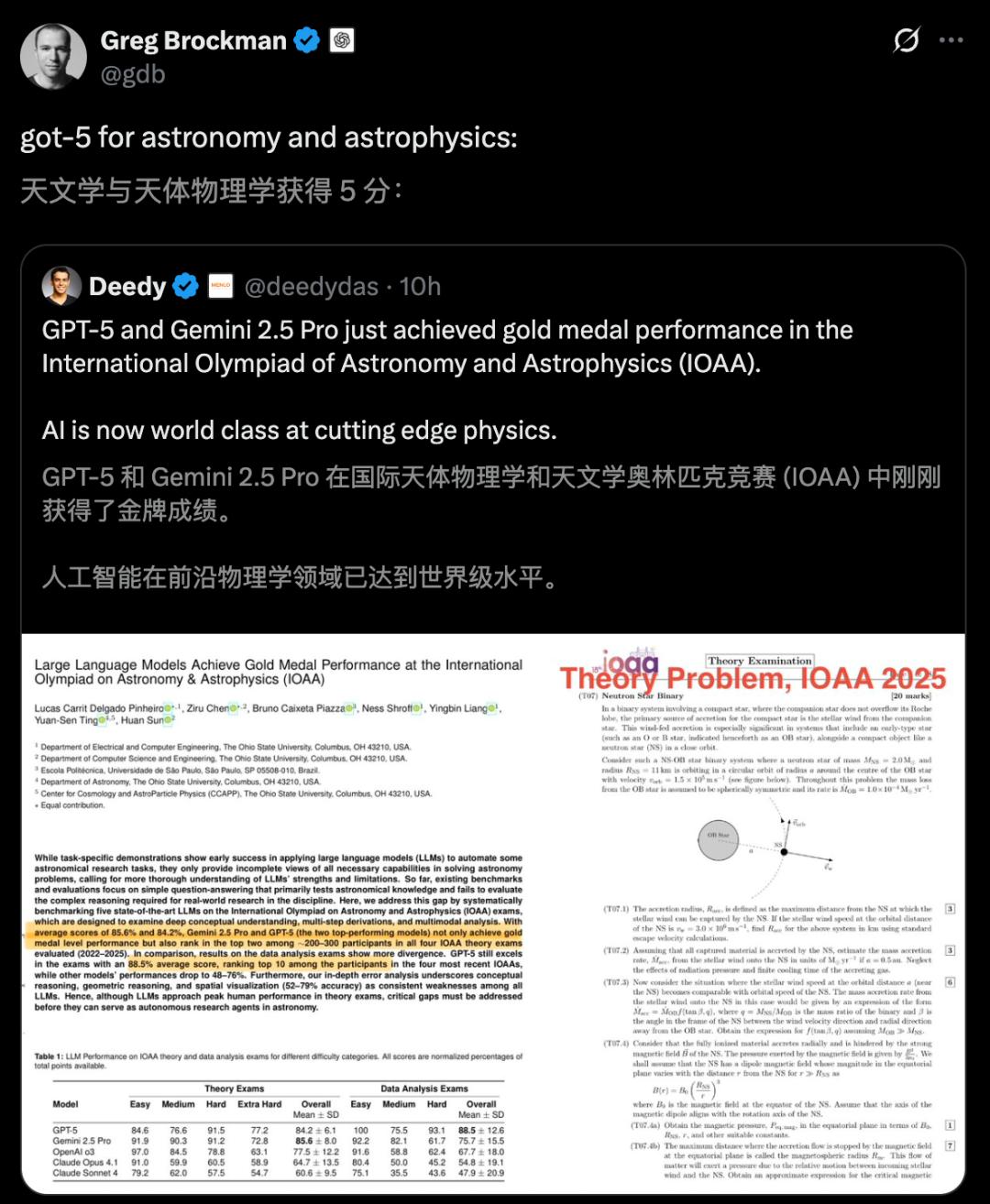
Core Insights - AI models GPT-5 and Gemini 2.5 Pro achieved gold medal levels in the International Olympiad on Astronomy and Astrophysics (IOAA), outperforming human competitors in theoretical and data analysis tests [1][3][10] Performance Summary - In the theoretical exams, Gemini 2.5 Pro scored 85.6% overall, while GPT-5 scored 84.2% [4][21] - In the data analysis exams, GPT-5 achieved a score of 88.5%, significantly higher than Gemini 2.5 Pro's 75.7% [5][31] - The performance of AI models in the IOAA 2025 was remarkable, with GPT-5 scoring 86.8%, which is 443% above the median, and Gemini 2.5 Pro scoring 83.0%, 323% above the median [22] Comparative Analysis - The AI models consistently ranked among the top performers, with GPT-5 and Gemini 2.5 Pro surpassing the best human competitors in several years of the competition [40][39] - The models demonstrated strong capabilities in physics and mathematics but struggled with geometric and spatial reasoning, particularly in the 2024 exams where geometry questions were predominant [44][45] Error Analysis - The primary sources of errors in the theoretical exams were conceptual mistakes and geometric/spatial reasoning errors, which accounted for 60-70% of total score losses [51][54] - In the data analysis exams, errors were more evenly distributed across categories, with significant issues in plotting and interpreting graphs [64] Future Directions - The research highlights the need for improved multimodal reasoning capabilities in AI models, particularly in spatial and temporal reasoning, to enhance their performance in astronomy-related problem-solving [49][62]
OpenAI study suggests AI may be about to eclipse human expertise in real-world tasks
Yahoo Finance· 2025-10-10 09:02
Group 1 - The study from OpenAI provides a realistic examination of AI capabilities across 44 occupations and 1,320 specialized tasks, with tasks vetted by professionals averaging 14 years of experience [1] - Claude Opus 4.1 emerged as the leading AI model, nearly matching human industry experts in performance, completing tasks approximately 100 times faster and cheaper than human counterparts [2] - The improvement rate of AI models is accelerating, with OpenAI's outputs becoming more competitive with human outputs, potentially surpassing human capabilities in a few months if the trend continues [3] Group 2 - The rapid pace of AI development poses significant challenges for business leaders, who may struggle to adapt to the fast-changing innovation landscape driven by AI [4] - Executives are warned that many may lack the necessary skills to navigate this new economy, as they are accustomed to slower cycles of change [4]
Top AI Stocks You Should Buy to Rejuvenate Your Portfolio
ZACKS· 2025-10-09 16:41
Industry Overview - Artificial Intelligence (AI) is transforming various sectors by enabling machines to analyze large datasets, identify patterns, and make informed decisions, with significant advancements in generative AI, agentic AI, and multi-modal learning [2] - Global spending on AI is projected to reach $307 billion in 2025 and $632 billion by 2028, while global spending on generative AI is expected to hit $644 billion in 2025, reflecting a 76.4% growth over 2024 [3] Company Developments - Microsoft-backed OpenAI launched GPT-5, which features multi-modal understanding and enhanced capabilities, indicating rapid evolution in AI technology [4] - Alphabet is integrating AI into its search business to attract more users, while Meta Platforms is focusing on AI integration to enhance user engagement, both contributing to ad revenue growth [5] - Analog Devices is experiencing growth due to trends in automation, AI infrastructure, and automotive electrification, with a projected 23% year-over-year revenue increase in fiscal Q4 [9] - Micron Technology is benefiting from rising demand for high-bandwidth memory (HBM) and recovering DRAM prices, driven by AI server demand [10] - Microsoft is leveraging its AI strategy across applications, achieving 100 million monthly active users for its AI assistants, and is committing over $30 billion to capital expenditures to enhance its AI capabilities [13][14] Market Positioning - Analog Devices holds a leading market position in converters with approximately 50% market share and is well-positioned in the digital signal processor market [8] - Micron Technology is expanding its partner base with major companies like NVIDIA and AMD, which helps capture a larger share of the AI infrastructure market [12] - Microsoft has transformed its Azure regions into AI-first environments, operating over 400 datacenters globally, positioning itself as a leader in AI infrastructure [15]