CoWoS封装方案

Search documents
台积电不相信AI有泡沫
创业邦· 2026-01-22 00:09
Core Viewpoint - TSMC's recent financial report has provided strong validation for the AI industry, showcasing significant growth and robust capital expenditure plans that signal future demand for chip manufacturing [6][9]. Financial Performance - TSMC's Q4 2025 financial results exceeded expectations, with revenue growth for eight consecutive quarters and a gross margin surpassing 60%, comparable to software giants [6][12]. - The company has projected capital expenditures of $52 billion to $56 billion for 2026, a substantial increase from $40.9 billion in 2025, indicating confidence in future orders from clients like NVIDIA and AMD [9][28]. Market Dynamics - TSMC's capital expenditure is primarily allocated for building production lines and purchasing equipment, which typically takes 2-3 years to yield results, thus reflecting anticipated growth in orders from chip design companies [9][28]. - The demand for AI computing chips has surged, leading to a shortage of 3nm capacity, with TSMC reportedly halting new 3nm orders due to full capacity bookings for the next two years [18][25]. Competitive Landscape - TSMC's dominance in the 3nm process technology is underscored by its ability to maintain high gross margins, driven by strong demand from AI chip manufacturers [14][18]. - Competitors like Samsung and Intel have struggled to keep pace, with TSMC's 3nm technology remaining unmatched in terms of performance and yield [18][20]. Advanced Packaging - TSMC's advanced packaging technology, particularly CoWoS, has become critical for AI chips, with significant demand leading to a substantial increase in its capital expenditure allocation for this segment [19][20]. - The company has captured a significant share of the advanced packaging market, with NVIDIA alone accounting for approximately 57.4% of TSMC's current capacity [22][20]. Client Relationships - TSMC's collaboration with NVIDIA has evolved from design processes to system-level integration, indicating a deepening partnership that may see NVIDIA surpassing Apple as TSMC's largest client by 2026 [25][28]. - The shift in client dynamics highlights TSMC's reliance on major customers for securing orders and mitigating risks associated with advanced process technologies [25][28].


台积电不相信AI有泡沫
Xin Lang Cai Jing· 2026-01-20 13:20
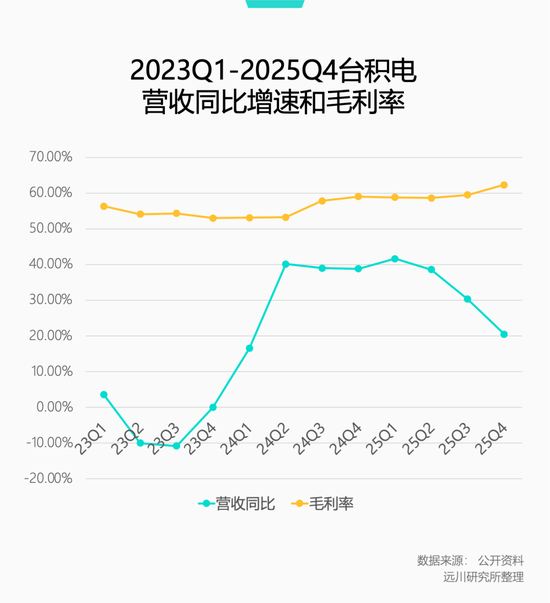
Core Viewpoint - TSMC's financial report serves as a strong endorsement for the AI industry, showcasing significant growth and profitability metrics that exceed expectations, with a gross margin surpassing 60% and continuous revenue growth over eight quarters [1][19]. Group 1: Financial Performance - TSMC's Q4 2025 financial results showed revenue growth for eight consecutive quarters, with a gross margin of 62.3%, rivaling software giants [1][24]. - The company reported a substantial increase in capital expenditure guidance for 2026, projecting between $52 billion and $56 billion, a significant rise from $40.9 billion in 2025, indicating strong future demand [3][21]. Group 2: Market Position and Technology - TSMC's dominance is attributed to its 3nm process technology and advanced packaging solutions, with 3nm revenue accounting for 28% of total revenue in Q4 2025, marking a record high [6][24]. - The company has maintained a high gross margin due to the unique demand for AI computing chips, with major clients like NVIDIA and AMD driving this demand [9][27]. Group 3: Competitive Landscape - TSMC's ability to maintain high margins is partly due to the lack of strong competition in advanced process nodes, as rivals like Samsung and Intel have struggled to keep pace [10][28]. - The advanced packaging technology, particularly CoWoS, has become critical for AI chips, with TSMC capturing a significant share of this market, further solidifying its competitive edge [11][31]. Group 4: Client Dynamics - NVIDIA has emerged as a key client, with expectations that it will surpass Apple as TSMC's largest customer by 2026, reflecting a shift in the client landscape [17][35]. - TSMC's collaboration with NVIDIA has evolved from process design to system-level integration, indicating a deepening partnership that could redefine the future of chip manufacturing [34][35]. Group 5: Future Outlook - TSMC's capital expenditure plans suggest a robust growth trajectory, with a projected compound annual growth rate of 25% from 2024 to 2029, driven by strong demand for advanced process technologies [19][37]. - The company has already secured significant orders for its upcoming 2nm process, indicating a healthy pipeline of demand that contrasts sharply with the challenges faced during the initial rollout of the 3nm process [37].
台积电不相信AI有泡沫
远川研究所· 2026-01-20 13:16
Core Viewpoint - TSMC's recent financial report has provided strong validation for the AI industry, showcasing significant growth and robust capital expenditure plans that signal future demand for chip manufacturing [5][8]. Financial Performance - TSMC's Q4 2025 financial results exceeded expectations, with revenue growth for eight consecutive quarters and a gross margin surpassing 60%, comparable to software giants [5][12]. - The company projected capital expenditures of $52 billion to $56 billion for 2026, a substantial increase from $40.9 billion in 2025, indicating confidence in future orders from clients like NVIDIA and AMD [8][27]. Market Dynamics - TSMC's dominance is attributed to its advanced 3nm process technology, which accounted for 28% of revenue in Q4, driving a 20% increase in average wafer prices over two years [12][16]. - The demand for AI computing chips has surged, leading to a shortage of 3nm capacity, with reports indicating that TSMC has stopped accepting new orders for this process due to full capacity bookings [16][24]. Competitive Landscape - TSMC's competitors, particularly Samsung and Intel, have struggled to keep pace with its advancements in process technology, allowing TSMC to maintain a significant competitive edge [16][19]. - The advanced packaging technology, CoWoS, has become critical for AI chips, with TSMC holding a dominant position in this area, further solidifying its market leadership [17][20]. Client Relationships - TSMC's collaboration with NVIDIA has evolved from design to system-level integration, with NVIDIA expected to surpass Apple as TSMC's largest client by 2026 [22][24]. - The company has successfully diversified its client base, reducing reliance on any single customer, which is crucial for sustaining growth in advanced process technologies [23][26]. Future Outlook - TSMC's capital expenditure plans reflect a strong forecast for the semiconductor industry, with anticipated revenue growth rates of 25% from 2024 to 2029, driven by increasing demand for advanced chips [27].

摩根大通:一文读懂英伟达下一代芯片封装技术“CoWoP”
美股IPO· 2025-08-05 09:08
Core Viewpoint - Morgan Stanley reports that Nvidia is exploring a revolutionary chip packaging technology called CoWoP (Chip-on-Wafer-on-PCB), which is expected to replace the existing CoWoS packaging solution [2][5]. Group 1: CoWoP Technology Overview - CoWoP utilizes advanced high-density PCB technology to eliminate the ABF substrate layer in CoWoS packaging, directly connecting the intermediary layer to the PCB [3][6]. - The potential advantages of CoWoP include simplified system structure, improved data transmission efficiency, better thermal management, and lower power consumption [9]. Group 2: Supply Chain Impact - The introduction of CoWoP is seen as negative news for ABF substrate manufacturers, as the added value of substrates may significantly decrease or disappear [10]. - Conversely, PCB manufacturers are presented with significant opportunities due to the shift in complexity and precision routing to the RDL layer [10][11]. Group 3: Commercialization Challenges - Morgan Stanley analysts believe that the probability of CoWoP's commercialization in the medium term is low due to multiple technical challenges [5][12]. - Current PCB technology, even with mSAP, can only achieve line/space widths of 20-30 microns, which is still far from the desired performance [13]. Group 4: Nvidia's Innovation Leadership - Regardless of whether CoWoP is successfully mass-produced, Nvidia continues to lead innovation in data center AI infrastructure through a system-level approach [17]. - Nvidia's roadmap, which includes advancements towards CoWoS-L and CoPoS, may conflict with the pursuit of CoWoP [15].