DDR4内存颗粒

Search documents
AI算力浪潮驱动存储市场量价齐升
Zheng Quan Ri Bao Zhi Sheng· 2026-01-08 17:09
Core Insights - The price of storage chips, particularly DDR5 server memory, has surged due to explosive demand driven by AI, with prices exceeding 50,000 yuan and approaching 60,000 yuan [1] - The current supply-demand imbalance is expected to persist until 2028, primarily due to the increased memory requirements of AI servers, which are 8 to 10 times higher than traditional servers [1] - Major cloud service providers like Google, Meta, Microsoft, and Amazon AWS are projected to invest a historical high of 600 billion USD in AI infrastructure by 2026, further driving demand for storage chips [2] Market Trends - Since September 2025, the spot price of DDR5 memory chips has increased by over 300%, while DDR4 memory chips have risen by 158% [2] - The rapid expansion of AI data centers is expected to lead to further increases in storage chip demand and prices in 2026 [2][3] - The global supply of DRAM is anticipated to grow by 15% to 20%, while demand is expected to increase by 20% to 25% in 2026, indicating a continued supply shortage [3] Industry Opportunities - The domestic storage industry is seen as entering a historic opportunity phase, with a focus on domestic substitution and benefits across the supply chain [4] - Companies like Changxin Technology are accelerating their investments, with plans to raise 29.5 billion yuan for technological upgrades and R&D, aiming to complete most equipment installations by the end of 2027 [4] - Xi'an Yiswei Materials Technology and Ningbo Jiangfeng Electronic Materials are also expanding their production capabilities to meet the growing global demand for high-end semiconductor materials [4] Market Size Projections - The storage chip market in China is expected to approach 500 billion yuan by 2026, driven by strong demand from AI models, data centers, and smart terminals [5]
内存芯片价格飙涨400%! 法巴:巨头停产旧型号 美光、Sandisk直接受益全球抢货潮
Zhi Tong Cai Jing· 2025-12-11 03:12
Core Viewpoint - The memory industry is entering a historic upcycle driven by artificial intelligence (AI), with companies like Micron Technology (MU.US) and Sandisk (SNDK.US) expected to benefit significantly from this trend [1][2]. Group 1: Market Trends - DRAM and NAND spot prices have seen significant year-on-year increases of 408% and 165% respectively in November, indicating a strong upward trend in pricing [1]. - The average selling price of DRAM is projected to rise by 35% quarter-on-quarter in Q4 and by 10% in Q1 2026, driven by ongoing supply constraints [1]. - NAND prices are also expected to increase by 15% in Q4 and by 7% in the following quarter, reflecting similar supply dynamics [1]. Group 2: Historical Context - Historically, DRAM upcycles last about 8 months with an average price increase of 53%, while NAND upcycles last around 6 months with a 40% average price increase [2]. - Currently, the DRAM upcycle is in its 5th month with prices up 55% from the trough, and the NAND upcycle is in its 4th month with prices up 51% from the trough [2]. Group 3: Competitive Landscape - Major players like Samsung and SK Hynix, which control approximately 70% of the global DRAM market, are shifting focus towards high-end chips, planning to phase out DDR4 production by late 2025 to early 2026 [3]. - Tech giants such as Google, Amazon, Meta, and Microsoft are expected to invest $400 billion in AI infrastructure this year, further driving demand for memory chips [3]. Group 4: Supply Dynamics - The memory chip industry is experiencing a "super cycle," with manufacturers aggressively stockpiling chips due to surging demand [4]. - Semiconductor distributors report a significant increase in demand over the past couple of months, with customers adopting strategies of ordering double or triple the usual quantities [4].

内存芯片价格飙涨400%! 法巴:巨头停产旧型号 美光(MU.US)、Sandisk(SNDK...
Xin Lang Cai Jing· 2025-12-11 03:03
Core Viewpoint - The memory industry is entering a historic upcycle driven by artificial intelligence (AI), with companies like Micron Technology (MU.US) and Sandisk (SNDK.US) expected to benefit significantly from this trend [1][2]. Group 1: Market Trends - Consumer-grade DRAM and NAND TLC spot prices increased by 408% and 165% year-on-year in November, indicating a strong upward trend in pricing [1]. - The average selling price (ASP) of DRAM is projected to rise by 35% quarter-on-quarter in Q4 and by 10% in Q1 2026, driven by ongoing supply constraints [1]. - NAND prices are also expected to increase, with a forecasted rise of 15% in Q4 and 7% in the following quarter [1]. Group 2: Historical Context - Historically, DRAM upcycles last about 8 months with an average price increase of 53%, while NAND upcycles last around 6 months with a 40% average price increase [2]. - Currently, the DRAM upcycle is in its 5th month with prices up 55% from the trough, and the NAND upcycle is in its 4th month with prices up 51% from the trough [2]. Group 3: Competitive Landscape - Major players like Samsung and SK Hynix, which control approximately 70% of the global DRAM market, are shifting focus towards high-end chips, planning to phase out DDR4 production by late 2025 to early 2026 [3]. - The demand for AI infrastructure is expected to reach $400 billion this year from tech giants like Google, Amazon, Meta, and Microsoft, further straining supply for non-HBM memory chips [3]. Group 4: Supply Dynamics - The memory chip industry is experiencing a "super cycle," with manufacturers stockpiling chips due to surging demand [4]. - Semiconductor distributors report a significant increase in demand over the past couple of months, with customers adopting double or triple ordering strategies reminiscent of previous shortages [4].
内存芯片价格飙涨400%! 法巴:巨头停产旧型号 美光(MU.US)、Sandisk(SNDK.US)直接受益全球抢货潮
智通财经网· 2025-12-11 02:54
Core Viewpoint - The memory industry is entering a historic upcycle driven by artificial intelligence (AI), with companies like Micron Technology (MU.US) and Sandisk (SNDK.US) expected to benefit significantly from this trend [1][2]. Group 1: Market Trends - Consumer-grade DRAM and NAND TLC spot prices increased by 408% and 165% year-over-year in November, indicating a strong upward trend in pricing [1]. - The average selling price (ASP) of DRAM is projected to rise by 35% quarter-over-quarter in Q4, with a further 10% increase expected in Q1 2026 [1]. - NAND prices are also expected to rise by 15% in Q4 and 7% in the following quarter, driven by ongoing supply constraints [1]. Group 2: Historical Context - Historically, DRAM upcycles last about 8 months with an average price increase of 53%, while NAND upcycles last around 6 months with a 40% average price increase [2]. - Currently, the DRAM upcycle is in its 5th month with prices up 55% from the trough, and the NAND upcycle is in its 4th month with prices up 51% [2]. Group 3: Competitive Landscape - Major players like Samsung and SK Hynix, which control approximately 70% of the global DRAM market, are shifting focus towards high-end chips, planning to cease DDR4 production by late 2025 to early 2026 [3]. - Tech giants such as Google, Amazon, Meta, and Microsoft are expected to invest $400 billion in AI infrastructure this year, further intensifying demand for memory chips [3]. Group 4: Supply Dynamics - The memory chip industry is entering what analysts refer to as a "super cycle," with manufacturers aggressively stockpiling memory chips due to surging demand [4]. - Semiconductor distributors report a significant increase in demand over the past couple of months, with customers adopting double or triple ordering strategies reminiscent of previous shortages [4].
2026-2032年DDR4内存颗粒行业专项研究及投资战略咨询报告
Xin Lang Cai Jing· 2025-12-09 13:41
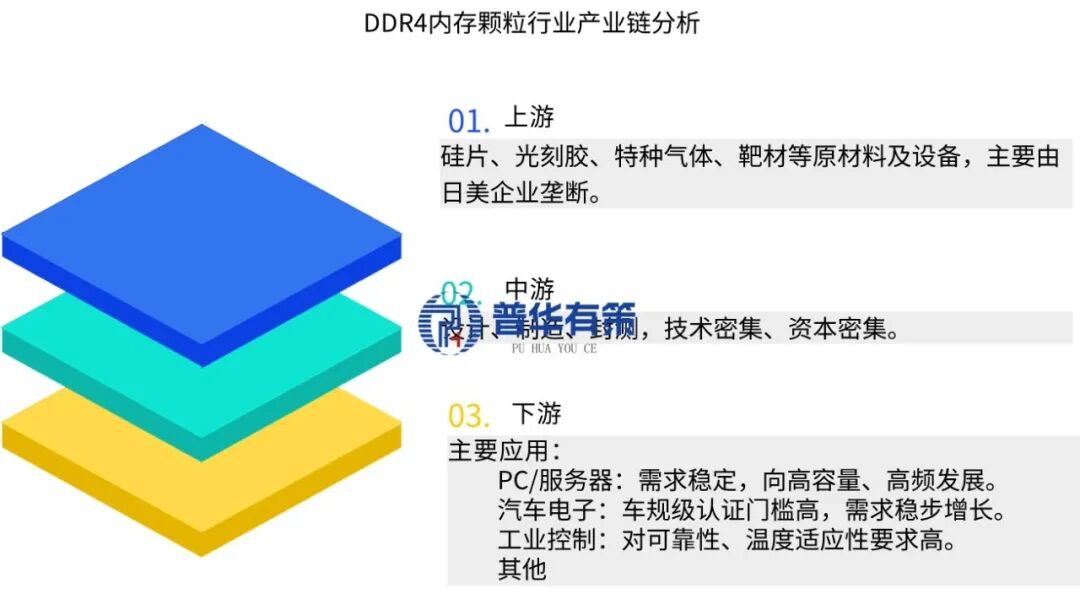
Core Insights - The DDR4 memory chip industry is facing challenges due to the rise of DDR5 technology, which is expected to dominate high-end markets, while DDR4 will retreat to mid-low-end and specific legacy markets [6][22][27] - Despite the decline in traditional PC and server markets, emerging applications such as AI edge computing and smart vehicles are creating new, differentiated long-tail demand for DDR4 [6][22][25] Industry Overview - DDR4 memory chips are critical components in computers, servers, and various electronic devices, directly influencing system performance through their specifications such as frequency, capacity, and power consumption [1][6] - The DDR4 industry is characterized by a high degree of technological barriers, with upstream suppliers primarily from Japan, the US, and the Netherlands, leading to a concentrated market structure [3][19] Supply Chain Analysis - Upstream components include silicon wafers, photoresists, specialty gases, and semiconductor manufacturing equipment, which are crucial for the production of DDR4 chips [3][19] - Downstream applications for DDR4 are diverse, including servers, personal computers, industrial control, automotive electronics, and consumer electronics, each with varying performance and reliability requirements [3][19] Policy Environment - The industry is influenced by various policies, including China's "14th Five-Year Plan" which emphasizes self-sufficiency in semiconductor manufacturing and aims to increase the domestic production rate of DRAM [4][20] Development Trends - The market is expected to shift from general growth to structural differentiation, with DDR4 maintaining a long-tail demand cycle of 5-8 years in low-end consumer electronics and traditional industrial control [6][22] - The focus for DDR4 technology will shift towards optimizing existing processes rather than pursuing new nodes, emphasizing reliability and specific application adaptations [6][23] Domestic Industry Restructuring - The Chinese DDR4 industry is undergoing a restructuring process driven by the need for self-sufficiency, with a focus on localizing materials and equipment supply chains [6][24] - Geopolitical risks are accelerating the push for domestic DDR4 chip penetration in critical infrastructure and industrial sectors [6][24] Emerging Applications - The rise of AI and IoT is creating unexpected opportunities for DDR4, particularly in edge devices where cost, power consumption, and reliability are more critical than peak performance [6][25] - The demand for low-power DDR4 (LPDDR4) is expected to grow in mobile devices and energy-sensitive data centers, aligning with global sustainability goals [6][26] Market Outlook - The DDR4 market is projected to experience a decline in the long term due to the encroachment of DDR5, but short-term demand is supported by existing inventory and specific market needs [6][27] - The competitive landscape is shifting, with international giants focusing on DDR5 while domestic players target mid-low-end markets [6][27]

活久见,内存条涨成“理财产品”
3 6 Ke· 2025-10-22 02:21
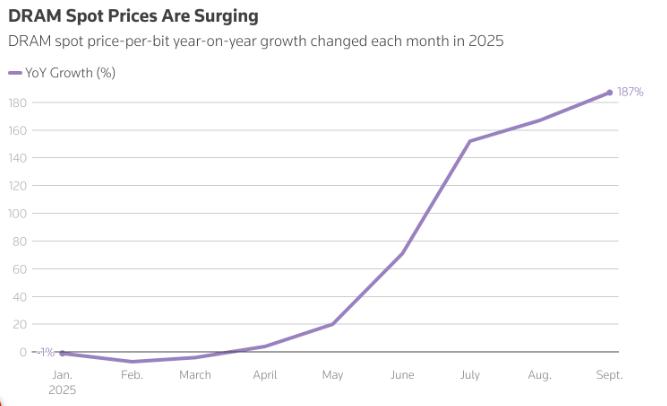
Core Insights - The memory chip prices are expected to surge in 2025, with DDR4 prices more than doubling, as demand increases due to the AI chip manufacturing boom [1][2] - The global memory chip industry is entering what analysts describe as a "super cycle," driven by tight supply and increased demand from various sectors [1][2] - Major manufacturers like Samsung and SK Hynix are shifting production towards higher-margin products like DDR5 and HBM chips, reducing their focus on DDR4 [2][9] Industry Trends - The demand for DRAM chips has surged, with reports indicating that the average inventory cycle for DRAM chips has dropped to eight weeks, significantly lower than previous periods [6][8] - The average price of DDR5 server memory modules has skyrocketed, indicating a shift in market dynamics favoring memory manufacturers [3][9] - The AI infrastructure investments by major tech companies are projected to reach $400 billion this year, further fueling demand for memory chips [2][9] Company Performance - Memory chip manufacturers are experiencing significant profit margins, with Samsung's DRAM business operating at a 40% profit margin and HBM at 60% [9] - The stock prices of memory manufacturers have seen substantial increases, with Samsung's stock rising over 80%, and SK Hynix and Micron's stocks increasing by 170% and 140%, respectively [9][10] - The current shortage of memory chips is leading to price hikes in consumer electronics, with companies like Raspberry Pi announcing price increases due to rising memory costs [9][10]
存储芯片概念再度大涨 创业板半日涨近0.7%
Mei Ri Jing Ji Xin Wen· 2025-10-16 04:51
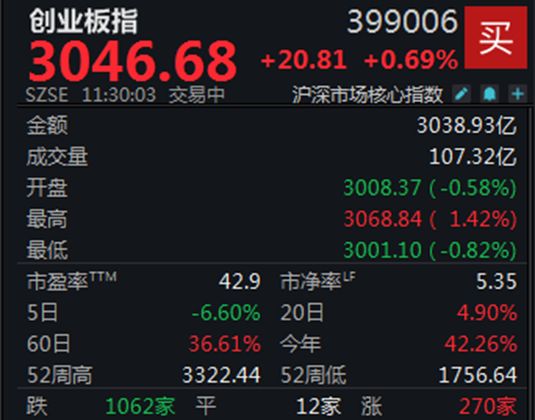
Market Overview - The stock market experienced fluctuations with the ChiNext Index leading the gains, closing up 0.69% at 3046.68 points [1][2] - The Shanghai Composite Index rose by 0.1% to 3916.1 points, while the Shenzhen Component increased by 0.15% [1] Industry Insights - The Ministry of Industry and Information Technology emphasized the importance of smart connected vehicles in promoting new industrialization and sustainable development [3] - The smartphone market in mainland China saw a year-on-year decline of 3% in Q3, with Vivo leading the market with a shipment of 11.8 million units, capturing 18% market share [3] Sector Performance - The storage chip sector showed strong momentum, with significant gains in stocks such as Demingli and Bawei Storage, which saw increases of over 10% [3][4] - The first wave of price increases in the storage market began in April, with major companies like Samsung and SK Hynix reducing DDR4 production to focus on higher-end memory types [4] Company Highlights - **Shannon Semiconductor**: Expanded upstream supply channels and obtained AMD distributor qualification, enhancing customer stickiness and competitiveness [7] - **Kepu Cloud**: As a leader in AI digitalization, the company is expected to see performance growth due to its acquisition of Jintai Technology and the favorable conditions in the storage chip industry [8] - **Bawei Storage**: Focuses on the semiconductor storage industry chain, developing storage solutions and advanced packaging, creating a differentiated competitive advantage [8] - **Jiangbolong**: A leader in the domestic storage module industry, actively enhancing its competitive edge through TCM and PTM models [9]