DeepRare系统

Search documents
连发Nature、Cancer Cell:上海交大团队利用AI增强罕见病及癌症诊断
生物世界· 2026-03-02 08:00
Core Insights - The article discusses the development of two groundbreaking AI models for medical diagnosis: DeepRare for rare diseases and KEEP for cancer diagnosis, both showcasing significant advancements in the application of AI in healthcare [3][6]. Group 1: DeepRare Model - DeepRare is the world's first AI-driven diagnostic system for rare diseases, surpassing the diagnostic accuracy of clinical experts with over ten years of experience [3]. - This model aims to provide hope for the 300 million patients suffering from rare diseases globally, marking a milestone in the integration of AI into clinical workflows [3]. Group 2: KEEP Model - KEEP is a knowledge-enhanced vision-language pathology foundation model designed for cancer diagnosis, outperforming existing models, particularly in rare cancer subtypes [6]. - The model integrates a comprehensive disease knowledge graph containing 11,454 diseases and 139,143 attributes, reorganizing millions of pathology image-text pairs into 143,000 semantically structured groups [11]. - KEEP has demonstrated superior performance on 18 public benchmarks (over 14,000 whole slide images) and 4 rare cancer datasets (926 cases), establishing knowledge-enhanced visual language modeling as a powerful paradigm in computational pathology [11].


从四年到四周 中国罕见病“确诊难”正加速破局
Di Yi Cai Jing· 2026-02-28 04:33
Core Insights - The report highlights that there are over 4,000 known rare diseases in China, affecting approximately 20 million patients, indicating that rare diseases are a significant public health issue rather than a marginal medical concern [1] - In 2025, China approved around 48 rare disease medications, with more than 17 coming from domestic companies, reflecting a shift towards local innovation in rare disease treatment [1] Group 1: Diagnosis and Treatment Improvements - The average diagnosis time for rare disease patients has been reduced from four years to less than four weeks, with costs cut by 90% [3] - The establishment of over 40 rare disease diagnostic centers across various hospitals has facilitated the implementation of multidisciplinary treatment (MDT) services [3][4] - The National Health Commission has emphasized rare diseases in its annual medical quality improvement goals, promoting cross-institutional collaboration to address misdiagnosis and delayed diagnosis [2][3] Group 2: AI Innovations in Rare Disease Diagnosis - The DeepRare AI model, developed by Shanghai Jiao Tong University, has achieved a diagnostic accuracy of 57.18% based solely on clinical symptoms, significantly improving upon previous models [4][5] - Other AI models, such as "Nezha·Lingtong" and "Xiehe·Taichu," have been introduced to provide rapid diagnostic support and tailored solutions for rare diseases, indicating a comprehensive approach to AI in this field [6] - The proliferation of AI tools in rare disease diagnosis aims to enhance screening capabilities, particularly in grassroots medical settings where access to genetic testing is limited [5][7] Group 3: Policy and Industry Implications - The integration of AI and big data into rare disease diagnosis is seen as a complementary approach to traditional clinical practices, aiming to improve early diagnosis rates and accessibility of information [7] - As the policy framework for rare diseases in China continues to develop, the collaboration between technology companies and public health objectives will be crucial for enhancing the overall healthcare system [7]
从四年到四周,中国罕见病“确诊难”正加速破局
Di Yi Cai Jing· 2026-02-28 04:26
Core Insights - The report highlights the growing recognition of rare diseases in China, with over 4,000 known rare diseases affecting approximately 20 million patients, indicating that rare diseases are not marginal medical issues but significant public health concerns [2][3]. Regulatory and Approval Landscape - In 2025, China approved around 48 rare disease drugs, with more than 17 coming from domestic companies, reflecting a shift towards local innovation in rare disease treatment [2]. - The National Health Commission has included rare diseases in its annual medical quality improvement goals, emphasizing the need for better diagnosis and treatment protocols [3][5]. Diagnostic Improvements - The average diagnosis time for rare diseases has significantly decreased from four years to less than four weeks, with diagnostic costs reduced by 90% [5]. - The establishment of over 400 rare disease diagnostic centers across China has facilitated better collaboration and reduced the time from disease onset to diagnosis through mechanisms like remote consultations and case sharing [4][5]. Technological Advancements - The introduction of AI tools, such as the DeepRare system, has improved diagnostic accuracy for rare diseases, achieving an initial accuracy rate of 57.18%, which can exceed 70% when combined with genetic data [6][7]. - Other AI models, like "哪吒·灵童" and "协和·太初," have been developed to provide rapid diagnostic support and tailored treatment plans for rare diseases, particularly in pediatric cases [7][8]. Industry Collaboration and Future Directions - The report indicates a trend where technology and internet companies are playing a supplementary role in addressing the challenges of rare disease diagnosis and treatment, particularly in under-resourced areas [8]. - The ongoing development of a comprehensive policy framework for rare diseases in China will be crucial for integrating effective practices from the private sector with public health objectives [8].
国际罕见病日
Xin Lang Cai Jing· 2026-02-27 16:25
Core Insights - The article highlights the advancements in rare disease diagnosis and treatment, particularly through the integration of artificial intelligence (AI) in the medical field, which is expected to revolutionize the approach to rare diseases and potentially lead to a significant increase in new drug developments by 2026 [4][12]. Group 1: AI in Diagnosis - The Shanghai Jiao Tong University School of Medicine and the AI Institute have launched the world's first traceable AI diagnostic system for rare diseases, named DeepRare, which has already served over 600 top medical research institutions globally [4][6]. - The average diagnosis time for rare diseases in China has been reduced from 4 years to approximately 4 weeks due to AI advancements, significantly improving the efficiency of the diagnostic process [7][10]. - AI models are now capable of narrowing down diagnostic possibilities and identifying disease causes more effectively, transforming the diagnostic journey for patients [6][10]. Group 2: Drug Development - Historically, less than 10% of rare diseases have clear treatment options, leading to a sense of hopelessness among patients after diagnosis [8][9]. - The integration of AI in drug development is expected to shorten the research and development cycle significantly, with some companies reporting reductions from an average of 4.5 years to just 18 months for certain rare disease drugs [10][12]. - The emergence of new drugs, particularly in the field of myasthenia gravis, has been notable, with four new drugs approved in the past year, indicating a shift in the treatment landscape for rare diseases [9][10]. Group 3: Future Outlook - Experts predict that 2026 could mark a pivotal year for the emergence of new drugs for rare diseases, driven by AI innovations [5][12]. - The ongoing clinical research and the development of new therapies are expected to enhance the quality of life for patients suffering from rare diseases, providing them with renewed hope [11][12].

节后要暴涨9大题材梳理:全上热搜!涉及人形机器人、算力、6G
Sou Hu Cai Jing· 2026-02-23 16:20
Group 1: Market Overview - The first trading day of the A-share market in the Year of the Horse is expected to open high, supported by overseas market performance and major themes such as humanoid robots and AI models [2][4] - During the Spring Festival, the Hong Kong stock market rose nearly 1%, and the FTSE A50 index increased by 1.6% [2] Group 2: Humanoid Robots - Humanoid robots made a significant appearance during the Spring Festival Gala, showcasing their capabilities and benefiting the related industry chain [4][5] - Notable companies include Magic Atom, Galaxy General, and Yushu Robotics, which demonstrated advanced robotic performances [4][5] - The demand for these robots surged, with products selling out quickly on platforms like JD.com [6] Group 3: AI Models - The stocks of AI model companies such as Zhipu and MiniMax saw significant increases, with Zhipu's stock price rising nearly 43% and MiniMax's by about 15% [7][9] - Zhipu's new flagship model GLM-5 has achieved high performance in programming tasks, leading to increased user demand and computational power needs [11] Group 4: Autonomous Driving - Tesla's Cybercab, a fully autonomous electric vehicle, has begun production, marking a significant step in the commercialization of autonomous driving [12][13] - Data shows that Tesla's Full Self-Driving (FSD) system has a significantly higher mileage before accidents compared to other driving modes [13] Group 5: 6G Technology - Chinese scientists have made breakthroughs in optical communication and 6G technology, achieving record data transmission rates [14][15] - This advancement is expected to enhance China's capabilities in the semiconductor field and reduce reliance on foreign technology [15] Group 6: Lithium Industry - UBS has expressed a bullish outlook on the lithium market, predicting a 14% increase in global lithium demand by 2026, driven by electric vehicle sales and energy storage systems [16][17] - The report indicates a significant price increase for lithium products, forecasting a new super cycle in lithium prices [16] Group 7: Alcohol Industry - The Chinese government aims to cultivate at least 10 billion-level specialty brewing industrial parks by 2028, promoting growth in the alcohol industry [19][20] - This initiative is expected to benefit related listed companies in the alcohol sector [21][22] Group 8: AI in Healthcare - A research team has developed an AI system capable of diagnosing rare diseases, showing improved accuracy compared to previous models [23][24] - This innovation is anticipated to benefit companies involved in AI and healthcare [24] Group 9: AI Hardware - Companies in the AI hardware sector, particularly those producing AI optical modules, are experiencing high demand, with orders extending into 2026 [25][26] - The growth in AI capital expenditure from major tech companies is expected to benefit these hardware manufacturers [27][28]


准确率突破70%!中国科研团队研发出全球首个可溯源罕见病诊断系统【附AI医疗行业前景分析】
Xin Lang Cai Jing· 2026-02-20 04:12
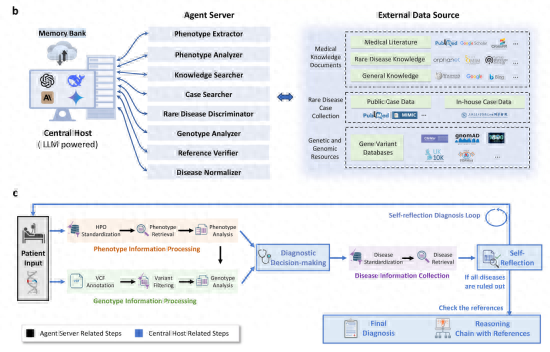
Core Insights - The DeepRare system, developed by Shanghai Jiao Tong University and Xinhua Hospital, is the world's first "traceable inference" AI diagnostic system for rare diseases, addressing the critical need for transparency in medical decision-making [2][4] Group 1: DeepRare System Features - DeepRare employs a unique "central-branch" Agentic AI architecture that mimics the clinical reasoning of experienced doctors, generating a complete "evidence chain" for each diagnosis, thus enhancing transparency in medical decisions [2][9] - The system achieved an initial diagnostic accuracy of 57.18% based solely on clinical symptoms, which is a 24 percentage point improvement over leading international models; this accuracy exceeds 70% when combined with genetic data [2][3] Group 2: Impact on Rare Disease Diagnosis - Rare disease diagnosis typically takes patients 4-5 years and multiple hospital visits; DeepRare's capabilities allow for earlier screening at community and county hospitals, significantly reducing the time to diagnosis and facilitating timely treatment [3][9] - The system's "symptom-level" diagnostic ability positions it as a crucial first line of defense in areas lacking genetic testing resources, thereby lowering misdiagnosis rates [3][9] Group 3: AI in Healthcare Transformation - AI is fundamentally reshaping the healthcare sector, enhancing diagnostic accuracy, reducing costs, and shifting the focus from disease-centered to patient-centered care models [3][4] - The integration of AI in various medical fields, including imaging, treatment personalization, and surgical assistance, is expected to improve overall healthcare efficiency and outcomes [3][4] Group 4: Market Outlook - The AI healthcare industry in China is projected to experience explosive growth, with an expected annual growth rate exceeding 25%, potentially reaching a market size of nearly 30 billion yuan by 2028 [7]

中国科研团队研发DeepRare系统破解罕见病确诊难题
Xin Lang Cai Jing· 2026-02-20 03:08
Core Insights - The article highlights a groundbreaking achievement in AI rare disease diagnosis by a collaborative team from Shanghai Jiao Tong University and Xinhua Hospital, with the introduction of the DeepRare system, which addresses the global challenges of difficult diagnosis and high misdiagnosis rates in rare diseases [1] Group 1: DeepRare System Overview - DeepRare is the world's first intelligent evidence-based reasoning diagnostic system for rare diseases, developed to overcome the challenges of traditional medical AI [1] - The system employs an innovative "central-body" architecture that surpasses traditional medical AI across three dimensions [3] Group 2: Key Features of DeepRare - The system integrates vast medical literature and clinical case data, breaking down data silos to provide comprehensive knowledge support for each diagnosis [3] - DeepRare possesses a "slow thinking" capability akin to human doctors, allowing for iterative hypothesis testing and self-reflection to fill information gaps and correct logical flaws [3] - It features a transparent reasoning process, providing a complete evidence chain for each diagnostic conclusion, addressing the "trust crisis" in AI healthcare [3] Group 3: Performance Metrics - DeepRare achieved a first diagnosis accuracy rate of 57.18% using only patient clinical phenotypes, a 23.79 percentage point improvement over the best international models in the field [5] - In retrospective human-machine comparisons, DeepRare's diagnostic recall rate surpassed that of rare disease specialists with ten years of clinical experience, marking it as the first method to outperform human doctors in this metric [5] - When genetic data is included, the accuracy rate for complex cases exceeds 70.6%, significantly outperforming the widely used Exomiser tool, which has an accuracy of 53.2% [5] Group 4: Implementation and Future Plans - The DeepRare online diagnostic platform is set to launch in July 2025, having already attracted over 1,000 professional users and covering more than 600 medical and research institutions globally within six months [7] - The system is currently undergoing internal testing at Xinhua Hospital, where it will serve as a "digital quality control officer" for rare disease diagnosis [7] - The collaborative team is initiating a "10,000 clinical validation plan" to complete tens of thousands of real-world validations of difficult rare diseases within six months, aiming to extend this "Chinese solution" to global rare disease patients [7]
Nature 重磅:上海交大人工智能学院×新华医院「梦之队」,如何用 AI 智能体终结罕见病确诊的「百年孤独」?
机器之心· 2026-02-19 03:47
Core Viewpoint - The article discusses the development of DeepRare, an AI system designed to improve the diagnosis of rare diseases, which currently face long diagnosis times and high misdiagnosis rates. The system outperforms experienced specialists by simulating human expert "slow thinking" logic [1][4]. Group 1: Clinical Need for AI - The current medical knowledge explosion makes it impossible for even the most talented doctors to keep up with over 7,000 rare diseases, leading to significant delays in diagnosis and treatment [6]. - The integration of AI in rare disease diagnosis is seen as a necessary step to alleviate the burden on healthcare professionals and improve patient outcomes, especially in pediatric and genetic cases [6]. Group 2: Technological Leap - DeepRare represents a paradigm shift from traditional predictive models to a system that emphasizes logical reasoning and decision-making, allowing it to autonomously plan diagnostic paths rather than merely recalling information [9]. - The system incorporates a "dynamic reflection mechanism" that identifies logical gaps in patient data and actively seeks new evidence, enhancing its diagnostic accuracy [10]. Group 3: Implementation and Productization - The establishment of OneX Intelligence aims to bridge the gap between academic research and practical application, transforming DeepRare into a clinical decision support system that integrates seamlessly with existing hospital systems [13]. - DeepRare has been deployed within Xinhua Hospital for internal testing, focusing on quality control in rare disease diagnosis and enhancing the interpretation of genetic sequencing reports through automation [14]. Group 4: Organizational Innovation - The collaborative model at Shanghai Jiao Tong University promotes deep integration between AI researchers and medical professionals, facilitating a more effective development process for AI applications in healthcare [18]. - The success of DeepRare is viewed as a reflection of the innovative organizational structure that encourages not only academic publication but also the commercialization of research findings [19].

中国科研团队,研发出AI看病系统
财联社· 2026-02-19 01:25
Core Insights - The article discusses the development of DeepRare, an AI system for diagnosing rare diseases, which is the first of its kind to provide a traceable reasoning process for its diagnoses [1][3]. Group 1: System Features - DeepRare offers a complete "evidence chain" with each diagnosis, akin to how experienced doctors explain their reasoning during patient evaluations [3]. - The system utilizes a vast repository of global medical knowledge and real case studies, allowing it to hypothesize, validate evidence, and self-correct before reaching a conclusion [3]. Group 2: Performance Metrics - The initial diagnostic accuracy of DeepRare, based solely on clinical symptoms without genetic testing, is reported at 57.18%, which is an improvement of nearly 24 percentage points over previous best models [3]. - When genetic data is included, the diagnostic accuracy of the system exceeds 70% [3]. Group 3: Implementation and Adoption - Since its launch in July of the previous year, DeepRare has been adopted by over 600 medical institutions globally, ranging from major hospitals in China to leading laboratories in Europe and the U.S. [4]. - The system is already deployed at Shanghai Xinhua Hospital and is set to assist doctors in diagnosing rare diseases by filling in gaps and preventing missed diagnoses [4]. Group 4: Future Plans - The research team plans to establish a global alliance for rare disease diagnosis and treatment, aiming to validate the system further with 20,000 real cases in the next six months [4].