EPYC处理器

Search documents
AMD CPU,市占飙升
半导体行业观察· 2026-02-13 01:09
Core Viewpoint - AMD achieved significant growth in CPU market share across all major segments by the end of 2025, with a record high x86 processor shipment share of 29.2% in Q4, capturing 35.4% of x86 CPU revenue, indicating a strong competitive position against Intel [2][19]. Client CPU - AMD's client CPU market share increased by 3.8% in a single quarter, driven by competitive desktop and mobile CPU product lines, while Intel struggled with supply issues [3][6]. - In Q4 2025, AMD's client CPU market share rose to 29.2%, with a year-over-year increase of 4.6%, reflecting strong sales in desktop and mobile products [6][19]. - Intel maintained a dominant position with 70.8% of client CPU shipments but faced significant declines, reallocating manufacturing capacity to server CPUs [6][19]. Desktop CPU - AMD's desktop CPU market share reached 36.4%, benefiting from strong demand for its Ryzen 9000 series, while Intel's share dropped by 9.5% compared to Q4 2024 [9]. - AMD's desktop CPU revenue share hit 42.6%, indicating robust sales of high-margin processors, while Intel held 57.4% of total revenue due to strong OEM relationships [9]. Mobile CPU - AMD achieved a record market share of 26% in the mobile CPU segment, with a quarter-over-quarter increase of 4.1%, while Intel retained 74% of the market [13]. - AMD's mobile CPU revenue share reached 24.9%, showing significant growth and indicating increased competitiveness in both high-volume and high-margin segments [13]. Server CPU - AMD's server CPU market share increased to 28.8%, with a quarter-over-quarter growth of 1%, as the adoption of EPYC processors accelerated in cloud and AI/HPC deployments [18]. - AMD's server CPU revenue share rose to a record 41.3%, highlighting its success in selling high-priced, high-margin processors, while Intel held 58.7% of total revenue [18]. Summary - AMD's performance in the CPU market in 2025 was characterized by increased shipment volumes and revenue shares across all segments, with a notable x86 processor shipment share of 29.2% and revenue share of 35.4% in Q4 [19]. - The company's success is attributed to a strong product portfolio, while Intel's decline is linked to a lack of competitive products in the high-end market and supply constraints in the low-end market [19].


AMD万亿市值之路,逻辑何在?
美股研究社· 2026-02-10 11:10
Core Viewpoint - 2025 is projected to be a transformative year for AMD as it shifts from a component manufacturer to a full-stack architect for data center and AI infrastructure [2] Financial Performance - AMD reported strong Q4 results with non-GAAP EPS of $1.53, exceeding expectations by $0.21; revenue surged 33.8% year-over-year to $10.3 billion, surpassing forecasts by $630 million [2] - The record financial performance is attributed to three core pillars: rapid expansion of AI business, sustained dominance in the CPU sector, and successful transition to a system-level scale model [2] Business Segment Analysis - The data center segment has become the primary growth engine, accounting for over 52% of total revenue in the quarter, with sales reaching $5.4 billion, a 39% year-over-year increase and a 24% quarter-over-quarter increase [3] - The Instinct GPU business is characterized by an aggressive annual update cycle to keep pace with the rapid development of generative AI models [3] - The MI350 series has been adopted by 8 out of the top 10 global AI companies and several cloud service providers, highlighting its performance and total cost of ownership advantages [3] Future Outlook - Analysts are optimistic about the upcoming MI450 series, expected to launch in the second half of 2026, which could be a pivotal moment for the industry [3] - The fifth-generation EPYC processors are driving market share growth, with data center revenue projected to grow 32% year-over-year to a record $16.6 billion in FY2025 [5] - AMD aims for data center revenue of approximately $100 billion over the next five years, despite current annual revenue of $17 billion, indicating an ambitious target [12] Market Position and Valuation - AMD's current non-GAAP P/E ratio stands at 49.99, comparable to Nvidia's 45.78, marking the lowest valuation since the AI boom began [8] - The PEG ratio from a GAAP perspective is only 0.5, indicating strong attractiveness [9] - The company is expected to achieve EPS exceeding $20 by 2030, suggesting a potential market capitalization of $1 trillion to $2 trillion based on current valuation multiples [14] Risks and Challenges - Despite a generally optimistic outlook, AMD's high valuation presents limited operational flexibility, as evidenced by stock price declines following earnings reports [7] - The company's future valuation heavily relies on execution capabilities, particularly in delivering integrated rack-level solutions through the Helios platform [14] Conclusion - As the AI semiconductor industry progresses towards 2026, AMD is positioned uniquely as the only supplier capable of delivering leading performance across the entire computing stack, from mobile AI PCs to AI supercomputers [15]
AI芯片厂商 集体被存储“卡住咽喉”
2 1 Shi Ji Jing Ji Bao Dao· 2026-02-06 02:45
Core Insights - The rising prices of storage chips are significantly impacting the AI chip market, particularly affecting companies like Qualcomm and MediaTek, which are closely tied to the mobile sector [1][10] - Despite the challenges posed by storage price increases, major AI chip manufacturers reported record earnings, with AMD achieving a record revenue of $10.3 billion in Q4 FY2025, driven by strong demand in data centers and gaming [1][2][3] - Qualcomm's revenue for Q1 FY2026 reached $12.3 billion, a 5% year-over-year increase, with significant contributions from its semiconductor and technology licensing businesses [5][6] AMD Performance - AMD's data center revenue hit a record $5.4 billion in Q4 FY2025, up 39% year-over-year, driven by strong demand for EPYC processors and Instinct GPUs [3][4] - The data center segment's contribution to AMD's overall revenue surpassed 50% for the first time in the last quarter of the fiscal year [2] - CEO Lisa Su emphasized the importance of 2025 for AMD, highlighting the acceleration of high-performance processor adoption and the rapid expansion of AI business in data centers [1][2] Qualcomm Insights - Qualcomm's semiconductor business generated $10.6 billion, with mobile hardware and automotive sectors achieving record revenues [6][7] - The company noted that the mobile market is facing challenges due to storage supply constraints, particularly affecting high-end smartphone demand [10][11] - Qualcomm's CEO acknowledged that while the mobile sector is under pressure, growth in automotive and IoT markets may help mitigate the impact [11] Arm's Financials - Arm reported record revenue of $1.224 billion for Q3 FY2026, a 26% increase year-over-year, driven by higher royalty rates and increased usage of Arm-based chips in data centers [5][12] - The company is diversifying its revenue streams beyond mobile, with significant contributions from IoT and embedded markets [12][13] - Arm's CEO mentioned organizational changes to align with AI deployment strategies, focusing on three business units: mobile and IoT, automotive and robotics, and data center and networking [13][14] Market Challenges - The ongoing rise in storage chip prices is expected to impact the overall smartphone market, with companies like Qualcomm and MediaTek adjusting their strategies to cope with increased costs [10][11] - AMD anticipates a slight decline in the PC market size due to rising commodity prices, while still aiming to increase its share in the enterprise market [12] - MediaTek's CEO indicated that the overall demand for smartphones may be negatively affected by rising memory and BOM costs, prompting strategic adjustments in product offerings [11][12]

AI芯片厂商,集体被存储“卡住咽喉”
2 1 Shi Ji Jing Ji Bao Dao· 2026-02-06 02:44
Core Insights - The rising prices of storage chips are significantly impacting the AI chip market, particularly affecting companies like Qualcomm and MediaTek, which are closely tied to the mobile sector [1][6] - Major AI chip manufacturers, including AMD and Arm, have reported record earnings, but concerns about storage chip prices and their effects on future performance remain prevalent [2][3][4] Group 1: AMD Performance - AMD reported record revenue of $10.3 billion for Q4 FY2025, a 34% year-over-year increase, driven by strong demand in data center, client, and gaming segments [2] - The data center segment achieved a record revenue of $5.4 billion, up 39% year-over-year, primarily due to the demand for AMD EPYC processors and increased shipments of Instinct GPUs [2] - AMD's CEO highlighted the importance of the Chinese market, noting revenue from the MI308 product and pending approval for the MI325 product [3] Group 2: Arm Performance - Arm achieved record revenue of $1.224 billion for Q3 FY2026, a 26% year-over-year increase, with royalty revenue rising 27% and license revenue increasing by 25% [4] - The growth in Arm's revenue is attributed to higher royalty rates for chips and increased usage of Arm architecture in data centers [4] - Arm is expanding its product line to increase revenue outside the mobile sector, focusing on cloud, automotive, and IoT markets [10] Group 3: Qualcomm Performance - Qualcomm reported revenue of $12.3 billion for Q1 FY2026, a 5% year-over-year increase, with semiconductor revenue reaching $10.6 billion [5] - The automotive segment achieved record revenue of $1.1 billion, up 15% year-over-year, while IoT revenue was $1.7 billion, up 9% [5] - Qualcomm's CEO acknowledged challenges in the mobile market due to storage supply constraints but remains optimistic about high-end smartphone demand [6][7] Group 4: MediaTek Insights - MediaTek's CEO indicated that rising memory and BOM costs are expected to negatively impact overall smartphone demand in 2026 [8] - The CFO noted that flagship models are seeing higher chip content, leading to increased average selling prices, but overall shipment volumes may face pressure [8] - MediaTek is also focusing on strengthening its non-smartphone business, with increasing revenue from data centers [9] Group 5: Industry Challenges - The ongoing shortage and rising prices of storage chips, particularly DRAM, are expected to affect the mobile industry significantly, with companies adjusting production plans accordingly [6][7] - OEMs, especially in China, are cautiously reducing chip inventory, which may reflect in future earnings guidance [7] - The mobile market is anticipated to prioritize high-end products due to lower price sensitivity among consumers in that segment [7]

AMD Q4数据中心收入猛增近40%创纪录,Q1营收指引不够炸裂,盘后跌近8%
硬AI· 2026-02-04 09:07
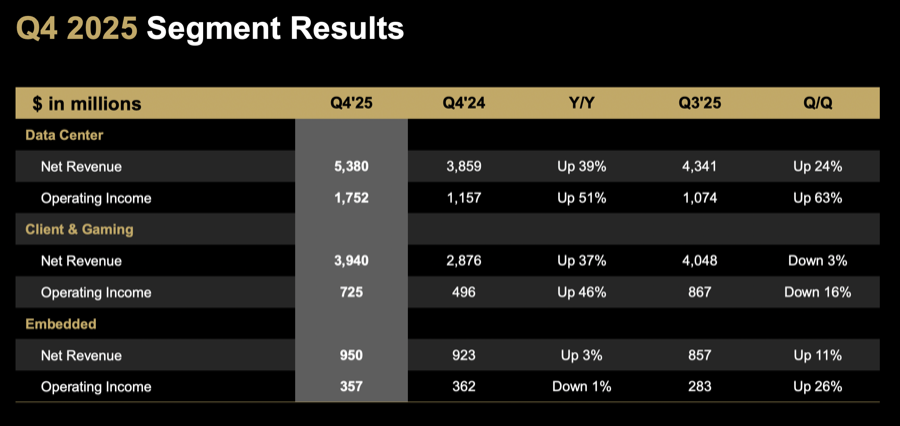
Core Viewpoint - AMD's Q4 revenue exceeded $10 billion, achieving a record high with a year-over-year growth rate of over 30%, although EPS growth has slowed down [2][3][8] Revenue and Earnings Performance - Q4 revenue reached $10.27 billion, a 34% year-over-year increase, slightly lower than the 36% growth in Q3 [8] - Adjusted EPS for Q4 was $1.53, a 40% year-over-year increase, surpassing analyst expectations by nearly 16% [8][11] - Operating profit for Q4 was $2.85 billion, a 41% year-over-year increase, exceeding analyst expectations [13] Business Segments - Data center revenue hit a record $5.4 billion in Q4, a 39% year-over-year increase, significantly up from 22% growth in Q3 [16] - Client and gaming segments contributed approximately $3.9 billion in revenue, with a year-over-year growth of 37%, although this was a slowdown from 73% growth in Q3 [21] Market and Competitive Landscape - AMD's Q1 revenue guidance is set between $9.5 billion and $10.1 billion, with a midpoint of $9.8 billion, slightly above consensus expectations [3][24] - CEO Lisa Su indicated strong demand for server CPUs and projected a 60% annual growth in data center revenue over the next three to five years [3][16] Challenges and Concerns - The market is concerned about AMD's ability to maintain growth momentum, particularly in the AI accelerator segment, as any conservative guidance may lead to negative market reactions [4][24] - AMD's sales of the Instinct MI308 chip in China amounted to approximately $390 million, with U.S. export restrictions expected to impact inventory and related costs by about $440 million in 2025 [23]

盘后大跌超7%!AMD Q4数据中心收入猛增近40%创纪录,Q1营收指引不够炸裂
美股IPO· 2026-02-03 23:34
Core Viewpoint - AMD's Q4 revenue growth remains above 30% year-over-year, with EPS growth slowing but exceeding analyst expectations by nearly 16% [1][3] Revenue and Earnings Performance - Q4 revenue reached $10.27 billion, a 34% year-over-year increase, slightly lower than the 36% growth in Q3 [6] - Adjusted EPS for Q4 was $1.53, a 40% year-over-year increase, surpassing analyst expectations of $1.32 by nearly 16% [7][8] - Operating profit for Q4 was $2.85 billion, a 41% year-over-year increase, exceeding analyst expectations of $2.47 billion by 15.4% [9] Business Segments - Data center revenue hit a record $5.4 billion in Q4, a 39% year-over-year increase, accelerating from 22% growth in Q3 [12] - Client and gaming business contributed approximately $3.9 billion in revenue, with a 37% year-over-year increase, slowing from 73% growth in Q3 [16] Guidance and Market Reaction - Q1 revenue guidance is set at $9.5 billion to $10.1 billion, with a midpoint of $9.8 billion, slightly above analyst consensus of $9.39 billion but below some optimistic forecasts exceeding $10 billion [3][5] - Following the earnings report, AMD's stock price fell, reflecting investor disappointment over the revenue guidance not meeting high expectations [3][5] Cost and Investment Considerations - AMD's adjusted gross margin guidance is approximately 55%, slightly above market expectations of 54.5% [5] - R&D expenses for Q4 were $2.33 billion, exceeding analyst expectations of $2.16 billion, indicating continued investment in next-generation CPU/GPU and AI platforms [9][10] Export Restrictions Impact - Sales of the MI308 chip in China amounted to approximately $390 million in Q4, with U.S. export restrictions expected to impact around $440 million in inventory and related costs by 2025 [17]

AMD(AMD) - 2025 Q4 - Earnings Call Transcript
2026-02-03 23:02
Financial Data and Key Metrics Changes - In 2025, the company achieved record revenue of $34.6 billion, a 34% year-over-year increase, with net income rising 42% to a record $2.5 billion and free cash flow nearly doubling to $2.1 billion [5][6][23] - For Q4 2025, revenue reached $10.3 billion, up 34% year-over-year, with gross margin at 57%, an increase of 290 basis points year-over-year [5][24] Business Segment Data and Key Metrics Changes - Data center segment revenue increased 39% year-over-year to a record $5.4 billion, driven by strong demand for EPYC processors and MI350 products [7][25] - Client and gaming segment revenue rose 37% year-over-year to $3.9 billion, with client revenue at a record $3.1 billion, up 34% year-over-year [16][26] - Embedded segment revenue grew 3% year-over-year to $950 million, reflecting demand across various end markets [18][26] Market Data and Key Metrics Changes - The company reported strong demand from hyperscalers in the cloud market, with EPYC cloud instances increasing over 50% year-over-year [8][9] - The enterprise market saw a significant shift towards EPYC adoption, with over 3,000 solutions optimized for major workloads [8][9] Company Strategy and Development Direction - The company is focused on capturing growth opportunities in high-performance computing and AI, with plans to grow data center segment revenue by over 60% annually over the next three to five years [15][20] - Strategic partnerships, such as with Tata Consultancy Services, aim to co-develop industry-specific AI solutions [12] Management's Comments on Operating Environment and Future Outlook - Management expressed confidence in the growth trajectory for 2026, driven by increased adoption of EPYC and Instinct products, alongside a return to growth in the embedded segment [22][30] - The company anticipates significant top-line and bottom-line growth, with a target of greater than 35% CAGR over the next three to five years [22] Other Important Information - The company closed the sale of its ZT Systems manufacturing business, which is reported separately in financial statements [27] - The company generated a record $2.3 billion in cash from operations during the quarter [28] Q&A Session Summary Question: Can you discuss customer engagements and demand for MI450 and Helios platforms? - Management confirmed strong customer engagements and progress on MI450 series development, with a ramp expected in the second half of the year [33][34] Question: Can you provide details on March guidance and data center GPU ramp? - Management indicated a sequential decline in client revenue but strong growth in data center, with expectations for GPU revenue to increase [38][40] Question: What are the assumptions for China MI308 sales beyond Q1? - Management forecasted $100 million in Q1 from MI308 sales to China but did not expect additional revenue due to the dynamic situation [45][46] Question: How is the company addressing server CPU capacity and growth trajectory? - Management noted increased supply capacity for server CPUs and strong demand, indicating a positive outlook for growth throughout 2026 [51][52] Question: What is the outlook for gross margins as new products ramp? - Management expressed optimism about gross margin progression, benefiting from favorable product mix and new product ramps [55][56]
AMD(AMD) - 2025 Q4 - Earnings Call Transcript
2026-02-03 23:02
Financial Data and Key Metrics Changes - In 2025, the company achieved record revenue of $34.6 billion, a 34% year-over-year increase, with net income rising 42% to $2.5 billion and free cash flow nearly doubling to $2.1 billion [5][6][23] - For Q4 2025, revenue reached $10.3 billion, up 34% year-over-year, with gross margin at 57%, an increase of 290 basis points year-over-year [5][24] Business Segment Data and Key Metrics Changes - Data center segment revenue grew 39% year-over-year to a record $5.4 billion, driven by strong demand for EPYC processors and MI350 products [7][25] - Client and gaming segment revenue increased 37% year-over-year to $3.9 billion, with client revenue at a record $3.1 billion, up 34% year-over-year [16][26] - Embedded segment revenue rose 3% year-over-year to $950 million, supported by demand in test and measurement and aerospace sectors [19][27] Market Data and Key Metrics Changes - In the cloud market, the number of EPYC cloud instances grew over 50% year-over-year to nearly 1,600, with significant adoption among hyperscalers [8][9] - The company noted a meaningful shift in EPYC adoption in the enterprise sector, with over 3,000 solutions now available optimized for major workloads [8] Company Strategy and Development Direction - The company is entering a multi-year demand supercycle for high-performance and AI computing, positioning itself to capture significant growth opportunities across all business segments [20] - The launch of the MI400 series and Helios platform is seen as a major inflection point for the AI business, with expectations of scaling AI revenue to tens of billions by 2027 [15][22] Management's Comments on Operating Environment and Future Outlook - Management expressed confidence in the growth trajectory for 2026, anticipating strong demand for EPYC and Instinct products, with a target of over 60% annual growth in the data center segment [22][48] - The company is optimistic about the data center AI revenue potential, with significant customer engagements and a strong order book [33][41] Other Important Information - The company repurchased 12.4 million shares in 2025, returning $1.3 billion to shareholders, and ended the year with $9.4 billion remaining in its share repurchase program [29] - The company is actively working on multi-year agreements with suppliers to ensure adequate supply for future growth [84] Q&A Session Summary Question: Can you discuss customer engagements and demand for MI450 and Helios platforms? - Management confirmed strong customer engagement and progress on MI450 development, with expectations for a second-half launch and significant ramp-up in 2027 [34][35] Question: Can you provide details on March guidance and data center GPU ramp? - Management indicated a sequential decline in client revenue but strong growth in data center, with expectations for a solid ramp in GPU revenue throughout the year [38][40] Question: What is the outlook for data center revenue growth in 2026? - Management expressed bullishness on data center growth, citing strong demand for EPYC and MI450 products, with a long-term target of over 60% growth [45][48] Question: How is the company addressing supply chain challenges for server CPUs? - Management noted increased supply capacity for server CPUs and strong demand, indicating confidence in meeting growth targets [52][53] Question: What is the strategy regarding memory procurement and inflationary costs? - Management highlighted proactive planning for memory procurement, ensuring alignment with demand and ramp-up schedules [82][84] Question: How does the company view the competitive landscape with ARM and x86? - Management emphasized the importance of high-performance x86 CPUs for AI workloads, asserting that EPYC is optimized for current and future demands [79][80]
AMD(AMD) - 2025 Q4 - Earnings Call Transcript
2026-02-03 23:00
Financial Data and Key Metrics Changes - In Q4 2025, revenue grew 34% year-over-year to a record $10.3 billion, driven by strong sales of EPYC, Ryzen, and Instinct processors [4][22] - Net income increased 42% to a record $2.5 billion, and free cash flow nearly doubled year-over-year to a record $2.1 billion [5][22] - For the full year, revenue grew 34% to $34.6 billion, with gross margin at 52% and record earnings per share of $4.17, up 26% year-over-year [22][24] Business Segment Data and Key Metrics Changes - Data center segment revenue increased 39% year-over-year to a record $5.4 billion, driven by strong demand for EPYC processors and MI350 products [5][24] - Client gaming segment revenue was $3.9 billion, up 37% year-over-year, with the PC processor business performing exceptionally well [14][25] - Embedded segment revenue increased 3% year-over-year to $950 million, supported by demand in test and measurement and aerospace markets [18][25] Market Data and Key Metrics Changes - Hyperscaler demand for EPYC processors was strong, with over 500 AMD-based instances launched in 2025, increasing EPYC cloud instances by more than 50% year-over-year [6][19] - The number of large businesses deploying EPYC on-premises more than doubled in 2025, indicating a significant market share gain [7][19] - The client market is expected to face inflationary pressures, but the company anticipates growth in its PC business, particularly in the enterprise segment [70] Company Strategy and Development Direction - The company is entering a multi-year demand supercycle for high-performance and AI computing, positioning itself to capture significant growth opportunities [19] - The launch of the next-generation Venice CPU and MI400 series is expected to extend the company's leadership in performance and efficiency [8][12] - Strategic partnerships, such as with Tata Consultancy Services, aim to co-develop industry-specific AI solutions [11] Management's Comments on Operating Environment and Future Outlook - Management expressed confidence in the strong demand for server CPUs and AI workloads, anticipating data center segment revenue growth of over 60% annually over the next three to five years [13][20] - The company expects significant top-line and bottom-line growth in 2026, driven by increased adoption of EPYC and Instinct products [20][29] - Management highlighted the importance of maintaining operational scale and deep customer partnerships to support long-term growth [19] Other Important Information - The company generated a record $2.3 billion in cash from continuing operations during the quarter, with inventory increasing to support strong data center demand [26] - The company repurchased 12.4 million shares and returned $1.3 billion to shareholders in 2025 [27] Q&A Session Summary Question: Can you talk about customer engagements and demand for MI450 and Helios platforms? - Management confirmed strong customer engagement and progress on MI450 series development, with expectations for a second-half launch and ramp [32][33] Question: Can you provide details on March guidance and data center GPU ramp? - Management indicated a sequential decline in client revenue but strong growth in data center, with expectations for GPU revenue to also increase [36][39] Question: What are the expectations for data center revenue growth in 2026? - Management expressed optimism about achieving the long-term target of over 60% growth in data center revenue, supported by strong demand for EPYC and MI450 products [44][46] Question: How is the company addressing supply chain challenges for server CPUs? - Management noted increased supply capacity for server CPUs and ongoing collaboration with supply chain partners to meet demand [50][51] Question: What is the outlook for operating expenses as AI revenue ramps? - Management expects operating expenses to grow slower than revenue, indicating potential leverage as revenue increases [62][63] Question: How does the company view the competitive landscape with ARM CPUs? - Management emphasized the importance of x86 CPUs for AI workloads and the optimization of EPYC processors to meet diverse customer needs [78][80]
AI的尽头是医疗!AMD苏姿丰最新对话:开发药物,将像造iPhone一样简单!
Xin Lang Cai Jing· 2026-01-07 10:57
Core Insights - The discussion at CES 2026 highlighted the transformative role of AI in biotechnology and pharmaceuticals, focusing on drug discovery and development [1][15] Group 1: AI in Drug Discovery - Absci is utilizing generative AI and synthetic biology to design new drugs, aiming to address unmet medical needs and ensure manufacturability [3][4][18] - The company is currently focusing on androgenetic alopecia and endometriosis, with the goal of fundamentally changing disease progression rather than just alleviating symptoms [4][19] - AMD's investment in Absci has significantly enhanced their reasoning capabilities, allowing them to screen over one million drug candidates daily [4][20] Group 2: Precision Medicine and Genomics - Illumina emphasizes the importance of high-precision DNA sequencing for disease prevention, diagnosis, and treatment, relying heavily on data and computational power [5][22] - The company generates more sequencing data daily than YouTube, making collaboration with AMD crucial for transforming vast data into medical insights [5][22][23] - Over the past decade, Illumina's technology has been applied in clinical diagnostics for major diseases, saving millions of lives [6][23] Group 3: AI's Future Impact on Healthcare - The integration of generative AI, genomics, and proteomics is expected to revolutionize the understanding of biology, accelerating drug development and changing disease prevention strategies [7][24] - AstraZeneca is leveraging AI to enhance productivity and innovation in drug development, utilizing historical experimental data to train generative AI models for faster candidate drug delivery [8][26] - The implementation of generative AI has resulted in a 50% increase in the speed of candidate drug delivery and improved clinical outcomes [10][26] Group 4: Vision for Healthcare Transformation - The executives express excitement about the potential of AI to shift from passive treatment to proactive prevention of chronic diseases, ultimately redefining longevity and health [12][29][30] - The collaboration among companies, academia, and AI startups is essential for achieving breakthroughs in healthcare [7][24][30] - AMD's role in optimizing the AI drug development workflow is highlighted as a key factor in advancing the industry [11][27]