
GUI Agent

Search documents
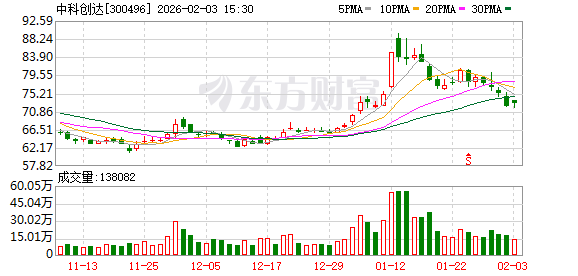
中科创达:公司与火山引擎的合作始于2024年
Zheng Quan Ri Bao· 2026-02-03 09:45
Core Viewpoint - The collaboration between the company and Volcano Engine has been evolving since 2024, focusing on the development of AI solutions for the smart automotive sector [2] Group 1: Partnership Development - The partnership began with the company's inclusion in the Volcano Engine Automotive Large Model Ecological Alliance [2] - A joint laboratory was established, and the company received HiAgent delivery authorization, indicating an upgrade in their collaboration [2] Group 2: Technological Advancements - The company leverages Volcano Engine's HiAgent and the Kouzi platform, combined with its own operating system technology, to create a comprehensive solution covering the entire chain [2] - In the smart automotive field, the company has launched an AI cockpit solution that enables real-time interaction between the vehicle and cloud brain, achieving a 500ms voice feedback response time and multimodal recognition and recommendation features [2] Group 3: User Experience Enhancement - The GUI Agent developed based on the Volcano Ark Mass platform can autonomously plan, reason, and execute UI interaction operations, significantly enhancing the cockpit interaction experience [2]


2026,AI才是真革命
虎嗅APP· 2026-01-25 03:36
Core Insights - The article emphasizes that the current state of AI is primarily focused on financial returns, with a significant shift towards understanding its practical applications in business settings [5][6] - It highlights a collective realization that AI's role is often limited to enhancing existing processes rather than creating revolutionary new solutions [12][21] Group 1: AI in Consumer and Business Sectors - In the consumer sector, while AI tools like ByteDance's Douyin and DeepSeek have seen high user engagement, the willingness to pay for advanced services remains low, with a subscription rate of only 25% to 30% in AI education [5][8] - The business sector, however, is more pragmatic, with traditional industries actively seeking to integrate AI to solve specific cost-related challenges, such as reducing bad debt losses in finance or shortening drug development cycles in pharmaceuticals [8][9] Group 2: Challenges in AI Implementation - Many AI startups struggle to demonstrate effective delivery capabilities, as businesses demand integration with existing systems and cost efficiency that outperforms hiring interns [10][11] - The article points out a "productivity paradox," where AI's current applications often lead to increased production of low-value content rather than meaningful improvements [11][18] Group 3: Data and Automation Debt - A significant barrier to effective AI deployment is the "data debt," where many companies lack proper data governance and training, leading to fragmented and unreliable data systems [22][23] - The article also discusses "automation debt," particularly in traditional manufacturing, where outdated software and lack of integration hinder AI's potential [24][25] Group 4: Future of AI - By 2026, the article predicts a major transformation in AI applications, driven by a significant reduction in inference costs, potentially down to 1% of human labor costs, which would fundamentally change the business logic of AI [28] - The emergence of "agent" AI, capable of autonomously completing tasks, is anticipated, with companies needing to encapsulate industry-specific knowledge into software to maintain competitive advantages [30][32] - The article concludes that successful AI applications will seamlessly integrate into existing business processes, focusing on tangible problem-solving rather than abstract concepts [36]

手机厂商、应用方如何看AI手机争议?A2A协作有望破局
Di Yi Cai Jing· 2026-01-12 12:24
Core Insights - The true challenge of intelligent agents is not just their ability to perform tasks but also their wisdom and execution capabilities, which require a deep understanding of user intent and actions [1] - The development of intelligent agents should not disrupt existing governance frameworks and commercial orders but should promote industry evolution through deep collaboration while ensuring safety and control [1] Group 1: Current Developments in AI Agents - Various exploration paths have emerged in the past year regarding whether AI can replace human tasks, with products attempting to operate through screen understanding and simulated actions, categorized as GUI Agents [3] - These products face significant challenges, including permission granting, accountability for errors, service invocation, and regulatory constraints [3] - Experts suggest that the authorization of intelligent agents should be scene-specific, with critical operations requiring secondary confirmation, and that not all scenarios should be authorized by third-party platforms [3] Group 2: Industry Perspectives on AI Implementation - OPPO's perspective indicates that while products like the Doubao phone positively impact the industry, they are not the final form of AI phones but rather a method to operate existing GUI interfaces [4] - The focus for phone manufacturers is on engineering and scalability, as any instability in system capabilities can lead to significant quality issues [4] - The future of intelligent agents is expected to shift towards A2A (Agent-to-Agent) collaboration models, with the core value for manufacturers lying in their long-term understanding of users rather than just model parameters [4] Group 3: Regulatory and Safety Considerations - The current GUI approach can activate the industry but should not be the sole focus; a more optimal evolution path that balances safety and development should be explored [5] - Apple's model is highlighted as a reference, establishing a collaborative mechanism between intelligent agents and apps through open APIs while ensuring safety boundaries [5] - The introduction of A2A mechanisms and market-based credit systems is suggested to improve authorization processes and manage potential risks associated with disruptive innovations [5]

豆包AI手机,打响APP入口争夺战
21世纪经济报道· 2025-12-27 12:35
Core Viewpoint - The emergence of the Doubao mobile assistant has sparked significant interest in the smartphone industry, being recognized as a "truly AI phone" due to its autonomous cross-application capabilities, although it faces challenges regarding user privacy and data permissions [1][3][5]. Group 1: Doubao Mobile Assistant and Industry Response - The Doubao mobile assistant was launched at the end of 2025, creating a stir in the smartphone market due to its ability to operate autonomously across applications [1]. - Despite the initial excitement, the Doubao mobile assistant encountered restrictions in its application usage, leading to an announcement regarding adjustments to its AI operational capabilities [1][3]. - The assistant's features are not significantly different from previously demonstrated smart applications by other manufacturers, indicating that while technology is evolving, commercial application remains a challenge [5][6]. Group 2: Challenges and Legal Considerations - The core challenge for AI phones, including the Doubao assistant, lies in legal disputes over cross-application automation and whether it infringes on the interests of internet companies [6]. - Current compliance standards are inadequate for the demands of AI, which seeks to perform tasks across multiple applications, highlighting a "standard vacuum" in the industry [6][15]. - The need for a unified protocol and open ecosystem is emphasized, as the integration of multiple agents requires collaboration between smartphone manufacturers and third-party service providers [15]. Group 3: Technological Advancements and Market Dynamics - The rapid improvement of domestic open-source large models has provided a solid foundation for the iterative development of AI phones, shifting focus from cloud-based models to offline capabilities [3][11]. - The introduction of the AutoGLM model and its open-source nature marks a significant step towards "technological equality," potentially leading to an explosion of edge AI applications [10]. - The competition in AI phones is evolving from mere hardware specifications to a comprehensive race involving edge capabilities, ecosystem openness, and user experience [17]. Group 4: Future Prospects and Ecosystem Development - The ultimate competition in AI phones is fundamentally about ecosystem development, requiring breakthroughs in technology and the establishment of an open collaborative framework [15]. - The industry faces three main challenges: ecosystem openness, cross-application scheduling permissions, and user habit formation [15]. - The trend of software and hardware boundaries blurring is evident, with companies exploring AI hardware to enhance data collection and user interaction [16][17].

豆包搅动AI手机池水 厂商摸索数据、权限边界
2 1 Shi Ji Jing Ji Bao Dao· 2025-12-27 07:07
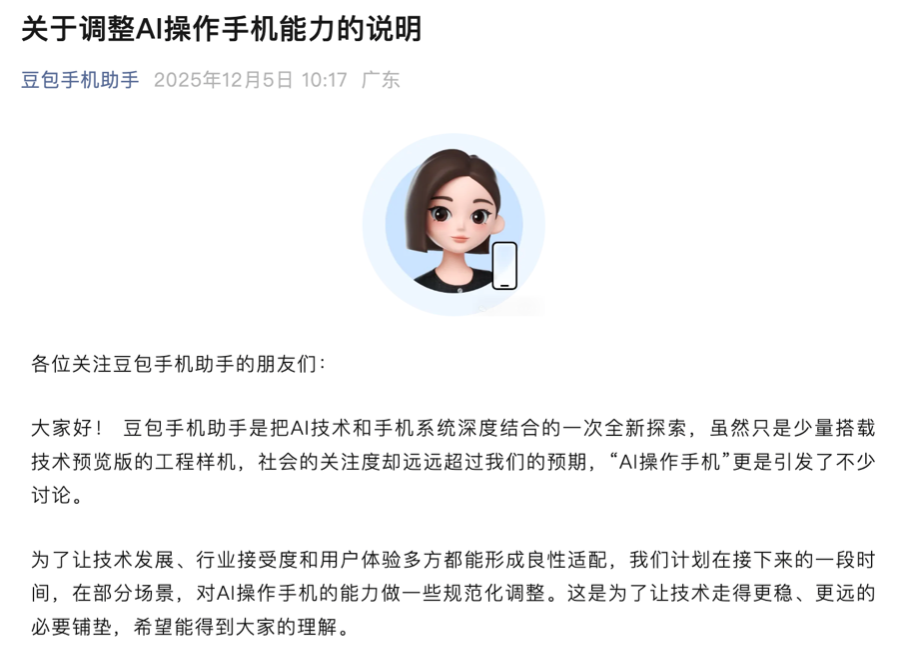
Core Insights - The launch of the Doubao mobile assistant in late 2025 has created significant waves in the smartphone industry, being recognized by users as a "truly AI phone" due to its autonomous cross-application operation capabilities [1][5] - However, the Doubao mobile assistant faced usage restrictions in multiple applications, leading to an official statement on December 5 regarding adjustments to its AI operation capabilities [1][3] - The challenges faced by Doubao reflect broader issues in the AI phone sector, particularly concerning user privacy and data rights, which require collaborative efforts from various stakeholders [3][7] Group 1: Technology and Development - The rapid improvement of domestic open-source large models has provided a solid foundation for the iterative development of AI phones, shifting focus from cloud-based models to offline capabilities [4][13] - The announcement of the open-sourcing of the AutoGLM model by Zhiyu on December 9 signifies a move towards "technological equality" in the mobile agent space, potentially lowering development barriers [3][12] - The evolution of AI phones is not just about technological advancements but also involves a complex interplay of patience, restraint, and ecosystem collaboration [4][17] Group 2: Market Dynamics and Competition - The Doubao mobile assistant's features are not significantly different from previously demonstrated smart applications by other manufacturers, indicating that the market is still in the early stages of realizing cross-application autonomous capabilities [5][6] - The competition in the AI phone market is fundamentally about ecosystem development, requiring a shift from traditional app models to a more integrated approach that allows for cross-application automation [17][21] - The emergence of AI agents is seen as a potential battleground for user engagement and control over data, with manufacturers needing to navigate the complexities of user habits and regulatory compliance [8][17] Group 3: Industry Challenges - The current landscape reveals a "standard vacuum" regarding user authorization and data rights, complicating the implementation of AI agents that require cross-application functionality [7][18] - The transition to AI agents necessitates a reevaluation of existing operational models, as traditional single-operation authorization methods are inadequate for the demands of AI-driven tasks [7][18] - The industry faces challenges related to memory and power consumption as the capabilities of end-side models expand, necessitating advancements in hardware to support these new demands [18][20] Group 4: Future Outlook - The AI phone competition is evolving from a focus on hardware specifications to a comprehensive race involving end-side capabilities, ecosystem openness, and user experience [21][22] - The integration of AI capabilities into hardware is expected to reshape traditional consumer electronics business models, moving towards subscription-based software services [20][22] - The developments surrounding the Doubao mobile assistant highlight the need for industry-wide collaboration to address the challenges of rights, interests, and standards in the evolving AI landscape [20][22]
AI进化速递 | OpenAI推出GPT Image 1.5
Di Yi Cai Jing· 2025-12-17 12:48
Group 1 - OpenAI has launched a new image generation model, GPT Image 1.5 [1] - Tencent has officially released its mixed reality model, Mixed Yuan World Model 1.5 [1] - Tencent's large model team has undergone structural adjustments, with former OpenAI researcher Yao Shunyu taking on a key position [1] Group 2 - Xiaomi has open-sourced its large model, MiMo-V2-Flash [1] - Jieyue Xingchen has announced a comprehensive upgrade of its GUI Agent, including the full launch of the cloud model Step-GUI and the opening of the GUI-MCP protocol [1] - Adobe Firefly has added a new video editing feature based on prompts [1] Group 3 - OpenAI is reportedly in talks with Amazon for an investment exceeding $10 billion, utilizing Amazon's AI chips [1] - Alphabet's autonomous driving company, Waymo, is negotiating a new round of financing, with a valuation potentially exceeding $100 billion [1]

阶跃星辰宣布GUI Agent全面升级
Mei Ri Jing Ji Xin Wen· 2025-12-17 12:33
Core Insights - The company announced a comprehensive upgrade of its GUI Agent, introducing the cloud model Step-GUI with over 200 task scenarios and support for long-step reasoning [1] - The GUI-MCP protocol has been opened, allowing for the deployment of an AI phone in as little as 10 minutes [1] Group 1 - The upgrade includes a full release of the cloud model Step-GUI [1] - The number of supported task scenarios has surpassed 200 [1] - The system now supports ultra-long step reasoning capabilities [1] Group 2 - The GUI-MCP protocol is now available for use [1] - Deployment time for an AI phone has been reduced to a minimum of 10 minutes [1]
中科创达(300496) - 2025年10月29日-31日投资者关系活动记录表
2025-11-02 09:26
Financial Performance - The company achieved a revenue of 1.848 billion CNY in the recent quarter, representing a growth of 42.87% year-on-year [4] - Net profit attributable to shareholders reached 70.568 million CNY, an increase of 48.26% compared to the previous year [4] - For the first three quarters, total revenue was 5.148 billion CNY, up 39.34% year-on-year, with net profit of 229 million CNY, reflecting a growth of 50.72% [4] Product and Technology Development - The company is focusing on AI integration across various sectors, including smartphones, smart vehicles, and smart hardware, with a goal to transition from traditional operating systems to AI-based operating systems (AIOS) [4] - AIOS is designed to revolutionize the OS landscape by integrating traditional interfaces with AI capabilities, enabling new forms of interaction such as generative UI and multi-modal experiences [4] - The company is actively developing AIOS for automotive applications, exemplified by the launch of the Drip OS platform in collaboration with Geely at the IAA Mobility 2025 [4][6] AIOS Strategy and Implementation - AIOS is structured into four levels: M1 (prototype), M2 (small-scale), M3 (expandable), and M4 (mass production), with a focus on effective AI strategy execution [5] - The Drip AIOS leverages Qualcomm's Snapdragon Ride platform, achieving real-time operation of 7B large models in vehicles, enhancing the AI cockpit experience [5][6] - The company is expanding its AIOS applications to include AI glasses and other IoT devices, aiming for a comprehensive AI ecosystem [5] Market Expansion and Collaboration - The company is enhancing its overseas automotive ecosystem, facilitating the entry of foreign brands into China and integrating with local middleware and software ecosystems [5][7] - Strategic partnerships with chip manufacturers like Qualcomm and NVIDIA are pivotal for the development of AIOS and related technologies [6][9] - The company is also collaborating with major AI model firms to optimize applications in smart automotive environments, enhancing user experience through advanced AI interactions [8][9] Future Outlook - The company anticipates continued growth in its smart software and AI sectors, driven by advancements in AI mobile technology and heterogeneous computing [8] - The focus will remain on building a robust AI ecosystem that supports smart homes and AI hardware, ultimately aiming for a fully interconnected AI environment [8][10] - The company is committed to maintaining a strong global presence with R&D teams across 16 countries, ensuring responsiveness to local market needs [10]
中科创达(300496):智能物联网爆发 海外表现强势
Xin Lang Cai Jing· 2025-08-31 12:49
Group 1: Financial Performance - In H1 2025, the company reported revenue of 3.299 billion yuan, a year-on-year increase of 37.4%, and a net profit attributable to shareholders of 158 million yuan, up 51.8% year-on-year [1] - In Q2 2025, revenue reached 1.831 billion yuan, reflecting a year-on-year growth of 49.7%, while net profit attributable to shareholders surged to 66 million yuan, a remarkable increase of 384.2% year-on-year [1] Group 2: Business Segments - The smart IoT business experienced significant growth, with revenue of 1.270 billion yuan in H1 2025, representing a year-on-year increase of 136.1%. This growth was driven by enhanced delivery capabilities in diverse handheld terminals and deep integration of AI technology [1] - The smart automotive segment generated revenue of 1.189 billion yuan in H1 2025, marking a year-on-year increase of 7.9%. The company introduced the AI-native vehicle operating system, Drip OS, aimed at becoming the intelligent core of vehicles in the AI era [2] - The smart software segment saw revenue of 841 million yuan in H1 2025, reflecting a year-on-year growth of 10.5%, continuing the recovery trend since Q4 2024 [2] Group 3: International Expansion - The company's overseas revenue reached 1.558 billion yuan in H1 2025, a year-on-year increase of 81.4%, with revenue from Europe and America alone surging by 151.1% to 1.105 billion yuan [3] - The demand for automotive intelligence and IoT solutions in overseas markets is robust, and the company supports enterprises in their global expansion through a "globalization + localization" strategy [3] Group 4: Future Outlook - The overall gross margin is under pressure, with revised forecasts predicting a gross margin of 35.0% for 2025 and 35.1% for 2026, down from previous estimates of 37.4% and 37.8% respectively [3] - Revenue forecasts for 2025 and 2026 have been adjusted to 6.402 billion yuan and 7.047 billion yuan, respectively, with net profit forecasts of 510 million yuan and 618 million yuan [3] - The company is expected to enter an operational upcycle, maintaining an "overweight" rating [3]