Gemini 3.0 Pro

Search documents
霸屏海外的神秘模型Pony Alpha身份曝光:就是智谱(02513)GLM-5
智通财经网· 2026-02-12 00:06
Core Insights - The anonymous model "Pony Alpha" has been revealed to be the testing version of Zhiyu's GLM-5, generating significant interest in the overseas developer community [1] - GLM-5 achieved the highest scores among current open-source models in several authoritative programming and agent benchmark tests, surpassing Gemini 3.0 Pro [1] - The model's performance is reported to be close to that of the top proprietary model, Claude Opus 4.5, indicating a strong competitive position for open-source solutions in high-end coding scenarios [1] Performance Metrics - GLM-5 scored 77.8 in SWE-bench-Verified and 56.2 in Terminal Bench 2.0, marking it as the highest scoring open-source model [1] - The model's capabilities allow it to compete directly with leading proprietary models, showcasing a significant advancement for the open-source community [1] Technical Features - GLM-5 utilizes a sparse attention mechanism derived from DeepSeek, enabling low deployment and invocation costs while providing robust system engineering capabilities [1] - This model offers an unprecedented open-source solution for developers and enterprises that require high-performance AI development assistants while prioritizing data privacy and cost control [1]
Ricursive获3亿美元融资,将芯片设计周期从几年缩短到几天
3 6 Ke· 2026-02-11 13:09
Core Insights - The development of AI heavily relies on the ability to validate ideas quickly, but the cost of doing so has increased significantly compared to the internet era, primarily due to the high costs of computing hardware [1] - Ricursive Intelligence, founded by Anna Goldie and Azalia Mirhoseini, aims to revolutionize chip design by significantly reducing the time and cost associated with creating custom chips, thereby addressing the bottlenecks in AI development [4][12] Group 1: Company Overview - Ricursive Intelligence was founded in December 2025 with an initial valuation of $750 million after raising $35 million in seed funding, followed by a $300 million Series A round led by Lightspeed Venture Partners, bringing its post-money valuation to $4 billion [2] - The company focuses on automating the entire chip design process, which is currently dominated by Cadence and Synopsys, both generating annual revenues of $5-6 billion [12] Group 2: Technology and Innovation - AlphaChip, developed by Ricursive Intelligence, can design semiconductor components in hours instead of years, having been applied to multiple generations of Google TPU [3][7] - The design process for advanced chips currently takes 12-36 months and costs between $200 million to $650 million, with a significant portion of costs attributed to labor and electronic design automation (EDA) tools [3][11] Group 3: Vision and Future Plans - Ricursive Intelligence envisions a shift from a "Fabless" model to a "Designless" model, where the entire chip design process can be outsourced, allowing for rapid transformation of ideas into manufacturable designs [12] - The company has outlined three development phases: reducing chip design time to weeks, achieving end-to-end design capabilities, and vertically integrating to create its own chips that enhance AI performance [11] Group 4: Impact on the AI Industry - The reduction in chip design costs and time could unleash significant innovation within the AI industry, allowing for more customized chips that meet specific needs for various applications, from cloud AI to hardware terminals [13] - The recursive cycle of AI empowering chip design and vice versa is expected to accelerate advancements in both fields, creating a feedback loop that enhances capabilities [10]


国海证券晨会纪要-20260129
Guohai Securities· 2026-01-29 01:05
Group 1: Company Overview - The report highlights the growth potential of the company through AIDC power engines, expansion to external customers, entry into the new energy sector, and a focus on internationalization [3][4] - The company is one of the few domestic manufacturers capable of producing high-power, high-displacement medium-speed internal combustion engines, with dual production capacity from Lingzhong Engine and Shanghai Diesel Engine [3][4] - The completion of the restructuring of SAIC Hongyan has significantly reduced the company's financial burden, leading to a projected turnaround in net profit for 2025 [5][6] Group 2: Financial Performance - The report anticipates a one-time gain of 3.367 to 3.467 billion yuan from the equity disposal due to the restructuring, which is expected to improve the company's financial structure [5] - The forecasted revenue for 2025-2027 is 6.09 billion, 6.77 billion, and 7.69 billion yuan, with year-on-year growth rates of -6%, +11%, and +14% respectively [7] - The projected net profit for the same period is 2.79 billion, 300 million, and 460 million yuan, with significant fluctuations in growth rates [7] Group 3: Strategic Direction - The new leadership has set a strategic goal to double sales and revenue by 2025, focusing on new energy and internationalization as key growth areas [6] - The company aims to diversify its revenue streams by increasing its presence in high-value, technology-intensive segments, including power batteries and electric drive bridges [6] - The strategy includes enhancing the proportion of external supply and optimizing product structure and overall profitability [6] Group 4: Industry Context - The report discusses the broader context of the AIDC power engine industry, noting high barriers to entry and the increasing demand for reliable power sources driven by AIDC construction expansion [4] - The report indicates that the current inflation in the computing power industry is expected to continue, which may improve profit elasticity for related companies [16][18] - The anticipated price adjustments by major cloud service providers reflect the tightening supply-demand dynamics in the AI training and inference markets, which could impact the overall cloud computing landscape [15][18]

3个AI参加日本高考,谁得分最高?
日经中文网· 2026-01-25 00:33
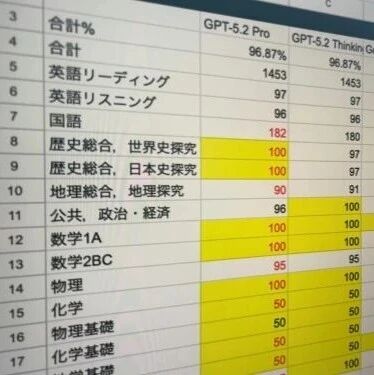
Core Viewpoint - The latest AI models from OpenAI, Google, and Anthropic have demonstrated high proficiency in the Japanese university entrance exams, with OpenAI achieving a score of 97% across 15 subjects, outperforming its competitors [1][3]. Group 1: AI Performance in Exams - OpenAI's model scored full marks in 9 subjects, including Mathematics I A, Mathematics II BC, Chemistry, and Physics, while achieving an overall score of 96.9% [4]. - Google and Anthropic scored 91.4% and 91% respectively, indicating a significant gap in performance compared to OpenAI [4]. - The average score of human test-takers was only 58.1%, highlighting the advanced capabilities of AI in academic assessments [4]. Group 2: Subject-Specific Insights - In specific subjects, OpenAI scored 100% in Mathematics I A and II BC, and 95% in Physics, while also excelling in Chemistry with a score of 100% [4]. - The AI models showed weaknesses in language subjects, particularly in reading comprehension and geography, where they lost points [4][5]. - OpenAI's model took 2-3 times longer than Google and Anthropic to complete the exams, indicating a potential area for improvement in efficiency [4]. Group 3: Future Projections - OpenAI's model is projected to improve its exam scores significantly over the next few years, with expected scores of 66% in 2024, 91% in 2025, and 97% in 2026 [3].

AI“参加”日本高考获佳绩
Xin Hua She· 2026-01-20 11:08
Core Insights - The recent Japanese university entrance examination saw AI models performing well, with OpenAI's model achieving perfect scores in 9 subjects [1] - The average score for OpenAI's model across 15 subjects was 96.9, while Google's model scored an average of 91.4 [1] - The examination, known as Japan's "Gaokao," has 21 subjects, with the most selected 15 subjects expected to have an average score of 58.1 this year [1] AI Model Performance - OpenAI's GPT-5.2 Thinking and Google's Gemini 3.0 Pro were tested on the 2026 university entrance exam questions [1] - OpenAI's previous models had also participated in the exam, with average scores increasing from 66 in 2024 to 91 in 2025 [1] - The latest AI models excelled in subjects like mathematics, physics, chemistry, and biology, but struggled with Japanese and geography [1] Limitations of AI - AI models demonstrated weaknesses in recognizing irregular shapes and answering questions related to world maps [1] - This indicates that while AI has advanced capabilities, there are still areas where performance is lacking, particularly in subjects requiring contextual understanding [1]
DeepSeek论文上新!下一代大模型实现“记忆分离”,V4不远了?
Di Yi Cai Jing Zi Xun· 2026-01-13 03:32
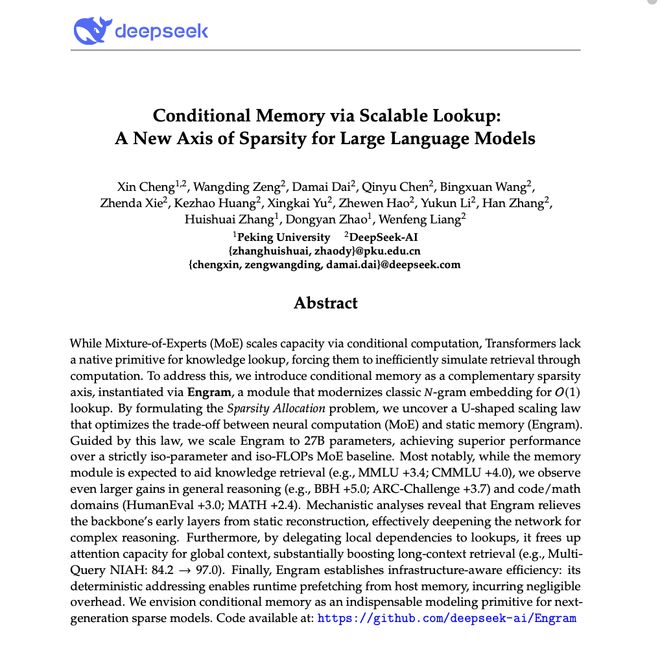
Core Insights - DeepSeek has released a new paper focusing on the conditional memory module of large models, suggesting it will be a core modeling primitive in the next generation of sparse large models [1][4]. Group 1: Research Findings - The new paper, co-authored with Peking University, is titled "Conditional Memory via Scalable Lookup: A New Axis of Sparsity for Large Language Models" and highlights the need for a native knowledge retrieval mechanism in existing Transformer architectures [4]. - The research identifies two distinct tasks in large models: deep dynamic computation for combinatorial reasoning and static knowledge retrieval, indicating that current models inefficiently simulate retrieval processes [4][5]. - DeepSeek introduces conditional memory as a supplementary dimension of sparsity, optimizing the trade-off between mixture of experts (MoE) and static memory (Engram) [4][6]. Group 2: Performance Improvements - The team discovered a U-shaped scaling law, showing that the mixed sparse capacity allocation between MoE experts and Engram memory significantly outperforms pure MoE baseline models [5]. - The introduction of the memory module not only aids knowledge retrieval but also yields notable improvements in general reasoning, coding, and mathematical tasks [5][6]. - The paper essentially proposes a "division of labor" optimization for large models, allowing specialized modules to handle specific tasks, thereby enhancing efficiency and resource allocation [6]. Group 3: Future Developments - Industry speculation suggests that the proposed conditional memory may be integral to the architecture of DeepSeek's upcoming flagship model, DeepSeek V4, expected to be released around February [6]. - Initial tests indicate that V4 may surpass other leading models in programming capabilities, with the previous model, V3, having already outperformed OpenAI's GPT-5 and Google's Gemini 3.0 Pro in various benchmarks [6].

AI破解500年《纽伦堡编年史》天书,仅用1小时,隐藏惊天真相被揭开
3 6 Ke· 2026-01-05 08:40
Core Insights - Gemini 3.0 Pro has successfully deciphered a 500-year-old handwritten annotation in the Nuremberg Chronicle, showcasing the advanced capabilities of AI in historical interpretation [1][30] - The AI was able to interpret complex Latin abbreviations and contextualize them within historical frameworks, achieving this in under one hour with minimal computational cost [1][28] Group 1: AI Capabilities - Gemini 3.0 Pro demonstrated exceptional visual recognition skills, reconstructing fragmented handwriting that had stumped historians for centuries [20][22] - The AI not only recognized characters but also understood the historical context and logic behind the annotations, integrating knowledge from various fields such as paleography, chronology, and theological history [11][30] - The process involved three major steps: visual recognition, contextual interpretation, and reconstruction of a 500-year-old "cyber reconciliation" of historical dates [18][27] Group 2: Historical Significance - The deciphered annotations revealed a comparison of different biblical chronologies, specifically the birth year of Abraham, highlighting a systematic 100-year discrepancy between two versions of the Bible [9][28] - This breakthrough signifies a shift in the authority of historical interpretation, challenging the traditional reliance on elite scholars and suggesting that AI can democratize access to historical knowledge [30][32] - The success of Gemini 3.0 Pro in this context may pave the way for future AI applications in deciphering other ancient texts, potentially transforming the field of historical research [18][29]

我的2025年度AI大盘点 - 前路已明。
数字生命卡兹克· 2025-12-31 01:21
Annual AI Models - The award for the Annual Writing Model goes to GPT-5.2 Thinking, which surpasses Gemini 2.5 Pro and GPT-4.5 in instruction adherence, style transfer, and world knowledge [2] - The Annual Coding Model is awarded to Gemini 3.0 Pro, noted for its strong front-end aesthetics and user experience, enabling users to develop ideas directly [4][7] - The Annual Drawing Model is awarded to Nano Banana, recognized for its significant impact on the AI drawing field and its demonstration of native multimodal advantages [10][15] - The Annual Music Model is awarded to Suno V5, which has elevated the AI music field and sparked a renaissance in creative content on platforms like Bilibili [16][18] - The Annual Voice Model is awarded to MiniMax Speech 2.0, which has achieved near-human emotional expression in voice synthesis, surpassing competitors like 11Labs [19][23] - The Annual Video Model is awarded to Sora2, which has made a significant impression in the AI video space with its engaging and realistic outputs [24][26] - The Annual Overall Model is awarded to DeepSeek R1, recognized for its substantial impact on AI perception in China and its competitive pricing compared to leading models [27][30][31] Annual AI Products and Features - The Annual AI Programming Product is awarded to Claude Code, which allows users to explore local codebases and customize workflows effectively [43][45] - The Annual AI Design Product is awarded to Lovart, a design-focused agent that offers various tools optimized for creative tasks [46][48] - The Annual AI Feature is awarded to ChatGPT DeepResearch, which significantly enhances research efficiency by generating comprehensive reports in a fraction of the time [49][54] Annual AI Applications and Hardware - The Annual AI Application is awarded to Manus, recognized for its role in popularizing the concept of general agents and its recent acquisition by Meta [55][62] - The Annual AI Hardware is awarded to Plaude Note Pro, which has successfully created a new category in AI hardware for meeting management and transcription [65][73]

从谷歌AI体系看应用叙事
2025-12-29 01:04
Summary of Key Points from Google AI Conference Call Industry and Company Overview - The conference call primarily discusses Google's advancements in AI technology, particularly focusing on the Gemini model and its applications in various sectors, including search, video generation, and cloud services [1][2][10]. Core Insights and Arguments Gemini 3.0 Pro Features - Gemini 3.0 Pro, released on November 19, 2025, supports multiple input modalities: text, images, audio, video, and PDF files [2] - It features a context window of 1 million tokens, significantly enhancing its reasoning capabilities compared to competitors like OpenAI's GPT 5.1 and Anthropic's Claude 4.5 [2][3] - The model's single-user session duration reached 7.2 minutes by October 2025, surpassing ChatGPT's 6 minutes, indicating increased user engagement [5] Video Generation Model VO Series - The VO series, particularly VO 3.0 and VO 3.1, has achieved native audio-visual synchronization and precise video control, maintaining a competitive price of $0.4 per second [4][6] - VO 3.1 utilizes a latent space diffusion model integrated with Transformer modules, enhancing its ability to generate high-quality video content [6] NanoBanana Image Generation Model - NanoBanana, developed on the Gemini framework, excels in high-resolution image generation and real-time knowledge integration through Google Search [7][8] - It operates on a token-based pricing model, charging $120 per million tokens, with each image consuming between 1,200 to 2,000 tokens [9] Financial Performance and AI Impact - Google's Q3 2025 revenue reached $102.3 billion, with search revenue at $56.5 billion and cloud revenue at $15.1 billion, driven by AI enhancements [11] - AI has become a key growth driver across Google's services, improving ad monetization efficiency and increasing cloud customer acquisition by 34% year-over-year [11][14] Additional Important Insights Market Trends and User Engagement - The AI browser Perplexity saw its traffic nearly double in 2025, with domestic AI search users reaching approximately 500 million and daily queries around 2 billion [15] - The domestic large model market experienced a daily token usage of 10.2 trillion, with significant contributions from companies like Alibaba and ByteDance [21] B2B and C2B Developments - Google Workspace has integrated AI capabilities into its suite, surpassing 1 million paid enterprise users by Q3 2025, enhancing user willingness to pay [23] - The company is actively engaging with various industries, including manufacturing and electronics, to deploy its AI models for applications like content creation and customer service [19][20] Future Investment Directions - The advancements in multi-modal models like NanoBanana Pro and VO 3.1 indicate potential growth areas in creative fields and consumer hardware, suggesting a broad market for AI applications in both B2B and C2B contexts [24]
罗福莉执掌小米大模型首秀!定调下一代模型,全新MiMo-V2开源还横扫Agent第一梯队
AI前线· 2025-12-17 08:00
Core Viewpoint - Xiaomi has introduced its new large model MiMo-V2-Flash, which emphasizes efficiency and practical deployment over sheer size, marking a significant step in its AI exploration journey [4][9]. Group 1: Model Overview - MiMo-V2-Flash features a total parameter scale of 309 billion, with only about 15 billion parameters activated during inference, utilizing a MoE (Mixture of Experts) architecture [8]. - The model incorporates Multi-Token Prediction (MTP) technology, designed for high-speed inference and agent workflows, aiming for efficiency rather than just increasing parameter size [8][21]. - Xiaomi's approach to MiMo-V2-Flash is driven by the need for models that are not only intelligent but also practical and deployable in real-world scenarios [21][22]. Group 2: Performance Metrics - During inference, the model achieves a throughput of 5000 to 15000 tokens per second in a single-machine environment, with a single request output speed of 150 tokens per second, representing a speed increase of approximately 2-3 times compared to models without MTP [24][47]. - MiMo-V2-Flash has entered the first tier in seven mainstream evaluations, particularly excelling in the SWE-Bench test with a 71.7% accuracy rate [27][28]. Group 3: Future Directions - The next generation of intelligent agents must be capable of continuous interaction with the real environment, moving beyond mere language processing to a unified, dynamic world model [30][32]. - Xiaomi emphasizes that true intelligence arises from interaction rather than just textual understanding, indicating a shift towards models that can engage with the physical world [52][53].