Kimi K2 Thinking模型

Search documents
月之暗面5亿美元C轮融资落地:手握百亿现金,K2系列驱动商业化狂奔
Sou Hu Cai Jing· 2026-01-01 16:42
Core Insights - Moonshot AI has successfully completed a $500 million Series C funding round, significantly oversubscribed, with a post-funding valuation of $4.3 billion (approximately 30 billion RMB) [2] - The company has accumulated over 10 billion RMB in cash reserves, showcasing strong market confidence in its technological capabilities and commercialization potential [2] Funding Details - The Series C funding was led by IDG Capital with a $150 million investment, and existing shareholders including Alibaba, Tencent, and Wang Huiwen participated in the oversubscription [2] - The funding process was efficient, taking less than two months to complete, continuing the company's trend of rapid fundraising [2] Market Position and Strategy - Despite holding substantial cash reserves, Moonshot AI has stated it is not in a hurry to go public, believing it can raise more funds from the primary market [3] - The company views an IPO as a means to accelerate the development of Artificial General Intelligence (AGI) while maintaining control over the timing of its public offering [3] Technological Advancements - 2025 is marked as a year of technological breakthroughs for Moonshot AI, with the launch of the Kimi K2 model and the Kimi K2 Thinking model driving rapid commercial growth [3] - The Kimi K2 model, as China's first trillion-parameter foundational model, excels in autonomous programming, tool usage, and mathematical reasoning, achieving state-of-the-art (SOTA) results in various benchmark tests [3][4] Model Capabilities - The upgraded Kimi K2 Thinking model is the most advanced open-source thinking model from Moonshot AI, capable of 300 rounds of tool usage and continuous thinking without human intervention [4] - This model has set new SOTA scores in challenging benchmarks, outperforming human averages in tests like the Humanity's Last Exam and OpenAI BrowseComp [4]

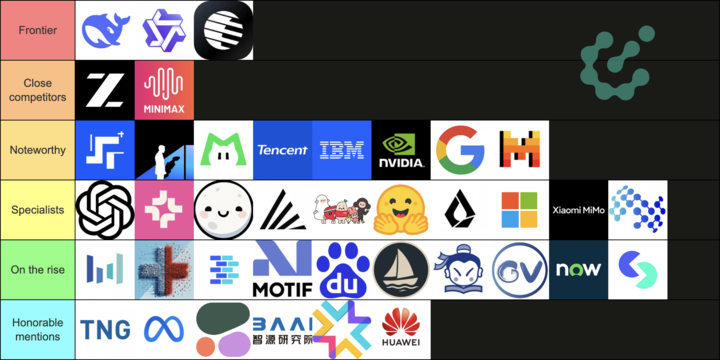
在这个开源「从夯到拉」榜单,我终于明白中国 AI 为什么能逆袭
Xin Lang Cai Jing· 2025-12-17 14:25
Core Insights - The recent ranking of open-source AI models highlights the dominance of Chinese models, with DeepSeek, Qwen, Kimi, Zhipu, and MiniMax leading the global landscape, while OpenAI and Meta's models lag behind [3][5][25]. Group 1: Performance and Market Position - Chinese open-source models are rapidly closing the performance gap with closed-source giants, excelling in dimensions such as performance, pricing, ecosystem, and usability [5][25]. - Kimi's K2 Thinking model, featuring a trillion parameters, has outperformed OpenAI's GPT-5 and Anthropic's Claude 4.5 in various benchmarks [11][14]. - MiniMax M2 has also shown strong performance, ranking fifth in comprehensive lists, surpassing competitors like Gemini 2.5 Pro and Claude Opus 4.1 [14][79]. Group 2: Technological Advancements - The introduction of interleaved thinking in models like MiniMax M2 and Kimi K2 Thinking allows for more efficient task execution by alternating between action and reflection [34][36]. - MiniMax M2 employs a full attention mechanism, which, despite increasing training and inference demands, has proven to deliver better performance compared to sparse attention models [75][78]. Group 3: Cost and Accessibility - MiniMax's API offers competitive pricing at $0.3/$1.2 per million input/output tokens, although its verbose nature leads to high token usage, which can offset cost advantages [79]. - The open-source movement in China is gaining momentum, with MiniMax's release reinforcing the leadership established by DeepSeek and other Chinese AI labs in the open-source domain [80][84]. Group 4: Community and Developer Adoption - There is a growing recognition among developers for the practicality and affordability of Chinese open-source models, with many citing them as preferable alternatives to established closed-source options like OpenAI [25][84]. - The rapid updates and releases from various Chinese companies indicate a robust and collaborative open-source ecosystem that is continuously evolving [11][14].

月之暗面又“亮”了?
Bei Jing Shang Bao· 2025-12-09 14:26
Core Insights - The company "月之暗面" is regaining public attention with recent developments, including the launch of subscription services and preparations for an IPO, as highlighted by its president Zhang Yutong [1][5][11] - The company emphasizes its strategic focus on core technological innovations and productivity tasks, distancing itself from entertainment and homogeneous competition [1][8] Company Developments - Zhang Yutong presented the latest advancements in the Kimi model's performance and product offerings at a Tsinghua University event, marking a significant return to the spotlight after a year of scrutiny [1][5] - The company has launched a subscription model for Kimi For Coding and introduced the Kimi K2Thinking model, which supports real-time tool usage [1][10] - There are indications that the company is preparing for an IPO, with analysts suggesting that the current market conditions may favor such a move [5][11] Market Position and Strategy - 月之暗面 is noted for its low valuation compared to leading U.S. model companies, operating with less than 1% of their resources while still achieving significant technological advancements [2] - The company aims to overcome data limitations rather than computational power, achieving efficiency improvements with the Kimi K2 model [4] - The focus is on niche areas such as complex task management and productivity, rather than competing directly with larger players in the entertainment sector [8][9] User Engagement and Performance - Kimi has approximately 9.67 million monthly active users, ranking fifth among native AI applications, while competitors like Doubao and DeepSeek have significantly higher user bases [7] - The company has shifted its strategy away from user scale competition, focusing instead on its unique strengths in technology and product offerings [8] Commercialization and Partnerships - 月之暗面 is pursuing a direct commercialization strategy for its consumer offerings, particularly in computationally intensive tasks, while maintaining free access for basic interactions [9][10] - The company has secured partnerships with notable platforms, integrating its Kimi K2 model into various applications, indicating a strong position in the B2B market [10]

20cm速递|科创创业ETF(588360)盘中涨超1.8%,科技竞赛打开估值上限
Mei Ri Jing Ji Xin Wen· 2025-12-09 09:52
Group 1 - The computer industry is entering a new phase of AI competition characterized by "strong reasoning + native multimodal" capabilities, with significant advancements from models like Kimi K2 Thinking, Gemini 3, and DeepSeek-V3.2 [1] - The demand for AI computing power is expected to grow due to the effectiveness of scaling laws in the electronics industry, with PCB demand likely to maintain high growth, driven by capacity release and product structure optimization [1] - The humanoid robot industry is transitioning from concept validation to commercialization, presenting opportunities for key component and complete machine companies to benefit from a "Davis double hit" [1] Group 2 - The Science and Technology Innovation ETF (588360) tracks the Science and Technology Innovation 50 Index (931643), which has a daily fluctuation of 20%, selecting 50 emerging industry stocks with large market capitalization and good liquidity from the Sci-Tech and ChiNext boards [1] - The index focuses on companies with strong technological attributes and high growth potential, covering core sectors such as information technology, new energy, and biomedicine, aiming to reflect the overall performance of listed companies in China's frontier industries [1]

多行业联合人工智能 12 月报:科技竞赛打开估值上限-20251208
Huachuang Securities· 2025-12-08 13:01
Strategy - The technology competition under the Kondratiev wave continues to open up valuation ceilings, with a focus on "bottleneck" and future industry high ground [14][15] - The current valuation of China's science and technology innovation is still lower than that during the internet boom in the 1990s, indicating potential for further upward movement [14][18] - The "14th Five-Year Plan" emphasizes seizing the high ground of technological development, focusing on key areas such as integrated circuits and advanced manufacturing [14][19] Electronics - The scaling law remains effective, with the introduction of multi-modal and agent models expected to accelerate AI computing demand [8][15] - The PCB industry is anticipated to maintain high growth due to its heavy asset nature and product structure optimization, which can lead to non-linear performance improvements for companies [8][15] Computer - New models are being launched intensively, marking a shift in AI competition towards "strong reasoning + native multi-modal" capabilities [9][15] - Significant releases include Google's Gemini 3 and DeepSeek V3.2, which enhance multi-modal understanding and practical applications [9][15] Media - Long-term optimism for the acceleration of AI product applications and commercialization, with a focus on AI agents, companionship, multi-modal applications, education, and edge AI [9][15] Humanoid Robots - The industry is transitioning from concept validation to commercialization, with companies that have growth potential in key components or specific solutions likely to benefit [10][15] - Investment opportunities are identified in the incremental component sector, with a focus on aesthetic preferences in the market [10][15] Automotive - The launch of Horizon Robotics' HSD and J6P models marks a significant step in mass production, with companies like WeRide and Pony.ai also making strides in the market [10][15] - Recommendations include focusing on luxury car opportunities with strong product pipelines and valuation elasticity, as well as autonomous driving technologies [10][15] Selected Portfolio - The December selected portfolio includes upstream production tools like Zhuoyi Information, upstream computing infrastructure such as Jingwang Electronics, and downstream applications like Alibaba [11][15]




张予彤以月之暗面总裁身份出席活动,与金沙江纠纷或已解决
Tai Mei Ti A P P· 2025-12-08 11:54
Core Viewpoint - Zhang Yutong has recently been confirmed to be attending events as the President of "Moon's Dark Side," responsible for overall strategy and commercialization, including financing and new product development [2] Group 1: Company Leadership and Structure - Zhang Yutong's position as President indicates her rising status within the company, despite ongoing disputes with金沙江 [3] - The ongoing dispute between金沙江 and Moon's Dark Side appears to be either unresolved in court or subject to a confidential settlement, allowing Zhang Yutong to continue her role [3] - Moon's Dark Side is reportedly in discussions with top international investment firms like IDG Capital and Tencent for a new round of financing, with a projected valuation of $4 billion [3] Group 2: Financial Developments - The current financing round is expected to raise $600 million, marking a significant milestone following a previous $300 million round in August 2024 [3] - The lead investor for this round has shifted from previously speculated firms to IDG Capital, with existing shareholders like Tencent participating [3] Group 3: Product Development - Earlier this year, Moon's Dark Side launched the Kimi K2 Thinking model, achieving a record low training cost of $4.6 million, surpassing DeepSeek and ranking first globally [4] Group 4: Historical Context of Disputes - The dispute between金沙江 and Zhang Yutong traces back to the establishment of循环智能 in May 2016, with significant developments occurring over the years, including Zhang's rise within金沙江 and her eventual departure [5][6][7] - The split between循环智能 and Moon's Dark Side was informally agreed upon, leading to the establishment of Moon's Dark Side in April 2023, with ongoing legal disputes regarding the split [7][8][9]

月之暗面估值或达40亿美元,或于明年下半年IPO
Sou Hu Cai Jing· 2025-11-24 07:42
Group 1 - The company Moonshot AI is in discussions for a new round of USD financing with top international investment institutions, aiming for a valuation of USD 4 billion [2] - The financing round is expected to raise USD 600 million, following a previous USD 300 million financing in August 2024 [2] - The lead investor for this round is IDG Capital, with participation from existing shareholders including Tencent and others [2] Group 2 - Moonshot AI's Kimi K2 Thinking model has achieved a record low training cost of USD 4.6 million, surpassing DeepSeek and ranking first globally on some open-source model leaderboards [2] - Despite its impressive performance, Kimi K2 Thinking scores 18 percentage points lower than GPT-5 in multi-turn dialogue coherence, highlighting ongoing challenges in AI development [2] Group 3 - The company has denied specific timelines for an IPO but is reportedly preparing for it, exploring dual listing options on the NYSE and HKEX [3] - With a valuation of USD 4 billion, Moonshot AI's IPO journey is seen as both a significant achievement and a critical test amid the US-China tech competition [3] - The company's revenue primarily comes from B2B API calls and customized solutions, with 2023 revenue estimated at approximately RMB 210 million, contrasting sharply with OpenAI's quarterly revenue exceeding USD 1 billion [3]
“千问恐慌”背后:全球AI价值正在重估
Huan Qiu Shi Bao· 2025-11-21 22:45
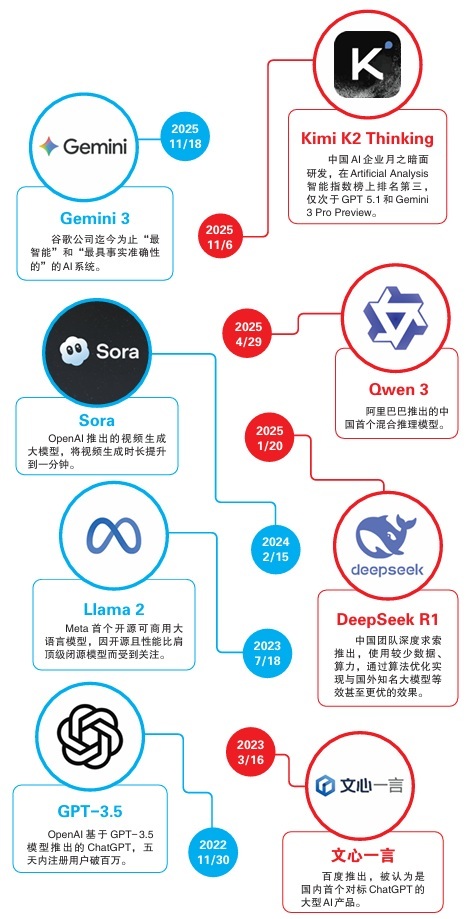
Core Insights - The article discusses the rising prominence of Chinese AI models, particularly highlighting the emergence of applications like Qwen from Alibaba, which are challenging established players in Silicon Valley [1][11][12]. Industry Overview - The Chinese AI market is transitioning from a "hundred models battle" to a differentiated competition phase, with applications covering various aspects of life and work [3]. - The launch of advanced models such as Baidu's Wenxin 5.0 and Alibaba's Qwen indicates a significant leap in capabilities, with Qwen already demonstrating the ability to generate comprehensive reports and presentations [3][6]. Competitive Landscape - Chinese AI models are not only catering to local users but are also gaining traction globally, with platforms like MiniMax's Hai Luo AI being utilized in over 200 countries [7]. - The performance gap between Chinese and American AI models has narrowed significantly, with reports indicating a mere 0.3% difference in capabilities [16]. Strategic Shifts - Chinese companies are moving away from the capital-intensive strategies of their American counterparts, focusing instead on algorithm optimization and cost-effective solutions [16][17]. - The trend of adopting Chinese AI models in Silicon Valley reflects a shift in preference towards open-source and cost-effective solutions, posing a challenge to traditional closed-source models from American firms [12][13]. Future Projections - Experts predict a surge in "national-level" AI applications around mid-2026 to mid-2027, as the technology matures and integrates more deeply into everyday life [10]. - The next phase of competition will focus on practical applications and user retention, with a need for AI to evolve from being merely entertaining to being genuinely useful [10][18]. Geopolitical Considerations - The geopolitical landscape is influencing the global AI market, with Chinese firms needing to navigate high regulatory barriers in Western markets while exploring opportunities in regions like ASEAN and the Middle East [19].
AI搜索应用Perplexity上线Kimi K2 Thinking模型
Feng Huang Wang· 2025-11-18 07:50
Core Insights - The Kimi K2 Thinking model developed by Moon's Dark Side has been integrated into the AI search application Perplexity, making it the only domestic model to be included alongside OpenAI's newly released GPT-5.1 [1] Group 1: Company Performance - Perplexity has experienced explosive growth since its establishment in 2022, currently boasting 30 million monthly active users and a valuation exceeding $20 billion, making it the highest-valued AI search application globally [1] Group 2: Product Innovation - Perplexity has pioneered a new category known as the conversational "answer engine," which transforms how users access and research information by providing instant answers based on the latest web information, complete with clear source citations [1] Group 3: Model Integration - Several AI applications, including Cherry Studio, Cline, CoStrict, Cursor, Genspark, Kilo Code, Kortix Suna, RooCode, Trae, Vercel, Visual Studio Code, Windsurf, and YouWare, have previously integrated with the Kimi K2 series models [1]
国产大模型在多项基准测试中超越GPT-5
21世纪经济报道· 2025-11-15 10:00
Core Insights - The article discusses the recent online Q&A session held by the founders of "Moon's Dark Side," focusing on their new Kimi K2 Thinking model, which has outperformed GPT-5 in several benchmark tests [1][3]. Model Performance - Kimi K2 Thinking is touted as the strongest open-source thinking model to date, achieving state-of-the-art (SOTA) performance in various tests, including 44.9% in the Humanity's Last Exam (HLE) compared to GPT-5's 41.7% [3]. - In the BrowseComp benchmark, Kimi K2 scored 60.2%, surpassing GPT-5's 54.9%, and in the SEAL-0 test, it achieved 56.3%, again outperforming GPT-5's 51.4% [3][4]. Technical Innovations - The model can autonomously perform 200 to 300 tool calls to solve complex problems, showcasing a new "think-tool-think-tool" execution mode [4]. - The team employed end-to-end reinforcement learning to maintain performance stability during extensive tool calls, ensuring effective retrieval and reasoning throughout the process [4]. Engineering Optimization - The team utilized H800 GPU clusters with Infiniband, maximizing the performance of each GPU despite limited computational resources [6]. - The training cost is difficult to quantify, with the stated $4.6 million not being an official figure, as most costs are related to research and experimentation [6]. Open Source Strategy - The open-source approach has garnered international recognition for Chinese AI models, with Kimi K2's API being significantly cheaper than competitors like Claude [8]. - Despite concerns about using Chinese LLMs, the founders believe that open-source models can alleviate some of these apprehensions [8]. Market Position - Kimi K2 has gained traction in the market, with a notable increase in API usage following restrictions on other models for Chinese IPs [8]. - In a recent ranking, Chinese models occupied seven spots in the top twenty, with Kimi K2 and Grok4 leading in daily processing volume, surpassing 10 billion tokens [8][9]. Future Developments - The company is planning the next-generation K3 model, which will incorporate significant architectural changes, including the experimental KDA (Kimi Delta Attention) module [10].