
MI325X人工智能加速器芯片

Search documents
特朗普政府或豁免美国科技巨头芯片关税
第一财经· 2026-02-10 14:46
Core Viewpoint - The article discusses the U.S. government's plans to exempt major tech companies like Amazon, Google, and Microsoft from chip tariffs to encourage investment in AI infrastructure, particularly data centers, while linking these exemptions to TSMC's investment commitments [3][6][9]. Group 1: U.S. Trade Policy and Tariffs - The U.S. plans to impose a 25% tariff on certain imported semiconductors and related products, citing national security concerns, as the domestic semiconductor production meets only 10% of demand [6][9]. - The tariff exemption will be tied to TSMC's investment in the U.S., with a commitment of $165 billion to expand capacity [6][9]. - The U.S. government is adjusting the exemption plan, which has not yet been signed by President Trump, to ensure it does not become a mere gift to TSMC [7][9]. Group 2: AI Investment Landscape - Major U.S. tech companies are projected to invest $700 billion in AI infrastructure by 2026, nearly double the previous year's total, with Amazon alone planning to invest $200 billion [9][10]. - This surge in investment is reshaping the economy, leading to increased demand for memory chips and computing components, causing shortages in traditional consumer electronics [10]. - The article highlights the disparity in AI investment between the U.S. and Europe, where funding is significantly lower, making it challenging for European countries to compete [10]. Group 3: Economic Implications - The reallocation of labor and materials in the U.S. to support these large tech projects is driving up construction costs and exacerbating housing crises in various cities [10]. - AI is viewed as a critical factor for long-term economic growth, with over 60% of businesses identifying technological advancements as the primary positive factor for the global economy [11].






海外政策周聚焦:高市早苗解散国会如何搅动资本市场?
Western Securities· 2026-01-18 13:27
Group 1: Political Context - Japanese Prime Minister Kishi Sanae intends to dissolve the House of Representatives at the beginning of the regular Diet session on January 23, with elections expected in early to mid-February[1] - The last dissolution of the House of Representatives occurred during the Ishiba regime, where the ruling Liberal Democratic Party (LDP) only secured 191 seats, a decrease of 56 seats from before the dissolution[1][2] Group 2: Government Support and Strategy - Kishi's intention to reorganize the House stems from a mismatch between a weak Diet and a strong cabinet approval rating, which is significantly higher than that of the previous Ishiba government[2] - The current ruling coalition barely holds a majority in the House of Representatives, while the LDP's support rate remains high, prompting Kishi to seek a new election to strengthen her position[2][3] Group 3: Market Implications - A successful election could provide Kishi with a majority in the House, facilitating the implementation of aggressive fiscal and industrial policies, which may lead to a bullish stock market but raise concerns about Japan's debt sustainability[3][4] - The Nikkei 225 index has shown a significant increase, reflecting market optimism about Kishi's potential electoral success, with expectations that it could rise to 55,000 points by the end of March[3][4] Group 4: Economic Concerns - Japan's government debt-to-GDP ratio has reached 240%, raising questions about fiscal sustainability amid plans for record budget increases and substantial bond issuance[3][4] - The bond market is under pressure, with the five-year government bond yield reaching its highest level since its introduction in 2000, reflecting investor concerns over fiscal expansion and increased debt supply[4]
超300亿主力资金爆买!电子板块领涨两市,长电科技等3股涨停!电子ETF(515260)盘中拉升2%,冲击3连阳
Xin Lang Cai Jing· 2026-01-16 06:11
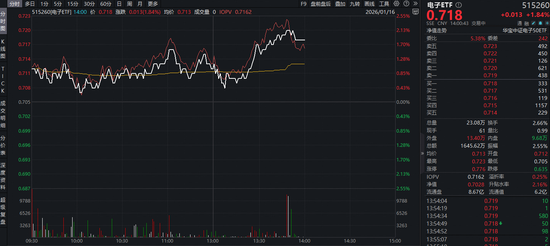
Core Viewpoint - The electronic sector is experiencing significant growth, with a net inflow of 31.058 billion yuan, leading among 31 primary industries in the A-share market, despite overall market consolidation [1][9]. Group 1: Market Performance - The electronic ETF (515260) saw an intraday price increase of over 2.1%, currently up 1.84%, marking three consecutive days of gains [10]. - Key stocks in the electronic sector, such as Longji Technology, Zhaoyi Innovation, and Tongfu Microelectronics, reached their daily limit, with Huazhong Microelectronics rising over 13% and Sanan Optoelectronics increasing by more than 9% [4][12]. Group 2: Macro Factors - On January 14, the U.S. government announced a 25% tariff on specific semiconductors, including Nvidia's H200 chip and AMD's MI325X AI accelerator chip, which may enhance market sentiment for domestic alternatives [2][14]. Group 3: Industry Trends - The explosive growth in global AI computing demand has led to a surge in the storage chip market, with prices for storage chips increasing dramatically, including a projected 1800% rise for DDR4 16Gb chips by 2025 [3][14]. - The semiconductor industry is expected to see a trend towards "self-control" and AI synergy, with a focus on domestic computing and semiconductor equipment, as well as potential recovery opportunities in consumer electronics by Q2 2026 [3][14]. Group 4: Company Developments - Unigroup Guowei announced plans for a private placement to acquire Ruineng Semiconductor, aiming to enhance its power semiconductor product matrix and strengthen its competitive position in the semiconductor industry [3][14]. Group 5: Investment Tools - The electronic ETF (515260) and its linked funds passively track the electronic 50 index, focusing on semiconductor and consumer electronics sectors, and include key stocks like Luxshare Precision and SMIC [5][14].

原油,大跌!刚刚,白银、黄金跳水
中国基金报· 2026-01-16 01:20
Market Overview - US stock market closed higher, driven by gains in bank and chip stocks, with the Dow Jones up by 292.81 points (0.60%) to 49,442.44, the Nasdaq up by 58.27 points (0.25%) to 23,530.02, and the S&P 500 up by 17.87 points (0.26%) to 6,944.47 [2] Chip Sector - The semiconductor sector saw a broad increase, with the Philadelphia Semiconductor Index rising by 1.76%, reaching a new all-time high. Notable gains included KLA Corporation up over 7%, Applied Materials up over 5%, ASML up over 5%, TSMC up over 4%, and AMD up 1.93% [10][11] - TSMC reported a 35% increase in net profit for Q4 2025, reaching approximately $16 billion, significantly exceeding expectations and marking seven consecutive quarters of double-digit growth [11] Bank Sector - Most bank stocks experienced gains, with Morgan Stanley up nearly 6%, Goldman Sachs up over 4%, Citigroup up over 4%, and JPMorgan up 0.48%. Wells Fargo was the only bank to decline, down 0.34% [16][17] - Goldman Sachs and Morgan Stanley reported record revenues in their trading divisions for the previous year. Goldman Sachs plans to issue investment-grade bonds to raise $16 billion, marking the largest such issuance in Wall Street history [17] Commodity Market - Oil prices fell sharply, with Brent crude down by $2.76 (4.15%) and WTI crude down by $2.83 (4.56%). This decline is attributed to market perceptions regarding potential de-escalation of military actions in the Middle East [19] - Gold and silver prices also dropped significantly, with silver down over 1.5% following the oil price decline [19][20]



涉及英伟达和超威!美国对部分半导体加征关税!紫光国微复牌一字涨停!电子ETF(515260)逆市劲涨1.88%
Xin Lang Cai Jing· 2026-01-15 11:25
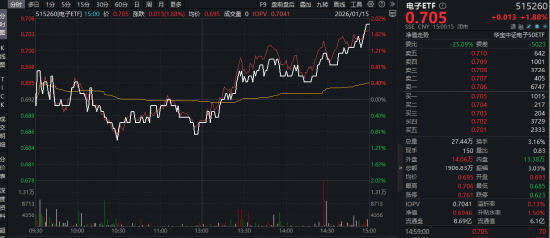
Core Viewpoint - The electronic sector experienced a significant surge, leading the market with a net inflow of 16.862 billion yuan, marking the highest absorption among 31 primary industries in the Shenwan classification [1][9]. Group 1: Macro Factors - On January 14, the U.S. White House announced a 25% tariff on specific semiconductors, including Nvidia's H200 chip and AMD's MI325X AI accelerator chip, which may enhance market sentiment for domestic alternatives [2][10]. Group 2: Industry Trends - The explosive growth in global AI computing power demand has led to a strong market for storage chips, with prices reportedly increasing by 18 times over the past year. Projections indicate that by 2025, prices for DDR4 16Gb chips could rise by 1800%, DDR5 16Gb by 500%, and 512Gb NAND flash by 300% [3][11]. Group 3: Company Developments - On January 14, chip giant Unisoc announced plans for a private placement to acquire Ruineng Semiconductor, aiming to integrate its power semiconductor product matrix and enhance its competitive position in the semiconductor industry [3][11]. Group 4: ETF and Investment Tools - The electronic ETF (515260) saw a price increase of 1.88%, recovering its 5-day moving average, and serves as an efficient tool for investors looking to gain exposure to core assets in the electronic sector, including semiconductors and consumer electronics [1][9][12].

英伟达、超威半导体受波及,美国宣布加征25%关税
第一财经· 2026-01-15 03:33
Core Viewpoint - The U.S. government will impose a 25% import tariff on certain semiconductor products and manufacturing equipment starting from the 15th, citing national security threats as the reason for this decision [1]. Group 1: Tariff Details - The tariff will apply to specific products, including Nvidia's H200 chip and AMD's MI325X AI accelerator chip [1]. - The tariffs are based on Section 232 of the Trade Expansion Act of 1962, aimed at addressing national security risks [1]. Group 2: Semiconductor Industry Context - The U.S. consumes about 25% of the global semiconductor products, but only produces about 10% of the chips it requires [1]. - The current semiconductor production capacity in the U.S. is insufficient to meet both defense and growing commercial demands, leading to significant economic and national security risks due to reliance on foreign supply chains [1]. Group 3: Exemptions and Future Actions - Semiconductor products used in data centers, research, maintenance, and public sectors are exempt from the new tariffs [1]. - Existing tariffs on passenger vehicles, light trucks, heavy-duty vehicles, steel, copper, and aluminum products from Canada and Mexico will not be subject to additional tariffs [1]. - If negotiations with relevant exporters do not reach an agreement within 180 days, further actions may be taken by the U.S. President [1]. Group 4: Broader Trade Implications - Recent tariff measures by the Trump administration, including those on pharmaceuticals and heavy trucks, have introduced new uncertainties in trade [1].
美国对部分半导体产品加征关税,涉及英伟达和超威
21世纪经济报道· 2026-01-15 03:31
Core Viewpoint - The U.S. government will impose a 25% import tariff on certain semiconductor products, including Nvidia's H200 chip and AMD's MI325X AI accelerator chip, starting from the 15th of this month, citing national security concerns [1]. Group 1: Tariff Details - The tariff is based on Section 232 of the Trade Expansion Act of 1962, aimed at addressing national security threats [1]. - Approximately 25% of global semiconductor products are consumed by the U.S., but only about 10% of the chips are produced domestically [1]. - The U.S. semiconductor capacity is insufficient to meet both defense and growing commercial demands, creating significant economic and national security risks due to reliance on foreign supply chains [1]. Group 2: Exemptions and Future Actions - Semiconductor products used in data centers, research, maintenance, and public sectors are exempt from the new tariffs [1]. - Products already subject to tariffs, such as passenger cars, light trucks, heavy-duty vehicles, steel, and aluminum, will not face double tariffs [1]. - If exporters do not reach an agreement with the U.S. within 180 days following the announcement, further measures may be taken by President Trump to adjust imports [1]. Group 3: Broader Trade Implications - Recent tariff measures by the Trump administration, including those on pharmaceuticals and heavy trucks announced in September 2025, have led to increased trade uncertainty [1].
【环球财经】美国白宫宣布对特定先进半导体等加征25%关税
Xin Hua Cai Jing· 2026-01-15 03:13
Core Viewpoint - The U.S. government has announced a 25% import tariff on specific advanced semiconductors, semiconductor manufacturing equipment, and derivatives, citing national security threats as the reason for this action [1][2]. Group 1: Tariff Implementation - The tariffs will take effect from January 15, targeting specific imports that include logic integrated circuits and related products that meet certain technical specifications [2]. - Products used in data centers, research, maintenance, and public sectors are excluded from the tariff [2]. - The tariffs will not be applied again to products already subject to tariffs, such as passenger cars, light trucks, and metals [2]. Group 2: Industry Impact - The measures aim to increase domestic semiconductor production and reduce reliance on foreign supply chains, addressing significant economic and national security risks [2]. - Currently, the U.S. consumes about 25% of global semiconductor products, but only produces about 10% of its own chip demand [2]. - The U.S. plans to negotiate with foreign jurisdictions to enhance its semiconductor industry, with potential for further tariffs in a second phase if negotiations do not yield results within 180 days [1][2]. Group 3: Specific Products Affected - Notable products affected by the tariffs include NVIDIA's H200 chip and AMD's MI325X AI accelerator chip [2].
美国对部分半导体产品加征关税 涉及英伟达和超威
Xin Hua She· 2026-01-15 03:03
Core Viewpoint - The U.S. government will impose a 25% import tariff on certain semiconductor products and manufacturing equipment starting from the 15th, citing national security concerns and the need to reduce reliance on foreign supply chains [1]. Group 1: Tariff Details - The tariff will apply to specific products, including Nvidia's H200 chips and AMD's MI325X AI accelerator chips [1]. - The tariff is based on Section 232 of the Trade Expansion Act of 1962, aimed at addressing national security threats [1]. Group 2: Market Context - The U.S. consumes about 25% of the global semiconductor products, but only produces about 10% of the chips it requires [1]. - Current U.S. semiconductor production is insufficient to meet defense and commercial demands, posing significant economic and national security risks [1]. Group 3: Exemptions and Future Actions - Semiconductor products used in data centers, R&D, maintenance, and public sectors are exempt from the new tariffs [1]. - Other products already subject to tariffs, such as passenger vehicles and metals, will not face additional tariffs [1]. - If negotiations with exporters do not reach an agreement within 180 days, further actions may be taken by the U.S. President [1]. Group 4: Broader Implications - Recent tariff measures by the Trump administration, including those on pharmaceuticals and heavy trucks, have introduced new trade uncertainties [1].