Megablock

Search documents
Tesla or General Motors: Which Stock is Better Positioned Now?
ZACKS· 2026-03-23 14:42
Key Takeaways General Motors appears better positioned now, with improving margins, software growth and capital returns.GM sees North America EBIT margins at 8-10% in 2026, up from 6.8% in 2025 on lower costs and mix.TSLA is ramping up robotaxis and robotics, but the strategy is capital-heavy and its 2026 EPS view is down.Tesla (TSLA) and General Motors (GM) are two dominant players in the U.S. auto space. While Tesla remains the largest electric vehicle (EV) seller, General Motors leads in overall vehicle ...


Tesla’s $4.3 Billion Not-so-Secret Is Officially Out
Yahoo Finance· 2026-03-18 04:01
Concerned about an AI bubble? Sign up for The Daily Upside for smart and actionable market news, built for investors. Last July, South Korea’s LG Energy Solution said it inked a $4.3 billion contract to supply batteries to … someone. The secret was as poorly kept as a college frat house, with reports immediately pointing to Tesla as the not-so-mysterious counterparty. Nearly eight months later, LG confirmed its deepened partnership with the Elon Musk-led automaker on Tuesday, after the Department of the I ...
Tesla, LG to build $4.3B battery plant as part of supply agreement
Yahoo Finance· 2026-03-17 16:45
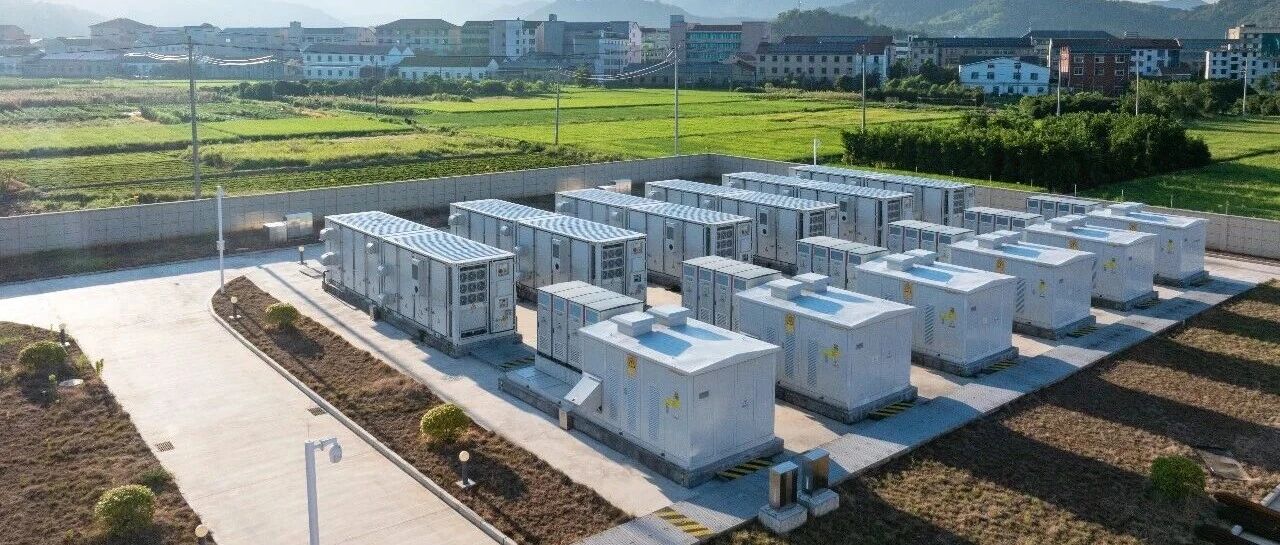
This story was originally published on Supply Chain Dive. To receive daily news and insights, subscribe to our free daily Supply Chain Dive newsletter. Tesla and LG Energy Solution have agreed to build a $4.3 billion manufacturing facility in Lansing, Michigan, to produce lithium-iron-phosphate cells for Tesla's Megapack 3 utility-scale energy storage systems, according to the U.S. Department of the Interior. Production at the facility is scheduled to begin in 2027, the agency said in a press release. ...
Tesla or NIO: Which Stock Is Worth Retaining in Your Portfolio?
ZACKS· 2026-02-17 14:46
Core Insights - Tesla is facing intensified competition and a decline in market share, with an aging model lineup and CEO Elon Musk's political involvement impacting sales [1][5] - In contrast, NIO is focusing on EV growth in its domestic market and global expansion, showing strong delivery momentum [3][10] Tesla's Position - Tesla's deliveries fell more than 8% in 2025, marking the second consecutive year of decline, raising concerns about demand and pricing power [5] - The energy generation and storage segment achieved record deployments of 14.2 GWh in Q4 and 46.7 GWh for the year, a 49% year-over-year increase [6] - Tesla plans to significantly increase capital expenditures to over $20 billion in 2026, supporting major facilities and AI infrastructure [7][9] - Robotaxi services are expected to expand to seven new U.S. cities, with Musk suggesting autonomous Teslas could reach half of the U.S. population by year-end, pending regulatory approvals [8] NIO's Growth Strategy - NIO delivered 326,028 vehicles in 2025, a nearly 47% increase, and has crossed 1 million cumulative deliveries [10][12] - Vehicle margins improved to 14.7% in Q3 2025 from 13.1% a year earlier, with management targeting a 20% vehicle margin over time [13] - NIO's battery swap technology remains a key differentiator, with over 100 million swaps completed and plans for 1,000 additional swap stations by 2026 [14] - The company is expanding into Central Asia, Australia, New Zealand, and Europe, enhancing user engagement through software upgrades [15] Valuation and Investment Outlook - NIO appears more attractive from a valuation perspective, trading at a lower price-to-sales multiple compared to Tesla, which is above its historical average [16][18] - NIO is positioned for improving fundamentals and valuation comfort, while Tesla faces declining deliveries and heavy capital spending commitments [19]

特斯拉2026战略会纪要 储能总体毛利率20.1%
鑫椤储能· 2026-02-14 00:36
Core Viewpoint - Tesla is focusing on enhancing its autonomous driving capabilities and expanding its Robotaxi services, with significant capital investments planned for future growth and technological advancements [1][5][17]. Group 1: Autonomous Driving and Robotaxi - Tesla has initiated paid Robotaxi services in Austin without safety drivers or follow cars, with over 500 vehicles in operation and expected exponential growth [1][9]. - The company aims to expand its Full Self-Driving (FSD) capabilities, with a target of covering 25-50% of the U.S. by year-end, pending regulatory approval [1]. - FSD paid users have reached nearly 1.1 million, with 70% opting for a one-time purchase; the transition to a subscription model is expected to impact automotive gross margins in the short term [1][10]. Group 2: Capital Investment and Financial Outlook - Tesla plans to invest over $20 billion this year across six major factories and AI capabilities, with cash and investments exceeding $44 billion available for use [2][18]. - The company anticipates record revenue from its energy business, projecting $12.8 billion in annual income by 2025, a 26.6% year-over-year increase [10][11]. - Overall gross margin is reported at 20.1%, the highest in two years, despite challenges from tariffs and fixed cost absorption [13]. Group 3: Product Development and Future Plans - The upcoming Optimus 3 robot is expected to demonstrate advanced capabilities, including learning through observation and voice, with mass production starting later this year [1][16]. - Tesla is transitioning its Fremont factory's Model S/X production line to focus on manufacturing 1 million Optimus robots annually [8]. - The company is committed to a vision of "Amazing Abundance," emphasizing the potential of AI and robotics to create a future of universal high income [4]. Group 4: Competitive Landscape - China is identified as a strong competitor in manufacturing and AI, with its capabilities being underestimated by external observers [3].
特斯拉第二增长曲线爆发:2025年储能部署激增49%,利润引擎超越造车?
Xin Lang Cai Jing· 2026-02-05 08:12
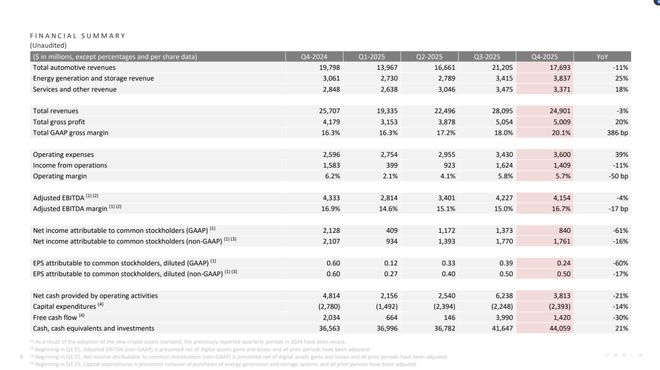
Core Insights - Tesla's energy generation and storage business has become a core pillar, with Q4 2025 revenues reaching $3.06 billion, a 25% year-over-year increase, indicating a shift from being a side business to a mainstay [2][3] - The energy sector's gross profit for 2025 was $3.8 billion, significantly higher than $2.64 billion in 2024, showcasing improved profitability amid challenges in the automotive sector [3][12] Financial Performance - Total automotive revenues decreased by 11% year-over-year to $19.8 billion in Q4 2024, while total revenues fell by 3% to $25.7 billion [1] - Energy generation and storage revenue increased by 25% to $3.06 billion in Q4 2025, with services and other revenue also rising by 18% [1][2] - Total gross profit for Q4 2025 was $5.01 billion, with a gross margin of 20.1%, up 386 basis points year-over-year [1] - Net income attributable to common stockholders (GAAP) dropped by 61% to $2.13 billion in Q4 2024, while non-GAAP net income decreased by 16% [1] Production and Capacity Expansion - Tesla is expanding its manufacturing network to meet global demand for grid-scale energy storage, with existing factories in California and Shanghai each having a capacity of 40 GWh [8] - A new factory in Houston is under construction, which will produce the innovative "Megablock" product, designed to enhance capacity and reduce installation costs for grid operators [9][11] Market Challenges - Despite strong performance, Tesla's management has warned of increasing competition in the energy production and storage sector, which may lead to declining retail or wholesale electricity prices [12] - The company acknowledges that lower electricity prices could diminish the attractiveness of its storage products for some customers, presenting a macroeconomic challenge for 2026 [12] Strategic Vision - Tesla's energy vision is taking shape, with significant growth in energy revenues and the introduction of new products like the Megablock, indicating a transition from an electric vehicle company to a comprehensive AI and energy giant [13]
【特斯拉(TSLA.O)】2026E全面向AI迈进,Robotaxi率先稳步推进——2025年四季报业绩点评(倪昱婧/邢萍)
光大证券研究· 2026-02-02 23:08
Core Viewpoint - Tesla's overall performance in 2025 showed a decline in revenue and net profit, with total revenue decreasing by 2.9% year-on-year to $94.83 billion and Non-GAAP net profit down by 26.4% to $5.86 billion [4] Group 1: Automotive Business Performance - In Q4 2025, Tesla's global delivery volume decreased by 15.6% year-on-year and 15.9% quarter-on-quarter to 418,000 units, with automotive revenue declining by 10.6% year-on-year and 16.6% quarter-on-quarter to $17.69 billion [5] - The average selling price (ASP) of vehicles was approximately $41,000, reflecting a year-on-year increase of 3.3% but a quarter-on-quarter decrease of 1.6% [5] - The automotive gross margin, excluding regulatory credits, improved by 4.3 percentage points year-on-year and 2.5 percentage points quarter-on-quarter to 17.9%, primarily due to optimization in sales region structure [5] Group 2: Energy Business Performance - In Q4 2025, Tesla's energy storage installation volume increased by 29% year-on-year and 14% quarter-on-quarter to 14.2 GWh, with energy business revenue rising by 25.4% year-on-year and 12.4% quarter-on-quarter to $3.84 billion [5] - The gross margin for the energy business was 28.6%, showing a year-on-year increase of 3.4 percentage points but a quarter-on-quarter decrease of 2.8 percentage points [5] - The outlook for the energy business remains positive, driven by the launch of Megapack 3, Megablock, and the ramp-up of the Shanghai energy storage factory [5] Group 3: AI Transition and Future Outlook - Tesla is expected to focus on AI transformation across its business segments, with the rollout sequence anticipated to be Robo-series, Unsupervised FSD, and robotics [6] - The Robotaxi fleet has rapidly scaled to 500 vehicles as of January 29, 2026, with plans for the Cybercab to enter mass production in Q2 2026 [6] - The management has indicated that by the end of 2026, Robotaxi services will expand to several major cities in the U.S., supported by Tesla's comprehensive charging, service, and channel network [6]
汽车行业周报:特斯拉举行2025Q4业绩财报会,比亚迪天神之眼5.0辅助驾驶发布-20260202
Guohai Securities· 2026-02-02 08:02
Investment Rating - The report maintains a "Recommended" rating for the automotive industry [1] Core Insights - Tesla's total revenue for 2025 was $94.827 billion, a 3% year-on-year decline, marking its first revenue drop. The net profit for the year was $3.794 billion, down 46% year-on-year. In Q4 2025, total revenue was $24.901 billion, also down 3%, with a net profit of $840 million, down 61% year-on-year. Tesla plans to focus on autonomous driving, robotics, and AI, with a new model, Cybercab, set to launch in April 2026 [5][13] - BYD launched its Tian Shen Zhi Yan 5.0 advanced driver assistance system, which incorporates enhanced learning capabilities and claims to improve driving stability and response times. As of December 31, 2025, BYD's assisted driving vehicle ownership exceeded 2.56 million, generating over 160 million kilometers of data daily [6][14] - The automotive industry is expected to face challenges in 2026 due to the reduction of new energy vehicle purchase tax incentives and trade-in subsidies. However, there are opportunities in the high-end upgrade of domestic brands and the acceleration of smart technology integration [15][16] Summary by Sections Recent Developments - Tesla held its Q4 2025 earnings call on January 29, 2026, announcing a strategic focus on autonomous driving and AI, with plans for significant capital expenditures exceeding $20 billion in 2026 [5][13] - BYD's Tian Shen Zhi Yan 5.0 was announced on January 28, 2026, featuring a new technology framework for enhanced learning capabilities [6][14] Market Performance - From January 26 to January 30, 2026, the automotive sector underperformed the Shanghai Composite Index, with the automotive index down 5.1% compared to a 0.4% decline in the Shanghai Composite [17][24] Industry Trends - The report highlights a shift towards high-end domestic brands and the integration of smart technologies in the automotive sector, recommending companies such as Jianghuai Automobile, Leap Motor, Great Wall Motors, and BYD for investment [15][16]

特斯拉要变了!建100GW光伏产能,不再追求汽车规模
2 1 Shi Ji Jing Ji Bao Dao· 2026-01-30 07:52
Core Viewpoint - Tesla's recent financial report highlights a shift in focus from traditional automotive manufacturing to a broader strategy encompassing autonomous driving, robotics, and energy solutions [3][4]. Financial Performance - In Q4 2025, Tesla reported revenues of $94.827 billion and a net profit of $3.794 billion, representing year-over-year declines of 2.93% and 46.50% respectively [3]. - The company delivered approximately 1.636 million electric vehicles (EVs) globally, with a production of about 1.655 million EVs, marking a record high in the Asia-Pacific market [3]. Business Developments - Tesla's Shanghai Gigafactory delivered 851,000 EVs in 2025, accounting for 52% of total global deliveries [3]. - The company achieved a record energy storage installation of 46.7 GWh, a year-over-year increase of 48.7% [3]. - Plans for the Shanghai Super Energy Factory include an annual production capacity of 10,000 Megapacks, with 2,000 units already produced by the end of 2025 [3]. Strategic Shift - CEO Elon Musk indicated a strategic pivot towards AI and robotics, aiming to create a "prosperous world" rather than merely increasing vehicle sales [4]. - Tesla's capital expenditure for 2026 is projected to exceed $20 billion, with significant investments in transforming production lines for humanoid robots and enhancing AI training capabilities [4]. Energy Initiatives - Tesla aims to achieve 100 GW of solar panel production capacity, which will support AI data centers and enhance grid capacity through solar and storage systems [6]. - The company plans to start production of Megapack 3 and Megablock at its Houston energy factory in 2026 [5]. Market Reactions - Following Tesla's strategic announcements and investment plans, some investment banks have expressed caution, with Morgan Stanley and Goldman Sachs lowering their target prices for Tesla shares [6].
大摩下调特斯拉目标价:“烧钱”模式将影响短期利润,自由现金流恐“由正转负”
Hua Er Jie Jian Wen· 2026-01-30 07:15
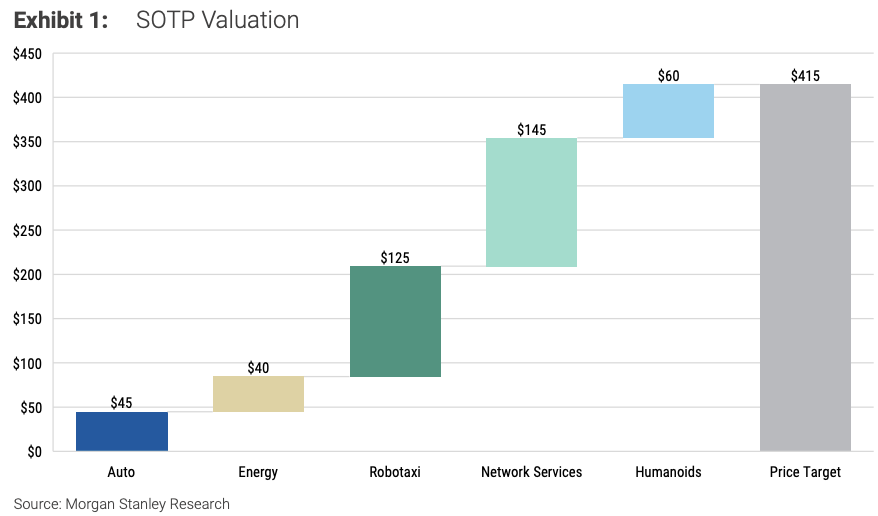
Core Insights - Tesla is transitioning from an electric vehicle manufacturer to a leader in physical AI, requiring significant capital expenditure, with projections for 2026 exceeding $20 billion, far above the market expectation of $11 billion [1][2] - Morgan Stanley has adjusted Tesla's target price from $425 to $415, maintaining a "hold" rating due to concerns over the company's future capital expenditures [1][6] - The anticipated cash burn for Tesla in 2026 is projected at $8.1 billion, a significant increase from a previous estimate of $1.3 billion [2] Financial Forecast Adjustments - Capital expenditure expectations have risen sharply from $13 billion to $21 billion, primarily to support infrastructure for physical AI [2] - Free cash flow is expected to turn negative, with a forecasted cash burn of $8.1 billion in 2026 and $500 million in 2027, only returning to positive in 2028 [2] - Operating expenses are projected to rise to 14.5% of sales in 2026, up from 13% in 2025, reflecting substantial investments in growth and AI projects [2] Strategic Transition - CEO Elon Musk announced the cessation of Model X and S production, reallocating resources to the production of Optimus humanoid robots, with an annual capacity target of 1 million units [3] - Tesla's Robotaxi initiative is progressing well, with over 500 vehicles currently operating in the San Francisco Bay Area, exceeding earlier expectations [3] - Plans are in place to launch Robotaxi services in seven additional cities in the first half of 2026 [3] AI Investment - Tesla has committed $2 billion to xAI to accelerate its physical AI market strategy, with the integration of the Grok chatbot into Tesla vehicles enhancing management capabilities for future autonomous fleets [4] - The company is exploring the establishment of a domestic chip manufacturing facility to mitigate potential supply chain constraints [4] Energy Business Outlook - The energy segment is expected to grow significantly in 2026, driven by the introduction of Megapack 3 and Megablock, although profit margins may face pressure from increased tariffs and competition [5] - Tesla plans to establish solar manufacturing capacity of approximately 100 gigawatts annually, indicating a long-term commitment to renewable energy [5] Valuation Adjustments - Morgan Stanley's target price adjustment reflects anticipated declines in adjusted EBITDA for 2026 and 2027, alongside increased cash consumption due to capital expenditures [6][9] - The base case target price of $415 implies a 50x EBITDA valuation for 2030, consistent with previous models, while bull and bear case scenarios have also been revised [9]