NEO系统

Search documents
AI智能体退烧、国产硬核突围,英伟达再定行业格局
3 6 Ke· 2026-03-26 02:33
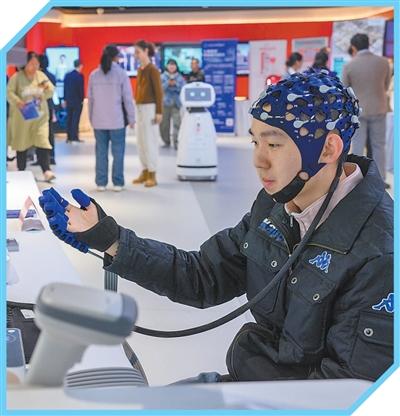
Group 1 - The technology sector is transitioning from "concept hype" to "value realization," with significant breakthroughs and controversies shaping the future landscape of technology [1][19] - AI agents have seen a cooling off period, with users reporting issues related to stability and practicality, highlighting the need for improvement in task execution and tool utilization [2][4] - Major companies are competing in the AI agent space, but many projects remain in the "toy" stage, lacking true business value despite some domestic products making progress in practical applications [4][5] Group 2 - A significant milestone was achieved with the approval of the world's first invasive brain-computer interface (BCI) medical device in China, breaking foreign monopolies and entering the commercialization phase [6][8] - The NEO system, a domestic invasive BCI, has shown promising clinical results, enabling paralyzed patients to perform basic movements and significantly improving their motor function [8] - In the energy sector, breakthroughs in commercial space and advanced physics are accelerating, with successful satellite launches and advancements in antimatter transportation paving the way for practical applications [16][18] Group 3 - NVIDIA's GTC 2026 conference set the tone for the next phase of AI development, focusing on Physical AI and the introduction of the Vera Rubin architecture, which is expected to generate significant chip orders by 2027 [9][11] - The competitive landscape in generative AI is shifting towards efficiency and scene adaptation, with Luma AI's Uni-1 model achieving notable performance improvements and cost reductions [13][14] - The industry is facing challenges in integrating generative AI into business processes, with many companies struggling to establish clear ROI despite significant investments [14]


马斯克领衔,脑机接口商业化元年来了?
Tai Mei Ti A P P· 2026-01-16 08:14
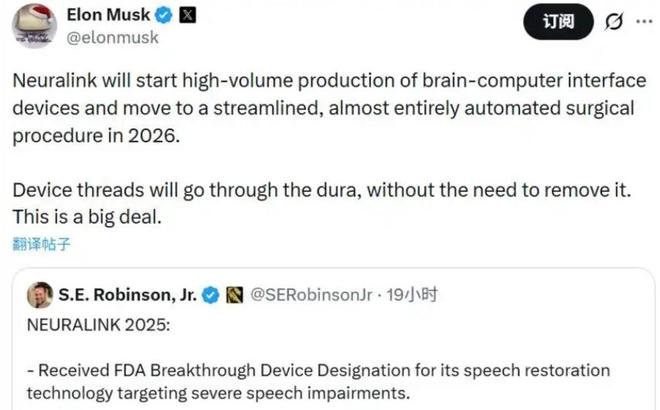
Core Insights - The announcement by Elon Musk regarding Neuralink's plans for large-scale production and fully automated surgeries in 2026 marks a significant step towards the commercialization of brain-machine interfaces (BMIs) [1][2] - The excitement in global capital markets is evident, with related stocks in the A-share market experiencing significant gains, indicating a strong investor interest in the BMI sector [2] Group 1: Technological Advancements - Neuralink is leading the invasive BMI sector by integrating AI into the entire process, significantly reducing surgery time from 6-8 hours to approximately 30 minutes, which is described as a "production line" approach [3][4] - The R1 surgical robot developed by Neuralink utilizes AI for real-time navigation, achieving micro-level precision in electrode placement, thus minimizing surgical trauma [3] - Neuralink's devices can decode neural signals with over 95% accuracy, allowing paralyzed individuals to perform tasks like gaming and social media interaction using only their thoughts [4] Group 2: Competitive Landscape - Chinese companies are exploring different technical routes in the BMI space, with firms like Boryeong and BrainTiger focusing on semi-invasive and flexible electrode technologies to balance signal quality and safety [5][6] - Boryeong's NEO system has successfully completed surgeries on 36 spinal injury patients, demonstrating the potential for restoring motor functions [5] - BrainTiger has made strides in real-time Chinese language decoding, achieving a 71.5% accuracy rate in clinical trials, showcasing advanced capabilities in high-level brain function decoding [6] Group 3: Market Challenges - Despite the technological advancements, the BMI industry faces significant hurdles in transitioning from innovative technology to a mature business model, with current clinical trials being limited in scope [7][8] - The market for BMIs is highly specialized, targeting severe neurological conditions, which may limit its immediate commercial viability [8] - The long-term reliability of implanted devices is a concern, as immune responses can lead to signal degradation, posing challenges for sustained use [9] Group 4: Ethical and Regulatory Considerations - The collection and use of neural data raise ethical questions regarding privacy and data security, with a lack of established regulations in place [10][11] - The potential for misuse of technology and risks associated with hacking highlight the need for a robust ethical framework to guide the commercialization of BMIs [10][11] - The balance between investor enthusiasm and the practical realities of the BMI market will be crucial for the industry's future [11]
脑机接口行业深度报告:解码大脑交互密码,开启人机协同纪元
EBSCN· 2025-12-26 11:02
Investment Rating - The report maintains an "Overweight" rating for the biomedical sector [4] Core Insights - The brain-computer interface (BCI) industry is at a critical stage of policy support, rapid technological iteration, and accelerated commercialization, with a global market approaching $10 billion [3][9] - The industry is driven by both policy and technology, with significant investments from major countries, including approximately $4.5 billion from the U.S. BRAIN Initiative and hundreds of billions in China [1][51] - The medical application of BCI technology is the most mature segment, focusing on neurorehabilitation, functional replacement, and disease treatment, with a dual growth curve emerging from medical and consumer applications [2][45] Summary by Sections Industry Overview - BCI is defined as a technology that creates a communication channel between the brain and external devices, enabling direct information exchange [16] - BCI can be categorized into invasive, semi-invasive, and non-invasive types, each with distinct applications in medical rehabilitation, consumer interaction, and military use [17][19] - The global BCI market is projected to grow from $1.2 billion in 2019 to approximately $7.63 billion by 2029, with a compound annual growth rate (CAGR) exceeding 13% [24] Policy Guidance - Major countries have launched BCI-related initiatives, with the U.S. and EU leading in funding and research efforts [52][53] - China's "Brain Plan" aims to enhance brain science and BCI technology, with significant funding expected in the coming years [54][57] Clinical Applications - The medical sector is the primary focus for BCI applications, with significant demand driven by conditions such as stroke and disabilities [45][48] - Clinical trials for BCI products are accelerating globally, with notable advancements in both invasive and non-invasive technologies [3][19] Industry Progress - The report highlights the competitive landscape, noting that while foreign companies like Neuralink and Synchron have a head start, domestic firms are making significant strides in key areas such as flexible electrodes and real-time language decoding [2][4][30] - The BCI industry is characterized by a complex supply chain, with upstream components like electrodes and chips, midstream product supply, and downstream applications across various sectors [30][33] Investment Recommendations - Investors are advised to focus on companies with strong technological barriers and clinical application capabilities, particularly in the medical sector, which is the most developed area for BCI commercialization [3][9] - Specific companies to watch include medical scene integrators and leaders in invasive/semi-invasive technologies, such as Xiangyu Medical, Weisi Medical, and Brain Tiger Technology [3][9]




未来产业的现在进行时
Ren Min Ri Bao· 2025-11-20 01:05
Quantum Technology - China has established the world's largest quantum communication network, comprising 8 core sites and 159 access stations [4] - The third-generation superconducting quantum computer "Benyuan Wukong" is set to officially operate in January 2024, with over 80% domestic components [9] - "Benyuan Wukong" has been accessed over 37 million times by users from 163 countries, completing 740,000 quantum computing tasks across various fields [11] Biological Manufacturing - Biological manufacturing combines traditional fermentation and synthetic biology, opening new industrial spaces [12] - China holds over 70% of global biological fermentation capacity, leading in the production of amino acids and organic acids [12] - Challenges include the need for core strains and key enzymes, as well as the development of a robust biological information database [13] Nuclear Fusion Energy - Controlled nuclear fusion, known as "artificial sun," is advancing with significant breakthroughs in technology [14][15] - The "China Circulation No. 3" has achieved record ion and electron temperatures of 120 million and 160 million degrees Celsius, respectively [15] - By 2027, "China Circulation No. 3" is expected to conduct burning plasma experiments, moving towards commercial fusion power generation by mid-century [15] Brain-Computer Interface - Brain-computer interface technology is expanding into various fields, including medical rehabilitation and consumer electronics [17][18] - The industry is supported by a collaborative ecosystem involving research, industry, and policy frameworks [18] - Key focus areas include core technology development, innovation ecosystem enhancement, and ethical regulatory frameworks [18] Humanoid Robotics - Humanoid robots are evolving rapidly, with advancements in joint modules and motion control [19][20] - The Shenzhen area is developing a "embodied intelligence port," fostering a complete industrial chain from R&D to application [20] - The local government has introduced action plans to promote technological innovation and industry development in humanoid robotics [20] 6G Technology - 6G technology aims to enhance connectivity and integrate various technologies, supporting the development of a smart society [21][22] - It is expected to achieve 10 to 100 times the speed and reliability of 5G, covering all domains of connectivity [21] - China is advancing in 6G research and aims for commercial implementation by 2030 [22]