
NVIDIA A100

Search documents
半导体-中国 AI GPU:加速追赶美国技术-Greater China Semiconductors-China AI GPUs – Closing the Gap with the US
2026-03-12 09:08
March 11, 2026 10:21 PM GMT Greater China Semiconductors M Asia Pacific Insight China AI GPUs – Closing the Gap with the US High AI capex and sustained policy support have catalyzed China's AI GPU ecosystem. In this deep dive, we introduce a framework to assess the sector's commercial value, competitiveness, and consolidation path. Rapid expansion of AI technologies is driving China's transition toward a higher quality growth model. Last year, we examined the state of AI development in China and its traject ...


亚马逊 500 亿美元发债背后:AI 狂潮正在制造一场企业债危机
美股研究社· 2026-03-11 11:59
*内容仅为呈现不同市场观点与研究视角,并不意味着本公众号对文中观点结论认可。 每一轮技术革命,都会伴随着一轮资本狂潮。 而当资本狂潮到达顶峰时,资产负债表往往比技 术本身更值得警惕。 历史上,铁路革命、互联网泡沫以及页岩油繁荣,无一不是在技术叙事的高潮中,留下了沉重 的债务遗产。技术或许是真的,但买单的方式往往决定了结局的惨烈程度。 亚马逊最新一笔接近 500 亿美元的发债计划,让 AI 基础设施竞赛再次暴露出一个被忽视的问 题——这场算力战争,正在越来越依赖债务融资。在资本市场的叙事中,AI 被描述为"下一个 互联网",象征着无限的边际收益与轻资产扩张。但从资产负债表上看,它更像是一场史无前 例的企业债扩张周期。科技巨头们正在用工业时代的资本密度,去追逐信息时代的的增长梦 想。 如果这种趋势持续下去,AI 泡沫的终局,或许不会是技术破灭,而是债务结构的压力测试。当 利率波动遇上资产贬值,那些杠杆最高的玩家,可能最先倒在黎明之前。 5 0 0 亿 美 元 融 资 : A I 算 力 战 争 进 入 " 债 务 时 代 " 【如需和我们交流可扫码添加进社群】 370 亿美元的美元债券发行,加上计划中的 100 ...



半导体先进封装产业解读
2026-03-09 05:17
半导体先进封装产业解读 20260308 摘要 先进封装已成为超越摩尔定律的关键路径,通过倒装、TSV、RDL 等技 术解决 7nm 以下制程漏电功耗高、成本指数级增长及算力传输损耗等 物理瓶颈。 CoWoS-S 凭借硅中介层与 TSV 实现高性能互联,是 NVIDIA H100/A100 及 AMD MI300 等旗舰 AI 芯片的主流方案,但成本较高。 CoWoS-L 通过硅桥局部互联平衡性能与成本,目前在台积电为英特尔 提供的 2.5D 封装中占比约 60%,是未来超大尺寸 AI 芯片及国内华为升 腾、寒武纪等工艺迁移的方向。 CoPoS 技术以矩形面板替代圆形硅中介层,可将材料利用率从 70%- 75%提升至 100%,台积电计划 2026 年试产、2027 年量产,盛合晶 微、长电、甬矽处于调研打样阶段。 国内现阶段 CoWoS 形态严格意义上属于 2.5D 水平集成,长电科技 XDFOI 已布局类似 2.5D CoWoS 形态,而 3D 垂直集成(如 HBM)仍 需中介层具备功能性实现。 CoWoP 旨在取消昂贵的基板环节,直接将芯片组合安装至 PCB,但受 限于热膨胀系数差异及信号线宽要求,目前 ...

NVIDIA Corporation (NVDA) Powers the Next Era of Cloud and High-Performance Computing
Yahoo Finance· 2026-03-05 00:39
NVIDIA Corporation (NASDAQ:NVDA) is one of the best blue chip stocks to buy for the long term. On March 3, Akamai Technologies (NASDAQ:AKAM) announced it has acquired thousands of NVIDIA Blackwell GPUs to expand its distributed cloud infrastructure for AI inference workloads. The $14.2 billion cybersecurity and cloud computing company, whose stock has risen 26% over the past six months, said the deployment will support AI research, fine‑tuning, and post‑training optimization across its global network while ...
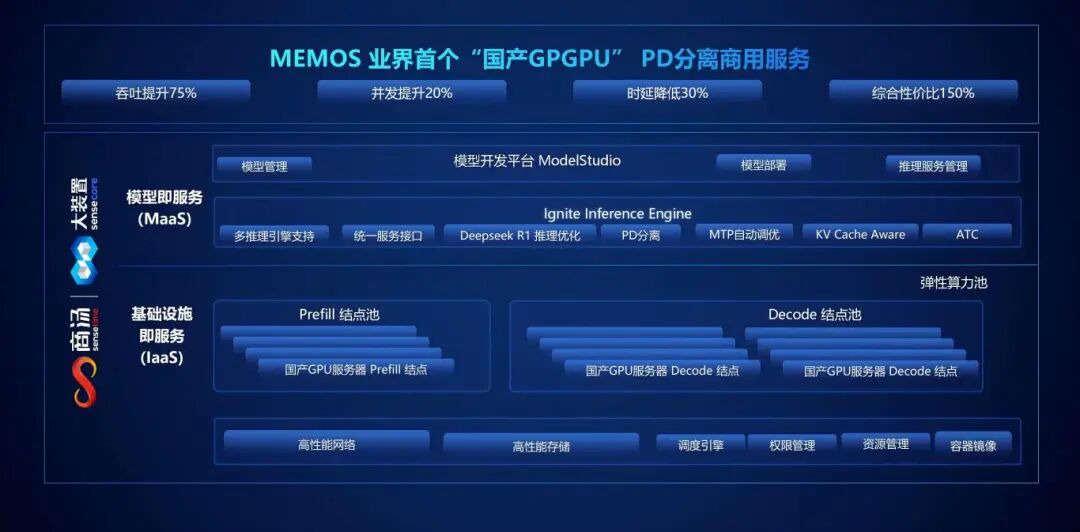
业界首个!记忆张量联手商汤大装置落地国产 PD 分离集群,推理性价比达 A100 的 150%
Xin Lang Cai Jing· 2025-12-05 12:56
Core Insights - The collaboration between Memory Tensor and SenseTime has successfully implemented the first commercial inference cluster based on "memory-computation-scheduling" integration on domestic GPGPU, achieving a 20% increase in single-card concurrency and a 75% increase in throughput, with a cost-performance ratio reaching 150% of the NVIDIA A100 [1][8][6] Group 1: Technological Advancements - The core product MemOS by Memory Tensor is the only memory-centric infrastructure that covers system design from low-level inference to memory models and application engineering, categorizing cognitive structures into three types of memory and forming a scheduling link across time scales [5][9] - The PD separation has transitioned from an optimization technique to a new inference paradigm, allowing for a comprehensive description and measurement of performance in production environments [5][12] Group 2: Performance Metrics - The overall throughput of the cluster improved by over 75%, increasing from 107.85 tokens/s to 189.23 tokens/s, effectively decoupling computation and storage [6][12] - Single-card concurrency capability increased by approximately 20%, from 25.00 concurrent requests per card to 29.42, significantly reducing the risk of queuing and overflow during peak periods [6][12] - The total time to first token (TTFT) remained stable below 2 seconds, with a 70%+ increase in KV Cache hit rate in popular scenarios, enhancing the cost-effectiveness of inference for high-frequency, multi-turn interactions [6][12][13] Group 3: Future Directions - Future collaborations will focus on building a memory-driven pipeline inference foundation on a larger scale of domestic GPGPU clusters, creating observable, reversible, and evolvable infrastructure capabilities [7][14] - The shift from parameter computation to memory computation and from static inference to dynamic pipelines positions domestic GPGPU as a potential leader in defining the next generation of inference paradigms [7][14]
实锤了:GPU越多,论文接收率越高、引用越多
机器之心· 2025-10-17 08:12
Core Insights - The article discusses the significant advancements in the AI field over the past three years, primarily driven by the development of foundational models, which require substantial data, computational power, and human resources [2][4]. Resource Allocation and Research Impact - The relationship between hardware resources and the publication of top-tier AI/ML conference papers has been analyzed, focusing on GPU availability and TFLOPs [4][5]. - A total of 5,889 foundational model-related papers were identified, revealing that stronger GPU acquisition capabilities correlate with higher acceptance rates and citation counts in eight leading conferences [5][9]. Research Methodology - The study collected structured information from 34,828 accepted papers between 2022 and 2024, identifying 5,889 related to foundational models through keyword searches [8][11]. - A survey of 229 authors from 312 papers indicated a lack of transparency in GPU usage reporting, highlighting the need for standardized resource disclosure [9][11]. Growth of Foundational Model Research - From 2022 to 2024, foundational model research has seen explosive growth, with the proportion of related papers in top AI conferences rising significantly [18][19]. - In NLP conferences, foundational model papers have outpaced those in general machine learning conferences [22]. Research Contributions by Academia and Industry - Academic institutions contributed more papers overall, while top industrial labs excelled in single-institution output, with Google and Microsoft leading in paper production [29][32]. - The research efficiency between academia and industry is comparable, with industry researchers publishing an average of 8.72 papers and academia 7.93 papers [31]. Open Source Models and GPU Usage - Open-source models, particularly the LLaMA series, have become the predominant choice in research, favored for their flexibility and accessibility [35][37]. - NVIDIA A100 is the most widely used GPU in foundational model research, with a notable concentration of GPU resources among a few institutions [38][39]. Funding Sources and Research Focus - Government funding is the primary source for foundational model research, with 85.5% of papers receiving government support [41][42]. - The focus of research has shifted towards algorithm development and inference processes, with a significant portion of papers dedicated to these areas [42]. Computational Resources and Research Output - The total computational power measured in TFLOPs is more strongly correlated with research output and citation impact than the sheer number of GPUs used [44][45]. - While more resources can improve acceptance rates, the quality of research and its novelty remain critical factors in the review process [47].

第四范式发布“Virtual VRAM”虚拟显存扩展卡 GPU资源利用率实现突破
Zhi Tong Cai Jing· 2025-09-30 01:39
Core Insights - The rapid development of AI large models has highlighted GPU memory capacity as a critical bottleneck for training and inference efficiency [1][3] - Fourth Paradigm has launched the "Virtual VRAM" plug-in virtual memory expansion card, which transforms physical memory into a dynamically scheduled memory buffer pool, allowing for elastic expansion of GPU computing resources [1][2] Company Overview - Fourth Paradigm's "Virtual VRAM" can expand the virtual memory capacity of a single graphics card up to 256GB, significantly enhancing the capabilities of existing GPUs without requiring hardware changes [2] - The product is designed for two main application scenarios: addressing insufficient memory for large model single-card operations and enabling multiple models to be deployed on the same GPU in light-load scenarios [2] Industry Implications - As the number and parameter scale of AI models continue to grow rapidly, memory capacity has become a key factor in building AI capabilities and controlling costs for enterprises [3] - The new product from Fourth Paradigm is expected to provide a cost-effective computing expansion solution, helping users maintain high performance while achieving cost reduction and efficiency improvement [3] - Future plans include collaborations with more memory manufacturers to further optimize and popularize AI infrastructure [3]