
Nand

Search documents
Micron Stock Falls As Investors Suspect Peak Is Near And Take Profits
Investors· 2026-03-19 15:08
Core Viewpoint - Micron Technology reported impressive earnings, but investors are concerned that the peak performance may be nearing, leading to profit-taking in the stock [1][3]. Financial Performance - Micron's earnings surged 682% year-over-year to an adjusted $12.20 per share for fiscal Q2, with revenue increasing 196% to $23.86 billion, marking the third consecutive quarter of revenue acceleration [2][3]. - For fiscal Q3, Micron forecasts adjusted earnings of $19.15 per share, up 903%, on sales of $33.5 billion, up 260% [3]. Stock Market Reaction - Following the earnings report, Micron's stock fell nearly 2% to $453.79, with an earlier drop of up to 8.8% to $421.11 [4]. - The stock had previously reached a record high of $471.34 after breaking out of a consolidation pattern [4]. Analyst Insights - Analysts from Mizuho Securities expressed concerns that Micron's forecasted gross margin of 81% for fiscal Q3 may indicate a peak for the company [5]. - Micron anticipates capital expenditures exceeding $25 billion for fiscal 2026, a significant increase from the previous estimate of $20 billion [6]. - Analysts suggest that heavy investments in new manufacturing capacity could lead to oversupply, which is historically a sign of a peak in the memory cycle [6][7]. Market Position and Future Outlook - At least 17 Wall Street analysts raised their price targets for Micron following the earnings report, with Barclays increasing its target to $675 from $450 [9]. - Analysts believe that the peak for DRAM and NAND chips may occur in the second half of 2027, with Micron's strong performance driven by AI demand and supply constraints [8][11]. - Micron's strategic customer agreements are seen as indicators of stability and visibility for future growth [10].

Micron Obliterates Wall Street's Q2 Targets On AI Data Center Business
Investors· 2026-03-18 20:44
Core Viewpoint - Micron Technology reported exceptional fiscal Q2 results, exceeding Wall Street expectations, driven by strong demand in the AI data center sector, although its stock experienced a slight decline in after-hours trading [1][2]. Financial Performance - Micron achieved adjusted earnings of $12.20 per share on sales of $23.86 billion for the quarter ending February 26, significantly surpassing analyst expectations of $9.19 per share on sales of $19.97 billion [2][3]. - Year-over-year, Micron's earnings surged by 682%, while sales increased by 196% [2]. - For the upcoming quarter, Micron forecasts adjusted earnings of $19.15 per share on sales of $33.5 billion, compared to analyst expectations of $12.03 per share on sales of $24.29 billion [3]. Market Position and Strategy - Micron set new records in revenue, gross margin, earnings per share (EPS), and free cash flow in fiscal Q2, attributed to strong demand, tight industry supply, and effective execution [4]. - The company is investing in its global manufacturing capabilities to meet the growing demand for memory as a strategic asset in the AI era [5]. - Micron's stock has seen a year-to-date increase of 62% and recently broke out of a six-week consolidation period [6]. Product Development - Micron has begun volume shipments of HBM4 memory systems to support Nvidia's data center applications, with plans to expand capacity [9]. - The company produces two main types of memory chips: DRAM and NAND, competing with major players like Samsung and SK Hynix [7]. Stock Performance - In after-hours trading, Micron's stock slipped over 1% to 455, after closing at 461.73 during regular trading, where it reached an intraday record high of 471.34 [5][6]. - Micron is featured on three IBD lists, indicating strong market interest and performance [9].
和海外算力共振了——半导体设备ETF(159516)大涨点评
Sou Hu Cai Jing· 2026-01-15 09:31
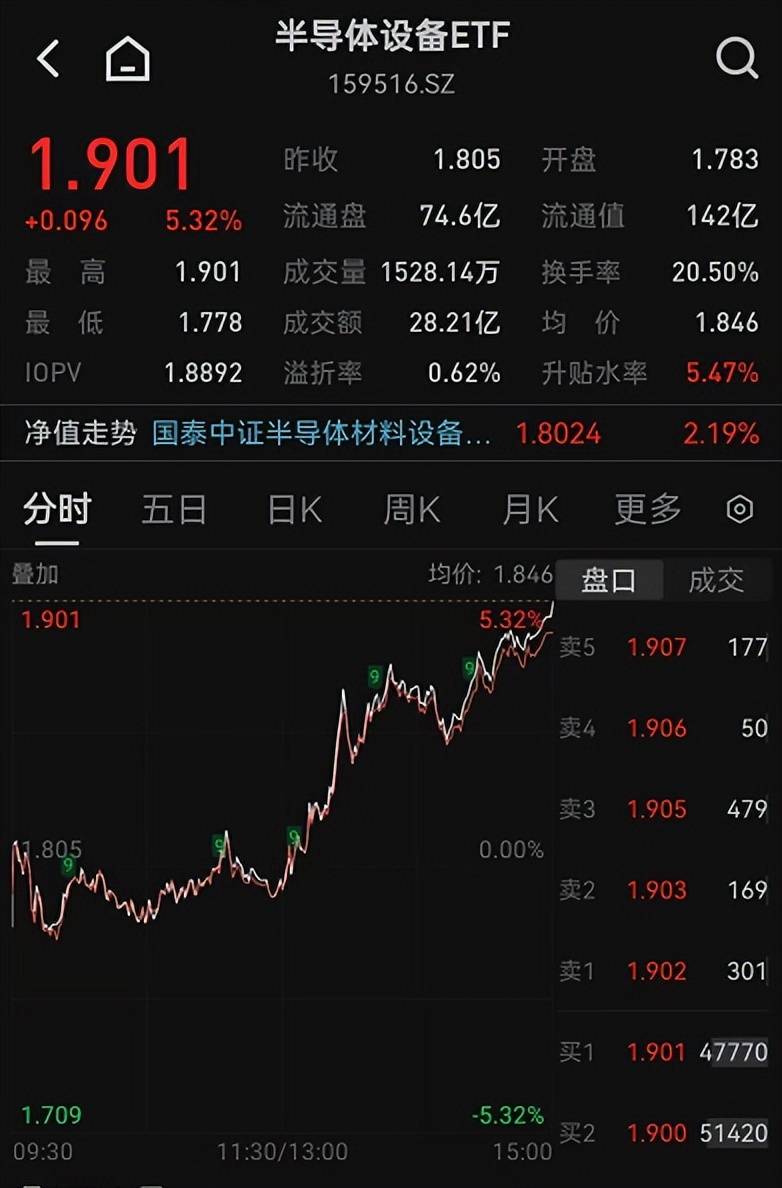
Market Overview - The total trading volume in the Shanghai and Shenzhen markets was 2.91 trillion yuan, a decrease of 1.04 trillion yuan compared to the previous trading day [1] - The Shanghai Composite Index fell by 0.33%, while the Shenzhen Component Index rose by 0.41%, and the ChiNext Index increased by 0.56% [1] - The Semiconductor Equipment ETF (159516) saw a significant increase, closing up by 5.32% [1] Semiconductor Equipment ETF Details - The closing price of the Semiconductor Equipment ETF was 1.901, with an opening price of 1.805 and a lowest price of 1.783 [2] - The trading volume was 15.28 million shares, with a turnover rate of 20.50% [2] - The total trading value reached 2.821 billion yuan, with an average price of 1.846 [2] Factors Driving Growth - TSMC's capital expenditure (capex) expectations exceeded forecasts, with projections of 52 to 56 billion USD for 2026, indicating a growth rate of 27% to 37% compared to 2024's 40.9 billion USD [3] - The domestic semiconductor equipment industry is resonating with global computing power demands, as TSMC remains a key player in AI-related manufacturing [3] - The AI boom is expected to drive demand for various components, including PCBs and memory products, further enhancing the semiconductor industry's outlook [3] Storage Market Insights - The current increase in storage prices is attributed to rising demand driven by AI, with the global storage industry entering an expansion phase [4] - The domestic storage sector is benefiting from this price surge, with expectations of increased production capacity [4] Future Outlook - The AI technology wave is unlikely to slow down in the short term, with storage shortages expected to persist until 2026 [5] - The growth rate of storage demand may outpace that of chips, necessitating sufficient storage to match the increasing computational needs [5] - The Semiconductor Equipment ETF (159516) is recommended for continued observation, as ongoing price increases and upcoming product launches are expected to boost the semiconductor equipment sector [5]


踏雪追光,算力不眠——通信ETF及半导体设备ETF大涨点评
Sou Hu Cai Jing· 2025-12-23 01:18
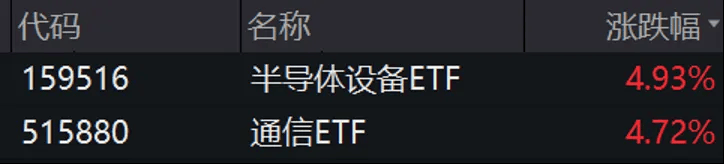
Market Overview - The market opened high and continued to rise, with total trading volume in Shanghai and Shenzhen reaching 1.86 trillion yuan, an increase of 136 billion yuan from the previous trading day. The Shanghai Composite Index rose by 0.69%, the Shenzhen Component Index by 1.47%, and the ChiNext Index by 2.23% [1] Company Performance - Micron Technology reported its FY26 Q1 earnings, with revenue of $13.643 billion, exceeding market expectations of $12.95 billion and its own previous forecast of $12.5 billion. The revenue growth was driven by price increases, improved cost execution, and a shift towards higher-value products. The DRAM segment, which accounts for 79% of revenue, saw a year-over-year growth of 69%, with an average selling price (ASP) increasing by 20% quarter-over-quarter. NAND revenue also increased by 22% quarter-over-quarter [2][3] Capital Expenditure - Micron raised its capital expenditure guidance for FY26 to $20 billion from the previous estimate of $18 billion, reflecting ongoing strong demand in the AI sector. The company indicated that storage supply will remain significantly short, potentially lasting until 2026 and beyond [2] Industry Trends - Fiber optic prices in China have been rising since Q3, driven by strong demand and tight overall supply. The demand is fueled by AI needs in North America and anticipated increases in fiber demand by 2027. Additionally, data center interconnect (DCI) is expected to contribute significantly to demand [4] Economic Policy Impact - The Bank of Japan raised interest rates by 25 basis points to 0.75%, the highest level in 30 years. This move alleviated short-term concerns about the impact of Japanese rate hikes on global market liquidity [4] Future Outlook - The communication sector remains robust, with a projected doubling of the optical module market growth by 2026. The demand is driven by rapid growth in GPU and ASIC shipments, leading to increased networking needs. The upcoming product iterations from Nvidia and Google are expected to further boost demand for high-end optical modules [5] ETF Insights - The communication ETF includes over 48% optical modules and 9% fiber optics, reflecting the fundamentals of North American AI progress. The semiconductor equipment ETF is also expected to benefit from Micron's increased capex guidance, indicating a potential new wave of capacity expansion in the storage sector [7][6]
Dell, Other Computer Makers Drop On Profit-Margin Concerns
Investors· 2025-11-17 16:34
Core Insights - Morgan Stanley warns that soaring memory-chip prices will negatively impact profit margins for computer makers, leading to downgrades for several companies including Dell Technologies [1][5][6] Memory Market Dynamics - The memory market, particularly Nand and DRAM, is experiencing a pricing 'supercycle' due to increased demand from hyperscalers, a shift to high bandwidth memory (HBM), and previous underinvestment in Nand [2][4] - Spot prices for memory commodities have surged by 50-300% over the past six months, with contract prices expected to rise by double digits each quarter through 2026. Memory fulfillment rates may drop to as low as 40% in the next two quarters [3] Company-Specific Downgrades - Dell Technologies' stock was downgraded from overweight to underweight, with a price target reduced from $144 to $110. Hewlett Packard Enterprise's rating was cut to equal weight with a target of $25, down from $28. HP's stock was downgraded to underweight with a target of $24, down from $26 [5][6] - Other companies affected include Asustek, Giga-Byte Technology, Lenovo, and Pegatron, which were also downgraded by Morgan Stanley [6] Market Reactions - Following the downgrades, Dell's stock fell over 6% to $124.53, HPE's stock dropped more than 6% to $21.34, and HP's stock decreased over 3% to $23.58. In contrast, memory-chip makers Micron Technology and Sandisk are trading at record highs [6]

Memory超级周期:何时退出?
傅里叶的猫· 2025-10-24 14:46
Core Insights - The memory industry is experiencing a cyclical recovery driven by increased capital expenditures from hyperscale companies and demand from AI inference, with historical data suggesting that the industry has not yet reached its peak [5][10] - UBS indicates that demand growth is outpacing supply growth, leading to a projected shortage in the coming year [7] Market Trends - The current memory cycle is reminiscent of past cycles, particularly the rise of cloud computing, with AI inference driving demand [5][7] - Memory stocks have seen an average increase of 178% this year, but to match the peak growth of 160% YoY seen in 2017, contract prices would need to rise by approximately 60% [10] Investment Strategies - Morgan Stanley suggests a more lenient approach to valuations during the upward phase of the cycle and an optimistic outlook on earnings expectations, especially during super cycles [9] - Historical data indicates that memory stocks typically peak 4 to 8 months before earnings peak, suggesting a need for cautious exit strategies [10] Demand and Supply Analysis - The demand and supply model shows that while demand is increasing, supply is not keeping pace, leading to ongoing shortages [12][14] - Inventory levels in the industry are never zero, which means that even in tight supply conditions, there will always be some inventory, affecting pricing dynamics [14]

Micron Trounces Estimates Thanks To AI Data Center Growth
Investors· 2025-09-23 20:38
Core Viewpoint - Micron Technology reported strong fiscal fourth-quarter results, exceeding analyst expectations, driven by robust growth in AI data centers, leading to a rise in its stock price in after-hours trading [1][2]. Financial Performance - Micron earned an adjusted $3.03 per share on sales of $11.32 billion for the quarter ending August 28, surpassing analyst expectations of $2.86 per share and $11.22 billion in sales [2]. - Year-over-year, Micron's earnings increased by 157%, while sales rose by 46%, marking the third consecutive quarter of triple-digit percentage gains in earnings [2]. - For the current quarter, Micron forecasts adjusted earnings of $3.75 per share on sales of $12.5 billion, compared to Wall Street's expectations of $3.10 per share and $11.91 billion in sales [3]. Stock Performance - In after-hours trading, Micron's stock rose nearly 2% to $169.27, following a 1.1% increase during the regular session, closing at $166.41 [4]. - The stock reached a record high of $170.45 in intraday trades last Thursday [4]. Market Position and Strategy - Micron's CEO highlighted the company's strong momentum entering fiscal 2026, emphasizing its unique position as the only U.S.-based memory manufacturer to capitalize on AI opportunities [5]. - The company produces two main types of memory chips: DRAM and NAND, with a recent boost from high-bandwidth memory (HBM) for AI applications [5][6]. - Micron is featured on three IBD lists: IBD 50, Leaderboard, and Tech Leaders, indicating its strong market presence [6].