Nano Banana Pro

Search documents
AI Stocks Worth Adding to Your Portfolio for Healthy Returns
ZACKS· 2026-03-11 17:56
Industry Overview - Artificial Intelligence (AI) is transforming various sectors including robotics, healthcare, finance, cybersecurity, and e-commerce by enabling machines to process data, recognize patterns, and make autonomous decisions [2] - Global AI spending is projected to reach $2.5 trillion by 2026, representing a 44% increase from 2025 [3] - The demand for AI chips is rising, with significant contributions from companies like NVIDIA and Micron Technology, as well as partnerships between OpenAI and AMD/NVIDIA [3] Company Highlights - Micron Technology is experiencing increased demand for High Bandwidth Memory (HBM) and a recovery in DRAM pricing, with DRAM revenues constituting over 79% of its total sales in Q1 of fiscal 2026 [6] - Micron is well-positioned to benefit from AI-related infrastructure spending, particularly in GPU clusters and AI data centers, supported by partnerships with major tech firms [7] - Teradyne is capitalizing on strong AI-related demand, with significant growth in its semiconductor test business, particularly in the System-on-Chip (SoC) and memory test segments [8][9] - Teradyne's compute segment is expected to drive substantial revenue growth, with AI applications projected to account for up to 70% of its revenue in Q1 of 2026 [10] - NVIDIA is benefiting from the AI boom, with strong demand for its GPUs and computing solutions, particularly the Blackwell GPU computing platforms used for AI applications [11] - NVIDIA anticipates a 77% year-over-year revenue increase to $78 billion in Q1 of fiscal 2027, driven by continued AI demand [12]


高中生AI创业,现在只招龙虾员工:每月成本2800
量子位· 2026-03-08 06:45
Core Viewpoint - The article discusses a unique business model where a company operates entirely with AI, without any human employees, showcasing how low-cost entrepreneurship can be effectively achieved through AI technology. Group 1: Company Structure and Operations - The company operates with a monthly cost of $400, acquiring over 450 paying users [2][8]. - It utilizes a complete organizational structure with various departments including design, development, research, content, and operations, all managed by AI [5][6]. - The main operational brain is an AI named Jarvis, which automates task allocation among different AI employees without human intervention [12][13]. Group 2: AI Utilization and Efficiency - The research department, led by Atlas, conducts deep research using multiple APIs to compile industry reports [15]. - The content team, consisting of Scribe and Trendy, produces high-quality articles and tracks trending topics to ensure timely content creation [16][17]. - The design department handles all visual needs with specialized AI tools for static images, videos, and animations [19][20]. Group 3: Development and Quality Assurance - The development and quality assurance are managed by Clawed and Sentinel, which review and optimize code regularly [21][22]. - Clawed reviews the codebase nightly and can initiate multiple AI to collaborate on development tasks [23]. - Sentinel performs quality checks every two hours to monitor code vulnerabilities [24]. Group 4: Entrepreneurial Background and Management - The founder of the company has no coding background and initially had limited knowledge of technology [26][27]. - The entrepreneur effectively communicates with AI through well-crafted prompts, establishing clear work standards and collaboration logic [29][31]. - The company aims to hire efficient managers with their own AI teams rather than traditional developers in the future [34].

海外华人15人团队打造,统一理解与生成的图像模型,超越Nano banana登顶图像编辑
机器之心· 2026-03-06 06:16
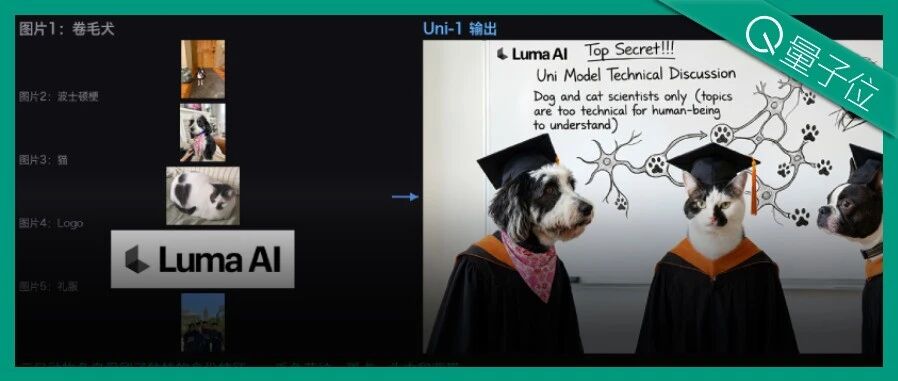
Core Insights - Luma has launched a new image generation model called Uni-1, which integrates understanding and generation within the same architecture, aiming to enhance AI's cognitive capabilities beyond mere image creation [1][2] Model Performance - Uni-1 has demonstrated superior performance in various tasks compared to competitors like GPT Image 1.5 and Google Nano Banana Pro, particularly in generating Chinese text, information graphics, and complex scene compositions [18][22][39] - The model excels in generating visually coherent and contextually relevant outputs, maintaining clarity and structure in dense information graphics [28][36] Technical Features - Uni-1 employs a decoder-only autoregressive Transformer architecture, achieving optimal results on the RISEBench reasoning-informed generation benchmark, which evaluates temporal, causal, spatial, and logical reasoning [10][81] - The model's design allows for a unified approach to visual understanding and generation, enhancing its ability to perform complex tasks that require both capabilities [79][80] Team Background - The core research team behind Uni-1 consists of fewer than 15 members, led by notable scholars with impressive academic backgrounds, including awards and significant contributions to the field of AI [85][90] - Key figures include Song Jiaming, known for his work on diffusion models, and William Shen, recognized for his research across various domains in computer science [88][94] Industry Context - Luma's approach contrasts with larger companies like Google and OpenAI, which rely on vast resources to develop models, suggesting that innovative architecture can yield competitive results even for smaller teams [97][99] - The launch of Uni-1 marks a significant step towards Luma's goal of creating a unified multimodal intelligence system that extends beyond static images to include video, voice, and interactive simulations [98][99]

黑马图像模型被Nano Banana技术负责人点赞!15人华人小队,DDIM之父&CVPR最佳论文作者带队
量子位· 2026-03-06 03:36
Core Viewpoint - Luma AI has launched a new model, Uni-1, which competes directly with Google's Nano Banana Pro and GPT Image 1.5, showcasing advanced capabilities in image understanding and generation [1][6]. Group 1: Model Capabilities - Uni-1 is a unified model for image understanding and generation, featuring abilities such as character pose transfer, storyboard generation, draft and material combination, draft-to-comic transformation, multi-reference scene composition, draft-guided photo editing, UV mapping generation, and greeting card creation with text [3][6]. - In various authoritative task evaluations, Uni-1 not only matches the performance of Nano Banana Pro and GPT Image 1.5 but also achieves world-leading results in certain tasks [6]. - The model excels in generating a Chinese New Year greeting card, accurately rendering text and images, outperforming both GPT Image 1.5 and Nano Banana Pro in text clarity and design [11][12]. Group 2: Performance Comparisons - For multi-reference scene composition, Uni-1 accurately integrates features from multiple reference images, maintaining identity characteristics and organizing them into a coherent scene, while competitors struggled with basic integration [15][16]. - In information graphic extraction tasks, Uni-1 successfully reproduces the layout and all visible text from a real-world poster, while its competitors failed to maintain text accuracy and layout integrity [21]. - The model demonstrates superior capabilities in converting rough sketches into professional-grade comics, maintaining detail and composition accuracy [26]. Group 3: Team and Technology - The impressive results of Uni-1 come from a small team of fewer than 15 researchers, led by notable figures in the field, including Song Jiaming and Shen Bokui, who have made significant contributions to diffusion models and computer vision [8][40][41]. - The core philosophy of Uni-1 is to unify image understanding and generation into a single model, allowing for simultaneous modeling of time, space, and logic, which enhances both understanding and generation capabilities [46][48]. Group 4: Industry Implications - The success of Uni-1 suggests that unified models may represent the future direction of visual AI, enabling complex tasks to be performed within a single framework [51]. - The achievement of a world-class product by a small team highlights that top-tier AI research does not necessarily require large teams or unlimited resources, emphasizing the importance of the right technological approach [52].
Nano Banana 2免费上线,超Pro版本100分登顶竞技场,API价格还对半砍了
3 6 Ke· 2026-02-27 09:50
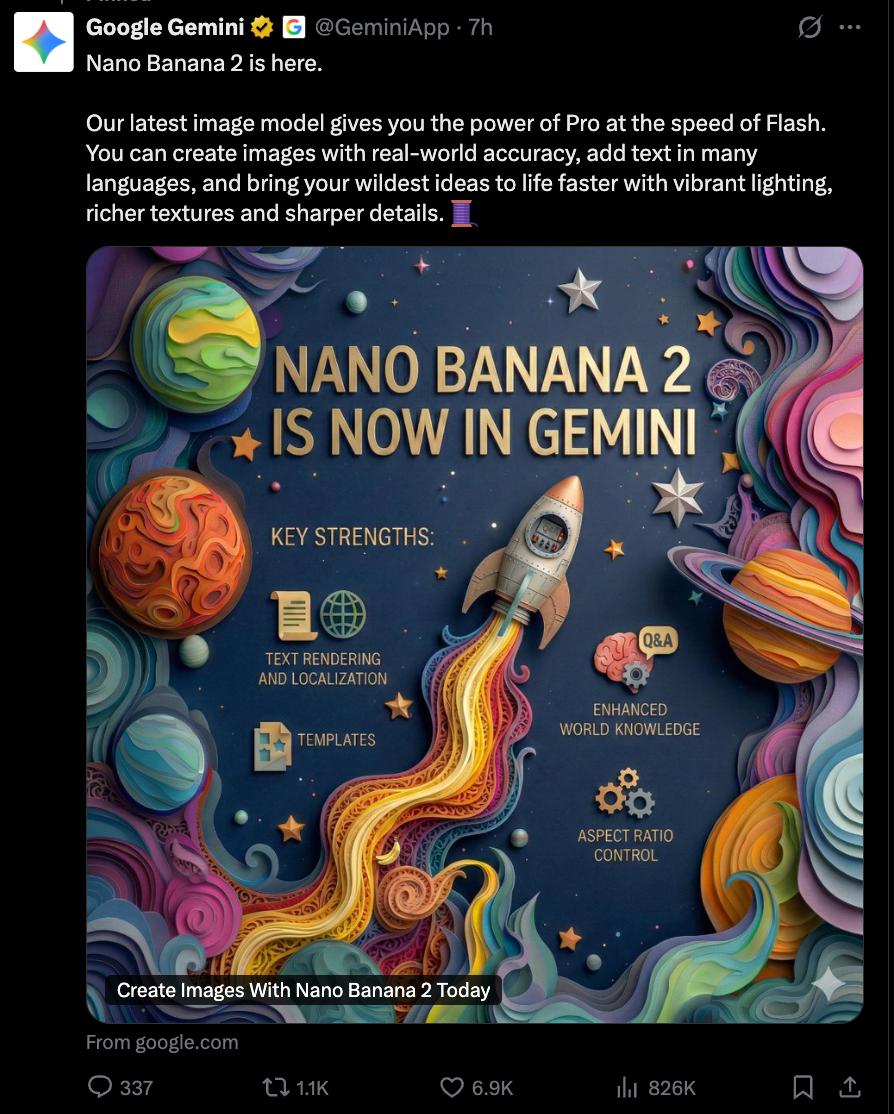
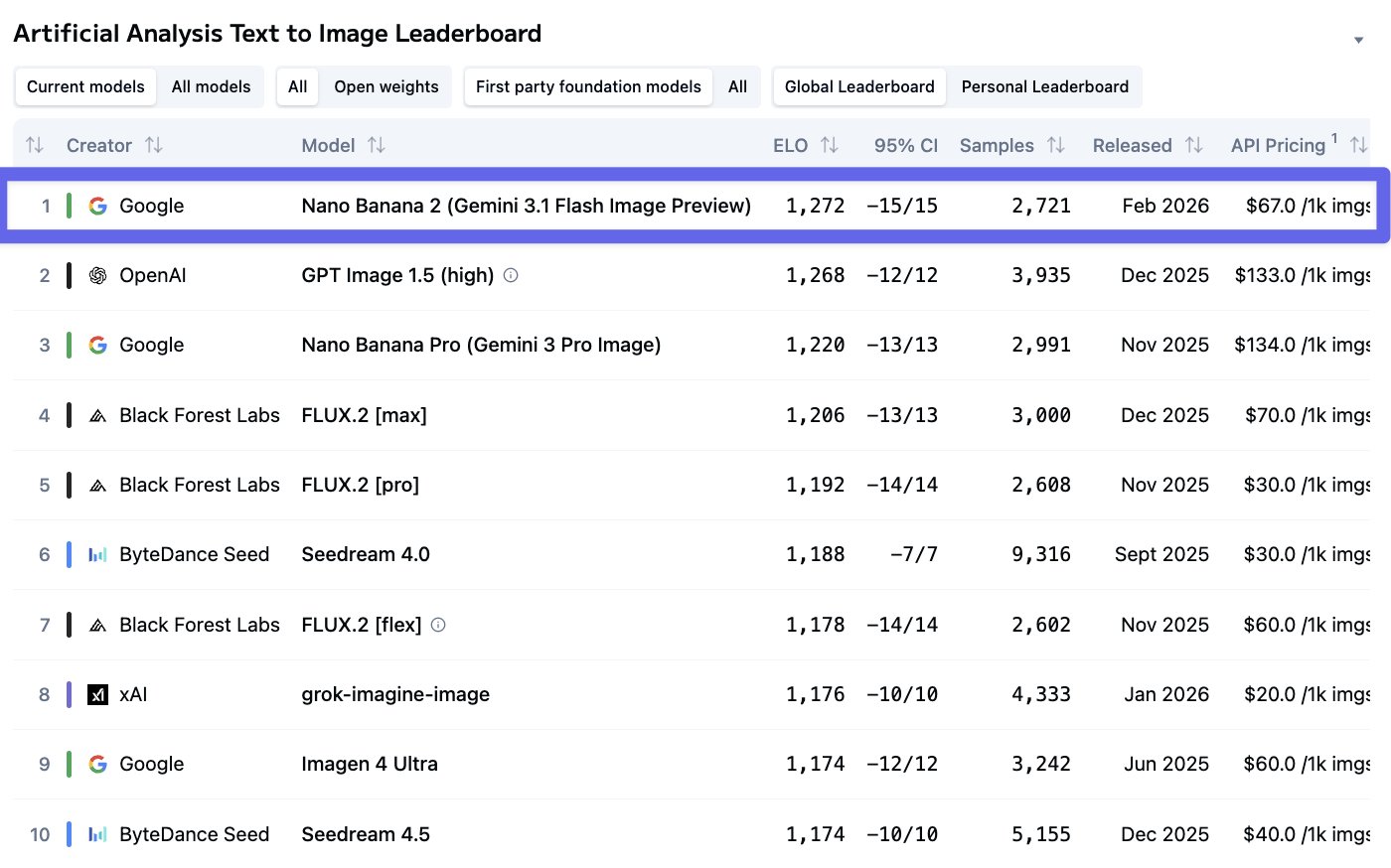
Core Insights - The launch of Nano Banana 2 has redefined image generation and editing capabilities, surpassing its predecessor, Nano Banana Pro, in both performance and cost-effectiveness [4][16]. Group 1: Product Features - Nano Banana 2 combines professional-grade image generation capabilities with high-speed performance, allowing for image creation in just a few seconds [4][6]. - The model enhances creative control, maintaining consistency for up to 5 characters and fidelity for up to 14 objects within a single workflow [8]. - It features improved instruction-following capabilities, enabling the execution of complex prompts with greater accuracy [10]. Group 2: Performance and Pricing - Official tests indicate that Nano Banana 2 outperforms Nano Banana Pro in overall performance, visual quality, and information accuracy [16]. - The pricing structure for image generation is significantly lower, with a 1K resolution image costing approximately $0.067, which is half the price of Nano Banana Pro [15]. - The model has been integrated into Google's search services and advertising business, enhancing its utility and reach [18]. Group 3: Market Impact - The introduction of Nano Banana 2 has sparked discussions about the potential end of the designer era, as users express excitement over the model's capabilities and affordability [21]. - Users are already exploring innovative applications of Nano Banana 2, indicating a strong interest in its creative possibilities [22].

谷歌Nano Banana 2来了,设计师时代结束了?
Di Yi Cai Jing· 2026-02-27 05:54
Core Insights - Google has launched Nano Banana 2 (Gemini 3.1 Flash Image), which combines speed and performance at a lower price point, marking it as the best image generation and editing model to date [1][4]. Group 1: Product Performance - Nano Banana 2 ranks first in the text-to-image leaderboard and third in the image editing leaderboard, outperforming GPT Image 1.5 and Nano Banana Pro [1][4]. - The model offers advanced world knowledge, precise text rendering and translation, thematic consistency, accurate instruction execution, and improved visual fidelity [4][13]. - It can generate high-quality, photo-realistic images while maintaining character likeness and object consistency, enhancing narrative creation [16]. Group 2: Pricing and Cost Efficiency - Nano Banana 2 is priced at half the cost of Nano Banana Pro, with a per-image cost of $0.067 for 1k images and $0.5 for input, compared to $0.134 and $2 for the Pro version [4][5]. - The model's cost-effectiveness has been highlighted by both evaluation agencies, emphasizing its superior performance and speed [4]. Group 3: User Experience and Applications - Google has developed a program called "Window Seat" to demonstrate the model's capabilities, allowing users to generate realistic images based on real-time weather data [5]. - The model supports advanced text rendering and localization, enabling dynamic UI generation and multi-language text integration in images, which is valuable for international businesses [13]. - Users have reported mixed experiences, with some noting issues in accuracy and stability, particularly in complex scenarios [11][16].
Nano Banana 2发布!速度更快,4K直出,接入谷歌全线产品
Founder Park· 2026-02-27 04:07
Core Viewpoint - Google has launched its latest image generation model, Nano Banana 2, which significantly enhances generation speed, multilingual text processing, and real-time internet connectivity, capable of producing 4K images in one go [2][3]. Performance and Rankings - In the Artificial Analysis benchmark test, Nano Banana 2 achieved the top global ranking for text-to-image generation [4]. - It ranked third in image editing capabilities, following GPT Image 1.5 and Nano Banana Pro [5]. - On the Global Leaderboard, Nano Banana 2 scored 1,272 Elo points, outperforming competitors like GPT Image 1.5 and Grok Imagine Image Pro [6][7]. Unique Features - Nano Banana 2 integrates world knowledge and real-time web search, allowing it to generate accurate visual representations based on existing structures and styles [11][12]. - The model can create information graphics and data visualizations, demonstrating its understanding of complex concepts [13][16]. - It features a "Window Seat" application that generates realistic airplane window views based on real geographical and weather data [26][27]. Text Rendering and Localization - The model has improved text rendering capabilities, producing clear and accurate text suitable for marketing materials [28][29]. - It includes a "Global Ad Localizer" tool that translates advertising materials into different languages while adjusting visual elements to fit target markets [31][32]. Quality and Consistency - Nano Banana 2 offers enhanced subject consistency, maintaining the characteristics of up to five characters and fourteen objects within a single workflow [34][35]. - The model supports various resolutions, including a new 512px option optimized for low-latency scenarios, and offers extreme aspect ratios for diverse applications [49][51]. Integration and Availability - Nano Banana 2 is integrated across Google's product line, including the Gemini App, Google Ads, and various developer platforms [101][102][107]. - It replaces the previous Nano Banana Pro model in Fast, Thinking, and Pro configurations, with users able to switch back if needed [104][106].

Nano Banana 2,泄露
3 6 Ke· 2026-02-25 23:26
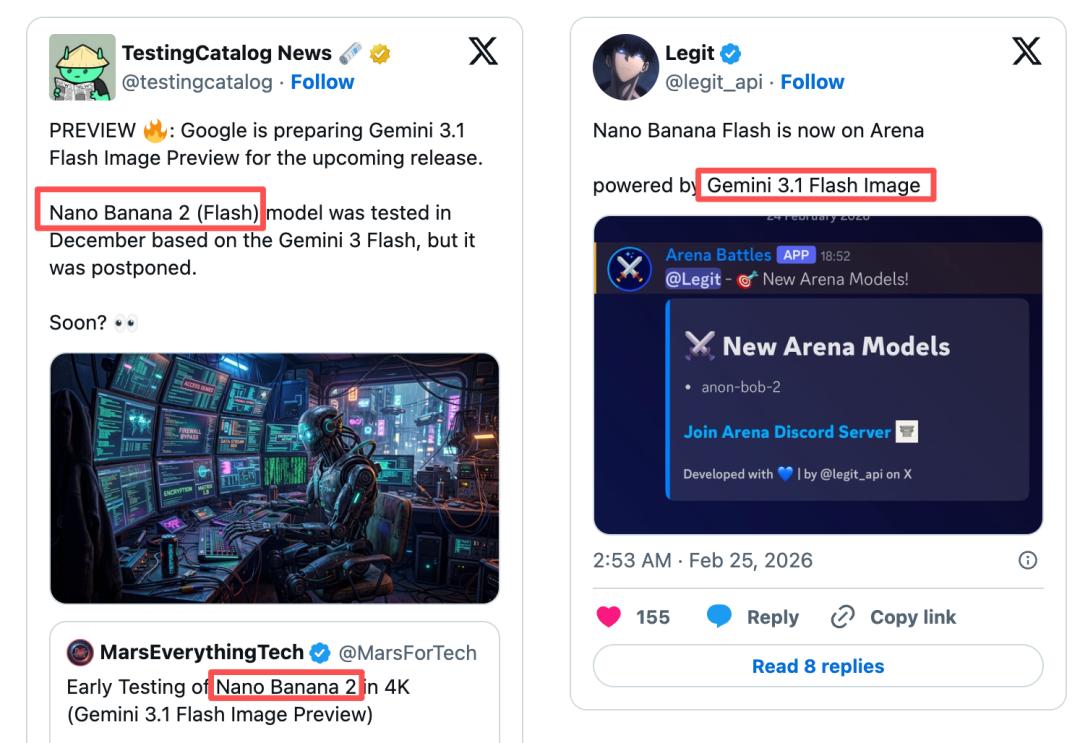
Core Insights - The upcoming release of Nano Banana 2, also known as Gemini 3.1 Flash Image preview, has become a hot topic among AI developers, with significant anticipation regarding its performance and pricing compared to its predecessor, Nano Banana Pro [1][3][16] Group 1: Product Features and Expectations - Nano Banana 2 is expected to offer 4K image generation capabilities, faster processing speeds, and a lower price point than Nano Banana Pro, which has garnered considerable attention in the industry [3][15] - Early tests of Nano Banana 2 have shown promising results in detail generation and text rendering, indicating a strong performance in these areas [6][15] - The model is anticipated to combine the speed and cost advantages of the Flash series with visual quality that is comparable to or better than Nano Banana Pro, potentially revolutionizing the market [15][16] Group 2: Competitive Landscape - The AI image generation competition is intensifying, with recent releases from competitors such as ByteDance's Seedream 5.0, Alibaba's Qwen-Image-2.0, and Zhiyuan's GLM-Image, which may challenge Google's new model [17] - The industry is poised for a new wave of innovation as these developments unfold, suggesting that Nano Banana 2 may not establish a definitive advantage in the market [17]
过了个年,AI 圈变天了?但没人告诉你为什么
歸藏的AI工具箱· 2026-02-25 04:28
Core Insights - The article discusses the significant changes in the AI landscape, particularly the emergence of the "Agent" era, which is characterized by AI systems that can perform tasks autonomously rather than just responding to queries [1][2][4]. Group 1: Changes in AI Functionality - By early 2026, AI has evolved from a simple question-and-answer tool to an autonomous agent capable of understanding intent, breaking down tasks, and delivering completed products [17]. - The new models, such as Claude Opus 4.6 and GPT-5.3 Codex, exhibit improved programming capabilities, judgment, and the ability to work independently for extended periods [19][20][25]. - AI can now participate in its own development, creating a feedback loop that enhances its capabilities over time [31][34]. Group 2: Local Execution and Data Management - The new generation of agents operates locally on users' computers, allowing direct access to files and data without needing to upload or copy-paste [38][40]. - The Model Context Protocol (MCP) enables agents to connect with external services seamlessly, enhancing their functionality [47]. - Skills, which are pre-defined modules of expertise, allow agents to perform specialized tasks without requiring extensive prompts from users [49][56]. Group 3: Team Collaboration and Efficiency - The introduction of SubAgents allows a main agent to delegate tasks to specialized sub-agents, improving efficiency and maintaining the quality of output [99][100]. - Agent Teams enable multiple agents to work simultaneously on different aspects of a project, significantly increasing productivity [108][110]. - The use of Git's file locking mechanism ensures that multiple agents can collaborate without conflicts, streamlining the development process [111]. Group 4: Evolution and Knowledge Transfer - The GEP (Genome Evolution Protocol) allows agents to inherit successful strategies from one another, enhancing their learning and adaptability [127][130]. - This evolution in agent capabilities means that the collective knowledge of agents can be shared, reducing the cost and time required for problem-solving across different organizations [132]. Group 5: Implications for the Workforce - The shift towards using agents for various tasks may lead to smaller companies, as fewer human roles are needed to accomplish the same amount of work [150][152]. - The educational system may struggle to keep pace with the rapid advancements in AI, necessitating a shift in focus from execution skills to judgment and decision-making abilities [155][156]. - Middle management roles may be at risk as AI systems become capable of performing tasks traditionally handled by these positions [157].
智谱市值创历史新高
Di Yi Cai Jing Zi Xun· 2026-02-13 08:18
Core Insights - The AI video generation model Seedance 2.0 from ByteDance and the new model GLM-5 from Zhiyu have sparked ongoing excitement in the market, leading to significant stock price increases for related companies [2] - The demand for computing power has surged, with the semiconductor equipment index rising by 2.02% and specific companies like Fuchuang Precision and Jingyi Equipment seeing gains of 11.6% and 5.92% respectively [2] Group 1: Market Reactions - On February 13, cultural media theme index saw Light Media rise by 15.3% and Zhangyue Technology by 10%, while AI application index recorded Shen Technology up by 10.02% and Fengyuzhu up by 9.98% [2] - Despite declines in the Hang Seng Index and Hang Seng Tech Index, Zhiyu and MiniMax saw stock increases of 13.78% and 9.86%, with Zhiyu's market capitalization reaching a new high since its listing [2][3] Group 2: Pricing Strategies - Zhiyu announced a price increase for its GLM Coding Plan subscription service, with an overall price hike starting from 30% due to strong market demand and the need for enhanced service quality [4] - The CEO of ListenHub noted that the price increase reflects the growing scarcity and value of tokens as model capabilities improve, confirming earlier expectations of rising costs [5] Group 3: Model Advancements - The GLM-5 model has doubled its parameters from 355 billion to 744 billion and increased its pre-training data from 23 terabytes to 28.5 terabytes, enhancing its capabilities significantly [5] - Multi-modal models like Seedance 2.0 and Nano Banana Pro are consuming tokens at rates far exceeding pure text, indicating a substantial increase in demand for computational resources [6] Group 4: Competitive Landscape - The recent advancements in domestic models like Seedance 2.0 and GLM-5 indicate a shift towards practical applications in work and life, with a focus on video generation and coding [8] - Zhiyu's GLM-5 is directly competing with Anthropic's Claude Opus 4.5, although it still lags behind in certain advanced capabilities [9] - Chinese AI models are rapidly closing the gap with their U.S. counterparts, with significant contributions from companies like DeepSeek and Alibaba, showcasing strong global competitiveness [9]