Neoverse

Search documents
Arm (NasdaqGS:ARM) Conference Transcript
2026-03-24 18:02
Arm (NasdaqGS:ARM) Conference March 24, 2026 01:00 PM ET Company ParticipantsCharlie Kawwas - PresidentJongwook Kye - EVPKevin Weil - Chief Product OfficerMatt Garman - CEOMohamed Awad - EVP of Cloud AIPaul Saab - Software EngineerRani Borkar - PresidentRene Haas - CEOSantosh Janardhan - Head of Global InfrastructureNone - Company RepresentativeNone - Company RepresentativeNone - Video NarratorRene HaasSuch a nice warm welcome. Thank you. Welcome to our live stream audience watching the Arm Everywhere event ...

Arm (NasdaqGS:ARM) Conference Transcript
2026-03-24 18:00
Arm (NasdaqGS:ARM) Conference March 24, 2026 01:00 PM ET Speaker1Please welcome Arm's Chief Executive Officer, Rene Haas.Speaker4Such a nice, warm welcome. Thank you. Welcome to our live stream audience, watching the Arm Everywhere event. I don't think we've ever done a live stream event like this. To the folks here, in the audience, thank you so much for coming to the historic Fort Mason. You may not know that Fort Mason, here in California was actually a official defense site for the Civil War. This is wh ...
Arm Holdings plc (ARM) Enters a Multi-Year Partnerships With Tensor
Yahoo Finance· 2026-03-04 17:17
Core Insights - Arm Holdings plc (NASDAQ:ARM) has entered a multi-year strategic partnership with Tensor to develop the world's first agentic AI personal Robocar, a level 4 autonomous vehicle designed for personal use [1][7] - The Robocar is expected to be commercially launched in 2026 and will utilize over 400 Arm cores per vehicle, marking the highest number of Arm technology integrated into a single vehicle [2] Technology and Features - The Robocar will be equipped with a comprehensive array of sensors, including 37 cameras, 5 lidars, 11 radars, 22 microphones, 10 ultrasonic sensors, 3 IMUs, GNSS, 16 collision detectors, 8 water-level sensors, 4 tire-pressure monitors, a smoke detector, and triple-channel 5G [3] - Arm's processors will be utilized throughout the vehicle, including specialized cores like Neoverse for heavy AI tasks and Cortex-X for in-cabin functionalities and peak control [3] Company Overview - Arm Holdings designs, develops, and licenses CPU products and related technologies for semiconductor companies and original equipment manufacturers [4]
Arm-回调创造买入机会
2026-02-10 03:24
February 6, 2026 05:00 AM GMT Arm Holdings plc | North America Pullback creates a buying opportunity Near-term shortages stress sentiment on royalties growth while a longer term transition to complete chip design offers strong intrigue. These opposing forces add to volatility and will be the tale of price progression into FY27. We keep our $135 price target and Overweight rating despite shortage fears. Key Takeaways Concerns outweigh longer-term transition. Management struck a positive tone on the Q3 result ...
Arm FY26Q3财报一览:Royalty数据中心营收继续翻倍,高研发投入压制利润率抬升
Xin Lang Cai Jing· 2026-02-07 04:35
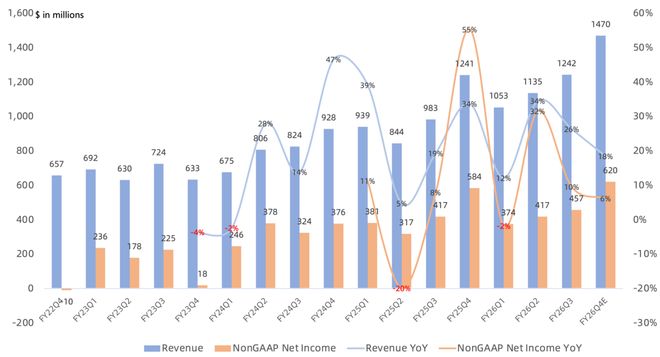
Core Insights - Arm reported Q3 FY26 revenue of $1.24 billion, a 26% year-over-year increase, slightly above market expectations of $1.23 billion [4] - Despite a high gross margin of 97.4%, GAAP operating profit was low at $185 million, below the expected $246 million, primarily due to high R&D expenses [3][4] - Management indicated that the growth in data center revenue is expected to surpass mobile revenue in 2-3 years, driven by custom chips for large cloud service providers [10][12] Financial Performance - Revenue: $1.24 billion, up 26% YoY, exceeding the guidance of $1.23 billion [4] - GAAP Gross Margin: 97.4%, a slight increase of 0.4 percentage points YoY, but below the expected 97.7% [4] - GAAP Operating Profit: $185 million, a 6% increase YoY, but below the expected $246 million; GAAP operating margin at 15%, down 3 percentage points YoY [4] - Non-GAAP Net Profit: $457 million, up 10% YoY, exceeding expectations of $438 million; Non-GAAP net margin at 37%, down 5 percentage points YoY [4] Business Segments - License & Other Revenue: $505 million, a 25% YoY increase; 50 Arm Total Access contracts signed, with a 7% annual fee increase [7] - Royalty Revenue: $737 million, a 26% YoY increase, driven by growth in data centers and mobile; data center royalty revenue has doubled YoY [10] Market Outlook - Management expects Q4 revenue of $1.47 billion, an 18% YoY increase, with Non-GAAP net profit projected at $620 million, a 6% increase [12] - Anticipated growth in Royalty revenue in Q4 is expected to be in the low double digits, while License revenue is expected to grow in the high double digits [12] - Management's guidance for FY27 indicates a reasonable expectation of 20% revenue growth [12] Strategic Insights - The demand for server CPUs is being driven by Agentic AI, which aligns with Arm's strengths in energy efficiency [12] - The first generation of CSS royalty fees is significantly higher than previous generations, indicating a potential for increased revenue from new mobile devices [12] - Management expressed concerns about the impact of a potential 20% decrease in mobile shipments on royalty revenue, estimating a 4-6% impact on mobile royalty income [12]

芯片,突传重磅!
证券时报· 2025-11-19 23:44
Group 1: AI Investment and Valuation - Microsoft and NVIDIA plan to invest up to $15 billion in AI startup Anthropic, raising its valuation to $350 billion from $183 billion in September [2][3] - Anthropic will purchase $30 billion worth of computing power from Microsoft's Azure cloud platform, committing to a capacity of up to 1 billion watts [2][3] - This investment reflects the growing interconnection between cloud computing, chip suppliers, and leading AI developers, raising concerns about a potential valuation bubble [3] Group 2: GlobalFoundries Acquisition - GlobalFoundries announced the acquisition of Singapore-based silicon photonics chip manufacturer AMF, aiming to become the largest silicon photonics chip manufacturer globally [5][6] - The acquisition will enhance GlobalFoundries' technology portfolio and production capabilities, integrating AMF's assets and expertise to meet the growing demand in AI data centers and telecommunications [5][6] - Silicon photonics technology is expected to replace traditional optical modules, with market share projected to increase from 30% in 2025 to 60% by 2030 [6] Group 3: Arm and NVIDIA Collaboration - Arm announced the integration of its Neoverse platform with NVIDIA's NVLink Fusion technology, facilitating easier pairing of Arm-based CPUs with NVIDIA's GPUs for large-scale data center operators [7][8] - This collaboration aims to set new standards for AI infrastructure, with Arm's Neoverse platform expected to capture 50% of the global market share in top-tier data centers by 2025 [7][8] - The partnership reflects NVIDIA's strategy to open its NVLink platform for integration with various custom chips, reinforcing its central position in the AI industry [8]



泡沫恐慌?芯片,突传重磅!
券商中国· 2025-11-19 15:09
Core Viewpoint - Concerns about an AI valuation bubble persist in the market, yet major chip companies continue to make significant investments in the sector [1] Group 1: Investment in AI Startup Anthropic - Microsoft and NVIDIA plan to invest up to $15 billion in AI startup Anthropic, raising its valuation to $350 billion from $183 billion in September [2][4] - Anthropic will purchase $30 billion worth of computing power from Microsoft's Azure cloud platform, committing to a capacity of up to 1 billion watts [2][3] - This investment reflects the growing interdependence between cloud computing, chip suppliers, and leading AI developers, with concerns about potential cyclical AI transaction bubbles [3] Group 2: GlobalFoundries Acquires AMF - GlobalFoundries announced the acquisition of Singapore-based silicon photonics chip manufacturer AMF, aiming to become the largest silicon photonics chip manufacturer globally [5] - The acquisition will enhance GlobalFoundries' technology portfolio and production capabilities in Singapore, complementing its existing capabilities in the U.S. [5][6] - Silicon photonics technology is crucial for AI infrastructure, enabling high-speed, energy-efficient data transmission [6] Group 3: Arm and NVIDIA Collaboration - Arm announced the integration of its Neoverse platform with NVIDIA's NVLink Fusion technology, facilitating easier pairing of Arm-based CPUs with NVIDIA GPUs for large-scale data center operators [8][9] - The Neoverse platform is designed for high-efficiency and high-performance scalability, with expectations to capture 50% of the global market share in top-tier data centers by 2025 [8] - This collaboration signifies NVIDIA's strategy to open its NVLink platform for integration with various custom chips, reinforcing its central role in the AI industry [9]

ARM(ARM.US)2026财年Q2电话会:目前公开宣布的所有新增算力都基于Arm架构
Zhi Tong Cai Jing· 2025-11-07 02:53
Core Insights - ARM's efficiency in computing platforms is approximately 50% higher than competing solutions, leading to significant adoption by major companies like NVIDIA, Amazon, Google, Microsoft, and Tesla [1][2] - The unprecedented demand for computing power is primarily based on ARM technology, contributing to over 100% year-on-year growth in the Neoverse business segment [1][2] - The Chinese market has shown strong performance with historical high demand, driven mainly by license revenue, including a large licensing deal [1][7] Financial Performance - In Q2, SoftBank-related revenue increased from $126 million to $178 million, a rise of $52 million, which serves as a future reference benchmark [5] - The revenue from SoftBank includes IP licensing and design services, with design services having a lower profit margin [5] Strategic Initiatives - ARM's acquisition of DreamBig Semiconductor is aimed at enhancing its Ethernet and DMA controller capabilities, which will expand its product offerings [3] - Collaboration with SoftBank on the Stargate project is expected to provide significant business opportunities in data center construction [3] Market Trends - The infrastructure business is growing at twice the average rate of other categories, with expectations of a 15% to 20% revenue share in ARM's royalty income [6] - The shift in data center computing from training to inference is anticipated, with strong demand for ARM's technologies in edge computing [7] Future Outlook - ARM maintains confidence in its future prospects based on current capital expenditures and the ongoing strong AI cycle [1][7] - The company plans to provide clearer guidance for Q4 based on its licensing reserves and the timing of large licensing deals [1][7]
Arm自研芯片?最新回复
半导体芯闻· 2025-11-06 09:55
Core Viewpoint - Arm Holdings Plc is optimistic about its revenue forecast, driven by increasing interest in chip designs for AI data centers, with projected Q3 revenue around $1.23 billion and earnings per share of $0.41, surpassing analyst expectations [5][6]. Group 1: AI and Chip Development - Arm's strategy involves close collaboration with clients in chip development, providing support to those with less manufacturing experience [2][3]. - The demand for AI is substantial, with expectations that it will significantly improve health outcomes, cure diseases, and enhance software development in the next decade [2][3]. - Arm does not perceive a bubble in AI, as the created capacity is being fully utilized across various industries to develop new applications and enhance productivity [3]. Group 2: Financial Performance - Arm's revenue for Q2 increased by 34% to approximately $1.14 billion, with earnings per share of $0.39, and licensing revenue of $515 million, exceeding analyst expectations [7]. - The company is experiencing strong demand for its Neoverse products used in data center computing, with revenue doubling [6][7]. - Arm's stock price rose approximately 3.6% in after-hours trading, reflecting a 30% increase year-to-date, although it still lags behind other chip stocks benefiting from AI demand [7]. Group 3: Strategic Initiatives - Arm is transforming into a more comprehensive design provider under CEO Rene Haas, aiming to capture market share in AI computing data centers [5][6]. - The company plans to acquire DreamBig Semiconductor Inc., which produces chips for networking, indicating a strategic move to enhance its offerings [7].
Arm Holdings 2026财年第二季度财报电话会议记录全文
美股IPO· 2025-11-06 01:13
Core Viewpoint - Arm Holdings reported strong Q2 FY2026 results with record revenue of $1.14 billion, a 34% year-over-year increase, exceeding guidance by $75 million [1][10] - The growth was driven by increased demand for AI computing across various sectors, including data centers, smartphones, automotive, and IoT [6][10] Revenue Breakdown - Royalty revenue reached a record $620 million, up 21% year-over-year, benefiting from growth in all major markets [1][10] - Licensing revenue surged 56% to $515 million, driven by customer demand for next-generation AI products [1][10][11] - Annual Contract Value (ACV) increased by 28%, significantly above the company's long-term expectations of mid-single-digit growth [1][11] AI Computing Demand - The acceleration in AI computing demand spans from milliwatt-level edge devices to megawatt-level hyperscale data centers [2][6] - Arm's Neoverse platform has seen significant adoption, with over 1 billion CPUs deployed, addressing power constraints in data centers [2][6] - Strategic partnerships, such as with Meta, aim to enhance AI efficiency across unified computing platforms [2][6] Market Trends - The demand for computing subsystems (CSS) continues to exceed expectations, with 19 CSS licensing agreements signed [2][7] - The introduction of Lumix CSS mobile computing platform enhances AI capabilities in mobile devices [8] - The automotive sector is witnessing advancements with Arm's technology, contributing to the development of smart vehicles [8] Future Outlook - The company anticipates Q3 revenue midpoint of $1.225 billion, representing approximately 25% year-over-year growth [13] - Royalty revenue is expected to grow slightly above 20%, while licensing revenue is projected to increase by 25% to 30% [13] - Continued investment in R&D is planned to capture the vast opportunities presented by AI [13][47]