CSS

Search documents
Arm FY26Q3财报一览:Royalty数据中心营收继续翻倍,高研发投入压制利润率抬升
Xin Lang Cai Jing· 2026-02-07 04:35
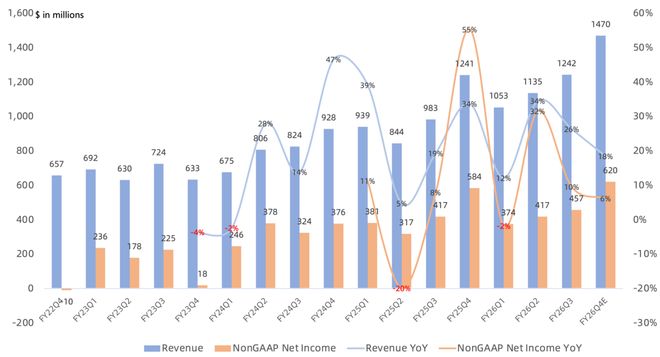
Core Insights - Arm reported Q3 FY26 revenue of $1.24 billion, a 26% year-over-year increase, slightly above market expectations of $1.23 billion [4] - Despite a high gross margin of 97.4%, GAAP operating profit was low at $185 million, below the expected $246 million, primarily due to high R&D expenses [3][4] - Management indicated that the growth in data center revenue is expected to surpass mobile revenue in 2-3 years, driven by custom chips for large cloud service providers [10][12] Financial Performance - Revenue: $1.24 billion, up 26% YoY, exceeding the guidance of $1.23 billion [4] - GAAP Gross Margin: 97.4%, a slight increase of 0.4 percentage points YoY, but below the expected 97.7% [4] - GAAP Operating Profit: $185 million, a 6% increase YoY, but below the expected $246 million; GAAP operating margin at 15%, down 3 percentage points YoY [4] - Non-GAAP Net Profit: $457 million, up 10% YoY, exceeding expectations of $438 million; Non-GAAP net margin at 37%, down 5 percentage points YoY [4] Business Segments - License & Other Revenue: $505 million, a 25% YoY increase; 50 Arm Total Access contracts signed, with a 7% annual fee increase [7] - Royalty Revenue: $737 million, a 26% YoY increase, driven by growth in data centers and mobile; data center royalty revenue has doubled YoY [10] Market Outlook - Management expects Q4 revenue of $1.47 billion, an 18% YoY increase, with Non-GAAP net profit projected at $620 million, a 6% increase [12] - Anticipated growth in Royalty revenue in Q4 is expected to be in the low double digits, while License revenue is expected to grow in the high double digits [12] - Management's guidance for FY27 indicates a reasonable expectation of 20% revenue growth [12] Strategic Insights - The demand for server CPUs is being driven by Agentic AI, which aligns with Arm's strengths in energy efficiency [12] - The first generation of CSS royalty fees is significantly higher than previous generations, indicating a potential for increased revenue from new mobile devices [12] - Management expressed concerns about the impact of a potential 20% decrease in mobile shipments on royalty revenue, estimating a 4-6% impact on mobile royalty income [12]

ARM2026财年Q3电话会
Xin Lang Cai Jing· 2026-02-06 12:26
Core Viewpoint - ARM's data center business is expected to grow significantly in the next 2 to 3 years, potentially matching or exceeding the smartphone business, which currently accounts for 40% to 45% of total revenue [1][8]. Group 1: Financial Performance and Guidance - Data center revenue growth is currently outpacing other business segments, with its share expected to rise from over 15% towards 20% [1][8]. - The company has raised its fiscal year 2026 revenue guidance from an initial "at least 20%" to a midpoint of 22%, exceeding previous expectations [1][12]. - For fiscal year 2027, while no formal guidance is provided, maintaining a 20% growth rate is deemed reasonable [1][12]. Group 2: Research and Development - R&D spending is increasing at a rate higher than revenue growth, with expectations of a slowdown in R&D expenditure growth after Q1 of the following year [1][14]. - The company anticipates that the growth rate of R&D spending will stabilize, moving towards a more moderate pace [1][14]. Group 3: Market Dynamics and AI Integration - ARM views the recent volatility in the software sector as typical during major technological shifts, emphasizing that AI will not replace chips but rather coexist with them [2][15]. - The deep integration of AI within enterprises is still in its early stages, with ARM itself not fully transformed yet [2][15]. - The demand for computing power remains substantial, and ARM is focused on long-term opportunities in this evolving landscape [2][15]. Group 4: CPU Role in Data Centers - The shift in data centers is moving from training to inference workloads, with CPUs becoming increasingly important due to their efficiency and low latency [3][10]. - The trend of increasing CPU core counts is expected to continue as AI workloads evolve, benefiting ARM's positioning in the market [3][10]. Group 5: Royalty Revenue and Market Impact - Despite anticipated declines in smartphone shipments, ARM expects minimal impact on royalty revenue due to a focus on high-end markets and the transition to newer architectures [4][5]. - The company estimates that even with a 20% drop in smartphone sales, the impact on royalty revenue would only be around 2% to 4% [5][9]. - ARM's royalty income is projected to remain robust, supported by growth in cloud AI and infrastructure business, which offsets potential risks from the mobile sector [4][5]. Group 6: Future Outlook and Strategic Initiatives - The CSS (Compute Subsystems) business is showing significant growth, with expectations that its contribution to royalty revenue will rise from around 15% to over 50% in the next 2 to 3 years [10][11]. - ARM is actively involved in developing new products and services, with future updates on fiscal year 2028 expected as plans are finalized [12][12].

从业 43 年的程序员直言:AI 不会取代程序员,软件开发的核心从未改变
程序员的那些事· 2026-01-12 00:48
Core Viewpoint - The article argues that AI will not replace software developers, emphasizing that the future of software development remains in the hands of developers who can translate ambiguous human thoughts into precise computational logic [1][2]. Group 1: Historical Context - The prediction that "programmers will be replaced" has never come true throughout the history of computing, which spans over 43 years [3]. - The author has witnessed multiple technological revolutions, each heralded as the end of programmers, such as the rise of Visual Basic and low-code platforms [4][6]. - Historical cycles show that each wave of technology has led to an increase in the number of programs and programmers, exemplifying the "Jevons Paradox" with a market size of $1.5 trillion [9]. Group 2: Differences with Current Technology - The current wave of Large Language Models (LLMs) differs significantly from past technologies in scale and impact, with LLMs not reliably improving development speed or software reliability [10][11]. - Unlike previous technologies that provided stable and reliable solutions, LLMs often slow down development and create a dual loss situation unless real bottlenecks are addressed [11]. Group 3: Essence of Programming - The core challenge of programming has always been converting vague human ideas into logical and precise computational expressions, a difficulty that persists regardless of the programming tools used [12][17]. - The complexity of programming lies not in the syntax but in understanding what needs to be achieved, a challenge that remains unchanged over decades [17][18]. Group 4: Future Outlook - AI will not eliminate the need for programmers; instead, the demand for skilled developers will continue to grow, especially as companies realize the true costs and limitations of AI technologies [19][20]. - The future of software development will likely see AI playing a supportive role, assisting in tasks like prototype code generation, while the critical decision-making and understanding will still rely on human developers [19][20].

美国“斩杀线”引热议!年薪 45 万美元程序员半年变流浪汉
程序员的那些事· 2026-01-06 03:33
Core Viewpoint - The article highlights the precarious nature of high-income jobs in the tech industry, illustrating how a sudden loss of income can lead to a rapid descent into financial ruin and homelessness, as exemplified by the story of a programmer who went from earning $450,000 to becoming a homeless individual in just six months [3][10]. Group 1: The "Killing Line" Concept - The term "Killing Line" originally from gaming refers to a critical threshold that, once crossed, leads to irreversible consequences in life, reflecting the fragility of individual and collective survival in society [2]. Group 2: The Programmer's Financial Struggles - The programmer, Jack, had a high salary of $450,000, equivalent to over 3 million RMB, but faced monthly fixed expenses totaling $16,500, including a $12,000 mortgage, $3,000 car loan, and $1,500 in insurance, leaving him with little to no savings [3][4]. - Jack's financial situation exemplifies the "high salary, low savings" phenomenon prevalent among the American middle class, where individuals are often trapped in a cycle of high expenses and lack of financial buffers [4]. Group 3: Job Loss and Its Consequences - Jack's life took a downturn due to an unexpected layoff, a common occurrence in the U.S. employment system, which allows employers to terminate employees without cause or severance [5]. - The tech industry is experiencing a wave of job losses due to AI advancements, making it increasingly difficult for displaced workers like Jack to find new employment [7]. Group 4: Medical Debt and Bankruptcy - Following his job loss, Jack faced a medical emergency that resulted in a $60,000 bill, of which only $12,000 was covered by insurance, leading to insurmountable debt and the loss of his home [8]. - Medical debt is a significant contributor to personal bankruptcies in the U.S., with approximately 25-35% of bankruptcies directly linked to medical expenses, even among insured individuals [10]. Group 5: The Cycle of Despair - Jack's situation illustrates a vicious cycle of homelessness and credit destruction, where lack of a permanent address hinders job applications, further exacerbating his financial instability [9]. - The systemic issues in the U.S. economy, including weak employment protections and a credit system that penalizes individuals for financial misfortunes, contribute to the rapid decline of individuals like Jack from stability to homelessness [10].

“同事介绍私活,甲方说酬金 12 万,但同事只给我 5 万,这合理么?我肝了两个多月,每天熬到一两点”
程序员的那些事· 2026-01-05 15:41
Group 1 - The article discusses the importance of maintaining a proper mindset when engaging in freelance work, particularly in the context of compensation and relationships with colleagues [2] - It emphasizes that freelancers should evaluate their own costs and the fairness of the compensation received, rather than focusing on how much their colleagues earn from the same project [2] - The article suggests that maintaining good relationships with colleagues can lead to more opportunities for freelance work in the future [2] Group 2 - The article provides an analogy comparing freelance work to a company project, highlighting that employees typically do not expect to receive a large share of profits from a project completed for their employer [2] - It points out that the colleague who referred the freelance opportunity may have incurred costs or invested effort that is not immediately visible to the freelancer [2] - The overall message encourages freelancers to appreciate the opportunities provided by others and to foster positive professional relationships [2]

为什么后端老是觉得前端简单?
菜鸟教程· 2025-10-27 03:30
Core Viewpoint - The article discusses the complexities and challenges faced by both front-end and back-end developers, emphasizing that each role has its own difficulties and intricacies that are often overlooked by those outside the field [2][12]. Front-end Development - Front-end development involves a wide range of technologies and frameworks such as React, Vue, Angular, and Svelte, which require continuous learning and adaptation due to rapid changes in the market [7]. - Tools like Webpack and Vite are essential for building applications, but they can be complex to configure and troubleshoot [7]. - The use of TypeScript adds a layer of complexity to JavaScript, but it can help prevent errors in the long run [7]. - CSS layout techniques like Flex and Grid, along with responsive design and animations, require attention to detail to ensure a good user experience [7][11]. - Front-end developers must ensure that applications are visually appealing and user-friendly, which involves meticulous attention to detail in design and functionality [11]. Back-end Development - Back-end development is often perceived as less complex because it lacks a visible interface, but it involves critical tasks such as managing data integrity, server performance, and application logic [11]. - Back-end developers must handle high concurrency, database design, and system architecture, which are essential for maintaining application stability and performance [11][12]. - The responsibilities include designing database structures, implementing caching strategies, and ensuring the system can handle peak loads without failure [11]. Comparison of Roles - The article highlights that perceptions of complexity in development roles are subjective and depend on one's position within the development process [9]. - Both front-end and back-end developers face unique challenges, and the article argues that neither role is inherently easier than the other [12]. - The visibility of front-end work makes it easier for outsiders to critique, while back-end work often goes unnoticed despite its importance [12].

GPT-5:前端开发者的“选择自己的冒险路线”
3 6 Ke· 2025-09-05 10:33
Core Insights - OpenAI claims that GPT-5 excels in front-end coding, outperforming its predecessor in 70% of internal tests [2] - Mixed reviews from developers indicate that the initial excitement around GPT-5 may be overstated, with some users reporting a decline in performance [3][4] - A poll conducted by AI engineer Shawn Wang revealed that over 40% of respondents rated GPT-5 as "average" or "poor" [4] Developer Experiences - Influential developer Theo Browne initially praised GPT-5 but later expressed disappointment, stating that its performance had worsened over time [3] - A GitHub Copilot user criticized GPT-5 for its weak summarization and explanation capabilities, comparing it unfavorably to Claude Sonnet 4 [3] - Developers are exploring the potential of GPT-5 to create applications without traditional frameworks like React, suggesting a shift in front-end development practices [7][8] Performance Comparisons - The ability of GPT-5 to create websites without frameworks has impressed some developers, raising questions about the necessity of tools like React [8] - Differences in performance between various versions of GPT-5 have been noted, with some users experiencing less impressive results with non-premium versions [10] - A study by Sonar highlighted the varying coding styles and effectiveness of different AI models, indicating that GPT-5's coding personality is still being evaluated [11]

年薪 15 万程序员下班送外卖,自称解压放松。网友:工作不饱和了吧
程序员的那些事· 2025-08-25 06:35
Core Viewpoint - The article discusses the unconventional choice of a programmer, referred to as "Xiao Ma Ge," who works at a state-owned enterprise in Zhengzhou, China, earning an annual salary of approximately 150,000 yuan. He engages in food delivery as a form of relaxation and also pursues self-media as a potential career path [1][3]. Group 1 - Xiao Ma Ge's primary motivation for delivering food is to relieve stress from his job, which involves significant logical thinking. He finds the activity enjoyable and likens it to a treasure hunt [1]. - The article highlights the mixed reactions from the public regarding Xiao Ma Ge's decision to deliver food, with some questioning why a salaried employee would take on such work [3][4]. - There is speculation that Xiao Ma Ge's food delivery is more about promoting his self-media endeavors rather than just relaxation, suggesting a deeper ambition behind his actions [4][5]. Group 2 - The article notes that Xiao Ma Ge's annual salary of 150,000 yuan could potentially increase to 300,000 yuan as he gains more experience in his field, indicating a positive career trajectory [5]. - The contrasting mindsets between those with a safety net (like Xiao Ma Ge) and those without (who may rely solely on food delivery for income) are discussed, emphasizing how this affects their approach to work and stress [5].

全球科技业绩快报:ARM 1Q26
Haitong Securities International· 2025-07-31 14:03
Investment Rating - The report does not explicitly state an investment rating for ARM, but it provides insights into the company's performance and future expectations, indicating a generally positive outlook based on growth drivers in AI and custom chip solutions. Core Insights - ARM's FY1Q26 revenue was $1.05 billion, slightly below market consensus of $1.06 billion, with EPS at $0.35, in line with expectations. Royalty revenue increased by 25% YoY to $585 million, while License revenue decreased by 0.8% YoY to $468 million due to a strong base in FY1Q25 [1][6]. - The company is evolving towards full-end solutions to address increasing chip complexity and extended development cycles, with strong demand for Compute Subsystem (CSS) solutions, which have licensing fees twice that of Armv9 [2][7]. - ARM's custom chips are driving significant growth in cloud-based AI, with over 70,000 enterprises running AI workloads on Arm Neoverse chips, representing a 40% YoY increase. The company expects to capture nearly 50% market share among leading hyperscale customers this year [3][8]. - For 2Q26, ARM expects revenue between $1.01 billion and $1.11 billion, with a midpoint representing a 25% YoY increase. Non-GAAP EPS is projected to be between $0.29 and $0.37, with a median of $0.33, slightly below market expectations [9]. Summary by Sections Financial Performance - FY1Q26 revenue: $1.05 billion, slightly below consensus of $1.06 billion - EPS: $0.35, in line with expectations - Royalty revenue: $585 million, up 25% YoY - License revenue: $468 million, down 0.8% YoY [1][6] Business Strategy - ARM is transitioning to full-end solutions to tackle chip complexity and development cycles - Demand for CSS exceeds expectations, with licensing fees significantly higher than previous models - ARM supports chiplet development and aims to expand into complete solutions [2][7] AI and Market Outlook - Over 70,000 enterprises using Arm Neoverse chips for AI workloads, a 40% YoY increase - Expected market share among hyperscale customers to approach 50% - ARM's platform combines AI performance with energy efficiency, enhancing TCO [3][8] Future Guidance - 2Q26 revenue guidance: $1.01 billion to $1.11 billion, midpoint indicating 25% YoY growth - Non-GAAP EPS guidance: $0.29 to $0.37, median of $0.33, below market consensus [9]
程序员:在 8 家公司当工具人后,终于明白“有用”和“被重视”差了 10 条街
程序员的那些事· 2025-06-04 02:13
Core Viewpoint - Understanding the distinction between being "useful" and being "valued" in the workplace is crucial for career development and personal growth [3][4]. Group 1: Definitions and Implications - "Useful" refers to being proficient in specific tasks, allowing superiors to delegate work confidently, but often leads to being seen as merely filling gaps rather than being integral to strategic discussions [6]. - "Valued" means being included in core conversations and decision-making processes, which provides opportunities for meaningful growth and contribution to the company [6]. Group 2: Personal Experiences - During a company crisis, an individual was recognized as essential not just for past performance but for future contributions, receiving a retention bonus equivalent to 50% of total compensation [10]. - In a later role, despite achieving targets and receiving bonuses, the individual felt stagnant as they were not invited to strategic discussions, highlighting the difference between being "useful" and "valued" [12]. Group 3: Recommendations - Individuals are encouraged to reflect on their roles and assess whether they are merely "useful" or genuinely "valued" within their organizations [13].